Category Archives: Self

Which Level of Consciousness Do You Want To Be In?

Welcome to this week’s Bill Harvey Blog
Created February 20, 2026

Flow state, the Zone, where everything does itself perfectly, you exceed your expectations of performance limits.

You have undoubtedly noticed that you are not always at your best. Almost nobody is. Sometimes we have very smart ideas, at other times our minds are dull, and at other times we think we are thinking very intelligently, only to discover that we were way off and should have known better from various earlier experiences and supposed learnings.

We generally assume that this is the way things are and that there is no way to improve our own mental/emotional performance, with some exceptions. We might read a self-betterment book or article once in a while. We might take a supplement that is for making our memory and other faculties work better. If someone we trust gives us earnest advice, we might listen with an open mind, and take it to heart, try to be better in the way suggested. We might even meditate or do yoga.

All of this is admirable. But is it enough? Have we pulled out all the stops to maximize our own performance at the game of life? Should we? Is it worth it? If it were so important, wouldn’t everybody be doing it?

The game isn’t set up that way. Particularly today, when so many people have more than one job in order to make ends meet and maintain the all-important lifestyle, who’s got the time for the luxury of being a perfectionist in any area of life? With two media bombarding you during most waking moments (sometimes only one), who can focus on anything anyway? And if you had a moment to spare, would you want to fill it with something that seems very hard and complicated?

Of course not. Nor should you. Fortunately, upping your consciousness does not have to be hard, nor complicated. And it can make you feel better fast and all the time. This post is all about the lazy person’s way of hacking consciousness. Winning with minimum effort. What a relief!

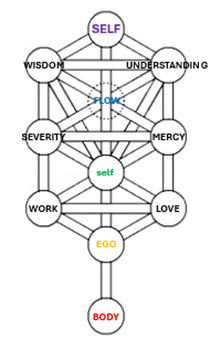
First, a quick, simplified map of the three levels of consciousness you can be in:

  1. Flow state, the Zone, where everything does itself perfectly, you exceed your own expectations of performance limits, and are as happy as a child at play at their favorite game. This is where you want to be as much as possible. Peak experience as Maslow called it.
  2. Observer state. Here you have no external dependencies – whatever happens, you remain impassive. You have no internal dependencies – you are able to also remain unmoved by emotional alarms going off inside of you. All by force of will, courage, determination, and sheer grit. That’s all you need to ACCEPT WHAT IS. Also known as Stoicism. You take the blows, self-inflicted or otherwise, and do not cave in. As if you didn’t care at all about anything. The way heroes are characteristically depicted in all stories since stories began. You also keep an eye on things inside and out and carefully discriminate courses of action, waiting as long as practical before making each decision, like George Washington and Davy Crockett. Including decisions about what and who to believe. All the old locked-down decisions are unlocked again in Observer state. You coolly observe in detail everything all over again with a completely open mind and no biases from all previous experiences.
  3. EOP – Emergency Operating Procedure – you keep up by moving as fast as you can to get all the things done that have been heaped upon you by yourself and others, get them all over with, and you defer enjoyment until after the list has been mostly ticked off when you can indulge in effortless escapism without having to think about your life or about anything serious. During this time, you experience endless moments of irritation about one little thing or another. You may or may not realize that it is your ego that is causing the irritation, and that you are dependent on others to keep you in a good mood, at which they usually fail.

Those are the three choices, in the briefest summary. The wisest choice among these is to spend as little time as possible in the lowest state. It is achievable by establishing the Stoic mindset as your main point of view. You don’t want to be cast around by outside forces; you want to be your own person, able to stand alone when necessary. You don’t want dependencies, you don’t even want to be dependent on your own internal clamor of bad feelings and babbling voices.

You want to identify with the SELF that is your inner essence, the pure EXPERIENCER, and take everything else with a grain of salt.

Is that all there is to it? Just that one principle will keep you in the two upper states of consciousness?

Not quite.

There is one other basic rule. Do not add any negativity to whatever negativity has gone before.

Stop your negative facial expressions and body language, and internal wallowings, and above all, any hurtful statements. Don’t add any negativity to the sauce of life; there’s plenty already. It will bring you and everyone else down, except for the Stoics in the crowd.

Love to all,
Bill


Live chat with my avatar now.

Become All You Really Are

Powerful Mind Part 41

Welcome to this week’s Bill Harvey Blog. December 19, 2025
Created December 22, 2023

Read Powerful Mind 40       |              See all 12 Powerful Mind Keys

Who are you, really? You probably play many roles in life, and try to live up to what others expect of you in each role. Your body language now moves by itself without you even noticing it, but each move was pressed into you like a piece of movable type impressing into clay, by your subconscious emulation of your role models.

My unofficially adopted older brother, Bill Heyer opined that my book Mind Magic might be retitled Really See Yourself. He was talking about your real self underneath those acquired roles and conditioned habits.

The movement in psychotherapy today to consider the inclusion of psychedelics in treatment – which goes back to antiquity and is related more to rites of passage than to treatment of mental diseases – reflects the common experience of those who have seriously experimented with LSD, psilocybin and other mind-altering chemicals of suddenly being able to see themselves, their imitative robotic selves and the true experiencer self under the layers of conditioning. This is generally a life-altering experience, and it is for the better, for minds that have been strengthened enough to withstand the extreme disorientation and to be able to integrate it into a constructive total picture of reality.

This degree of self-realization does not however, require drugs; putting the 12 Keys into practice will take you to the same place in a more gradual way.

In your day-to-day life, you have seen yourself on some occasions as having a lot to offer the world, and at other times you may have seen yourself as worthless, but these mood swings are part of the package, not evidence of what your true value is. Your true value in my estimation of reality far exceeds your most grandiose views of yourself. Because my best guess is that deep down inside each of us is an avatar of the universe itself, what the human race has always called God.

In my theory summarized in A Theory of Everything Including Consciousness and “God,” all that exists is a single consciousness at play, a single Experiencer that multiplies itself in order to behold and interact with itself from many viewpoints.

Those philosophers who accept the idea of the universe possibly being conscious but reject the idea that this consciousness is benevolent, base their position on the existence of suffering. They conclude that the existence of suffering proves that there cannot be a loving God. My fiction series Agents of Cosmic Intelligence is designed to demonstrate one of many scenarios in which there can be a benevolent conscious universe and suffering can exist in that universe as a learning experience resulting from enabling eternal avatars to have free will. It is we, the avatars, who cause the suffering by errors we make from which we learn more and more, lifetime after lifetime.

You may be an avatar of the universe. My theory may be wrong. Nothing of this is scientifically provable yet. However, if you open your mind to all possibilities, you can gather evidence through your own experience. If you do not foreclose the possibility, you may hear in your mind “advice” that appears to be coming from wisdom you yourself didn’t know you possessed, and which works spectacularly well in the real world. This may come in the form of words or of a wordless hunch that comes true. When you are not blocking these possibilities by arbitrary or conditioned fixed-position skepticism, you might be surprised to notice how often you get these accurate intuitions. Jung included intuition as one of the four functions of consciousness, along with perceptions/memories, thinking, and feeling.

Intuitions can be explained without necessarily invoking extrasensory perception. For example, the totality of experiences stored in memory might be the source of these hunches we cannot explain, which we name as subconscious processing.

Many of us succeed in opening our minds to all possibilities to a degree that enables us to experience unusual and often useful events, such as knowing before picking up the phone whom the call is coming from, what someone is about to say, why one friend always flinches when you lift your right arm expressively, where a particular industry will be in a few years, exactly what to say to relieve a person who is torturing himself or herself, and to see through fakery. And much more.

All you truly are is probably so much greater than what you think.

Ego wants to believe that but for the wrong reasons. Ego is essentially a defensive system, what Hobbes was talking about when he described how we will pick fights with people out of fear. Ego is the operating system of the biological AI inside our brains and nerve networks. In higher states of consciousness, when one perceives Oneness directly, feeling at one with the universe and loving everything and everybody while retaining realistic understanding of weaknesses in others, which render them not to be trusted in the present moment, the ego has been bypassed, and the conscious mind is focused on itself.

Empiricism has devolved in current practice into measuring the things we can measure with instruments. Its original meaning was to observe what actually happens in reality, and that includes within one’s own psyche. William James was among the last of the great psychologists to employ introspection as a methodology, and more recently, Maslow and Csikszentmihalyi brilliantly drew upon introspection as a supplement to the observation of behaviors. Introspection helps explain behavior. You can use that yourself. If you do something that you yourself cannot explain why you did it, introspection can ultimately reveal why some part of you, perhaps ego attachments, perhaps Emergency Oversimplification Procedure (EOP), caused you to do it.

The civilization culture we take for granted has dwarfed our concept of ourselves. Acceleritis is the word I coined to describe how information overload has forced us into EOP and to call attention to the fact that it is all still accelerating, that unless we learn the trick of really seeing ourselves and everything else without conditioned filtration, we are going to be more gnomish in the future than we are today. We can see evidence all around us of civilization on the brink of falling apart, people becoming more distrustful of one another and more pessimistic, creating a self-fulfilling prophecy of doom that we will live out if we don’t take charge of our own consciousness now.

We used to have a mythos that awed and inspired us, and many of us still retain a fragment of that in religion or inclusive idealism. We recommend keeping an open mind about anything being possible unless and until it is proven otherwise by multiple replications of the scientific method. That open-mindedness allows awe and wonder to coexist with logic and reason. Until we know for sure what the universe is and what consciousness is, based on science as proven as quantum physics and relativity, we make our decisions day to day based on not knowing if we are an avatar of the universe whose consciousness shall live forever, or an animal that will die permanently, we have to make those moment to moment decisions to be optimal in the context of both possibilities.

In that existential situation, it is not unreasonable to talk to God in your own mind if you feel like it. The conscious universe of which you are a part is a real possibility; no law of existing science precludes it. Many respected scientists take a premature stand against anything even remotely close to God, and in our respect for them, many of us downgrade the possibility of God, although this is what a follower does by blindly and loyally following everything an authoritarian says. Take back your right to think for yourself without being swayed by what others, even brilliant scientists, think. Take back your autonomy. You can do this without invoking faith, wishful thinking, superstition, or belief, just by remembering with extreme clarity that nothing has been proven yet either way.

As Arthur C. Clarke said, “Any sufficiently advanced technology is indistinguishable from magic.” He also pointed out that what we don’t know is vast compared to what little we do know so far. Under these conditions, it is a mistake to adhere rigidly to one or the other indefensible position. At some point in your life (you might be one of the rare people lucky to have already reached this stage), your own experiences might compel you to take the position that you know that God exists, and you will make all your decisions in the context of that certainty. But there’s no need to rush it. Best to stick to empiricism, your own experience, and not foreclose any possibilities without sufficient evidence that such foreclosure will benefit you permanently.

We have embarked on Key #11. Stay open to the possibilities that you may have extrasensory perception, precognition, even the possibility that the universe is trying to help you and is sending you messages. Remove the blocks.

More to come on this.

Here’s a little video holiday present for you.

Happy Holidays!

Card design and concept by Christine K. Niver. Photo by Bill Harvey of the view from his home office.

My best to all,
Bill


Live chat with my avatar now.

Study Thyself

Powerful Mind Part 17

Welcome to this week’s Bill Harvey Blog, February 21, 2025
Created June 30, 2023

Read Powerful Mind Part 16

“Know Thyself” goes back to the Delphic Oracle Temple in Sixth Century B.C. Greece then known as Hellas. The saying is attributed by legend to Apollo and by historians to a group of seven sages of whom the best known is Thales, who postulated that the universe itself contains a natural force that brought about all of existence, and was the first human on record to have predicted the exact timing of an eclipse. Socrates based much of his philosophy on these two words.

In general use at the time, the phrase was interpreted as knowing one’s own capabilities and limits. Plato altered the meaning to knowing one’s own soul. Judeo-Christian philosophers added the meaning of knowing one’s own relationship with The Creator.

In the context of metacognition, in my view, to know oneself means to have undergone the strenuous and time-consuming process of studying oneself as if “one is an observer from the outside, with a means of seeing, feeling and hearing what is going on within oneself,” including what lies below the conscious mind. And with the help of this objective pseudo-outside view, one has successfully edited one’s own thoughts, feelings, and automatic reactions, and thus achieved an inner integrity, a oneness, a simplification, and an autonomous focus. When these conditions have been met, I would call such a person, one who knows themself.

Note the mention of “what lies below the conscious mind.” This has become a hairy subject in psychology. The heavy emphasis placed on hewing to the a priori assumption of materialism within the social structures of academic scientists, while any a priori assumption is anathema to the concept of objective science, has caused psychologists as well as all other types of scientists to veer away from language which undermines their social standing within their fields. The words “unconscious” and “subconscious” – which had been the core of the Freudian/Jungian revolution in psychology – are now taboo. Words such as “preconscious” are preferred, but the safest way to discuss the subject is to use the lengthier construction “events that do not reach the threshold of conscious awareness.”

This latter workaround actually has some value in my estimation. It calls attention to the fact that qualia (subjective experiences within the psyche) can succeed or fail to leap over the line into conscious awareness. This is important to the inner explorer because it is a cue to strive to pay sufficient inner attention to become conscious of more of the arising qualia: thus making more of the subconscious, conscious.

One who achieves this degree of self-knowledge will experience moments of inner clarity when a fear or anger reaction starts to subtly arise and one catches and squelches it within less than a second.

In Parts 14, 15, and 16 of Powerful Mind, we have reviewed how each of us became substantially unfree, subtly enslaved to imposed views, and we covered the method of close self-analysis, and resolute perseverance in disciplining the mind and becoming an original person.

We leaned heavily on the metaphor of “the robot” to help your inner senses grasp the true relationship between the parts of yourself which have become automatic (the robot) and the essence of who you really are (the real you). One exercise we recommended is to check your level – are you trapped in the robot right now, or are you in the Observer state?

As we look back at the last few posts we see an opportunity to add one further recommendation as to how to know where you are.

If you sense some dilemma you seek to resolve, the likelihood is that you are in the robot. When you are in the Observer state, you are solving problems as they arise and there is no feeling of any dilemma.

One of the main objectives of Powerful Mind is to reduce all of the vast complexity of purifying and mastering one’s mind, to a set of a dozen principles, each of which can be stated in a few words.

The first of these principles, or Keys as we call them, was described in Powerful Mind Parts 10-13, and is:

Doubt your own last thought/feeling.

This is the method that most directly confronts the robot. As we specified in that section, this Key must be applied with balance and perspective to avoid sinking into a robotic Hamlet information analysis paralysis. If you find yourself having lost all confidence in your own intuitions, you will know then that the robot has judoed you and is still running the show. The doubt is meant as a momentary wipe – the “arc” we have spoken of earlier – a distance between the arising of an impulse to believe something specific, and your confirmation of your approval or the denial of your approval of that impulse. If too much time goes by without reaching closure you are being indecisive and need to shut out the world for 20 minutes or so in order to really study the situation and reach your best judgment as to an action plan which can later be improved as you learn more.

The second Key which we have been working on in Powerful Mind Parts 14-17 is:

Study, edit, and reset your automatic reactions.
This is radical new mental strategy #2,
The second simple key to the doorway
Of the upper mind.

Whereas the first Key is a permanent one, useful at all times, when applied correctly with balance, this second Key is one that is most important for the first year or so of the rest of one’s life, after making the decision to clear out the debris of other people’s influence, and re-evaluating everything from one’s own autonomous, empirically-driven, pragmatic and aesthetic intuitions. After the first year or so, you may see yourself needing to use this Key a bit less often, and that, if it happens, will be a good sign.

Love to all,
Bill

Superfluous Superstructure of the Self

June 7, 2024
Welcome to this week’s Bill Harvey Blog

We all pay some attention to our inner lives. But for some of us this means sustained micro-observation and for most of us it is occasional flashes in between slavish addiction to the endless rushes of information coming in through our five fascinating physical senses.

This tsunami of infobits roaring in has itself escalated over time, causing even more outward focus.

But even 2500 years ago, Aristotle made the same observation, commenting that the unobserved life is not worth living. He was trying to get more people to turn inward. His teacher’s teacher Socrates had started the whole thing by his exhortation “Know Thyself”. (Socrates had inspired Plato with whom Aristotle studied.)

The greatest philosophers and psychologists of all time were all practiced at inner micro-observation. This was especially true in ancient India, and for example, metacognition is at the core of Buddha’s teachings. In the modern era this includes William James, perhaps the best of them all at concentrated introspection, as well as Carl Jung, Sigmund Freud, and Abraham Maslow. Freud however was more of a rationalist, deducing things logically, whereas Jung was more of an intuitionist, taking the original feelings arising in his cognition without embellishing them with rational overlays as much as Freud did.

A long time ago by introspection I realized that thoughts do not arise as thoughts but as feelings, and then the cognitive affective processes embellish those feelings with attributed meanings, interpretations, often involving images, metaphors, and words, at which point they are truly what we all call thoughts.

This has recently been discovered by science, decades and millennia after the same insight was available to each of us by micro-inner-observation.

It will help you attain metacognition to imagine that your inner space has a map. At the pure core of your being imagine that you have a center, something like an energy or a gas, that you can sense. In higher states of consciousness such as the spiritual level of Flow state you can see this self of yours as light, often bluish. Most of the time you can only feel it.

Imagine now in this map that there is another part of yourself that you yourself have built over time, a superstructure that is overlaid on top of the central sphere of your selfness. Suspend disbelief for the sake of argument, and for the moment consider my theory that this part of you is akin to an artificial intelligence (AI) that has a physical underpinning of neurons and their interconnections in your brain and nervous system, specific neurons and interconnections which were caused by your experiences, especially where there were degrees of emotion and assimilated “learning”. The word “learning” is in quotes because much of this was mis-learning.

The entire superstructure taken together corresponds to what Freud termed the Ego.

This superstructure uses a substantial part of your mental energy but the return on that energy investment tends to be negative. The expenditure of this incremental cognitive load tends to do you a lot more harm than good.

Freud said that this appurtenance was called into being when the baby first experiences frustration at not getting what it wants or needs. It functions as the security officer (Worf in Star Trek) and press agent, business manager, negotiation agent, sales rep for what Freud called the Id, and I refer to above as your core beingness.

The reason I say Freud was more of a rationalist is that when I introspect into my Id or core essence self I do not find the animal selfishness and limitation to hardwired instinct that Freud said I would find there. Instead I find a happy lightness of being that is not needy but is caring and fascinated.

Try this experiment and I feel that you will totally get what I’m saying and can add it to your personal strength arsenal.

  • Take your place in your core, the pure witness, the observer.
  • From that vantage point, simply observe the feelings that arise in your superstructure.
  • You will sense the apparent duality in you at that point, probably a realization of your own indifference and yet interest in these ego feelings.
  • This higher feeling is the most important key to metacognition.

You may have experienced this many times in your life, and it may have come about by temporarily hitting bottom. When you have been pushed around by life and have not seen the lesson the universe intended, you may in your frustration, resentment and rage just say to yourself that you give up, you just don’t care anymore.

When this happened to Bucky Fuller – heartbroken by unrequited love – he decided to commit suicide. Once he did that he was in his core self, looking at all of the superstructural self he had built, disillusioned in a good way by all that stuff, having just given it all up. He now discovered no reason to end his life, for a new better version of it was just beginning. He then became the Bucky Fuller genius we all remember.

You can practice this core self-perspective any time you want, for a few seconds or minutes or extended periods, even continuously for the rest of your life.

The essence of the feeling is that you are above all the nigglings in your superstructure. It’s only habit which has made you so vulnerable to those sudden feelings of worthlessness, fear, anxiety, defeatism, hatred, envy, resentment, and so on which have become automatic and super powerful.

Habits reinforced by hundreds of thousands of repetitions in your life do not pack up and go away right away. They will sometimes come back and even overpower you sometimes. But once you have learned to identify with your core and not your superstructure you are on the high road to true freedom. Keep practicing this Observer state and you cannot lose.

My best to all,
Bill


Live chat with my avatar now.