Category Archives: Powerful Mind

Recapturing the Spiritual Meaning, Awe and Wonder of Life

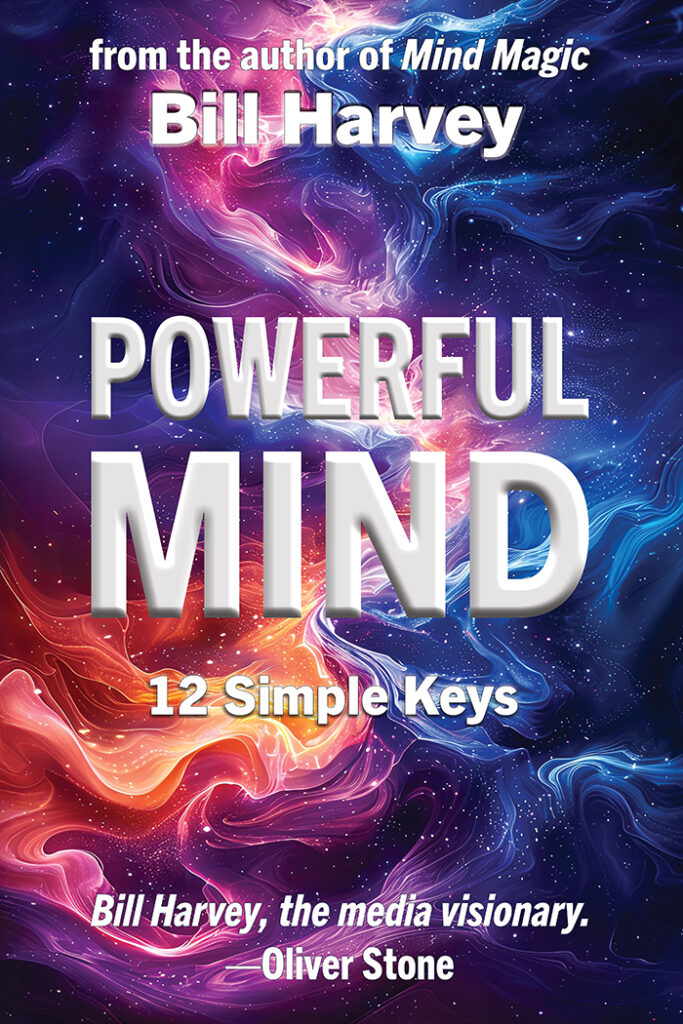
A recent, wonderful article in The Edge Magazine about my latest book, POWERFUL MIND

Welcome to this week’s Bill Harvey Blog, June 12, 2026

Excerpts from Powerful Mind: 12 Simple Keys – The Human Effectiveness Institute, February 2026

We all have a yearning, subconsciously, to get back to the Garden, to feel that numinous, magical thrill we remember from childhood. We yearn to have that feeling all the time, not just in momentary flashes, such as peak experiences that came out of nowhere on a beach or a mountain or in meditation, where we experienced the certainty of ubiquitous love all around us and throughout our own being.

In my book, Mind Magic, I speculated that the amount of information and question-producing stimuli processed daily by the average person has been accelerating since the invention of written language. I surmised that this acceleration causes a mental/emotional state I call the Emergency Oversimplification Procedure (EOP).

In this state of consciousness, questions are set aside, experiences are not assimilated, personal effectiveness is reduced, creativity is blocked, the awe and wonder of life that we felt as children fades away, we subscribe to black-and-white thinking imposed by others, we use prerecorded responses most of the time, and new learning and growth are stifled. We are coping but not mastering life.

We can regain our individuality, solve our problems through focused attention, become happier, and give back more to others. We can accelerate our growth by slowing down and choosing what to do next based on real value.

Recapturing the spiritual meaning, awe and wonder of life

Keep asking the ultimate questions.

Why is there a universe at all? Who am I? Why am I here? What am I doing here?

When we first ask ourselves these questions as children, we are awed. We might experience an oxytocin (the “love hormone”) rush, with the hair at the base of our neck standing up and chills up and down our spine.

Most of us eventually give up on these questions as unanswerable. We don’t see how these ultimate questions relate to our daily lives, but they do. In ways we’re unaware of, we make hidden assumptions about these ultimate questions, leaving us with little motivation to act nobly. So, our lives tend to devolve into quiet desperation (Thoreau).

We come full circle and are reborn by allowing ourselves to return to our childhood perspective of awe and wonder.

As a starting point, let’s consider briefly how Einstein and Wheeler, two of the most advanced and sophisticated scientists of our time, contemplated these questions.

Einstein felt sure that the universe is evidence of an intelligence far greater than our own – an intelligence that our intelligence can learn to understand. This gave Einstein those oxytocin thrills all his life, from childhood through adulthood.

Wheeler postulated that the universe initially existed as probability waves and evolved into consciousness, collapsing them into the matter-energy spacetime universe we all experience. He coined the term “Participatory Anthropic Principle” to mean that we, as consciousness, participate in creating the universe we are a part of.

Both scientists were comfortable assuming that the universe can be thought of and described as one thing, of which we, the observers and co-creators, are intrinsic parts. Philosophers’ and scientists’ acceptance of this is a thread running through the history of thought, going back to long before the Rig Veda in the East and Thales in the West.

When considering the ultimate questions, it helps to begin there.

Visualize the whole universe as one thing.
Every individual of every species
Every idea
Every event
Every moment of time
Every percept
Every lump of matter and energy
All parts of one thing.
– Mind Magic

We may be on the verge of the next great leap in physics: a world where the universe is seen as intelligent, and each of us plays a creatively intrinsic role within that universe.

Whether scientifically validated or not, this worldview would radically change how we relate to one another. Simply keeping an open mind about this possibility will positively impact how people relate to one another.

We once believed in a mythos that awed and inspired us, and many of us still hold on to a piece of that in our religious or spiritual practices – an inclusive sense of idealism. We repeatedly emphasize the importance of keeping an open mind about anything being possible unless and until it is proven otherwise. This open-mindedness allows us to experience awe and wonder alongside logic and reason.

In this existential situation, it’s not unreasonable to converse with God in our minds if we feel inclined to do so. The conscious universe we are all part of is a real possibility; no existing law of science rules it out.

We can reclaim our right to think independently without being swayed by what others, even brilliant scientists, claim to be the truth. We can take back our autonomy. We can do this without invoking faith, wishful thinking, superstition, or belief in anything; we simply need to remember with maximum clarity that nothing has been proven either way yet.

We can utilize our newly developed inner visibility to identify what lifts us and what pulls us down, quickly reducing negative emotions, accepting whatever is happening as reality, and handling it constructively and patiently without getting caught up in it.

Our free will, personal freedom, and unwavering will are our most valuable assets. More important than our negative feelings, our will protects our positive feelings of love, joy, and wonder.

Having fun, such as when we’re engaged in our passion work, boosts our emotional, cognitive, and even physical well-being through effortless and natural body movement. This is the Flow state.

It felt incredibly powerful the first few times I experienced the Flow state as a young child. It seemed I had discovered another level of reality that felt very magical, although I was certain it had a scientific basis.

Whether starting over to lift a bad mood, enjoying the process of creating something in a Flow state, or whatever else we’re doing, the ability to focus our attention and notice what is happening inside and around us helps us reach the highest outcomes, even as we refrain from becoming attached to those outcomes.

Powerful Mind: 12 Simple Keys book by Bill HarveyThe techniques presented in Powerful Mind aim to rekindle the magic of reality and initiate a positive upward spiral in our creativity.

Avoiding our usual habitual responses increases our chances for creativity and learning. We pause and rethink things.

Creativity, by definition, is always somewhat unpredictable. True freedom always exalts creativity.

Embrace the essence of life, such as wonder, awe, the Flow state, and spiritual moments. These peak experiences, as Maslow called them, have always been at the heart of the work of great artists, musicians, thinkers, poets, and others who have made life more beautiful and precious. By remaining open to these experiences, we find that they happen more frequently.

When we shift into the Flow state as a way of life, we transcend the ego, as if the ego had been training wheels that we can now take off. We can now sense and live from our authentic selves, our whole selves, not from the defensive ego but from the joyous muse within us. The muse was with us all along, although it may in reality be the One Self that is the universe, living through us.

Reprinted with permission from the June 2026 issue of The Edge Magazine 

Love to all,

Bill


The Signals We Subconsciously Send Program Our Reality

Welcome to this week’s Bill Harvey Blog
Created May 8, 2026

This truism is well backed by scientific verification. Micromomentary gestures, body language, eye movements, word choices, tones of voice, are all carefully scrutinized by trained intelligence field agents, psychoanalysts, law enforcement officers, professional negotiators, and many other people who are looking for “tells” either to be able to make a better deal for themselves or to truly help the person being observed, or in rare cases, both.

At a cosmic level, a wide range of scientists and nonscientists already know or believe in the idea that we causally impact our future experiences based on the signals we send ourselves, even when those signals are only being sent within our own minds, to ourselves, and even when we are not consciously aware of sending those signals to ourselves – and to the universe.

This applies even to those of us who are consciously aware of the way we program our own reality with expectations that we have inside us and hide from others. By definition, the subconscious is not something we are tracking, so stuff that goes on at that level can easily slip by us.

For example, we may not realize that our doing something apparently harmless that comforts us, can be read by the subconscious as a signal that we need to compensate for a sense of failure. This can program us to fail.

So can our being overly cautious or conservative in our estimates of tactical success. We may think it’s good for us to plan on a pessimistic basis so we will be even happier when we exceed that low bar. But it could also be that we are programming parts of ourselves to hit that low bar or even below it.

Michelangelo said:
The greater danger for most of us lies not in setting our aim too high and falling short; but in setting our aim too low and achieving our mark.

Michelangelo believed that settling for mediocrity (hitting a low target) is more damaging to the human spirit than failing while attempting something grand.

Even a lack of spirituality can harm our chances of success in life. If we live life in a framework of physicalism, where our underlying basic assumption is that only the obvious reality exists, and there is nothing more, we can subconsciously be doubtful that we can ever experience more success than we have at the present moment. Of course, consciously we may be unaware that this holding ourself back is happening.

If we live life in a frame of mind that is open to the unknown, making no limiting assumptions about the unseen, we are not blocking moments of leakage of the spiritual into life, even if only for brief moments that we might not even think of as spiritual, simply as feeling extraordinarily good.

Maslow was once asked about religion and he turned the question into something else. Instead of replying about the known and agreed-upon religions, he used the word differently, in the context of his notion of peak experiences. He said:

The two religions of mankind tend to be the peakers and the non-peakers, that is to say, those who have private, personal, transcendent, core-religious experiences easily and often and who accept them and make use of them, and, on the other hand, those who have never had them or who repress or suppress them and who, therefore, cannot make use of them for their personal therapy, personal growth, or personal fulfillment. 

He was talking about openness to the possibility of cosmic spirit, something mysterious about which we know very little, but not prematurely denying its existence.

He also said, echoing Michelangelo in a different way, “We fear to know the fearsome and unsavory aspects of ourselves, but we fear even more to know the godlike in ourselves.”

There is practical benefit to leaving it open in one’s conscious mind that the nature of reality could include a benevolent God, that the universe itself could be conscious (why not? We are! The universe is a lot bigger than we are, with a lot more energy than we have, how could we be conscious and it not be conscious? We know it has consciousness in it). The practical benefit is that that thing lying squashed flat within us, that thing called hope, has a springboard from which to fly once again. Having real unfaked hope within us makes our subconscious try bigger plays.

Here is an experiment you can try.

When you are alone, go outside and as close to nature as is convenient. Breathe deeply. Casually empty your mind for a moment. Then imagine that you can make your life come out very happy, happier than you remember ever being, and that limits you assume you have are holding you back, so you must make every effort to stop imagining that you have any limits. You can restart your life right now with a new, creative attitude, reconsider everything you want to reconsider, taking your time and deciding over time exactly what you want to do with the rest of your life, and with the courage to actually set those plans in motion and stick with them all the way.

When you get started and have your first setback, don’t allow yourself to become deflated. Stop and look for what was the subconscious signal that got in the way.

There will be many rest stops like this caused by many setbacks. They are necessary because of the nature of the subconscious; you need these little setbacks to identify and root out the hidden signals that have always held you back.

You may be surprised at what some of them are. One might be that you have been too humble, too modest – too much of a very good thing – not all the things that hold us back are inherently bad things, some of them are great things which we have simply overplayed.

You may find, as you come out from holdback assumptions, that you are feeling somewhat cocky all of a sudden. Let yourself enjoy it and make it a way of life that rubs off on the people around you rather than rubbing them the wrong way.

Love to all,
Bill


Live chat with my avatar


New Power of You Podcast:
Balancing our internal & external worlds to improve
satisfaction, well-being, and performance


My new book POWERFUL MIND is now available in e-Book format at

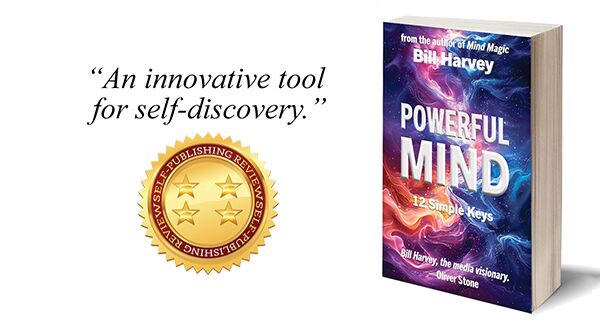
amazon    &      Barnes & NobleAn innovative too for self-discovery

“A compelling, optimistic, and original approach to mental focus, Powerful Mind is an innovative tool for self-discovery and creative liberation. Succinctly outlined and intuitively structured, this book is replete with rational advice, using a radical but commonsense approach. It takes a rare and adroit thinker to incorporate myriad worldviews and welcome diverse readers, regardless of ideological allegiance, but Harvey shows himself to be precisely that. The book is a masterfully structured, intellectually affirming, and potentially paradigm-shifting read.”
~ Self-Publishing Review, ★★★★

The Feeling of Being Guided by a Higher Power to Do Good

Powerful Mind Part 46

Welcome to this week’s Bill Harvey Blog – January 30, 2026
Created January 26, 2024

Read Powerful Mind 45              |              See all 12 Powerful Mind Keys

A 2023 Pew survey found that 45% of Americans “have had a sudden feeling of connection with something from beyond this world.”

“Have you ever wondered what life is all about?” I asked the precocious two-year-old.

“All the time,” she replied.

This is the kind of conversation that parents should initiate as early as possible in a child’s upbringing.

But since this is a rarity, we tend to grow up shoving our awe and wonder out of our conscious minds, because we don’t have time to dally. It’s all coming at us too fast, especially in recent centuries. A conscious mind process forms, which Freud named the Ego and the Superego.

The Ego presents itself as the active conscious mind, and so we all think of it as our self. It’s really more of a chosen spokesperson for the much greater totality of the real self that is our individuality.

The Superego is that part of the Ego (in my estimation) that second-guesses ourselves, our inner critic. Freud considered the Superego a separate functionality in which society’s demands are embedded as the conscience.

H.L. Mencken said, “Conscience is the inner voice that warns us that somebody may be watching.”

The dorsolateral prefrontal cortex may be the part of the brain playing a major role in the manifestations Freud labeled the Superego. It is probably also the structure supporting what Daniel Kahneman labeled as System 2, explicit thinking. Interestingly, Observer state (my term for metacognition) is very useful, and I associate it with the executive control network mediated by the frontal brain; but in  Flow state, which is even more effective than Observer state, the frontal regions of the brain give up control to more primitive parts of the brain (“hypofrontality”), and the Ego and inner critic disappear, as intuition and practice meld everything into a sense of oneness that does itself effortlessly.

When one begins to shift into Flow state as a way of life, it transcends the Ego, as if the Ego had been training wheels which you can now take off your bike. You can now sense and live from the real you, your full self, not the defensive Ego, but from the joyous Muse within youIt was you all along, although it may also be the Self of the Universe living through you.

By now, many people know about the Flow state, and it has become formally recognized by the scientific and medical communities. However, there are some aspects of that state which are still taboo subjects. These are the spiritual intuitions which often accompany the Flow state.

We’ve already discussed Noia, my term for the intuitive feeling that invisible forces are trying to help us by getting us to notice certain stimuli which appear to be giving us information relevant to our current situation and/or thought process. U.S. Andersen, whom I’ve cited earlier, writes about surrendering control to what he calls the Secret Self, and he is talking about the same thing I’ve often referred to as the Universe, or the Muse within. The religion of Islam also preaches the same notion of releasing control to Allah.

It’s conceivable that one should first use the conscious mind and intuition to practice at life and gain a degree of proficiency at it before giving up the inner critic continuously second-guessing oneself, i.e., the Ego. Without practice, the Flow state might not come on so easily just by making a decision to release conscious control. Instead, one might be fooled by impulses coming from the Ego that one thinks are coming from higher guidance.

I know from my personal experience that the latter misclassification has dramatically fooled me many times in my life, especially as a youngster.

I think now that many spiritual people think they are being guided to make political choices by higher powers when it might actually be the Ego masquerading as God.

Even those of us who experience some Flow state every day are (wisely) hesitant to speak much about a feeling of being guided from above. It’s the sort of statement that can cause one to wind up being pigeonholed as a nut.

U.S. Andersen embraces this sense of being guided by the Universe to do things that will develop us as individuals and enable us to provide more value to others. Having been a successful pro football player and businessman, perhaps he was less concerned about how people labeled him.

In this book, Powerful Mind, being serialized here, I’ve already recommended that you keep an open mind about whether the Universe might be a single Self, and you one avatar of The One. It is definitely a scientific possibility that cannot be ruled out. Whether or not in Flow state, I now take it as almost a certainty, because of my experiences. But I do not urge you to believe anything, merely keep an open mind to all possibilities, and notice what your own experience teaches you.

Set your sights high. Visualize how you want your life to be without undershooting out of fear of being heartbroken by failure. Don’t be attached to any outcome, just visualize the outcomes you want, curtail negativity, and enjoy your life each moment. Turn negativity into learning and creatively adapting to circumstance. Don’t fight what is; go with it and steer toward the positive.

As Bob Dylan wrote, “You’re gonna have to serve somebody.” Each of us is serving by the work we choose to do; we are serving people, and they pay us money for what we do for them. In your life’s best dream—your visualization that you will refresh daily—you have to be doing the work that gives you joy and gets you into the Flow state, otherwise you are not on the path to your dream. If you have to make a difficult switch in your life, do it in the way that gives you and others joy rather than stress, and make changes patiently.

Leave open the possibility that you are working for the Universe and that it will guide you along the way to your dream; look for possible messages in everything, but don’t talk yourself into wishful thinking, stay balanced and open-minded, use all of your faculties, all of the instruments in your inner orchestra.

Attune yourself to what is happening to you – become one with it – and go with its flow, except where you feel the need to go around certain parts of it that simply don’t feel right.

Believe in yourself and your ability to tackle any problem life throws your way, just know that you have to put everything else aside and patiently, without time pressure, use single-pointed focus on that one problem. Other side thoughts will arise, but note them in writing and put them aside for later. You can tackle everything, but take it one at a time, don’t rush, and you’ll see that you can solve everything you need to.

The feeling of being guided by a higher power to do good is a wonderful feeling. Make sure you are being an empiricist about it, that other people are sincerely thanking you, that you are really doing good in general, not just for selected others, with some other folks actually being harmed by your actions, but doing good for everybody. That and a feeling of joy in your life are the two essential checkpoints that you are on the path to your dreams.

Key #12:

Continuously focus on, bring out, and enjoy the Good

The 12 Powerful Mind Keys

Powerful Mind Key

New Mental Strategy

Blogpost Link

#1

Trial-doubt your own last thought/feeling.

#2

Study, edit, and reset your automatic reactions.

#3

Constructively and kindly express what you are really feeling.

#4

Root for the Universe, not just for your current vehicle.

#5

Self-rating is irrelevant.

#6

Be sure of what YOU want and enjoy the journey to your dreams, without attachment to outcomes.

#7

Take Observer position, note your feelings without owning them.

#8

When there is too much going on, rotate attention to make sure every workstream is covered.

#9

Consciously determine how much to take your time.

#10

Patiently determine the most constructive use of each salient inner experience.

#11

Inner Visibility: See Your BioAI, See Your Muse.

#12

Continuously focus on, bring out, and enjoy the Good.


POWERFUL MIND 12 Simple Keys
will be out in February

POWERFUL MIND 12 Simple Keys by Bill Harvey

Love to all,
Bill

Mind Dwell Hath Consequences

Powerful Mind Part 45
Welcome to this week’s Bill Harvey Blog, January 23, 2026.
Created January 19, 2024

Read Powerful Mind 44              |              See all 12 Powerful Mind Keys

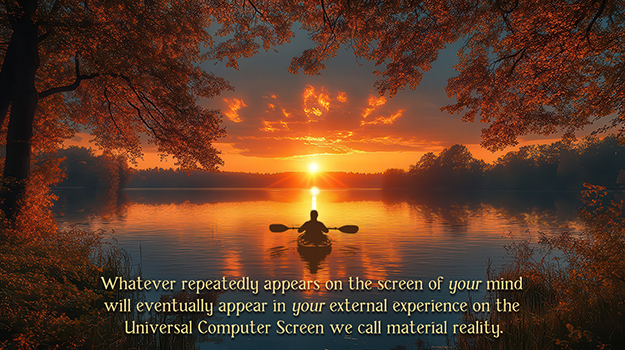
Whatever repeatedly appears on the screen of your mind will eventually appear in your external experience...

Quote from You Are the Universe: Imagine That, Chapter 17 – “Predreaming” by Bill Harvey

My wife Lalita is an avid reader; she reads a couple of books a week. The other day, she came across a book she had to mention to me, because of the similarity of its title to my book Mind Magic. The book is called The Magic in Your Mind. It was written by U.S. (Uell Stanley) Andersen, an American football player and businessman. I was fascinated, looked it up, bought it, and read it. The book asserts that our imagination controls what happens to us in our lives. This is not a new idea, nor is it just an idea: since antiquity, rare human beings have discovered this way of using their mind, verified that it works, and written about it. The earliest trace of it is in the Vedas, going back to memorized but not written texts possibly as early as ~1700 BC or even earlier, finally converted to written form ~500 BC.

In the Sermon On The Mount (~27 CE), Jesus quotes Proverbs 23:7: “As a man thinketh, so shall he be.”

The Law of Attraction was the book by William Walker Atkinson (1906), which might have inspired Jose Silva to create the Silva Mind Control Method (1977) – or Jose might have discovered it again by himself. In between these books (1961), was when Andersen published his book. The Secret was then published by Rhonda Byrne in 2006. Any of these writers might have been inspired by earlier books, and/or themselves discovered the phenomena and the ways of using them.

I’m finding the writing in Andersen’s book to be inspiring and exalting to read. Even though I know these things, the way he explains them is beautiful and lofty. His poetic metaphors and allusions have the ring of truth. I wish I had found his book before he passed away in 1986; it would have been great fun to have conversations with him.

When I was writing Mind Magic in 1972 (published in 1976), I purposely avoided metaphysics and cosmology because I wanted the book to have universal appeal, including atheists and people of all religions. The methods in Mind Magic are positioned as “useful fictions” and as “lenses” which had been invented by me and tested in my life. The reader is invited to try them and see for themselves that they are pragmatic, i.e., the methods work.

In my book You Are The Universe – YATU (2014), I went the other way and rooted my mental methodologies in a picture of the Universe as One Self playing all roles, thus each of our minds is actually the universal mind enjoying the view from one avatar’s perspective. In that book (YATU) I report on my own (mundane and extraordinary) experiences and theorize about how reality works, in order to explain those experiences. And I theorize why The One Self is playing this game.

Chapter 17 of YATU is called “Predreaming” and is all about how to use the mind to cause the future you want, and how to avoid accidentally “ordering poison from the menu” by careless use of these same faculties. An excerpt:

Whatever repeatedly appears on the screen of your mind will
eventually appear in your external experience on the Universal
Computer Screen we call material reality.
You are tuning in these material experiences, ordering them,
Attracting them to you, by dwelling on them.
It makes no difference if your dwelling on them consists of
prayer to get them (your desires), or dread of getting them (your fears).
The “dwelling-on” places the order, in either case.
Oblivious to our inherited “ordering power”, almost all of us are
using it against ourselves.

The difficulty of using this Predreaming method is not the intense visualization of your most precious dreams actually coming true in real life; that part is fun, it’s almost like daydreaming with purpose. The hard part is keeping your mind from repeatedly drifting into emotively imaging dreaded eventualities that are exactly what you most ardently desire to not happen.

In my novel Pandemonium: Live To All Devices, the character Templegard is the only soldier-spy tested by U.S. Army Intelligence who is able to not think of a green monkey. For most of us, even those of us with relatively high degrees of mental self-discipline, it’s almost impossible to not think of something. The trick is to not avoid thinking of X, but to focus on thinking of Y, and that will work, but requires practice at first.

Any negativity in the mind will tend to bring negativity into your actual life. This is why in previous chapters of Powerful Mind, we have oft mentioned quickly turning off internal alarms and moving on to solutions for whatever is causing those alarms. Negativity is a very useful alarm system, but when we are in Emergency Oversimplification Procedure (EOP), we tend to wallow in the alarm that is going off, rather than turning it off, thanking it, and moving on to planning how to deal with the thing that is causing the alarm to go off.

The more intensely you detail the future you want to happen, the better. This same attention to detail is valuable in preparing contingency plans for what you will do if the very things that you do not want to happen, happen anyway. Not only planning what you will say or do or what your face and body language will communicate, but experiencing it in your imagination, what it will look like and feel like from being inside yourself in that future moment.

Once you have pre-experienced the worst eventualities, you will find that some of their sting has been burned out. This will make it easier to casually turn aside if they pop up again in your mind. You will feel prepared and less concerned that such a thing might happen to you. Stoic, courageous, and fatalistic. Resolved.

This can be done every night before going to sleep, as regards what might happen in the day ahead. First, disarm the undesired outcomes by preparing for them, then put them aside and focus on predreaming the outcomes you do want to happen. If you are comfortable praying, go right ahead. I think of praying as asking for cosmic fire support. I don’t feel comfortable asking the Universe for help in trivial self-serving matters; I feel comfortable asking for the Universe to help in instances where the outcomes I want are beneficial to all concerned, although in the short run, some may be more benefitted than others.

Andersen argues that we should strive to change our identification with our ego to our identification with the Universe. This is unquestionably right in my opinion, however, it can run into friction with one’s atheism or specific religious beliefs (many Jews, for example, are uncomfortable equating themselves with God). This is why I rephrase his exhortation to identify with our Muse, the “voice” (some guidance might not involve words) inside that gives us the best advice. It comes down to the same thing as Andersen’s advice. And in Mind Magic, the final chapter is all about Identifying with the Universe. Here in Powerful Mind, I’m refining that only slightly into identifying with your Muse, as operationally easier to put into practice. You will, by doing so, tend to let lower thoughts float downstream without acknowledging them or identifying with them. You’ll instead tend to wait for the Muse and invite it space in which to be heard (or the advice felt and comprehended without words).

More on Key #12 in upcoming posts. In the meantime, ration negativity, and keep track of what percent of your time you detect it inside; and enjoy purposeful daydreaming about the future you want with all of your powers of imagination.


My new book, on which this blog series is based,
POWERFUL MIND 12 Simple Keys
will be out in February
POWERFUL MIND 12 Simple Keys by Bill Harvey

Love to all,
Bill


Live chat with my avatar now.