Category Archives: Positive Thinking

The Signals We Subconsciously Send Program Our Reality

Welcome to this week’s Bill Harvey Blog
Created May 8, 2026

This truism is well backed by scientific verification. Micromomentary gestures, body language, eye movements, word choices, tones of voice, are all carefully scrutinized by trained intelligence field agents, psychoanalysts, law enforcement officers, professional negotiators, and many other people who are looking for “tells” either to be able to make a better deal for themselves or to truly help the person being observed, or in rare cases, both.

At a cosmic level, a wide range of scientists and nonscientists already know or believe in the idea that we causally impact our future experiences based on the signals we send ourselves, even when those signals are only being sent within our own minds, to ourselves, and even when we are not consciously aware of sending those signals to ourselves – and to the universe.

This applies even to those of us who are consciously aware of the way we program our own reality with expectations that we have inside us and hide from others. By definition, the subconscious is not something we are tracking, so stuff that goes on at that level can easily slip by us.

For example, we may not realize that our doing something apparently harmless that comforts us, can be read by the subconscious as a signal that we need to compensate for a sense of failure. This can program us to fail.

So can our being overly cautious or conservative in our estimates of tactical success. We may think it’s good for us to plan on a pessimistic basis so we will be even happier when we exceed that low bar. But it could also be that we are programming parts of ourselves to hit that low bar or even below it.

Michelangelo said:
The greater danger for most of us lies not in setting our aim too high and falling short; but in setting our aim too low and achieving our mark.

Michelangelo believed that settling for mediocrity (hitting a low target) is more damaging to the human spirit than failing while attempting something grand.

Even a lack of spirituality can harm our chances of success in life. If we live life in a framework of physicalism, where our underlying basic assumption is that only the obvious reality exists, and there is nothing more, we can subconsciously be doubtful that we can ever experience more success than we have at the present moment. Of course, consciously we may be unaware that this holding ourself back is happening.

If we live life in a frame of mind that is open to the unknown, making no limiting assumptions about the unseen, we are not blocking moments of leakage of the spiritual into life, even if only for brief moments that we might not even think of as spiritual, simply as feeling extraordinarily good.

Maslow was once asked about religion and he turned the question into something else. Instead of replying about the known and agreed-upon religions, he used the word differently, in the context of his notion of peak experiences. He said:

The two religions of mankind tend to be the peakers and the non-peakers, that is to say, those who have private, personal, transcendent, core-religious experiences easily and often and who accept them and make use of them, and, on the other hand, those who have never had them or who repress or suppress them and who, therefore, cannot make use of them for their personal therapy, personal growth, or personal fulfillment. 

He was talking about openness to the possibility of cosmic spirit, something mysterious about which we know very little, but not prematurely denying its existence.

He also said, echoing Michelangelo in a different way, “We fear to know the fearsome and unsavory aspects of ourselves, but we fear even more to know the godlike in ourselves.”

There is practical benefit to leaving it open in one’s conscious mind that the nature of reality could include a benevolent God, that the universe itself could be conscious (why not? We are! The universe is a lot bigger than we are, with a lot more energy than we have, how could we be conscious and it not be conscious? We know it has consciousness in it). The practical benefit is that that thing lying squashed flat within us, that thing called hope, has a springboard from which to fly once again. Having real unfaked hope within us makes our subconscious try bigger plays.

Here is an experiment you can try.

When you are alone, go outside and as close to nature as is convenient. Breathe deeply. Casually empty your mind for a moment. Then imagine that you can make your life come out very happy, happier than you remember ever being, and that limits you assume you have are holding you back, so you must make every effort to stop imagining that you have any limits. You can restart your life right now with a new, creative attitude, reconsider everything you want to reconsider, taking your time and deciding over time exactly what you want to do with the rest of your life, and with the courage to actually set those plans in motion and stick with them all the way.

When you get started and have your first setback, don’t allow yourself to become deflated. Stop and look for what was the subconscious signal that got in the way.

There will be many rest stops like this caused by many setbacks. They are necessary because of the nature of the subconscious; you need these little setbacks to identify and root out the hidden signals that have always held you back.

You may be surprised at what some of them are. One might be that you have been too humble, too modest – too much of a very good thing – not all the things that hold us back are inherently bad things, some of them are great things which we have simply overplayed.

You may find, as you come out from holdback assumptions, that you are feeling somewhat cocky all of a sudden. Let yourself enjoy it and make it a way of life that rubs off on the people around you rather than rubbing them the wrong way.

Love to all,

Bill


Live chat with my avatar


New Power of You Podcast:
Balancing our internal & external worlds to improve
satisfaction, well-being, and performance


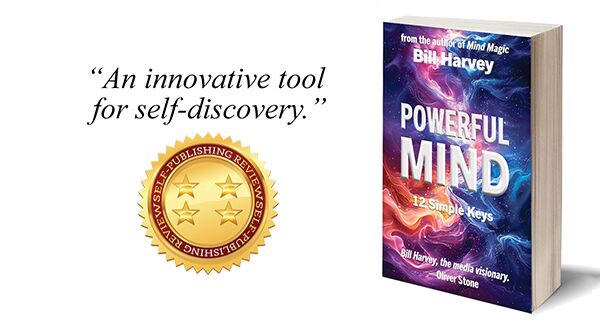
My new book POWERFUL MIND is now available in e-Book format at

amazon    &      Barnes & NobleAn innovative too for self-discovery

“A compelling, optimistic, and original approach to mental focus, Powerful Mind is an innovative tool for self-discovery and creative liberation. Succinctly outlined and intuitively structured, this book is replete with rational advice, using a radical but commonsense approach. It takes a rare and adroit thinker to incorporate myriad worldviews and welcome diverse readers, regardless of ideological allegiance, but Harvey shows himself to be precisely that. The book is a masterfully structured, intellectually affirming, and potentially paradigm-shifting read.”
~ Self-Publishing Review, ★★★★

Which Level of Consciousness Do You Want To Be In?

Welcome to this week’s Bill Harvey Blog
Created February 20, 2026

Flow state, the Zone, where everything does itself perfectly, you exceed your expectations of performance limits.

You have undoubtedly noticed that you are not always at your best. Almost nobody is. Sometimes we have very smart ideas, at other times our minds are dull, and at other times we think we are thinking very intelligently, only to discover that we were way off and should have known better from various earlier experiences and supposed learnings.

We generally assume that this is the way things are and that there is no way to improve our own mental/emotional performance, with some exceptions. We might read a self-betterment book or article once in a while. We might take a supplement that is for making our memory and other faculties work better. If someone we trust gives us earnest advice, we might listen with an open mind, and take it to heart, try to be better in the way suggested. We might even meditate or do yoga.

All of this is admirable. But is it enough? Have we pulled out all the stops to maximize our own performance at the game of life? Should we? Is it worth it? If it were so important, wouldn’t everybody be doing it?

The game isn’t set up that way. Particularly today, when so many people have more than one job in order to make ends meet and maintain the all-important lifestyle, who’s got the time for the luxury of being a perfectionist in any area of life? With two media bombarding you during most waking moments (sometimes only one), who can focus on anything anyway? And if you had a moment to spare, would you want to fill it with something that seems very hard and complicated?

Of course not. Nor should you. Fortunately, upping your consciousness does not have to be hard, nor complicated. And it can make you feel better fast and all the time. This post is all about the lazy person’s way of hacking consciousness. Winning with minimum effort. What a relief!

First, a quick, simplified map of the three levels of consciousness you can be in:

  1. Flow state, the Zone, where everything does itself perfectly, you exceed your own expectations of performance limits, and are as happy as a child at play at their favorite game. This is where you want to be as much as possible. Peak experience as Maslow called it.
  2. Observer state. Here you have no external dependencies – whatever happens, you remain impassive. You have no internal dependencies – you are able to also remain unmoved by emotional alarms going off inside of you. All by force of will, courage, determination, and sheer grit. That’s all you need to ACCEPT WHAT IS. Also known as Stoicism. You take the blows, self-inflicted or otherwise, and do not cave in. As if you didn’t care at all about anything. The way heroes are characteristically depicted in all stories since stories began. You also keep an eye on things inside and out and carefully discriminate courses of action, waiting as long as practical before making each decision, like George Washington and Davy Crockett. Including decisions about what and who to believe. All the old locked-down decisions are unlocked again in Observer state. You coolly observe in detail everything all over again with a completely open mind and no biases from all previous experiences.
  3. EOP – Emergency Operating Procedure – you keep up by moving as fast as you can to get all the things done that have been heaped upon you by yourself and others, get them all over with, and you defer enjoyment until after the list has been mostly ticked off when you can indulge in effortless escapism without having to think about your life or about anything serious. During this time, you experience endless moments of irritation about one little thing or another. You may or may not realize that it is your ego that is causing the irritation, and that you are dependent on others to keep you in a good mood, at which they usually fail.

Those are the three choices, in the briefest summary. The wisest choice among these is to spend as little time as possible in the lowest state. It is achievable by establishing the Stoic mindset as your main point of view. You don’t want to be cast around by outside forces; you want to be your own person, able to stand alone when necessary. You don’t want dependencies, you don’t even want to be dependent on your own internal clamor of bad feelings and babbling voices.

You want to identify with the SELF that is your inner essence, the pure EXPERIENCER, and take everything else with a grain of salt.

Is that all there is to it? Just that one principle will keep you in the two upper states of consciousness?

Not quite.

There is one other basic rule. Do not add any negativity to whatever negativity has gone before.

Stop your negative facial expressions and body language, and internal wallowings, and above all, any hurtful statements. Don’t add any negativity to the sauce of life; there’s plenty already. It will bring you and everyone else down, except for the Stoics in the crowd.

Love to all,
Bill


If You Assume the Worst, You Yourself Will Bring It About

Powerful Mind Part 36

Welcome to this week’s Bill Harvey Blog – November 7, 2025
Created November 10, 2023

Read Powerful Mind 35             |              See all 12 Powerful Mind Keys

The latest findings of neuroscience suggest that we, as individual human beings, interpret our own emotions as they happen. The physical signals we receive may suggest not only the degree to which our emotions are aroused, but they may even suggest the valence as either being positive or negative emotion, but then there is a cognitive interpretation layer we impose to further characterize to ourselves the emotions we are feeling.

In my own introspections, I had also come to that same conclusion long ago, that my mind had the ability to clarify the emotions I was experiencing. In some cases, I felt overwhelming arousal and initially took that to be fear and panic, but then, applying Observer state (metacognition) I was able to refine that classification into positive excitement and anticipation rather than negative fear. This was the way I learned to deal with stage fright when my showbiz parents put me on stage at age four.

The general reason why it is important to be able to bring emotional self-interpretation into play is to avoid making things worse.

There is a proven feedback loop between our expectations and the results we get. If we fear failure, it increases our probability of failure.

This goes beyond psychology. In physics, the greatest theorists, including Einstein, Wheeler, and Hawking, have postulated what Wheeler called the Anthropic Participatory Principle, the ability of consciousness to collapse probability waves into concrete objects. Einstein did not go quite as far, but could not describe relativity without including an observer (consciousness) in his equations.

Knowing that our inner emotional content has significant impact on the outcomes in our lives, and that we have the interpretation layer at our disposal in order to clarify exactly which emotions we are feeling, we face the choice of either:

A. Continuing to relinquish control over how we interpret our emotions, leaving that up to our brain’s default network to settle that as it will, and accepting the consequences.
B. Exercising our willpower to focus our minds on self-observation and clarifying our emotions based on the pragmatic principle that outcomes will be better to the degree that we classify our emotions more positively.

The ideal mental framework if we choose the “B” option is (1) gratitude for being alive and for the life we have been given, despite perceived imperfections, (2) resolute confidence that we shall attain our dreams someday, so long as we stay positive toward ourself and toward everyone else.

That’s the gratitude attitude that gives you the greatest chance of success at whatever you do. The word “someday” implies that we ought not be impatient or overly attached to the experience of success, but instead should enjoy the passage of time, the journey rather than the destination. This total package of attitudinal viewpoints is the master cocktail for maximizing success.

The implication is that in any given moment, if you sense your own emotions, the interpretation of those emotions should be the priority. If you are also besieged by your own tumble of thoughts and questions in your mind about various subjects, you might write down the fewest possible trigger words which will serve to remind you of those questions so that you can tackle them later on.

When I was very young, I took a very different path. I greatly esteemed thinking over feeling, for a very long time, and so I paid priority attention to my thoughts and questions of an intellectual and rational nature. I considered my emotions more as animal instincts to be conquered than as valuable signals. I was in my late teens by the time I realized that many of my intellectual questions were reduced to aesthetic preferences, i.e., feelings.

My undervaluing of feelings led me to take on a general preference for melancholy in the form of “glamorous cynicism”. I actually felt most comfortable being in a negative mood. Later on, this became a hard-to-break habit, but one which I eventually overcame. I had to see the way the negative mindset had ruined a number of great opportunities before I could wake up to, and bring in, the feeling side of the game to my self-recommended life systems (“psychotechnology”).

As we begin the description of Key #10 here, we are entering into the complexities of what goes on in the mind, from the subjective viewpoint of you, the experiencer. In this environment, every instant is besieged by qualia (subjective inner phenomena), some of which purport to describe the “outside” world (perceptions) and some of which report signals from the “inner” world (thinking, feelings, intuition, memories, imaginings, images). Operating according to the current norm for homo sapiens on Earth, all of this washes over you and what you pay attention to and do about it all, seems to do itself without much help from you, even when some of it is stuff that you do consciously but automatically, like saying thank you. But some of it riles you up and you over-react negatively, and some of it peps you up and you possibly over-react positively… all of it feeling fairly out of control, but you’re used to it, so it doesn’t induce panic most of the time.

Key #10 is completing the granular dissection of Observer state so that you are more fully prepared to deal with life with a far greater degree of conscious control.

We started with the feelings because they are the most powerful and least controllable qualia we experience. Remember the Gratitude Attitude in order to not be overtaken by your feelings, but to leverage your feelings so that you may channel their energies in the directions of your ultimate dreams.

Best to all,
Bill

The Art of Neutralizing Negative Emotion

Created June 3, 2022

Welcome to this week’s Bill Harvey Blog.

Negative emotion serves one pro-survival purpose only: it galvanizes us into action as an alarm system.

Once having detected her/his own negative emotion, the sophisticated Flow state experiencer moves quickly to neutralize the negative emotion and to work rationally and dispassionately on solving the problem which caused it. Like turning off the alarm clock in the morning.

What is a sophisticated Flow state experiencer? A person who has had the benefit of learning how to perform some skill so well that they repeatedly experience the sense of autotelic behavior: behavior that appears to do itself, perfectly, and without the need to put forth any effort for that to occur.

Such a person then invariably begins to contemplate this strange experience that comes and goes and is very welcome to stay longer than it ever does.

In a way, a sophisticated Flow state experiencer is like a lucid dreamer, one who is able to know the she/he is dreaming, and therefore able to control the dreams to a greater degree than the average person. “Life is but a dream” is a line out of the children’s song Row, Row, Row Your Boat. In that metaphor, the lucid dreamer is the sophisticated Flow state experiencer in the dream level we call “real life”.

I know that negative emotion can be neutralized because I do it all the time now. I’m not sure that I can put into words the perfect instructions for how you can do this, but I’ll try.

First, why? Why would you want to learn the trick of neutralizing your own negative emotions?

One obvious answer is that you feel bad when you have negative emotions and it’s obvious that nobody would choose to feel bad when they could otherwise feel good.

Another valid answer is that negative emotions reduce our effectiveness and keep us out of higher states of consciousness, such as the Observer state and the Flow state. 

In the Observer state you can see why you have an impulse that arises in you out of your subconscious. In normal waking consciousness you would either simply act out the impulse or hesitate without knowing what to do.

In Flow state you are beyond all that, your body and mind are doing everything perfectly without any inner heckling or gloating.

Negative emotion blocks both of these higher levels of performance. It also biases choices and decisions we make rather than enable objectivity and rationality in making better decisions.

When I neutralize negative emotion one thing that happens is that I observe what is going on inside me very attentively and put aside emotion entirely. I observe emotion and therefore am not inside it anymore. There is a falling away of my historic passions and motivations into a deferred file to be resumed later. I am highly cognizant of the lack of proof for any position over any other position in terms of human values. I experience sort of an ennui, or boredom, or tiredness with everything I stand for and believe in and am trying to bring about. I have a feeling, unspoken, of something like ho hum so what. I am as if reborn tabula rasa (blank slate). I can see things in new ways I could not before. Consider possibilities I never would have considered before. I have total free will with no mortgages from the past. All of this happens in a moment.

You might try this and see if it works for you the next time that something gives you negative emotion of any kind. Anger, hate, resentment, loathing, fear, guilt, melancholy, depression, sadness, regret, physical pain, loss.

Negativity keeps us from more quickly solving the problem that caused the negativity.

Love to all,

Bill


Visit Us On FacebookVisit Us On TwitterVisit Us On LinkedinVisit Us On Youtube