Tag Archives: Metacognition

How Did We Each Become Such a Rolebot?

Powerful Mind Part 15

Welcome to this week’s Bill Harvey Blog, February 7, 2025
Created June 16, 2023

Read Powerful Mind Part 14,

From our earliest experiences, people were telling us how we should be. For the first five years of our life, possibly the first 25, and unfortunately probably until the last breaths we take, we are very malleable creatures. The plasticity of our brains is widely known: we are constantly building new neural connections, which can then take on a life of their own, able to cause some of what we say to ourselves internally. We are particularly impressionable when we first come into the world for on our own, we know nothing, except the obvious physical needs as they arise, and so our instinct is to look for incoming advice.

Given these basic conditions, it’s understandable that even besides hard-wired primate mimicry programming in our genes, we would be largely shaped by each other. Other mechanisms more recently discovered such as mirror neurons enable our empathy with each other, serving a pro-species-survival behavior pattern of cooperation which has enabled us to erect the many artifacts of what we call civilization.

Freud, in what I feel is his most important book, Civilization and Its Discontents, comments based on his pioneering experiences of psychoanalysis with patients, how he perceives a common thread across neurotic people (today I believe he would classify us all that way), a pattern created by the thwarting of inner motivations by the constraints placed upon us by our particular form of societal civilization. From his sample, he concluded that the main problem was the limitation which most societies on Earth (his sample was mostly European upper class) place upon free sex. Free in the sense of being able to have sex with all the people that seem sexy to you. Had his sample been representative of the population of the planet, his focus on sex may or may not have remained the same. The total number of ways in which our behavior has been shaped by our laws and social conventions is far more all-encompassing than as relates to sex.

As each of us grows up we generally accede to the demands placed upon us to achieve acceptance and a sense of belonging.

This is one of the fifteen primal motivations discovered by my research. The scrip we pay for belonging is conforming. Sometimes that conforming is comfortable and sometimes it rankles us inside, but we go along with the game for safety and support within the herd. Freud’s wider point was that excessive conforming leads to neurosis, an early stage of insanity (disconnection from reality). Just as there are pre-cancerous states, there are also pre-insanity states.

Neuroscience and psychoanalysis both have many explanations to the phenomenon of our tendency to be influenced from the outside. My own method, concentration introspection, goes back much earlier than either of these two potent modern mind sciences, spanning millennia from the Rig Veda through the work of Freud, Jung, William James, Abraham Maslow, Mihaly Csikszentmihalyi, and John H. Flavell, who gave it a new name, metacognition, in the 1970s. All of these methods sheds more light on how it is that each of us is capable of being influenced in extraordinarily powerful ways from the outside – typically, without our realizing the full significance of the process, and its spread of effects.

From my recent media work, in collaboration across many industries and academia, where there is much to be learned from the scientific work of others, we now know that McLuhan was more right than he himself knew. He said the medium itself was more powerful than the messages which came through the media. He was referring to television and never claimed to have seen the digital future we now live in. And yet, the latest evidence about digital media shows that McLuhan’s concept is proven right in media he never anticipated.

The latest evidence is that the forced conventions of scrolling, mouse control, skippable and unskippable ads, and relentlessness of ads begging for attention, have caused the constraining of attention windows: digital media users fall into a pattern of giving only a second or two of attention to ads they do not ignore entirely. This is quite different from television, where under ideal circumstances of ad-context resonance, 15 seconds of immersive attention can occur when the viewer’s subconscious motivations resonate with the ad’s subconscious motivators.

So our present external world has taken a very strong hand in your life and mine so far.

It will take a lot of metacognition, introspection with concentration, for you to bring on the Observer state in your own castle. The state in which you can intuitively catch yourself thinking something for which you actually have no compelling evidence, but thinking that way has become habitual to you. And what you have been taking to be your very own self when you take your own counsels internally, is actually the residue of all of the imprints that have been made on you by the horde of stimuli you have experienced.

Clearing out excessive other-directedness from your self is a form of purifying the mind.

This purification is central to all of Eastern philosophy. Most of what is generally taken as mysticism is actually codified metacognition, using metaphors recognizable and meaningful in those cultures. Even astrology started as a way of evoking metacognition.

This is another example of how our society shapes us. I just wrote “even astrology” because it is a subject that has been denigrated in our present society. And even I follow society’s rules. I just understand what I am doing and why I am doing it, rather than playing a programmed set of roles, and not even realizing that I actually have a true self underneath all the roles. Realizing your true self from the inside is a freeing experience, and leads to a life living at least sometimes in the Flow state, the state of continuous impregnable happiness and effectiveness, bringing forth your unique gifts to the world.

Allocating just twenty minutes a day to studying yourself objectively (the socially acceptable term is “meditation”) is guaranteed to improve your life, even if it’s already perfect.

You don’t have to sit in a specific position. The main point is to observe your self, observe the workings of your mind. Stay on it, don’t get distracted from it. Watch what is going on in your mind as you unwind. What do you start thinking about first. Why that?

As soon as you realize you’ve been distracted, go back to the task. Have a way of taking ultra-brief notes – key phrases that will bring you back to where you just were. That way you can go on having revelations without worrying about remembering the ones you had a moment before.

Don’t filter things out that you feel like writing down because they might seem obvious to others. You are the only one who will ever see these notes. Unless you decide to publish some of them. Don’t do editing during metacognition, editing is for later. Metacognition is reconnaissance, the Observer state, assimilation of implications can come later, hence the notes.

Love to all,
Bill


Do It Your Way

Powerful Mind Part 14

Welcome to this week’s Bill Harvey Blog, January 31, 2025
Created June 9, 2023

Read Powerful Mind Part 13

Every human being is unique. A combination of genes and experiences that has never existed before and will never exist again. You are one of these unique creatures.

Then, why would your conversation, for example, sound like everyone else’s?
It’s partially because much of our learning is by imitation. That’s OK as a starting point, but then a fully realized individual will assimilate all of the different body movements and ideas that have been taken in imitatively. Not continue for an entire lifetime frozen into those imitated attitudes and behaviors.

Everyone has had the experience of having a friend or acquaintance who always says exactly the same things in any given type of situation. That person is playing tapes from his or her mind.

Everyone has had the version of this experience involving some unfortunate people who have lost some part of their short-term memory, and continue telling you the same stories, over and over again.

Imagine for a second that you, yourself, are a little bit that way. Not because of memory loss but simply habit.

How many times a day do you say the same word?

A few of us have been lucky enough to see monkeys, like in a zoo, or maybe even in the wild. Monkeys learn by imitation and you can see their learning take place, you can watch as they copy another monkey or a person – maybe even you are that person they are copying. Monkeys are closely related to humans, sharing a common ancestor, and seeing the way monkeys imitate can tell us a lot about ourselves, and get us to question all of our beliefs and ideas and attitudes, because maybe they became “ours” during a similar process.

It’s fun not to be a predictable person. That often requires giving fresh thought to a question rather than simply popping out the thing you always say about that question. That freshness is fun too. It isn’t a mistake to be playful in life, as long as your conduct suits the occasion. All of life is the playfulness of consciousness expressing itself.

It’s easiest to see how imitative behavior is formed when observing children, they are in the thick of it. Often, they don’t know the complete meaning of what they are saying, they are just repeating something they’ve heard. The problem is that this can continue way into adulthood.

You can imitate
Everyone you know
I told you so
—The Beatles, “I Dig a Pony”

We all value our freedom. We have a sense of free will: we observe ourselves making a decision, and we feel it inside when we have reached that decision. We know that we could have gone the other way. Therefore, we must have free will.

Some thinkers have pointed out that these feelings could be illusory, and that one could have predicted that decision from the outside, having observed your past behavior. It follows logically from this, that if you want to have free will and freedom of action, you need to study which actions you have been taking and try to discern why you have been taking those actions. Especially, was there someone else who influenced you to begin that pattern of action. Only after careful self-analysis can you know for sure that you are establishing your own self as an independent thinker and action-taker, not someone who has been other-directed for a lifetime.

Self-analysis starts with self-observation. You need to be aware of what you are doing from moment to moment, and why and how you are doing it. That is studying yourself as if from the outside. Each impulse that arises in you to do something is a phenomenon to be studied objectively. You don’t need to use words in your mind to ask yourself “Why would I do that” before following the impulse and allowing your body to take the action, or ignoring the impulse.

The level of detail is important when you are observing yourself. You will want to focus on the details, not jump to one general conclusion right away. How do your eyes move and what happens to your breathing when you are thinking about a given subject. Your expression and body as you walk into a room – what are you projecting to others – and why, at that moment?

Study not only things that seem to be important but also things which seem to be trivial. When you get out of bed in the morning, how do you swing your feet to the floor, and how long have you been doing it that way? Does the position you sleep in remind you of anyone else – e.g., your father or mother? It’s important to actually experience the feeling of discovering these things about yourself. How much of you has been simply copied from your models, and how much has been independently considered by the real unique you?

You don’t have to be like your friend in order to be his or her friend. Be your self. But first you must discover who that self is.

In some cases, you might come back to the same conclusions and ways of being as before. In other cases you may realize the way you do certain things – for example, the way you laugh sometimes is false and you’ve never liked that about yourself, you were mimicking someone else, and you’ve been doing it for a long time, and you’re going to learn how to break that habit by patiently catching yourself. At first, whatever program you are trying to delete from your repertoire will win over your will power, but as you persevere, you will gradually become dominant and the habit will eventually be totally broken, only to return in moments of extreme stress, until you lick it there too. Breaking conditioning is not easy but it can be done by this simple patient method.

But you have to be guiltless about your robot winning sometimes, especially in the beginning. Don’t let it depress you and don’t lose confidence. Accept that you will need to retrain your autonomic systems by not losing your cool, steadfastly and with resolve repeating the cancellation of those impulses as soon as you can in each situation. In some cases, you will have blurted something but you can explain and change your response to what you yourself truly feel in the moment. In other cases, you can stop it before a word leaves your mouth, but after you somehow telegraphed that you were about to say something. In the same way, you can truthfully explain the deconditioning you are going through, in order to become the person you are meant to be. There is no shame in metacognition, it’s a valuable skill that has never been given the attention in schools that it deserves. It will make you more effective and happier after your inner world housecleaning is done.

Love to all,
Bill


Visit Us On FacebookVisit Us On TwitterVisit Us On LinkedinVisit Us On Youtube

Respect Everything

Welcome to this week’s Bill Harvey Blog – November 29, 2024
Created February 23, 2024

We have not found any other way to effectively turn off the hate so why not try respect?

Open-mindedness is one of the most important principles of metacognition (continuously studying one’s own mind as if from the point of view of an outsider) according to Dr. Gerald Zaltman, who has taught neuroscience at Harvard, and metacognition at Harvard Business School. Without open-mindedness one tends to be locked into positions one has taken in the past, even though there might be new relevant evidence that could be considered.

If one is truly open-minded, then that person can also see the possible truth in positions 180 degrees away from their own. An atheist can see that it is possible that an intelligence created the universe. A progressive can see that there might be useful truth in some things that a conservative says.

How little we know, as Hoagy Carmichael’s and Johnny Mercer’s song tells us (from the 1944 Hemingway-based movie To Have and Have Not). Arthur C. Clarke put it another way, he said that of all the things that we can someday know, what we know now is an infinitesimally small percentage.

We have changed our scientific perspectives many times along the way, and we continue to change them. The wisest among us have this perspective and their epistemology naturally embraces open-mindedness. Although in most of his work a physicalist, the great Stephen Hawking in his final book quoted John Wheeler’s Participatory Principle which states that our consciousness helps create reality. This opens the door to overthrowing physicalism and establishing consciousness as the principal underlying reality.

These are great thoughts from great people. Open-minded to the very end, despite their decades of study and theorizing.

Compare that to the average person. The average person takes very strong stands based on, really, very little. They fall into a very deep rut as to what they believe and the beliefs they hate. Most of their assumptions are not something they themselves learned from their own life experiences, but heard about from others influential in their lives. This reflects an unconscious epistemology of Authority rather than Empiricism. The very selfsame unconscious epistemology that leads to Authoritarianism. Blind followership, in other words.

Without open-mindedness, a person drifts as if by animal instinct to be attracted to types of people, e.g. tough guys, or pretenders of that ilk. This is a survival instinct in many species (e.g. pecking order) and when human beings behave animalistically they are not rising to the occasion of having exclusive cognitive capabilities proprietary to our species.

The lack of open-mindedness impels us to be negatively motivated. We know what we are fighting against. We are less sure of what we are fighting for. This is most apparent in the current political climate. It would be most noble and most fun for governments to spend 100% of their time focusing on creative solutions. Instead, they appear to spend most of their time knocking down the ideas of others. Yet we must respect all of them if we are to be open-minded. Respect does not imply agreement or support. It simply reflects the recognition that we all deserve respect. Even those who do not respect us. Noblesse oblige.

Open-mindedness and respect go together. If one is open-minded, one tends to listen respectfully to the thoughts and feelings of others. If one is respectful, one tends to listen to others with an open mind, and to use metacognitive strength to hold at bay the screaming voices in one’s own mind reflexively denouncing what the other person is saying.

If all of reality is a single consciousness, the larger parent of that part of the consciousness we take to be our own, then respecting everything makes complete sense. We have been conditioned by centuries of majorities of thinkers we respected who could not see how ancient conceptions of God could be squared with the findings of science.

What came out of nowhere in the last half Century were new conceptions of God that fit neatly in with quantum physics and relativity. Just replace the word “God” with “the original consciousness field” and everything makes sense, the Participatory Principle, relativity, quantum entanglement, the Heisenberg effect, Bits Before Its, the jigsaw puzzle falls into place.

What Wheeler called the quantum foam could simply be the original consciousness field. The way Wheeler described the quantum foam, which pre-existed The Big Bang in his theory, was that virtual particles spontaneously arose from it and fell back into it. Sounds a lot like consciousness, with ideas and feelings arising from it and often disappearing back into it before we could grasp them.

Since we cannot prove that point right now, it comes down to being open-minded about it. For some of us who have noticed that our hunches, at least the dispassionate ones, often have great validity, we can decide to run our lives betting on cosmopsychism, as scientists are now calling it. When that struck me as more of a revelation than a hunch circa 1969 I called it The Theory of the Conscious Universe. I had a feeling that everything was conscious, it was an experience, more like a perception than an idea. I also dimly recalled that I had always had that perception as a child but it went away a long time before, slipping away quietly.

If we retain the realization that the world might be a very different sort of place than it appears, and take that possibility seriously, we naturally become more open-minded and respectful toward others, who may actually be ourselves at a different place in the game.

Whatever the truth might be, we can perhaps know it with certainty the next time we die.

In the meantime, if we can all agree that the world needs a bit of a makeover right now, which I think is a pretty pervasive take on things, we can exercise our will to take a stronger hand in the game by rising to a state of open-mindedness and respect for all things, as all things may be a part of our One Self.

This includes respect for our own current self. The popular term “self-esteem” is not quite as healthy as self-respect, because “esteem” implies a vain ego, and “respect” does not.

If we respect others, we shall find that it has increased our level of self-respect. It is a magnanimous position to take. We have taken unconditional responsibility to behave properly.

If we can apply respect in our daily lives, it will automatically tune down the hate. We have not found any other way to effectively turn off the hate so why not try respect?

Love to all,
Bill

Leading Neuroscientist Confirms Theory of Bio-AI

Welcome to this week’s Bill Harvey Blog:  July 19, 2024

As I was growing up, I was constantly studying my own mind. This was natural to me and then it was accelerated by my experiencing Flow state, mostly during some stage performances starting at age four.

I didn’t have a name for it other than describing it as “perfect performance as if doing itself.” There were other attributes I didn’t talk about because I knew they were taboo, such as the feeling that these experiences were otherworldly and suggested “magic” or the “supernatural”, which I repressed as I had decided that science was everything and that religion was merely superstition. I eventually revised the latter decision based on experiencing the spiritual level of Flow state.

I wanted to regain the “perfect performance” state and maintain it all the time. This motivated me to pay even more attention to what was going on in my mind at all times, and to relate that activity to the external world experiences I was having at the same time. I sought to relate states of my mind to the positive or negative feedback I was getting from other people and things.

The first “validation” that this strange “perfect” state existed came when I confessed my experiences to my favorite comedian of the era, Jack Carter. He said, “Oh sure, Billy, everyone in show business has that sometimes, it’s called ‘being on’.”

Mihaly Csikszentmihalyi coined the term “Flow state” when he studied the phenomenon as head of the psychology department at the University of Chicago. His first published work on the subject came out in 1975.

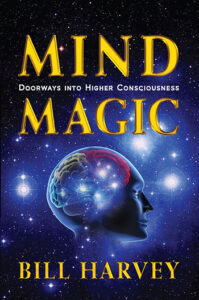
My first published work was written in 1972 and its subject matter was what I had learned about the states of my mind. It came out as the book Mind Magic in 1976. Throughout the book I referred to a part of the mind as “the robot”. This was the part of the mind that generated some of my actions that yielded the most negative results in the external world. The robot I had deduced was keeping me out of the “perfect” state (Flow state).

I knew that this automatic part of myself was making predictions. The following passage appears on pages 48-49 of Mind Magic:

MIND MAGIC by Bill Harvey“When you are about to see something, your mind automatically searches your memory for a comparable object (note the distinction between you seeing something and your mind having already seen it). If your mind finds something similar enough, it projects the stored image onto the new object so that you do not ever see the new object, but are merely dimly aware that there is a familiar type of object there… As a result of this, you mostly do not perceive your environment, instead perceiving mostly what you expect to perceive, i.e. you usually see your mind’s prediction.”

The term “artificial intelligence” and its abbreviation as “AI” appeared in 1955 in a project proposal by John McCarthy, Marvin Minsky, Nathaniel Rochester, and Claude Shannon. I became aware of the term as an avid sci-fi reader and began using it in my own sci-fi writing in the late 70s. In 1979 I formed one of the first neuroscience companies in the marketing field (Psychophysiological Research Management, PRM), partnering with Dr. Richy Davidson and Dr. Dan Goleman. Sometime thereafter, I began to use the term “bio-AI” as synonymous with “the robot”.

In 2002, Dr. Karl Friston published his first work on “active inference” in which he proved the existence of the prediction engine in the brain which I had introspected in myself a half-century before it became scientifically recognized. Friston’s work with many other scientists has identified the prefrontal cortex as being involved in the automated calculations often occurring below the level of consciousness. That suggests we have only had the bio-AI for about 200,000 years, for that is when the prefrontal cortex appeared.

After William James, psychology had become disenchanted with the use of introspective evidence, because of the tendency to bias and inaccuracy. However, the fact that in modern times an individual was able to predict science decades in advance by the careful use of introspection, strongly suggests that introspective evidence be reconsidered as a tool of psychology.

A few pages later in Mind Magic on page 53 it says:

“…society communicates expectations to you which you then see in place of seeing the realities themselves.”

This theme recurs throughout the book, emphasizing that cultural biases are conditioned into the bio-AI. This explains why brainwashing by social media, media “news”, parents and peer pressure is so powerful: it slips into the bio-AI inference engine below the level of consciousness.

We as a species are at a crossroads. The pro-survival bio-AI which enabled us to evade superior predators 200,000 years ago today often functions as contra-survival, as I discovered as a child by allowing my automated reactions to play out in the real world, which often resulted in negative results. The chaos into which the entire world has fallen today, to me, points to the urgent need for rapid widespread education of a new kind, teaching people how to bring decision making into the sphere of the conscious mind, what I call metacognition (term coined by John H. Flavell) and my partner Dr. Gerald Zaltman calls open-mindedness.

My interests in introspection and in neuroscience are connected to one another. My life’s work is to make the connections between the discoveries of neuroscience and the subjective inner life of the individual that will enable science and education to work together to cause most human beings to be able to spend most of their time in states of metacognition/open-mindedness and Flow. If we as a species can accelerate this process of what I call “psychotechnology” or “microcosmology” we can deter the drift back into the self-administered Feudal slavery of inviting “strong men” to take over our governance and protection. It’s never too late.

We all know how difficult it is to control the mind, to master oneself. Socrates said, “Know Thyself,” and Plato said, “I still do not know myself, so why would I spend time studying anything else?” (Phaedra) The only control panel or dashboard life gives us for achieving this task is the user interface (UI) we call the mind. The conscious mind experiences “qualia”, subjective experiences within consciousness, including words, images, snatches of memories, and especially feelings. We have control over certain things through this UI. We can choose to slow down our breathing, engage in positive imagination, question our attachment to certain outcomes, use reasoning and evidence, and these and many other tactics are within the sphere of our control. In this introspective world, we have the only chance we will ever get to solve our problems or to see that they are opportunities. Therefore, we cannot Behavioristically study only structure and function of the brain, we need to relate events at the physical level to the qualia at the mind level, or else we lose the value of having that control panel inside.

My best to all,
Bill


Live chat with my avatar now.