Tag Archives: Observer State

We Each Have a GPT4 Within Us

Powerful Mind Part 39

Welcome to this week’s Bill Harvey Blog.
Created December 8, 2023. Updated April 4, 2025

Read Powerful Mind 38             |              See all 12 Powerful Mind Keys

No computer system before the current Large Language Models (LLMs) has been able to fool humans into thinking that the computer is human or the intellectual equal – which is the Turing test, proposed by one of the pioneers of modern computers, Alan Turing, in March 1946. What is amazing about the LLMs is how human their texts sound.

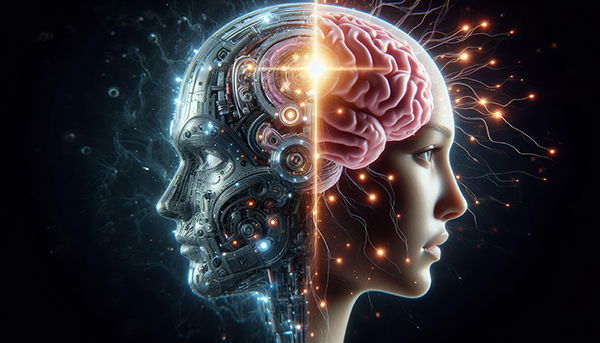
What is even more amazing is that all they are doing is a version of autocompletes – when your computer or smartphone fills in the next word or words you are going to key in. GPT4 and the other LLMs are gigantic versions of the same algorithm. The vast amount of training data is what makes them sound like us and be right so much of the time.

Unbeknownst to us, we have always had a similar function in our own brains. The reason it remained unknown to us for so long is that it passed the Turing test. We took it as our own words to ourself.

This function predicts what we will say next, based on what we have said in the past (which are the training data), and on what we just said to ourselves a moment ago (which is the prompt to be autocompleted).

On occasion, the robot (as I call the inner biological AI) might escalate what you just said to yourself (the prompt), using terms you had used in the past (training data) in association with that word you just used. “Escalate” means taking your prompt and making a more extreme statement as a follow-up. In this way, the inner AI may contribute to our recognized collective leanings into extremism throughout recorded history and never more so than today.

The problem is we take all of our thoughts at equal value. The ones we ourselves say to ourselves, and to the ones that are predictions by our robot. We didn’t know about this robot thing, so we presumed that any thought in our mind was propelled solely by our own free will. However, we find this to not be the case. There is another word source which accesses memory systems and – like today’s LLM chatbots – predicts/suggests what to say next.

Why is there such a system? Apparently pro-survival, it reminds the self how to promptly respond to incoming signals of each specific type. However, it will tend to self-past-consistency and so it will potentially underestimate where the self has evolved to at the current moment.

In Emergency Oversimplification Procedure (EOP), otherwise known as the default network, these snuck-in inputs will be taken as the self’s own.

In Observer state, otherwise known as the executive control network, the self senses that it is now going off a bridge too far and pulls itself back.

However, even in Observer state, for the past few millennia we have not known that the human brain has these predictive abilities, and they are right now being discovered by science. Using introspection, I discovered the robot and wrote about it in my 1976 book Mind Magic.

From my own direct experience, I link the robot with Freud’s concept of the Ego. In Civilization and its Discontents he writes that the ego first arises when the baby feels needy and frustrated. It acts as the self, but it is actually a self-protective layer of mind on top of the id, the original self. In childhood I was able to understand my own actions through this lens of distinguishing the different voices in my mind.

Science is now confirming that the robot, as I wrote about it in Mind Magic, is a real thing, not just a metaphor. It’s as if a cosmic chunnel is being built from two ends, science and introspection, and they are actually connecting.

The verification for these psychotechnologies – the 12 Keys among others – by science is coming at just the right time. The upcoming generations feel handed a raw deal and fearful about their future, and they spend most of their time in EOP like the majority of us, ill-equipped for the likely challenges. Psychotechnology can achieve maturity of thought processes relatively quickly.

When Observer state is achieved it enables objective formal operational and systems thinking. One starts from understood and believed-in goals, then proceeds ethically and thoughtfully to achieve those goals. Each individual in this converted state is on a Mission with a known purpose. Having a Mission makes the individual less willing to give in to useless inner negativity and more self-disciplined about taking prompt but unhurried action aimed at carrying out the Mission.

The individual achieves meaning without the same constant dependency on media diversions. Moving toward of a future of one’s own shaping, life is exciting enough on its own. In Observer state, each challenge is a learning experience on the way to the goal.

Further psychotechnology balances this drive with resilient nonattachment to outcomes. Yerkes and Dodson proved that optimal arousal causes superior performance vs. maximal arousal. Czikszentmihalyi proved that there is a state above Observer state which he famously called Flow state. Yale’s Neuroscience Master Chun notes that the random chatter between lobes disappears in Flow state.

Spiritual psychotechnology opens up the individual to the possibility of cosmic connection, and how to recognize and work with it.

Worry and Fix

Two little words. And yet a philosophy can be built on them.

A 50,000-foot view of what goes on in our minds is a mix of these two things. We’re always either worrying or fixing.

A great many people worry almost constantly. This appears to leave them little time for fixing.

A few of us have learned to minimize time spent worrying and maximize time spent fixing.

The two strategies are poles apart in terms of success rates. And inversely poles apart in terms of popular adoption.

But why would people choose to waste time worrying when they could be fixing?

People generally do not believe they have the power to make a difference in their own lives, let alone to change the world. They feel swept along by forces much stronger than themselves, some coming from the outside and some coming from the inside.

The traitorous thoughts coming from the inside are the ego, the aspect of self which resists community mindmeld; it is always in a cold war against the others perceived to be separate beings, essentially competitors, rivals. Everyone else is the potential rival.

Everyone else is also the threat vector coming at the ego from the outside. Inside and outside sources appear to agree on the dangerous nature of the others. Everyone else.

In higher states of consciousness – specifically Observer state and Flow state – these paranoid delusional biases are identified instantly by a person. In Observer state one is conscious of one’s own judgment swings and even fine-tuning adjustments taking place from moment to moment.

In the higher states, there is no worry because every challenge is accepted with valor and all time is spent on fixing, building, creating. Worries streak in, and last only fleeting minutes, while the focused mind dissects them, and establishes new rules of engagement (fixing).

The present environment is geared toward producing hyper-over-stimulation/distraction. This is the result of Acceleritis over the past six millennia. We became stimulation junkies and invented technodrugs to feed that addiction.

At one time not so very long ago, in the West, we felt very confident and competent. In the East and South, where most of current growth has come from, there was great hope.

Now uncontrolled thoughts and feelings have stampeded the herd. This is all utterly unnecessary.

We have the skills and resources to fix everything, even at the advanced state of ruin we have already made of the planet and its species.

But not without working together.

If we continue to wallow in delusional hate fantasies while Rome burns, well. You know how that ends.

Can we all please wake up from the nonsense and get to cooperating to fix the mess we made?

Further methods of attaining inner clarity (Key #10) in Part 40.

See all 12 Powerful Mind Keys

My best to all,
Bill

Study Thyself

Powerful Mind Part 17

Welcome to this week’s Bill Harvey Blog, February 21, 2025
Created June 30, 2023

Read Powerful Mind Part 16

“Know Thyself” goes back to the Delphic Oracle Temple in Sixth Century B.C. Greece then known as Hellas. The saying is attributed by legend to Apollo and by historians to a group of seven sages of whom the best known is Thales, who postulated that the universe itself contains a natural force that brought about all of existence, and was the first human on record to have predicted the exact timing of an eclipse. Socrates based much of his philosophy on these two words.

In general use at the time, the phrase was interpreted as knowing one’s own capabilities and limits. Plato altered the meaning to knowing one’s own soul. Judeo-Christian philosophers added the meaning of knowing one’s own relationship with The Creator.

In the context of metacognition, in my view, to know oneself means to have undergone the strenuous and time-consuming process of studying oneself as if “one is an observer from the outside, with a means of seeing, feeling and hearing what is going on within oneself,” including what lies below the conscious mind. And with the help of this objective pseudo-outside view, one has successfully edited one’s own thoughts, feelings, and automatic reactions, and thus achieved an inner integrity, a oneness, a simplification, and an autonomous focus. When these conditions have been met, I would call such a person, one who knows themself.

Note the mention of “what lies below the conscious mind.” This has become a hairy subject in psychology. The heavy emphasis placed on hewing to the a priori assumption of materialism within the social structures of academic scientists, while any a priori assumption is anathema to the concept of objective science, has caused psychologists as well as all other types of scientists to veer away from language which undermines their social standing within their fields. The words “unconscious” and “subconscious” – which had been the core of the Freudian/Jungian revolution in psychology – are now taboo. Words such as “preconscious” are preferred, but the safest way to discuss the subject is to use the lengthier construction “events that do not reach the threshold of conscious awareness.”

This latter workaround actually has some value in my estimation. It calls attention to the fact that qualia (subjective experiences within the psyche) can succeed or fail to leap over the line into conscious awareness. This is important to the inner explorer because it is a cue to strive to pay sufficient inner attention to become conscious of more of the arising qualia: thus making more of the subconscious, conscious.

One who achieves this degree of self-knowledge will experience moments of inner clarity when a fear or anger reaction starts to subtly arise and one catches and squelches it within less than a second.

In Parts 14, 15, and 16 of Powerful Mind, we have reviewed how each of us became substantially unfree, subtly enslaved to imposed views, and we covered the method of close self-analysis, and resolute perseverance in disciplining the mind and becoming an original person.

We leaned heavily on the metaphor of “the robot” to help your inner senses grasp the true relationship between the parts of yourself which have become automatic (the robot) and the essence of who you really are (the real you). One exercise we recommended is to check your level – are you trapped in the robot right now, or are you in the Observer state?

As we look back at the last few posts we see an opportunity to add one further recommendation as to how to know where you are.

If you sense some dilemma you seek to resolve, the likelihood is that you are in the robot. When you are in the Observer state, you are solving problems as they arise and there is no feeling of any dilemma.

One of the main objectives of Powerful Mind is to reduce all of the vast complexity of purifying and mastering one’s mind, to a set of a dozen principles, each of which can be stated in a few words.

The first of these principles, or Keys as we call them, was described in Powerful Mind Parts 10-13, and is:

Doubt your own last thought/feeling.

This is the method that most directly confronts the robot. As we specified in that section, this Key must be applied with balance and perspective to avoid sinking into a robotic Hamlet information analysis paralysis. If you find yourself having lost all confidence in your own intuitions, you will know then that the robot has judoed you and is still running the show. The doubt is meant as a momentary wipe – the “arc” we have spoken of earlier – a distance between the arising of an impulse to believe something specific, and your confirmation of your approval or the denial of your approval of that impulse. If too much time goes by without reaching closure you are being indecisive and need to shut out the world for 20 minutes or so in order to really study the situation and reach your best judgment as to an action plan which can later be improved as you learn more.

The second Key which we have been working on in Powerful Mind Parts 14-17 is:

Study, edit, and reset your automatic reactions.
This is radical new mental strategy #2,
The second simple key to the doorway
Of the upper mind.

Whereas the first Key is a permanent one, useful at all times, when applied correctly with balance, this second Key is one that is most important for the first year or so of the rest of one’s life, after making the decision to clear out the debris of other people’s influence, and re-evaluating everything from one’s own autonomous, empirically-driven, pragmatic and aesthetic intuitions. After the first year or so, you may see yourself needing to use this Key a bit less often, and that, if it happens, will be a good sign.

Love to all,
Bill

How Did We Each Become Such a Rolebot?

Powerful Mind Part 15

Welcome to this week’s Bill Harvey Blog, February 7, 2025
Created June 16, 2023

Read Powerful Mind Part 14,

From our earliest experiences, people were telling us how we should be. For the first five years of our life, possibly the first 25, and unfortunately probably until the last breaths we take, we are very malleable creatures. The plasticity of our brains is widely known: we are constantly building new neural connections, which can then take on a life of their own, able to cause some of what we say to ourselves internally. We are particularly impressionable when we first come into the world for on our own, we know nothing, except the obvious physical needs as they arise, and so our instinct is to look for incoming advice.

Given these basic conditions, it’s understandable that even besides hard-wired primate mimicry programming in our genes, we would be largely shaped by each other. Other mechanisms more recently discovered such as mirror neurons enable our empathy with each other, serving a pro-species-survival behavior pattern of cooperation which has enabled us to erect the many artifacts of what we call civilization.

Freud, in what I feel is his most important book, Civilization and Its Discontents, comments based on his pioneering experiences of psychoanalysis with patients, how he perceives a common thread across neurotic people (today I believe he would classify us all that way), a pattern created by the thwarting of inner motivations by the constraints placed upon us by our particular form of societal civilization. From his sample, he concluded that the main problem was the limitation which most societies on Earth (his sample was mostly European upper class) place upon free sex. Free in the sense of being able to have sex with all the people that seem sexy to you. Had his sample been representative of the population of the planet, his focus on sex may or may not have remained the same. The total number of ways in which our behavior has been shaped by our laws and social conventions is far more all-encompassing than as relates to sex.

As each of us grows up we generally accede to the demands placed upon us to achieve acceptance and a sense of belonging.

This is one of the fifteen primal motivations discovered by my research. The scrip we pay for belonging is conforming. Sometimes that conforming is comfortable and sometimes it rankles us inside, but we go along with the game for safety and support within the herd. Freud’s wider point was that excessive conforming leads to neurosis, an early stage of insanity (disconnection from reality). Just as there are pre-cancerous states, there are also pre-insanity states.

Neuroscience and psychoanalysis both have many explanations to the phenomenon of our tendency to be influenced from the outside. My own method, concentration introspection, goes back much earlier than either of these two potent modern mind sciences, spanning millennia from the Rig Veda through the work of Freud, Jung, William James, Abraham Maslow, Mihaly Csikszentmihalyi, and John H. Flavell, who gave it a new name, metacognition, in the 1970s. All of these methods sheds more light on how it is that each of us is capable of being influenced in extraordinarily powerful ways from the outside – typically, without our realizing the full significance of the process, and its spread of effects.

From my recent media work, in collaboration across many industries and academia, where there is much to be learned from the scientific work of others, we now know that McLuhan was more right than he himself knew. He said the medium itself was more powerful than the messages which came through the media. He was referring to television and never claimed to have seen the digital future we now live in. And yet, the latest evidence about digital media shows that McLuhan’s concept is proven right in media he never anticipated.

The latest evidence is that the forced conventions of scrolling, mouse control, skippable and unskippable ads, and relentlessness of ads begging for attention, have caused the constraining of attention windows: digital media users fall into a pattern of giving only a second or two of attention to ads they do not ignore entirely. This is quite different from television, where under ideal circumstances of ad-context resonance, 15 seconds of immersive attention can occur when the viewer’s subconscious motivations resonate with the ad’s subconscious motivators.

So our present external world has taken a very strong hand in your life and mine so far.

It will take a lot of metacognition, introspection with concentration, for you to bring on the Observer state in your own castle. The state in which you can intuitively catch yourself thinking something for which you actually have no compelling evidence, but thinking that way has become habitual to you. And what you have been taking to be your very own self when you take your own counsels internally, is actually the residue of all of the imprints that have been made on you by the horde of stimuli you have experienced.

Clearing out excessive other-directedness from your self is a form of purifying the mind.

This purification is central to all of Eastern philosophy. Most of what is generally taken as mysticism is actually codified metacognition, using metaphors recognizable and meaningful in those cultures. Even astrology started as a way of evoking metacognition.

This is another example of how our society shapes us. I just wrote “even astrology” because it is a subject that has been denigrated in our present society. And even I follow society’s rules. I just understand what I am doing and why I am doing it, rather than playing a programmed set of roles, and not even realizing that I actually have a true self underneath all the roles. Realizing your true self from the inside is a freeing experience, and leads to a life living at least sometimes in the Flow state, the state of continuous impregnable happiness and effectiveness, bringing forth your unique gifts to the world.

Allocating just twenty minutes a day to studying yourself objectively (the socially acceptable term is “meditation”) is guaranteed to improve your life, even if it’s already perfect.

You don’t have to sit in a specific position. The main point is to observe your self, observe the workings of your mind. Stay on it, don’t get distracted from it. Watch what is going on in your mind as you unwind. What do you start thinking about first. Why that?

As soon as you realize you’ve been distracted, go back to the task. Have a way of taking ultra-brief notes – key phrases that will bring you back to where you just were. That way you can go on having revelations without worrying about remembering the ones you had a moment before.

Don’t filter things out that you feel like writing down because they might seem obvious to others. You are the only one who will ever see these notes. Unless you decide to publish some of them. Don’t do editing during metacognition, editing is for later. Metacognition is reconnaissance, the Observer state, assimilation of implications can come later, hence the notes.

Love to all,
Bill


Starting Over

Powerful Mind Part 43
Welcome to this week’s Bill Harvey Blog, December 27, 2024
Created January 5, 2024
Read Powerful Mind 42


A useful exercise from time to time is to pretend that all of your experience to date has not happened, you have no preconceived notions of anything, and you are going to restart your life in this very moment.

After making this proclamation to yourself, since you no longer have any agendas, the first thing to do is to simply observe what is going on inside you, in the supposed absence of all previous records.

You might sense words in your mind, or perhaps only feelings. What are those feelings and/or words? The ones that come back first after the reboot?

Why did those arise first?

If they are feelings, they might be left over from your previous life, the one before the restart. Or they may be your first feelings in this new life. You’ll find yourself able to make some pretty confident guesses. Either the feelings will be negative, and stem from your previous life, or perhaps they might be positive, excited at the chance of starting all over.

Let’s say they are negative. You say to yourself (without words, they are unnecessary) that you’re breaking the rules of the game by carrying over feelings from the past. How come your past life led you to store up these bad feelings with such power over you that they were able to break confinement by your will?

You might answer yourself by reminding yourself that you never had been able to overcome negative feelings by your willpower alone.

OK, but that was then, this is now. You are reborn as a blank slate. You will get off on the right foot this time, and are absolutely determined to have a strong enough will to break the hammerlock of negative emotions over you.

Sustain the moment for as long as necessary and put all other things aside while you win the internal battle.

Notice words that arise in your mind. Which senator* are they coming from? What is the general mood of that senator? Are the words taking the side of your will to overcome negative emotions, or are they taking the side of the negative emotions?

As the exercise progresses you will see that the robot has not crossed over with you into a new blank slate, the robot has all of the baggage it has always been carrying, and intends to keep using it to manipulate you. This will give you a clearer and more comprehensive view of the robot than anything you have read in my writings. You will see what you and all of us are up against. It is almost like needing to fight off the mind of an invading demon that is trying to take us over completely and has almost entirely succeeded already.

However, you will always have the upper hand if you remain cool and open-minded and not give in to negative emotions, defeatism, or attachment. Simply observe these inner battles from above them. You’ll need to give up all of the attachments you had formed in your earlier life, before the restart.

The things you deeply love and care about, which are good for you and others, will always come back and seek a place in your heart, and you can welcome them back, but in a stoic manner: meaning you will not make yourself suffer by not experiencing these things enough, you will be grateful for what little of them you get.

There are resolution moments where we take life-turns and we can actually feel the difference inside, where something that once had power over us, no longer does.

Afterward, we might experience backsliding, and at such times focus our consciousness on sticking with our new resolution. Do not cause yourself to suffer, nor accept suffering at the hands of others, but remain resolute and compassionate to everyone and everything. It is possible to balance in an open-minded way and to help others without being carried off by oversensitivity to the suffering of others. You can do more good in the world by staying over the weather.

Use your newly developed inner visibility to study what brings you up and what brings you down, and curtail downward emotions immediately. Accept whatever is happening as reality and deal with it as constructively and patiently as possible without becoming caught up in it. Your free will, your personal freedom, your resolute will, is the most important thing that you have, more important than your negative feelings, your will is the protector of your positive feelings of love and joy and wonder.

Do not confuse willpower with stubbornness. Stubbornness is the opposite of open-mindedness. Taking intractable positions means you are not open to considering other ideas. This means you are attached to certain ideas and things without recourse to new facts, new learning. That is being stuck. That is Emergency Oversimplification Procedure (EOP) of the robot. Your consciousness should remain open to all possibilities while taking necessary actions based on your current best estimate of reality.

When you are having fun, such as when you do your passion work, will bring you up, not only emotionally but also cognitively and in terms of effective body movement. This is Flow state.

As I’ve mentioned before, when I was very young and experienced Flow state for the first times (on stage), it was very impactful on me. I had discovered another level of reality that felt very magical, although I was sure that it had a basis in science. My parents who had taught me everything about life from much earlier in my life than other parents discussed everything with their children, had never taught me about Flow state. Did they know it existed? I didn’t trust myself to know exactly how to explain it even to them and so I never did. Eventually, Jack Carter, the comedian I respected most, recognized what I was saying to him in a private conversation, and said that in showbiz it was called being “on”.

As I grew up I formed certain ideas about Flow state, which I thought about a lot because it was my aim to get into and stay in Flow state as much as possible. One idea I had was that every impulse received during Flow state was perfect. One could do no wrong. It took me years to see through that mistake. Actually, the foolish impulses continue to arise during Flow state but the ability to instantly discriminate the right impulses to follow has become impeccable, for as long as the state lasts.

With my wrong model of Flow state, I was always quickly taking myself out of Flow. Because I would act on decoy impulses thinking I could do no wrong.

Nowadays in Flow, I listen to the endless babble of my robot pretending to be me, following up on an inspired idea I just had as if with further improvements on it, when these follow-on remarks really added nothing of value.

As a note to neuroscientists studying states of consciousness, my original hypothesis was that only one set of instructions was being sent to my conscious mind, and the perfection of Flow state was therefore determined by the subconscious layer that sent my conscious mind these instructions. My current hypothesis (or observation) is that the impeccability of action is not at the generative layer but in the discrimination function. In Flow state, the conscious mind and body act as a single unit, confidently choosing correctly from among the sea of impulses constantly arising, with the self and other seeming to be of a single piece. It all feels like play or doing what comes naturally as opposed to striving.

Whether you are starting over to evade a bad mood, enjoying creating something in Flow state, or whatever you are doing, the ability to focus your attention and notice what is going on in and around you is what is going to get you through to the highest outcomes, even as you prevent yourself from becoming attached to those outcomes.

Your ability to see yourself inside continuously will reveal to you many important learnings. You will see that discomfort generalizes. If something makes you feel uncomfortable, soon other things will also be making you feel uncomfortable. You will see that being interrupted discomforts you, and that you quickly tire of it. This whole distraction culture which we have created continuously interrupts thoughts and feelings you are having, which contributes to the development of EOP as a form of “thick skin” to coexist with all the interruptive distractions going on almost all of the time. Acceleritis (information overload) has created a world of broken thoughts. We reduce the pain of this with EOP, but that actually makes things worse.

Be on the lookout for certain signs that you are in EOP. Procrastination is one of those signs. Something needs to be done but we put it off. If we stop and focus on it, the sense that it is overwhelmingly difficult melts away as we patiently and open-mindedly analyze it.

Circling is another form of procrastination. This is when your mind is in a loop, it keeps going around and around through the same path of steps, without adding new insights in the endless circling. Might be a good time to start your life over at times like that.

May your 2025 be filled with happy surprises!

Love to all,
Bill


*Senator

A Bill Harvey construct explained in Mind Magic. The bio-AI in your brain is referred to as “the robot”. The robot makes predictions and sometimes asserts motor control. From your own subjective point of view, it is not easy to discern your own free will from the will of the robot. To the extent that you act on impulses, you will be giving up maximum control to the robot. When you hear yourself thinking certain thoughts they may be coming from the robot. There the robot appears not as a single unified voice but as a huge auditorium filled with senators, who speak with apparent certain knowledge, but each senator speaking from a different persona. This is apparently an artifact of the brain’s bio-AI system. The AI clusters the verbal and visual inputs of others and this forms the senators, reducing the data to a manageable number of types. Back ↑