Category Archives: Uncategorized

Dial Back on Arousal to Reach Highest Performance

Volume 2, Issue 3

Science verifies the Vedas, Tantra, Qabala, and other ancient ideas

Hope you’re enjoying the new “2-minute read” format.

Thousands of years ago, individuals who trained themselves to be introspective all learned the same wisdom about the mind, in Greece and Egypt as in India and elsewhere. I’ve also rediscovered those bits of wisdom in a lifelong self-training to be an objective introspective observer — so as to really learn things and not just prop up my own ego, as we are all mostly forced to do by the information overload pressure that all too often sinks us into EOP.

The ancient wisdom even more applicable in today’s accelerating culture says that if we care too much we ruin it. Whatever “it” is. The word “attachment” is the meme of this wisdom, the gene from which a Pandora’s Box of linked ideas emerge.

Some became Buddhists, but most of the kids in my college class went on with their lives with their attachment level dialed way up, and this caused them painful life lessons from which they have grown up and consequently dialed down their attachment levels.

Although we find it expedient to ignore ancient wisdom, believing our science to be light-years ahead, science is only now coming to the same conclusions as the ancients but by humorously roundabout trips. If only psychology had listened to William James and seen introspection as a valuable tool of science. Science today would be accelerating into Observer and Flow state discoveries, leapfrogging over my mere intuitions and practical experience.

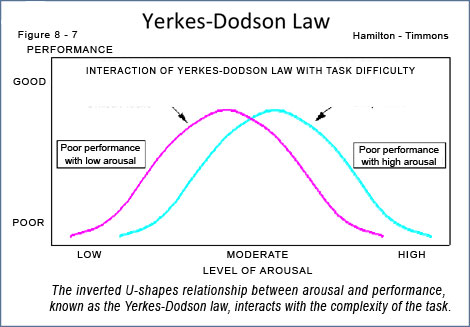
Consider the following “now-scientific” evidence. The widely-accepted Yerkes-Dodson law in psychology says that the optimal level of arousal for highest performance is moderate — a word Aristotle would also have chosen.he inverted U-shapes relationship between arousal and performance,  known as the Yerkes-Dodson law, interacts with the complexity of the task.

Note that arousal should be set even lower for more difficult tasks. Not rookie over-eagerness, but a fatalism that is above caring about success or failure — kind of a playful fun resignation to whatever outcome the universe chooses, so long as you like your play.

Arousal in this context means the same thing as the mental causes of physical and brainstem arousal — we call these motivations. If we are attached, meaning too highly motivated such that not succeeding would be anguishing — then we are not going to give our highest Flow state (Zone) performance.

Dial back the arousal. In future posts we will address the next question: how does one actually do that?

Best to all,

Bill

The Immediate Upside Opportunity of Engaged Relationships

Volume 2, Issue 1

The next boom could be right around the corner, but we have to create it

When one is in a depressed defeatist state of consciousness, one draws down upon his or her self all manner of further difficulties incremental to what caused the depression. Some might say this is just others reading and taking advantage of obvious clues of weakness, while others might say the Divine Matrix is mirroring and giving each of us what we need. The construct is irrelevant because the predictions are the same. Both are accurate.

The same thing happens on a global level, as in the Great Depression and in today’s economic swoon from which we are tepidly recovering. The perception is that there is not enough to go around.

Yet there is evidence that the resources of the planet, properly stewarded, are more than enough to prove Malthus wrong and to make everybody’s quality of life quite acceptable in terms of the basics. The fact that we have been squandering some or all of those resources of course creates a potential shortfall. But these are human actions thus conceptually under our control. We can change our actions.

However, we feel that we cannot control or change our actions. And the truth turns out to be that whatever we feel/think/believe comes true, as if we are creating our own future. Gosh, how can anyone say we are not creating it, as in The Secret? This was not mainstream thinking as recently as the 1970s, when I wrote Mind Magic and Seth Speaks became popular, but many today agree that whatever is in our minds later manifests in the consensual reality in some form. Nevertheless the Will is missing on a mass scale to grab hold of the reins and make the 180-degree course change that we all deep down inside want the planet to make. The difference between the imagined utopia and the present mess is just too vast and we feel exhausted before we begin. Pessimism trumps optimism among the core of the culture. We are indeed seen to be the screw-ups that many interpretations of the Bible said we are. You’ll guess that Bill is about to tell us Acceleritis and the inevitable trial and error consequences of our new cortex is behind the mess, and you’re right, that is my estimate of the situation.

This blog is always about “What can we do about it now?” This week’s post explores how we can start with our relationships and how the ripples in the pond will spread to the ends of the Earth.

First let’s recognize that the immediate opportunity, if not distorted by negative assumptions, could be seen as incredibly promising. The Arab Spring for example is a hopeful sign that the universally available information/communication phase has now rolled out into totalitarian territory and the effect is inevitable.

And there are other hopeful signs. Every member state of the UN has agreed to wipe out extreme poverty in the world by 2020 through implementation of the Millennium Development Goals (MDGs). Inspired by the ideas of economist Jeffrey Sachs, this program has been doing its job and is on track to make its numbers.

Genomics and nanotechnology along with a host of other new sciences and technologies, offer new potential for medicine, and growing realization of how we have poisoned and cancered ourselves with pesticides and other unwise choices. All of this simultaneously offers the possibility that we will begin to dial back the causes of ill health. When we are all feeling physically good and not worried caregivers of loved ones on the descent, this will do a lot to improve the way we use our minds.

However, we have to start now in the more difficult uphill condition of using our minds well, despite the many factors bringing us down to counterproductive mental habits that inexorably and progressively worsen our situational estimates.

Among the biggest opportunities that lie ahead include marketing to the developing nations around the world, and to all of the other nations as well. Global commerce is the biggest upside on the horizon, and Brookings Institute partnering with J.P. Morgan Chase has created the Global Cities Initiative to drive the exports of American goods and services that can bring us back into boom for a long time. This is an opportunity not just for Americans but for everyone.

There will be a host of new and better products and services that are more win/win in terms of the entire ecosystem of our minds, bodies, and external environments. Software will continue to amaze us with where it takes us. Facebook and Twitter will lead our evolution in the direction of developing each individual and marketing him and her across the Global Digital Matrix.

Money will cease to be a problem over the course of time, and fallbacks into depressions may not be necessary, once we learn how to play nice in this big blue/green sandbox. Money is a symbol used in trade and we can and do create as much of it as we want. Over time — once we are spending more time in Observer and Flow states — we can probably improve upon the fiscal implementation details currently in place via the Fed, international monetary policy agreements, etc. so that the symbology system does not itself continue to confuse us into believing we do not have enough to go around.

What about aggressor states and terrorists and other criminal and/or psychotic behaviors? Big challenges lie ahead. Some people are not good listeners and are past willingness to learn they have gone off course in any way. Compassion and good communication will not always succeed — especially here at the beginning of the True Global Enlightenment, while we are at the deepest depths of the Real Dark Ages.

How do we avert a nuclear escalation if Israel and Iran clash, for example? These and other real world threats have an increased probability of occurrence to the degree that we believe they are inevitable and do not use our creativity to dream up compelling alternative scenarios and then sell them at all levels.

Although many Americans have issues and concerns about the UN, this organization is the greatest hope for a communication strategy that the world has or can have. The only way to bring everybody to the table will always turn into what the UN is perceived to be, a place where America feels it is not being treated fairly because it is not the dominant and ruling voice. Every member state has to feel it has an equal voice — this is the nature of the give and take of having neighbors.

This is where Engaging Relationships comes in. We have to look at every relationship as an opportunity, whether we are enjoying it at the moment or not. We have to accept it as a given, making the best of it that we can — drawing upon the wellsprings of unfamiliar creativity patterns in doing so, and pulling out all the stops from the standpoint of making maximum improvements, optimizing all the issues together. We have to decide to appreciate the challenge in each case. We have to stop demonizing the other and accept who he or she is, seeing the good news that difficult relationships are a fine learning stimulus, and finding places in ourselves where we can make excellently productive fine tunings.   

The UN has to itself evolve. It needs a new activism aimed at reducing the incentives for aggression — perhaps something like Mutually Assured DEfense (MADE, as in we all have it MADE) — the opposite of the US Cold War program Mutually Assured Destruction (MAD). The UN would have a protocol for discussing each act of aggression to determine the share of blame to each player — never assuming either is 100% to blame — counting up the instances of unnecessary escalation, e.g. who struck the first blow, etc. The UN would also have a protocol for defusing each crisis early on — similar perhaps to Jim Channon’s First Earth Battallion.

Bill Rouhana, CEO of Chicken Soup for the Soul, has a program called Humpty Dumpty Institute that has worked hard to bring UN and Congress members into close communication with one another. This is a worthy program and along with other of Bill’s nonprofit initiatives should be seriously considered for sponsorship by major advertisers seeking to have Engaging Relationships with their customers. Telling people the benefits of your products is not enough anymore. The world is too serious a place. Since the 1930s Coca-Cola has known that its communications with customers must address their values and tensions (presentation to ARF Re:THINK 2012 this past week*). If you only communicate with them on the mercantile level, your customers think your brand is just interested in them as a wallet.

Ed Martin of Hershey is another chap who excels at finding and helping nonprofits with high potential to change the world for the better. For example, he is now helping Leonard DiCaprio and La Columbe Coffee’s charitable alliance, which is donating 100% of profits from its new coffee brand LYON to carefully-selected potentially high-yield environmental and disaster relief projects. At the same time he’s helping Hillary Clinton’s International diaspora Engagement Alliance (IdEA) — an innovative platform for public-private partnerships bringing together communities in the USA and “back home” in the plethora of countries that are the roots of most Americans — to promote trade, investment, volunteerism, philanthropy, diplomacy, entrepreneurship, and innovation.

These are our role models in showing how we can amp up our Engagement with the world — in all of our relationships and in new ones — enjoying each one more, in a gamelike fashion conducive to Flow state. The Human Effectiveness Institute has its own sponsorable nonprofit project involving democracy and social media, which we are offering to brands as a way of Engaging Relationships with customers and prospects. Brands interested in learning more, please click here.

As we focus this week on seizing the day with all our relationships, let’s remember to include the one we have with our self — which deserves some time allocation — and the relationship we have with the postulated One Self that is the Universe, in which we are an aspect and the whole at the same time. Each moment, let’s leave open at least the possibility that the Whole is aware of us.

*ARF will post the Coke presentation to their website within the next month where all ARF member companies can access it. www.thearf.org

Best to all,

Bill

Recall the Moments When You Shined

Not for ego gratification, but to be that You on command

We’ve got to start taking daily vacations. Not only is that what life is all about — what it is meant to be every second of every day — but on top of that, we then give far better service to each other.

Emotion is more powerful than Will in the average person today, because of Acceleritis, and the EOP condition it causes, bringing us down from Observer and Flow states where our Will is stronger than our emotions.

Emotion is the body casting its 800-pound vote through a cascade of brain chemicals, resulting in specific neuron energy gains in the amygdala and other brain locales, specific neuron energy reductions in the prefrontal cortex and other places, glandular secretions, and adrenalin. There are so many powerful brainwashing mind control technologies in play that you are typically helpless, in EOP, to do anything but be swayed into whatever those tyrannical electrochemical drivers impose on us.

It’s not at all dissimilar from what happens in the brain from chemicals such as sodium pentathol and more modern/secret drugs used in paramilitary and military interrogations. In the case of emotions the brain’s chemical process doesn’t necessarily get us to tell the truth. What it often does is restore sovereignty of our actions for a time period until we get out of it, to a loop between our limbic system and left brain, which is our “lower self”. Call it the ego. 

You believe your self to be that being.  (I know “your self” is one word, but made into two words it has a different meaning and is a provocative subconscious stimulus to a more empirical mental stance) You unhesitatingly fall back into those positions that are so easy to slide back into. You have those rapid flashes of envy, resentment, fear, etc. that you are so used to you don’t even notice them or consider them abnormal. You say things to your self that if you were listening like you do in the Observer state, you would see you are just wasting time trying to project an image to yourself of your latest achievements, or some other useless folly. You are not showing the noble side of your character.

You are highly unlikely to get flashes of insight, inspiration, happiness, gratitude, or love in EOP. These things are not at home in that state because the brain signatures are very different. The allocation of energy armies across the various parts of the brain is not conducive to these more beneficial and enjoyable experiences. Nor to high performance for your organization, your family, the world in general, your self, or the Universe (the power and brains behind which, some call “God”).

High performance is our obsession at The Human Effectiveness Institute. It is so easy to move the world toward improved decision making. These little tricks are not so hard. They make us feel so good that they fairly quickly take over as our preferred state of being. Challenges can kick us out of that state and in the early going it takes us a while to notice and then work our way back up to Observer/Flow states. With practice, we are kicked out, clear the mechanism, and get back in. Sooner or later we are almost always there, with rare relapses. But from the start, the process just makes us happier.

Don’t you know people who seem to be so mentally strong that they almost always seem happy, positive, never say a bad word about another person? There are more of us every day. It’s happening already. It’s happening all around us. More and more of us practicing random acts of kindness and senseless acts of beauty. Loving our neighbors as we love ourselves. Our actions coming from the knowledge that “with all beings and all things we shall be as relatives” (Sioux Indian proverb).

Sure, some of those people are still basically egotistical. It’s a phase. They’ll grow out of it. At least they are enthusiastic about something even if it is their own self.

An upbeat attitude goes a long way to inciting higher performance in one self and others. The affective/emotional is more powerful than the intellect. Negative emotion — even mild background radiation so-used-to-it you forget that it is inherently negative — conditions and entrains weak intellectual strategies/tactics, whereas positive emotion does the opposite to the cognitive faculties.

It’s worth a lot to get your self into a good mood. And where’s the penalty — what’s there to lose? It’s all upside — it feels good — you feel good — and you make others feel good. A total no-brainer.

So how do you get your self to feel good? A daily vacation is a great start.

All it means is you take a break and do whatever you want to do. Create a space away from other people (sometimes that is not necessary but it usually is in the beginning). Then you just do whatever you feel like from second to second. You play. Like a child again. Like who you really are.

Take notes if you feel moved to do so. Only then — no pressure.

If you’re home, empirically seek inner detection as to the feelings evoked in you when you gaze at objects in your home. Best to start with one and stay on it for a minute.

The point of this is in part just being attentive in the moment, slowing down, deceleration from Acceleritis — but it’s also to reconnect with parts of your self that might be buried just beneath the surface. Things that are so familiar to you, you no longer notice how you feel about them. The fact is, you probably love practically everything that is in your life right now. You probably would miss some of the things that you suppose you hate. Maybe I’m wrong but you are the only one who will know, you’re the only observer who can tell what the truth is about your own feelings.

When you’re on vacation, you want to be in bliss. It’s the whole point, so why not do little experiments that are fun and are part of checking out your feelings, in order to make sure they are in bliss — and if not, you get them there.

You aren’t in a hurry when you’re on your daily vacation. You won’t accomplish the vacation objective fully if you are conscious of how soon you have to get back to work and thus trying to cram in the fun, still speeding, still in the clutches of Acceleritis.

A personal experience as an example. I was taking a vacation alone at home on a Saturday, my day for most of my weekly nonprofit work and writing. I always feel great on the Sabbath as a result of it being a vacation day for me.

So I happen to be in my closet and my eye falls on a particular shirt. I feel a wave of love wash over me. I love that shirt. It is like a human being to me or a pet — I feel such tangible love for it. I realize that wherever I look I am still feeling love. It’s not just the shirt. I love all of this. I love life. It feels like it’s been this way continuously for as long as I can remember, although that’s not quite the case. Yet the way I feel at this moment is that I’ve always loved everything and how could it possibly be otherwise. I feel like I am looking at the Universe the way God would — the way God does.

I am back in the original consciousness in terms of the affective dimension, although not omniscient not omnipotent. I think of God then and a wave of gratitude comes over me — reverence too but mostly gratitude. What a great game you/I/we created. I love this game!

When I go back to work it is not because the vacation ended but rather it’s what I really want to do. A flood of ideas later validated by experience rush me so fast I have to write in my own shorthand, leaving out letters.

Start giving your self these daily vacations, please. And during vacation whenever you feel like it, jot down the times you were at your best in this lifetime, whatever times you shone mightily like the Sun. There is a richness of positive emotion at these times, and it’s good to bask in that feel-good-ness, to remember what it feels like rather than to bask is ego-glory. Capture it as an Observer not wallowing in ego about these events. Scientific detachment. Objective honesty with your self. Record the facts as a scientist in your diary or journal or whatever note keeping system you have for these vacation journeys.

Go back and look at this “Possible Flow State” record whenever you feel like it.

The point is to deeply realize without blockage or limitation that you can do this again. You can be that you on command.

In fact there is no scientific reason why you cannot live in Flow state virtually all the time. You might need a five-year ramp to get there and along the way there may be more Flow experiences each month, which you can record in your objective log.

It’s not just to pump your self up. It’s to manifest more Flow and Observer state in your life, so you enjoy life more but particularly so you can give high performance in your work and your love life and your life in general.

This I wish for you! And you can do it with no help from anyone. And it is not effort-laden work because it is vacation. So please, start now!

Love to all,

Bill

Who will be the next Google?

Looming opportunities for technological innovation

Google is a rich company because it developed the first search engine that really worked.

Someone was going to do it. There were a bunch of search engines. There still are. But Google got it right ahead of the others.

They did smart things after that too of course. Quickly did a 180 on advertising, from considering it bad to making it their business model. And they saw sponsorship of keywords as the way to generate billions fast. They did all of that really quickly. Some might say they were shallow in their original anti-advertising positioning, or cynical in being able to turn on a dime on what they considered a morality issue, but those are not the real answers. I think they were smart. They got the message quickly. That’s a good thing. Not being stuck is a good thing. Being able to look at things anew by sheer self-will is a good thing.

Imagine if back when the Greeks invented the alphabet, there were competitors with alternative alphabets. That was sort of the way it was with search engines, which are a kind of alphabet for finding things in endless meme space.

Apple is a rich company again because they continue — ahead of others — to give consumers the easy and beautiful way to get into computers and other computer-based technology based on computers. It’s really simple to get on the mental emotional side of the consumer and see what they are going to love. But simple does not imply easy or common, in the context of reality as it is here on Earth in 2012. Love is simple but people screw it up all the time. Simple, today, is not so simple to achieve.

AOL was a rich company for awhile because it was the first to make email and chat and an Internet-like experience available to people who were not gadget-minded or technology-oriented.

Facebook is a rich company because it was first to activate people to celebrate themselves and their friendships. The name helped, although MySpace is a good name too, so it wasn’t just that. MySpace somehow did not make it something one had to do. Facebook became something everyone had to do, even if one’s wall is being painted by everyone else including people you don’t know, and you never have time to update it yourself.

The relative yesterday-ness of AOL and Yahoo appears to be the result of not constantly re-inventing themselves to leapfrog ahead with still more technological innovations. Instead falling behind in figuring out what their users love, as our formidable editor Yana Lambert points out.

Perhaps they lost focus on technological innovation when they got caught up in learning the advertising business, which is a complex Glass Bead Game that can take up all one’s perceptual, intuitive, intellectual and emotional capabilities. The lesson at any rate is that if one wants to continue to be a rich company one has to continue to innovate technologically and not just in terms of advertising methods.

Where do the opportunities lie in early 2012 for technological innovation that will totally disrupt the playing board once again in terms of our everyday lives?

  1. Discovery Engine. Like Pandora, but for all content. Helps people discover things that interest and delight them that they are not discovering today. Collaborative Filtering Technique (CFT) as used by Amazon et al is just not good enough. Some degree of scalable content coding (keywords) is needed in order to add insight into why readers who bought Hermann Hesse also bought Thomas Mann. What keyword-codable qualities can be attributed to both authors? (My former company Next Century Media is still nurturing some technology that I started in this area — by way of full disclosure as I still have a little stock.)
  2. Self-Discovery Engine. Same thing but pointed inwards to find out more about yourself. Perhaps a program in whatever replaced Prolog. Carries on a conversation with you. When it strikes a chord, it brings out and shows you content that reveals a side of you, validating that you can now see a new side of you, because you find that content does resonate with you. This technology ideally gets developed in the same stream as the Discovery Engine. Xyte is a company to watch in this field. Freud was the first inventor in terms of popular self-knowledge in modern times but the quest goes back to the Vedas.
  3. Voice/Hand Signal/Eye Signal Command. Military technology carried over to the consumer world making cellphones, tablets, PCs/Macs, TVs etc. more capable of starting processes from simpler commands rather than screen and keyboard touches. Touchscreen is already far ahead of keyboards, but still they require many steps to get to what you want, where a single spoken word could get you there in a second. Today’s smartphones already have some voice command capabilities. One day you will be able to say “That” and look at something and your screen will fill with colorful thumbnails of things the world can tell you about the object you are looking at. Vizkinect is a company to watch. They are bringing down the cost of eye tracking and are currently focused on advertising but the implications of their work are much broader.
  4. Biofeedback for the masses. For years work has been going on to bring down the cost of biometry so that it can scale into a consumer market. One day it will get there and we will be able to afford yarmulkes with sensors and eyepieces that together tell us instantly the truth about our inner state. We can then learn that e.g. the last sentence I thought in my mind is not speaking from my prefrontal cortex but it is coming from the corpus callosum and limbic interactions that drive my ego. People will use this instead of drugs. It will literally get them high — higher than EOP that is.
  5. Agent. Apple in the era of the failed Newton device talked about a “consumer agent” — a bot that you could send forth to roam the Web for you, tirelessly doing your bidding to bring you insights, schedule your calendar by dealing with other bots and with real humans, etc. This will be a huge productivity booster when someone invents one that is really usable.
  6. Idea Mobilization. Technology that brings ideas and thinkers together automatically and suggest the ways their ideas already fit together. You get an email from a bot that links you with other people who turn out to be exactly the right people you should be meeting and working together with to solve problems you are both working on. LinkedIn being a baby-step model.
  7. Marketing the Individual. This turns advertising around and advertises the individual over the Web. The next natural evolution of Facebook. The kind of thing I have long thought would be the perfect premium incentive to offer people to opt-in to ongoing research online. Is this where Facebook is going with its new Timeline feature?
  8. Genomics. Seattle is a hotbed of innovation in this field. We are not far from the day when every person can afford to know his or her own unique genome early in life. Genomics should not be used to limit opportunity as in the State deciding the course of a person’s life based on the person’s genetic strengths and weaknesses as in the movie Gattaca. People should use their self-knowledge the way they want to use it, freely. They would do best to focus on their potential genetic strengths. Will be interesting to see if genomics correlates with astrology.
  9. The New Grid. As more people begin to generate their own electrical energy (solar, wind, biofuels, geothermal, etc.) they will have surpluses that can be uploaded as a way of gaining discounts on their energy bills, and later as a way of earning income. This is being held back by the old energy grid that sends electricity outward but is not everywhere capable of two-way traffic. Ironically the cable companies have some of the right-of-ways. If such a two-way grid existed everywhere, T. Boone Pickens would have gotten his Texas wind farm and could have sold cheap electricity to the whole country. Con Ed is said to be one of the players working on two-way grid.

Those are some areas where technological innovation will be popping disruptively in the years ahead. Companies will get rich by being first to get it right in each of these areas.

Best to all,

Bill