Tag Archives: Consciousness

Rediscovering that Ancient Territory: Your Own Mind

Updated March 27th, 2020

Now that we are all temporarily confined to quarters – with hopefully some escape to Nature – it’s a perfect time to spend some of it alone within our own selves, reinvestigating that ever-familiar landscape as if for the first time, taking a really good look at what’s in there, without expectations. But possibly with some other cartographer’s notes against which to compare your own inner experiences.

All of us are naturally curious about our own selves. When someone who knew us when, someone older, tells us a story about something we did when we were too young to remember it, we are raptly attentive.

Looking inward at oneself is the first step toward clarity.

If it were not for the culturally ubiquitous time pressure, we would have the same curiosity if offered a searchlight method to see more deeply into our own mind than ever before. Here we offer just such a searchlight.

This posting is a brief exploration into the architecture of inner experience and offers tools to look into your inner Self, through observation and experience. Why bother? Because in order to get into the two higher, most effective states of consciousness — the Observer State, where we can really see what is going on inside ourselves rather than being puppeteered by software in our heads, and the Flow state (Zone), where we are spontaneously doing everything just right — we need to become experts in the empirical study of our own minds and inner life.

What Is the Architecture of Our Inner Life?

Carl Jung defined the four functions of consciousness as perception, feelings, intellect and intuition — the latter referred to in day-to-day life as “hunches”. These are four kinds of events that can go on in consciousness.

Within consciousness, what we experience first is something inside that motivates us and moves us toward or away from something. Those are feelings. Instincts — hardwired genetic carryovers inherited before birth — are partly responsible for some or all of our feelings. The rest arise from motivations we accumulated during our lives, stuff we learned or decided to want or not want as a result of our experiences since birth.

So what are these things you call your thoughts, your feelings, your hunches, your perceptions? Consider, or reconsider, all of the experiences you have had of your own mind, your own inner life.

When I watch what goes on inside of me, it often starts with a feeling that is also somehow an image at the same time. Another part of me then takes that feeling/image and interprets it as a conscious thought — putting names, categorizations, and other specific recognizable details onto the original amorphous feeling/image.

I think that’s what a thought is. An interpreted feeling/image. Diverging from Jung, I posit that thoughts and feelings are the same thing, at different stages of development.

Thoughts add details to feelings/images, turning them into specifications, bringing out additional information that had somehow been packed into the feeling/image.

Possibly feelings are the most substantial and primary actor, coming out of our most intimate connection with our self, and arising to be transmuted into intuitions and/or thoughts and/or emotions and/or images/visions.

Perceptions coming in from the “outside” accompanied by an equal stream of feelings from “inside” suggests that feelings are another sense, like seeing and hearing. In which case, we simply perceive, and the rest of the functions are what evolves from our perceptions. In other words, feelings are inner perceptions, and what we call sense perceptions are outer perceptions. Inner and outer perceptions are the raw stuff of experience, and as we turn them over in our minds, those perceptions turn into thoughts and/or intuitions.

I suggest that perceptions evolve into what Jung classified as thoughts (intellect) and/or hunches (intuition). Outer perceptions — the five physical senses — are what Jung called “perceptions” — and the inner perceptions are what Jung called “feelings”. In my own experience, the raw stuff of my inner life is comprised of feeling/image arisings that I then articulate internally as thoughts, with either words or not, or observe as hunches, without inner words.

Intellect and intuition have always been seen as similar functions. Intellect reaches new conclusions step by effortful step. Intuition gets there in one leap, involuntarily, all by itself. Sometimes when the intuition or hunch is particularly credible and important and came out of nowhere, we call it inspiration, suggesting help from some outside invisible source.

The Searchlight to Our Inner Self

We need maps to study consciousness. We also need meditation to concentrate on seeing what really goes on inside by understanding the basic building blocks of all inner experience — thoughts, feelings, intuitions, and perceptions.

Try this. Find five minutes when you can’t be interrupted and there is nothing dragging you away like a deadline. You might not find time to try this until the weekend, so leave yourself a note somewhere you’ll see it Saturday or Sunday morning.

Sit with your eyes closed and back straight, with your head drawn up toward the ceiling. First, still the mind by experiencing your breath going in and out, without trying to control the breath in any way. After a half-dozen breath cycles or whenever you feel as if your mind is relatively still, begin the exercise.

Now simply watch for what happens at the very beginning of a thought or feeling. A thought or a feeling is going to arise. You are in a state of concentrated sharp attention and the game is to see that arising as quickly as possible, identify what it is, and be able to remember the experience of it as accurately as possible.

This is not as easy as it sounds because we tend to get so instantly caught up in the thought or feeling we forget that we are doing this exercise. That is, until through exercises like this, we find that we have gained true control of our minds in a gradual process that we get better and better at over time. By looking inside, we can begin to cut through dogma and other people’s beliefs, and see for ourselves who we are in our inner worlds.

Best to all,

Bill

Read the latest post at my media blog  “In Terms of ROI“ at MediaVillage.com.

Visualizing 2019

Visualize the whole universe as one thing

Originally posted January 5, 2016Volume 5, Issue 47

As we leap into 2019, with clear intentions and resolve, let’s keep this visualization in the forefront of our minds to guide our thoughts and actions:

Visualize the whole
Universe as one thing
Every individual

of every species
Every idea
Every event
Every moment of time
Every percept
Every lump of matter 
and energy
All parts of one thing*

Then, each day, realizing your connection with the Universe, play your hand as best you can:

You are a Musician,
harmonize.
You are an Actor,
detach.
You are Real,
don’t pretend.
You are in Time,
don’t hurry.*

May we all reopen our minds to the existence of all possibilities, as we rediscover the unique experiment that Nature has designed uniquely for each and every one of us on our branch of the Tree of Life.

Happy New Year 2019!
Bill

*From Mind Magic: Doorways into Higher Consciousness

Follow my regular media blog, In Terms of ROI at Media Village. Here is the link to my latest post.

THE FIRST SON – My Intention and Hope

October 11, 2018

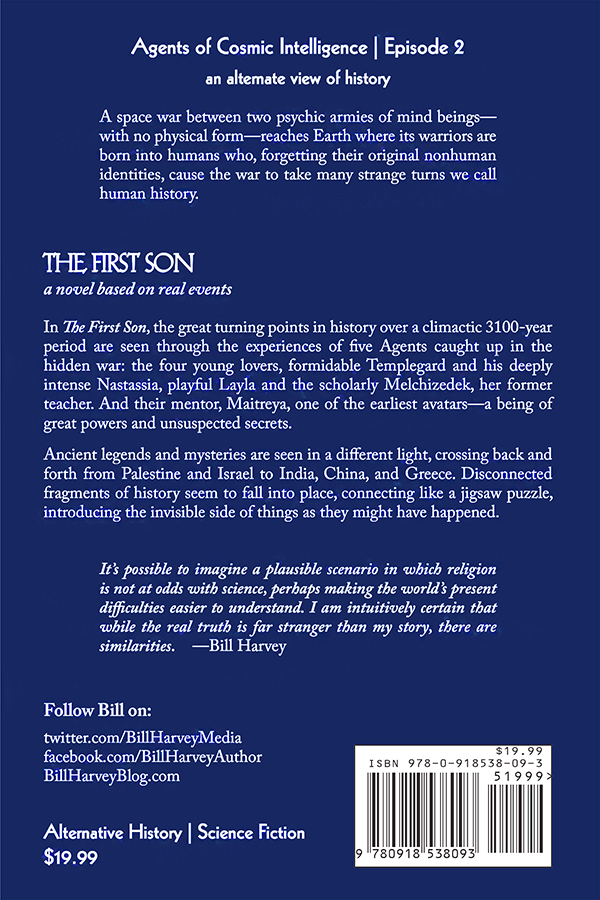
Just as with my nonfiction books MIND MAGIC and YOU ARE THE UNIVERSE, my intent in THE FIRST SON is to free the consciousness of the reader from habitual thinking and feeling. Sharing with you here my hope for the effect that reading my new sci-fi alternate history novel will have on its readers.

The First Son by Bill Harvey

Click the book to read about my first novel.

First of all, I hope the reader will be drawn into the characters and their love for each other. THE FIRST SON is like a family drama in a way. I’ve spent years working to make each of the characters three-dimensional and alive.

Almost as important is the visceral realization of the heroes’ dilemma. If you don’t get the trouble the heroes are in, or don’t care which way it comes out, I haven’t succeeded in really immersing you in the story, in which the whole multiverse is threatened.

At some point in THE FIRST SON story’s unfolding, I hope the reader experiences a shift, recognizing the subtle differences between the traditional historical account and the alternate perspective of the story, and gets the feeling that either way of looking at these events could be true. I am also hoping that the underlying thrill of history itself becomes part of the reading experience. The mystery of history—the fact that we don’t know exactly what really happened, and have always been just trying to piece it together.

A great deal of the action involves beings taking over each other’s minds, which is a metaphor for the way we continually hijack our own minds and feelings. The way psychic agents in the story protect themselves from takeover is the same advice I give in MIND MAGIC, morphed into fiction. I’ve found that one has more ability to discipline one’s own mind and feelings if a lens of defending oneself against an outside adversary is used. Readers will let us know the degree to which the novel has this effect of increasing self-mastery.

The most important cognitive/emotive shift THE FIRST SON hopefully creates is the opening of the reader’s mind to the possibility that science and religion are entirely compatible, and that what we call religion came out of visionaries who had psychic powers that are at the heart of all religious experience, what Freud called “the oceanic experience”. This can manifest as Flow state, being taken over by a benevolent and super-competent higher Self. It can manifest as speaking in tongues, channeling, shaking/quaking, dervishing, the Subud Latihan, oneness, mind reading, precognition, bliss, chills up and down the spine, hair standing on end, crying with happiness, laughing at a suddenly perceived cosmic joke, and other phenomena associated with all religions in one form or another.

In our culture today, these phenomena have been assigned to a sort of   by many people, and are not given much serious attention. By turning our backs on the most important questions in life and in history, we diminish ourselves. The wiser course of action is ours for the taking.

I have high hopes, as you can see.

Most of us would like to make at least a small contribution to making humankind less warlike, greedy, and unkind, and more loving and peaceful. Each day many of you readers are doing your best along these lines. We have to try new ways to achieve these important ends. THE FIRST SON is my current offering to this end. I hope you enjoy the journey.

One experience I know you will enjoy is listening to Paul Harvey’s brief and inspired A Letter From God.

In similar spirit to THE FIRST SON, except where Paul says we can never understand The One Self Inside Us All, and where he says that The One Self never speaks with us individually.

All my best,

Bill

Follow my regular media blog contribution, “In Terms of ROI“ at MediaVillage.com under MediaBizBloggers.

A More Alert Reaction

Just one of the benefits of Observer and Flow States

Originally posted March 1, 2012

 “A word to the wise is sufficient.” Confucius may have said this. The same conditions causing Acceleritis™ also reward those of us who can spend some time in the two higher states of performance. In the sped-up culture that continues to accelerate, we are more successful if we can extract learning and act on it quickly without delay.

The techniques, which we call psychotechnology, to help us stay in the Observer and Flow states therefore become important to learn and put into practice.

The wise are able to learn from a single experience without repetition because they are counting the cards. In the same sense that Captain Picard would say “more power to the shields”, the wise person has wordlessly said to himself/herself, “more power to observation”. This is why we say the entry into Flow state is through the Observer state.

It’s easier to turn on the Observer state than it is to just decide to turn on the Flow state.

The Flow state is a delicate balance of many variables. Having prepared by practicing being in the moment, not being attached to how well you perform or to anything else, being in the Observer state, having your skills in some degree of close balance with the challenge slope of the moment — these all must click for Flow to engage.

For the Observer state to take you over, there are fewer requirements. You must be single-pointedly focused — intensely following the thread of what is going on in the now, including and especially in your own mind and body, but equally in the “external” world. You must be intellectually honest with yourself, objectively critiquing your own last thought and feeling. You can’t critique what you don’t notice and so you are paying such close attention inwardly and outwardly that you are catching every inner impulse. You are bringing into your conscious awareness some of what would normally pass by subconsciously.

Getting into these “altered” states of consciousness is a “yogic” process — it is exactly the same kind of process one goes through in order to gain control of normally-involuntary muscles in the body, except in this case they are normally-unused “muscles” of the mind.

Some of what the Human Effectiveness Institute has rediscovered can be found in ancient Raja Yoga and Karma Yoga texts. I found it there years later, having discovered Flow state on stage at age 4 in the Catskill mountain resorts (then in their heyday).

An early experience worth sharing is one in which my Flow was so in the moment that I was unable to hear or even later remember the words I had adlibbed that got such huge laughs. Here’s an excerpt from a memoir I wrote for my Dad, bandleader and MC Ned Harvey:

Fat Jack was considered to be the hippest comic in the world by the denizens of the Borscht Belt. Jack E. Leonard was an insult comedian who may have created the genre. Don Rickles was next in the insult comedy lineage.

Speed and cleverness were the two main criteria. Fat Jack could backhand a comeback over the net even before the incoming line had ceased to echo in the air, and his riposte was both unpredictable and used the raw material of the incoming line. This was the stuff of genius.

Later I would think in terms of the terabytes per nanosecond of computing speed that would allow Jack to search his files, put together alternative combinations, and select the optimal response.

We were in our room in the Frat House, under the canteen…

In the room besides Ned, my mother Sandy, me and Fat Jack were a few other musicians and Bernie Klein the stage director. Jack was holding court and the other adults in the room were convulsed in spasmodic laughter. I was silent and missing a lot of the humor. I was maybe 5 years old.

For some reason Jack singled me out with his gaze and threw me a line. Then something weird happened — something that had never happened before.

I said something back and after an instant’s shocked silence the group broke up in surprised laughter. I was not able to hear my own voice. I had no idea what I’d said.   

Jack smiled too but threw me back a clever counterpunch that I also couldn’t hear — I answered him in the same voice that everyone else but me could hear. Again my line got a big laugh, bigger than the first. This went on for a while.

When it was over and the conversation moved on, I began to be able to hear again. Jack gave me a sweet goodbye, not characteristic for him. I had no idea what had happened.

There are levels in Flow we have written about here before. The level at which one is so sewn into the universe that subject and object merge, and there is no inner rehearsal — this is the level where it’s possible to eject words so effortlessly one cannot later recall what they were. The first words are not checked in any way and are just allowed to flow through motor control without a second thought as to result or risk. This has only happened to me one time since, with the same audience appreciation. The great standups did it almost every night.

Incidentally, “don’t attempt this at home” as they say on TV gator domination and hotdog skateboarding crash shows. Don’t run off at the mouth trusting that it will be Flow. Actions should be in the opposite sequence: first sense that you are in Observer state and then when you are in Flow state. Only then can you loosen the valve on top of your mental stream of consciousness as a firehose without embarrassing consequences.

The standard state of human consciousness in all industrialized cultures has as one of its aspects the psychic spark gap between the thought of what to say next and the act of saying it. That distance is enough to take the average person at the average time out of Flow. However, using Fat Jack as our above-average model, he might have had an inkling of what his foil was going to say next, so Fat Jack might have had a split second to forethink an answer and another split second to do a gut check before he was delivering the line with perfect command of his voice.

Flow neurology will be very interesting to study. There is a significant speedup in the thought process and ability to see one’s own mind (thoughts, feelings, images) clearly.

Let there be no miscommunication: we are not recommending that you say the first thing that pops out of your mouth. Definitely wiser to not interrupt. Wait for the moment and then if you have something significant to say, say it, letting yourself have the added time to refine and challenge whatever it is you think is worth saying next.

You and the people in your team don’t need to get to such levels of Flow in order to vastly increase the efficiency and effectiveness of your operation. (And obviously it would not be helpful to have no memory of what you’ve said.) Everyone else being in EOP most of the time, if you can move yourself and your people up to spending a quarter of work time in Observer state, you’ll be in the top percentile of high-performing teams, analogous to a winning sports team and elite paramilitary units.

What you want are sensible procedures for instilling this level of alertness.

Here are a few starter steps:

  1. Share the model of EOP, Observer, Flow. Present it as a model, a construct, a lens, a useful fiction, a stimulant. If it is later scientifically validated, that’s great, but for now the thing is to test and observe results. The only reason we founded the Human Effectiveness Institute is because in our experience the techniques we share are useful in increasing innovation and success.
  2. Create an atmosphere where there is nothing to fear. Support people when they make mistakes, while correcting them in good spirits and being on their side.
  3. Take side notes to keep the mind clear of distractions. Ultrabrief one- or two-word trigger phrases that will remind you of the thought or feeling. Stay observant and connected in the now, with the inner/outer attentional focus described earlier in this post. Share this technique with your team as well.
  4. Reset all beliefs and expectations back to zero, except for agreements and dutiful obligations. Reconsider all possibilities. Erase assumptions. Especially the hidden ones. Root out hidden assumptions and expose and neutralize them.

Here’s to more alert reactions, and to even more anticipatory and effective pro-actions!

Best to all,

Bill

Follow my regular media blog contribution, “In Terms of ROI“ at MediaVillage.com under MediaBizBloggers. Read my latest post.