Author Archives: Christine Niver

Leading Neuroscientist Confirms Theory of Bio-AI

Welcome to this week’s Bill Harvey Blog:  July 19, 2024

As I was growing up, I was constantly studying my own mind. This was natural to me and then it was accelerated by my experiencing Flow state, mostly during some stage performances starting at age four.

I didn’t have a name for it other than describing it as “perfect performance as if doing itself.” There were other attributes I didn’t talk about because I knew they were taboo, such as the feeling that these experiences were otherworldly and suggested “magic” or the “supernatural”, which I repressed as I had decided that science was everything and that religion was merely superstition. I eventually revised the latter decision based on experiencing the spiritual level of Flow state.

I wanted to regain the “perfect performance” state and maintain it all the time. This motivated me to pay even more attention to what was going on in my mind at all times, and to relate that activity to the external world experiences I was having at the same time. I sought to relate states of my mind to the positive or negative feedback I was getting from other people and things.

The first “validation” that this strange “perfect” state existed came when I confessed my experiences to my favorite comedian of the era, Jack Carter. He said, “Oh sure, Billy, everyone in show business has that sometimes, it’s called ‘being on’.”

Mihaly Csikszentmihalyi coined the term “Flow state” when he studied the phenomenon as head of the psychology department at the University of Chicago. His first published work on the subject came out in 1975.

My first published work was written in 1972 and its subject matter was what I had learned about the states of my mind. It came out as the book Mind Magic in 1976. Throughout the book I referred to a part of the mind as “the robot”. This was the part of the mind that generated some of my actions that yielded the most negative results in the external world. The robot I had deduced was keeping me out of the “perfect” state (Flow state).

I knew that this automatic part of myself was making predictions. The following passage appears on pages 48-49 of Mind Magic:
MIND MAGIC by Bill Harvey“When you are about to see something, your mind automatically searches your memory for a comparable object (note the distinction between you seeing something and your mind having already seen it). If your mind finds something similar enough, it projects the stored image onto the new object so that you do not ever see the new object, but are merely dimly aware that there is a familiar type of object there… As a result of this, you mostly do not perceive your environment, instead perceiving mostly what you expect to perceive, i.e. you usually see your mind’s prediction.”

The term “artificial intelligence” and its abbreviation as “AI” appeared in 1955 in a project proposal by John McCarthy, Marvin Minsky, Nathaniel Rochester, and Claude Shannon. I became aware of the term as an avid sci-fi reader and began using it in my own sci-fi writing in the late 70s. In 1979 I formed one of the first neuroscience companies in the marketing field (Psychophysiological Research Management, PRM), partnering with Dr. Richy Davidson and Dr. Dan Goleman. Sometime thereafter, I began to use the term “bio-AI” as synonymous with “the robot”.

In 2002, Dr. Karl Friston published his first work on “active inference” in which he proved the existence of the prediction engine in the brain which I had introspected in myself a half-century before it became scientifically recognized. Friston’s work with many other scientists has identified the prefrontal cortex as being involved in the automated calculations often occurring below the level of consciousness. That suggests we have only had the bio-AI for about 200,000 years, for that is when the prefrontal cortex appeared.

After William James, psychology had become disenchanted with the use of introspective evidence, because of the tendency to bias and inaccuracy. However, the fact that in modern times an individual was able to predict science decades in advance by the careful use of introspection, strongly suggests that introspective evidence be reconsidered as a tool of psychology.

A few pages later in Mind Magic on page 53 it says:

“…society communicates expectations to you which you then see in place of seeing the realities themselves.”

This theme recurs throughout the book, emphasizing that cultural biases are conditioned into the bio-AI. This explains why brainwashing by social media, media “news”, parents and peer pressure is so powerful: it slips into the bio-AI inference engine below the level of consciousness.

We as a species are at a crossroads. The pro-survival bio-AI which enabled us to evade superior predators 200,000 years ago today often functions as contra-survival, as I discovered as a child by allowing my automated reactions to play out in the real world, which often resulted in negative results. The chaos into which the entire world has fallen today, to me, points to the urgent need for rapid widespread education of a new kind, teaching people how to bring decision making into the sphere of the conscious mind, what I call metacognition (term coined by John H. Flavell) and my partner Dr. Gerald Zaltman calls open-mindedness.

My interests in introspection and in neuroscience are connected to one another. My life’s work is to make the connections between the discoveries of neuroscience and the subjective inner life of the individual that will enable science and education to work together to cause most human beings to be able to spend most of their time in states of metacognition/open-mindedness and Flow. If we as a species can accelerate this process of what I call “psychotechnology” or “microcosmology” we can deter the drift back into the self-administered Feudal slavery of inviting “strong men” to take over our governance and protection. It’s never too late.

We all know how difficult it is to control the mind, to master oneself. Socrates said, “Know Thyself,” and Plato said, “I still do not know myself, so why would I spend time studying anything else?” (Phaedra) The only control panel or dashboard life gives us for achieving this task is the user interface (UI) we call the mind. The conscious mind experiences “qualia”, subjective experiences within consciousness, including words, images, snatches of memories, and especially feelings. We have control over certain things through this UI. We can choose to slow down our breathing, engage in positive imagination, question our attachment to certain outcomes, use reasoning and evidence, and these and many other tactics are within the sphere of our control. In this introspective world, we have the only chance we will ever get to solve our problems or to see that they are opportunities. Therefore, we cannot Behavioristically study only structure and function of the brain, we need to relate events at the physical level to the qualia at the mind level, or else we lose the value of having that control panel inside.

My best to all,

Bill


Live chat with my avatar now.

Be Your Better Self

June 14, 2024
Welcome to this week’s Bill Harvey Blog

Life rushes at you from the first moment. You never can quite catch up. There are always things that you remember later that you forgot to remember for long periods of time. You learn to live with this. You come to accept that things arising within you that seemed very significant for a moment can get lost inside you.

It’s the things that really get to you hurtfully that you cling to. These are the flashing red lights on your inner dashboard and you obsess about them for hours or much longer until you finally come to grips with them in one way or another. When you find the inner method that works to put the hurt aside you keep using it even if you’re not quite sure how you did it. As long as you remember the inner attitude, the inner face you put on to yourself that enables you to shut the hurt away, that’s all you think you need, a little strange inner anesthesia you somehow instinctively come to discover and use. You never even imagine you might actually be able someday to figure out how you yourself work inside.

As you grow up things become a little clearer to you, to the degree that you actually pay some attention to your inner life. This is of course what we now, thanks to Dr. John Flavell in the 1970s, call metacognition.

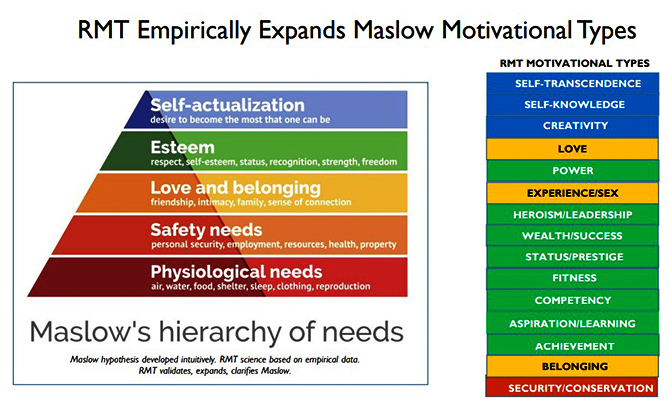
Dr. Abraham Maslow never actually conducted empirical research and experimentation in order to come to the magnificent intuition of the hierarchy of needs. He might have come across the ancient India chakra system of seven levels which is highly reminiscent of the hierarchy of needs (which originally had five levels and later in his life he added the spiritual sixth level).

What research he did was of the lives of self-actualized people, others like himself who had graduated from being motivated mostly by the esteem of others and self-esteem, to what he called the level of self-actualization, relaxing into the playful outward flow of inner creativity coming from the soul of the individual’s being, simply letting this happen without having any specific outcome goal for where it might all lead, the doing of it being fun for its own sake, autotelic as Mihaly Csikszentmihalyi called it, simply doing something for its own sake.

Maslow also studied himself very closely. He was expert at metacognition, introspection with concentration, meditating on himself. This and studying the lives of other self-actualized people like Einstein and Freud was the way he came to his towering insight into how what drives us evolves as we mature, if we do.

His focus was on motivations, needs, the drivers which are the causes of our behavior, the reasons why we are attracted to X and repelled by Y. And how this magnetic setting shifts over the course of a fulfilled lifetime.

Piaget was not looking at motivations at all. His interest was into the way our use of our cognition apparatus shifts as we go through childhood into adulthood.

Long before I came across these amazing teachers, I was obsessed with studying myself and both what seemed to drive me and how I was using my inner tools. I figured out a lot of it and then started to see that others, like Maslow and Piaget, Csikszentmihalyi and Freud, Jung and Epictetus, and so many others, had come before me had already figured the same things out the same way.

In my outer life, about 25 years ago, while introducing the first set top box data to research standards (measuring the TV audience via the cable/satellite box), I discovered 265 psychological variables which appeared to drive 76% of our television program viewing choices. Then, about five years ago, I was studying those 265 variables and I began to see how I could cluster them based on the semantic proximity between certain words and concepts, first into 86 clusters I called Need States, and then into 15 superclusters I called Motivations. Once I saw the 15 Motivations I realized there was a great unexpected relationship with Maslow’s hierarchy of needs:

Maslow Motivational Types - hierarchy of needs

It appeared that whereas Maslow got to the hierarchy of needs by a “top down” approach, we had gotten to the same place by a big data “bottom up” approach. Our bottom-up approach resulted in finding more granularity than Maslow had posited. There was not a single level of esteem, there are several levels of esteem, and also a few levels of self-actualization, and so on. Maslow’s progression inspired the way I present the 15 levels, the sequence in which I envision individuals grow into higher and higher levels of motivation. But what do I mean by “higher”? I mean “more noble”.

Looking at the 15-level version, we can see that the top four levels are different than the eleven lower levels. The bottom eleven are all about taking care of oneself, whereas the top four are also about taking care of others, and are therefore more unselfish, noble, ethical. The highest of the 15 levels which I call Self-Transcendence (and is the sixth level Maslow added toward the end of his life and called the Spiritual level) is the fullest realization of this nobility.

When I say in the title above “Be Your Better Self” what I am saying is —

Be aware of what drives you, and when you can see that it is all of these 15 things but to varying degrees and not always the same weight given to each level, you will realize that you have control over what drives you.

You can catch yourself doing something which you are doing simply to gain status/prestige. Do you want to be someone who is driven by that not-so-lofty goal?

Taking control of your own drivers was given the name Self-Metaprogramming by John Lilly, in a conversation with Oscar Ichazo in the 1970s.

Once you take responsibility and control for determining your own motivations consciously, a flow of ideas begins to open up between your conscious and your subconscious – more of your subconscious is now conscious. The yogic tradition believes that ultimately it can all be conscious, with nothing left below the level of the conscious mind. This is what enables advanced yogis to control even autonomic functions such as metabolic rate. For the definitive analysis of the most advanced states of consciousness read Daniel Goleman’s classic The Meditative Mind: The Varieties of Meditative Experience.

As you exercise conscious choice over your drivers, choosing to be driven by the highest motivations, more of your true essence will come out, and the influence of others which built the superfluous superstructure in your mind will recede, you will enter Flow state uninfluenced by the many distracting and contradictory inner voices and concerns about the lower motivations.

We are today at a very unique moment in history where much of human consciousness across the planet is dominated by pessimism, fear, anger, and hatred. And yet most human beings continue about their way doing little acts of kindness for each other every day. The pervasive mindset of world terror doesn’t seem to notice the supply of inner goodness we all keep demonstrating, because if it did notice, it would make the pessimism seem less justified.

Pessimism is its own punishment and it increases the probability of the feared scenario coming true.

When you are your better self you do notice and appreciate the goodness in us, and thereby you bring it out in all of us you connect with.

Give up the hatred of the people in the political party you abhor. They are just people like you.

George Washington warned us not to go with political parties at all. He said they would tear us apart. Let’s listen to his advice and stop making political parties the dominant game, they are just one aspect of the way we self-govern today, and maybe we’ll evolve even better ways to heed the first principles on which our nation was founded.

Recognize that anger and hatred inside is coming from your superfluous superstructure which was conditioned into you from the outside, and seize the moment to override the superstructure from the core essence of your own individuality and beingness. Both anger and hatred are permutations of fear which the superstructure of our mind finds more acceptable than fear. But giving in to such shallow mind games is to let oneself be run as if by autocompletes in a robotic coping system that continues to paint over the divine core of our being.

Choose to bring out the best of yourself. Focus on the top four levels of yourself. If something else bubbles up from the lower levels, don’t express those things right away. Give yourself time to decide about them before sharing them with others. Only express what will be constructive and uplifting.

My best to all,
Bill


Live chat with my avatar now.

Superfluous Superstructure of the Self

June 7, 2024
Welcome to this week’s Bill Harvey Blog

We all pay some attention to our inner lives. But for some of us this means sustained micro-observation and for most of us it is occasional flashes in between slavish addiction to the endless rushes of information coming in through our five fascinating physical senses.

This tsunami of infobits roaring in has itself escalated over time, causing even more outward focus.

But even 2500 years ago, Aristotle made the same observation, commenting that the unobserved life is not worth living. He was trying to get more people to turn inward. His teacher’s teacher Socrates had started the whole thing by his exhortation “Know Thyself”. (Socrates had inspired Plato with whom Aristotle studied.)

The greatest philosophers and psychologists of all time were all practiced at inner micro-observation. This was especially true in ancient India, and for example, metacognition is at the core of Buddha’s teachings. In the modern era this includes William James, perhaps the best of them all at concentrated introspection, as well as Carl Jung, Sigmund Freud, and Abraham Maslow. Freud however was more of a rationalist, deducing things logically, whereas Jung was more of an intuitionist, taking the original feelings arising in his cognition without embellishing them with rational overlays as much as Freud did.

A long time ago by introspection I realized that thoughts do not arise as thoughts but as feelings, and then the cognitive affective processes embellish those feelings with attributed meanings, interpretations, often involving images, metaphors, and words, at which point they are truly what we all call thoughts.

This has recently been discovered by science, decades and millennia after the same insight was available to each of us by micro-inner-observation.

It will help you attain metacognition to imagine that your inner space has a map. At the pure core of your being imagine that you have a center, something like an energy or a gas, that you can sense. In higher states of consciousness such as the spiritual level of Flow state you can see this self of yours as light, often bluish. Most of the time you can only feel it.

Imagine now in this map that there is another part of yourself that you yourself have built over time, a superstructure that is overlaid on top of the central sphere of your selfness. Suspend disbelief for the sake of argument, and for the moment consider my theory that this part of you is akin to an artificial intelligence (AI) that has a physical underpinning of neurons and their interconnections in your brain and nervous system, specific neurons and interconnections which were caused by your experiences, especially where there were degrees of emotion and assimilated “learning”. The word “learning” is in quotes because much of this was mis-learning.

The entire superstructure taken together corresponds to what Freud termed the Ego.

This superstructure uses a substantial part of your mental energy but the return on that energy investment tends to be negative. The expenditure of this incremental cognitive load tends to do you a lot more harm than good.

Freud said that this appurtenance was called into being when the baby first experiences frustration at not getting what it wants or needs. It functions as the security officer (Worf in Star Trek) and press agent, business manager, negotiation agent, sales rep for what Freud called the Id, and I refer to above as your core beingness.

The reason I say Freud was more of a rationalist is that when I introspect into my Id or core essence self I do not find the animal selfishness and limitation to hardwired instinct that Freud said I would find there. Instead I find a happy lightness of being that is not needy but is caring and fascinated.

Try this experiment and I feel that you will totally get what I’m saying and can add it to your personal strength arsenal.

  • Take your place in your core, the pure witness, the observer.
  • From that vantage point, simply observe the feelings that arise in your superstructure.
  • You will sense the apparent duality in you at that point, probably a realization of your own indifference and yet interest in these ego feelings.
  • This higher feeling is the most important key to metacognition.

You may have experienced this many times in your life, and it may have come about by temporarily hitting bottom. When you have been pushed around by life and have not seen the lesson the universe intended, you may in your frustration, resentment and rage just say to yourself that you give up, you just don’t care anymore.

When this happened to Bucky Fuller – heartbroken by unrequited love – he decided to commit suicide. Once he did that he was in his core self, looking at all of the superstructural self he had built, disillusioned in a good way by all that stuff, having just given it all up. He now discovered no reason to end his life, for a new better version of it was just beginning. He then became the Bucky Fuller genius we all remember.

You can practice this core self-perspective any time you want, for a few seconds or minutes or extended periods, even continuously for the rest of your life.

The essence of the feeling is that you are above all the nigglings in your superstructure. It’s only habit which has made you so vulnerable to those sudden feelings of worthlessness, fear, anxiety, defeatism, hatred, envy, resentment, and so on which have become automatic and super powerful.

Habits reinforced by hundreds of thousands of repetitions in your life do not pack up and go away right away. They will sometimes come back and even overpower you sometimes. But once you have learned to identify with your core and not your superstructure you are on the high road to true freedom. Keep practicing this Observer state and you cannot lose.

My best to all,
Bill


Live chat with my avatar now.

Interconnectedness

May 31, 2024
Welcome to this week’s Bill Harvey Blog

God bless Jerry Zaltman. In my May 17th blog post, I reported that Harvard’s pioneer neuroscientist who introduced the field of subconscious measurement by his creation of the patented ZMET system, is joining with me in a project to introduce methods in schools for thinking more constructively, objectively, clearly, and creatively. In laying the groundwork for this project, Jerry is finding that others are already moving in the same direction, which is inspiring.

Today I received notice from Jerry of a new paper in the Journal of Education for Business  – Mental health among college students: Relationships with Actively Open-Minded Thinking, Spirituality, and Psychological Wellbeing – by educators at two US state universities, Arkansas and Idaho, which proves that:

“Mental health, like many other physical diseases, can contribute to a significant loss of output in our economy. Higher education institutes can play a significant role in enhancing the mental wellbeing of college students. In support of this endeavor, this research investigates how actively open-minded thinking (AOT) and spirituality (SP) relate to psychological wellbeing (PWB). Data revealed that both AOT and SP have a positive impact on most dimensions of PWB and in some instances, SP acts as a moderator. Our study highlights the importance of SP in the PWB of college students.”

One might wonder how spirituality being taught in public and state schools jibes with the separation of church and state. This paper however addresses spirituality at its core essence as a feeling and as a concept of interconnectedness. The spiritual feeling an individual has is that person’s sense of being connected with others, and possibly even with the universe itself. The Founders who insisted on freedom of religion would probably not deny the teaching of this concept and the feelings that surround it.

In the paper, the authors compare spirituality in this meaning to holistic thinking, starting from the big picture of how a specific subject is connected with other subjects, before drilling down to a micro level within that subject of interest. In this they consciously align with what they call the Eastern philosophical approach, contrasting it with the Western approach of starting from the micro level and studying a subject and possibly never getting to seeing the connections between that subject and all other subjects.

Back in the 70s, someone came up with the idea of adding one more level to Piaget’s model of the evolution of human cognitive processes, Systems Stage, which would appear above Formal Operational Stage in the model. This is where holistic thinking comes in, seeing everything as part of a single interconnected whole.

Prior to that the term “Systems Thinking” was coined by Professor Jay Forrester in 1956 when he founded the Systems Dynamic Group at MIT’s Sloan School of Management.

The idea that we are all interconnected was reintroduced in a new way in the modern era by one of Piaget’s influencers, Carl Gustav Jung, who published the idea of the Collective Unconscious in 1916.

Today in the Standard Interpretation of Quantum Physics it is recognized that particles become entangled by association with one another and after that they are able to share information instantaneously regardless of the distance they are apart.

This lays the groundwork for physics to one day include the entanglements of consciousness as part of its quantum entanglement theory. John Wheeler has already established a framework for including consciousness in the quantum physics model, called the Participatory Anthropic Principle (1983), which Stephen Hawking referenced and tacitly endorsed in his final book.

This Principle explains that consciousness, which observes, transforms non-determined probability waves into concrete realities by its act of observation. In my book A Theory of Everything Including Consciousness and “God”, I carry Einstein’s, Wheeler’s, and Hawkings’ ideas further by speculating that a single consciousness is all that exists, and that one of the ways it operates is to “look out from” a multitude of apparent selves (all of us including everything in the universe), and that Wheeler’s Quantum Foam is the substance of that Original Consciousness.

Science consists of theory and experimentation. Experimentation is the way that theories are proven, altered, or disproven. One wonders what sorts of experiments could be run in order to study the relationship of consciousness to quantum physics.

Another brilliant neuroscientist and perhaps the first of the neurophysicists, Dr. Richard Silberstein, is the first to carry out experimentation into the possible quantum entanglement of consciousness.

Science Explores Telepathy from a New Angle

Robert A. Heinlein wrote many great books, one of which is called Time for The Stars. The story is about achieving interstellar travel but needing a way to stay in touch with Earth, a method that is not limited to the speed of light, because when traveling light years away, messages would take years to go back and forth, which is not conducive to providing learning to the people at home.

In the story, the solution found is that some identical twins are able to telepathically communicate with each other, and that these messages happen instantaneously regardless of distance.

My great friend and highly respected neuroscientist, Dr. Richard Silberstein, never read that Heinlein novel. But he got the same idea. He read scientific papers which led him to have the idea. Having invented and patented an improved brain measurement system (steady state tomography, SST) he applied that method (commercially available through the company that Richard founded, Neuro-Insight) to conduct an experiment with monozygotic (MZ, coming from a single egg, “identical”) human twins.

The experiment was written up in the respected neuroscience journal Frontiers in Neuroscience paper published about a month ago.  There is now strong statistical evidence that information was transmitted mind to mind in a significant number of cases within the design.

If and when science was to announce that telepathy is real, that too could have a potentially positive impact on the moods and emotions of the masses.

It would say —

We can be more than we think we can be.

Here’s a ten-minute video piece on Connectedness: Sanity Is an Acquired Taste: Connectedness

My best to all,
Bill


Live chat with my avatar now.