
Tag Archives: Vedas

Positive Thinking + Mindfulness = Mind Magic

Volume 3, Issue 23

People are always saying to me, “Bill, you’re one of the most positive people around.” While I take it as a high compliment, I am always thinking “How do I convey that positive thinking is not enough?”

Positive thinking is one of the cornerstones of success, Zone level performance, ability to withstand and meet challenges, ability to be happy… it is necessary but positive thinking alone is not sufficient to achieve all these things: there is more to psychotechnology.

The other cornerstone is mindfulness. The two main threads running through my book Mind Magic and through me might be summed up as combining those two mind techniques. That would be reductionism but it would not be way off base.

The thing about positive thinking is that it’s an idea all of us know by now, and it is not easy for most people to practice it. Many of the books on the subject exhort people to think positively and prove why it is important but they don’t tell the reader how to stay positive in the face of perceived threats, disappointments or other mood negators.

Actually achieving and maintaining a state of positive thinking as the natural equilibrium of the individual requires a number of component accomplishments including the toning down of excessive attachment to specific outcomes.

I didn’t set out to be a positive thinker. A philosopher by nature, like all children I wondered about everything, I just wondered more systematically, and in a bulldog fashion. I really wanted to figure things out. The positive thinking came along with a lot of other discoveries.

As a philosopher I am attracted to pragmatism. This moves the mind toward positive thinking as a side effect. From a pragmatic point of view, one does not start with positive thinking, but with questions as to what is our goal or purpose, and then what means will get us there. In the context of pragmatism, anything but positive thinking is an obvious waste of time and energy; negative handwringing for example is staying in the problem definition phase when it’s time to move on to the solution phase.

Having been led to positive thinking via pragmatism, I was then able to see the value of projecting positively, pre-visualizing positively, and communicating positively as simply more effective at achieving goals. I didn’t do those things out of a belief in thinking positively, but because I saw that they worked.

It might be more accurate (and less reductionist) to say that I took the best things I saw in all philosophies to bake my own philosophy. Pragmatism, operationalism, the stoicism of Epictetus, Hemingway’s fatalism, the Vedas, Kabbalah, Taoism, Buddhism, John Stuart Mill’s “greatest good for the greatest number”, and Zen (with apologies to all the others not mentioned for space/time reasons).

Still, pragmatism runs deep. What am I trying to accomplish? It sometimes can be simply to have fun — fun being conducive to the Flow state. Encourage the development of long-term goals to help people supervene short-term goals. What can I control and what must I accept? Non-attachment to outcome is key. Take the right action and let the chips fall as they may. Pre-visualize success.

Positive thinking is a corollary of pragmatism.

Mindfulness is something else again and another necessary component though insufficient without positive thinking. More on mindfulness in the next post.

Best to all,

Bill
Follow my regular blog contribution at Jack Myers Media Network: In Terms of ROI. It is in the free section of the website at  Bill Harvey at MediaBizBloggers.com. 
 

Doing Is Just One Way of Being

Volume 3, Issue 17

Effectiveness peaks in Flow state when the mind/body duality collapses and everything is One — the Zone. One of the obstacles to this condition is the predisposition that one must always be doing something.

This “Doing” hidden assumption has deep roots: the Work Ethic and industriousness virtue we were taught, the sense that while others are suffering one’s duty is to never stop searching for solutions, the inforush that has been accelerating since the cave paintings (which I call Acceleritis), the caffeine culture, the systemically out of whack mounting economic pressure, the TO-DO List that is never done, the admiration we feel for people bouncing with energy. Although the situation has been pandemic for millennia, it is so pronounced in Manhattan that New Yorkers traveling anywhere else sense everybody else as too laid back.

The first serious recorded psychology on the planet (the Vedas), which was set down some 3500 years ago, not long after the beginnings of Acceleritis, noticed this tendency as one of the three qualities of being, Rajas, the addiction to action (vs. Tamas, the addiction to rest, and Sattva, the addiction to knowing). The Vedas called these the three qualities of existence rather than using the negative term “addictions”, which is the author’s own perspective. This perspective sees anything deviating from pure observation, as a motivational drive, which only in the extreme literally becomes an addiction.

The good thing behind the Doing state of mind, beside often good intentions, is that there is a wellspring of creativity bursting to be channeled outward into something. One might be extremely grateful finding this creative drive inside. The point of this post is that the channeling of this drive is a science and an art to study and, yes, at certain times, control.

Being able to hold back the impulse to Doing confers the Observer state. The Observer state is the access portico into the Flow state, and it is easier to willfully switch into Observer state than it is to flip oneself by act of will into Flow state directly. Catching oneself assuming that one ought to be doing something, and arresting that assumption, is one of the easiest ways to get into the Observer state. Here is an exercise. More on this in our next post. 

Best to all,

Bill 

PS — New York tri-state area theater lovers, if you can, go see “The Outgoing Tide” at Ellenville NY’s Shadowland Theater. One of the most moving experiences on or off Broadway. Ends run in just a few days, June 16.

Follow my regular blog contribution at Jack Myers Media Network: In Terms of ROI. It is in the free section of the website at  Bill Harvey at MediaBizBloggers.com.

Entering and Sustaining Flow by How Much of the Mind Is Cooperating at One Time

Volume 3, Issue 4

Continuing our theme of recent posts, we are contemplating and “unpacking” Buddha’s root notion that mindfulness plus comprehension is the one route to true human happiness.

And we are relating that notion to our theory of Holosentience, wherein the brain and mind operate most perfectly and effectively when the sentience, or self-awareness, gathers itself into a wholeness exclusionary of nothing — when the selfness is so complete it disappears into absorption with the wholeness of experience in the now.

In earlier posts we posited that the physical brain is in Flow state (the Zone) when all parts of the brain are contributing and processing harmoniously. Below Flow in perfection is Observer state, where the self has a degree of objective detachment from its own emotional and cognitive arisings. In this state the prefrontal cortex is postulated to be in control though the whole brain is not yet in synchronistic action. These hypotheses are not yet supported by conclusive evidence.

Below the Observer state is what in the last 6000 years of recorded history has been called the normal state of waking consciousness, which I judge to be a state of brain process division far from Flow, and which I attribute to the information overload produced since written language was invented. I call this phenomenon Acceleritis. This lowest mental state I call Emergency Oversimplification Procedure (EOP) meaning that the mind is cutting corners to get things done despite being overloaded, overwhelmed, torn into warring bits, and confused.

Mindfulness is a word that has the connotation of striving for itself. The word has been used going back to the Vedas (the term is again on an upswing) as a tool to remind the seeker that he and she must remember to be mindful, to pay attention — but to what? To both the events around and outside oneself, and the ones inside. At the same time. “Inside” and “outside” both being constructs of the mind. In effect, “mindfulness” is the trigger word for the Observer state — a mnemonic device to remind oneself how to get out of EOP.

For my entire lifetime I have had the intuition of a common natural evolution of mindfulness and comprehension that is accessible internally to each of us. We don’t need outside inputs to discover it. So I have spent most of my life unpacking that intuition into communicable language. And articulating the intuitive cookie-crumb trail that is leading me myself back from EOP into Flow. In doing so I intuit myself to be reiterating the communication of the psychotechnology that resides within each of us, which others throughout history have also communicated, using language more common to their times, and often using metaphors when explicit language was challenged by a lack of models. Living today I have the advantage of the existence of models of information processing that are for the first time in history ideal for articulating what goes on experientially in our consciousness, since in our theory consciousness is an information processing system.

To be continued next week, with more techniques for attaining Observer state and making the transition to Flow.

Best to all,

Bill 

Dial Back on Arousal to Reach Highest Performance

Volume 2, Issue 3

Science verifies the Vedas, Tantra, Qabala, and other ancient ideas

Hope you’re enjoying the new “2-minute read” format.

Thousands of years ago, individuals who trained themselves to be introspective all learned the same wisdom about the mind, in Greece and Egypt as in India and elsewhere. I’ve also rediscovered those bits of wisdom in a lifelong self-training to be an objective introspective observer — so as to really learn things and not just prop up my own ego, as we are all mostly forced to do by the information overload pressure that all too often sinks us into EOP.

The ancient wisdom even more applicable in today’s accelerating culture says that if we care too much we ruin it. Whatever “it” is. The word “attachment” is the meme of this wisdom, the gene from which a Pandora’s Box of linked ideas emerge.

Some became Buddhists, but most of the kids in my college class went on with their lives with their attachment level dialed way up, and this caused them painful life lessons from which they have grown up and consequently dialed down their attachment levels.

Although we find it expedient to ignore ancient wisdom, believing our science to be light-years ahead, science is only now coming to the same conclusions as the ancients but by humorously roundabout trips. If only psychology had listened to William James and seen introspection as a valuable tool of science. Science today would be accelerating into Observer and Flow state discoveries, leapfrogging over my mere intuitions and practical experience.

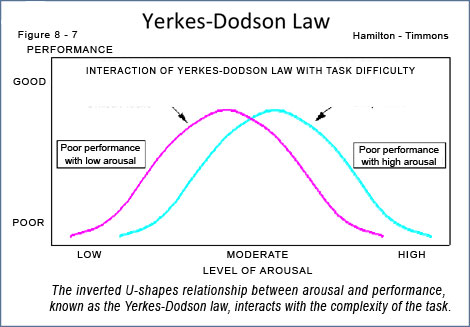
Consider the following “now-scientific” evidence. The widely-accepted Yerkes-Dodson law in psychology says that the optimal level of arousal for highest performance is moderate — a word Aristotle would also have chosen.he inverted U-shapes relationship between arousal and performance,  known as the Yerkes-Dodson law, interacts with the complexity of the task.

Note that arousal should be set even lower for more difficult tasks. Not rookie over-eagerness, but a fatalism that is above caring about success or failure — kind of a playful fun resignation to whatever outcome the universe chooses, so long as you like your play.

Arousal in this context means the same thing as the mental causes of physical and brainstem arousal — we call these motivations. If we are attached, meaning too highly motivated such that not succeeding would be anguishing — then we are not going to give our highest Flow state (Zone) performance.

Dial back the arousal. In future posts we will address the next question: how does one actually do that?

Best to all,

Bill