
Tag Archives: The Observer

The Immediate Upside Opportunity of Engaged Relationships

Volume 2, Issue 1

The next boom could be right around the corner, but we have to create it

When one is in a depressed defeatist state of consciousness, one draws down upon his or her self all manner of further difficulties incremental to what caused the depression. Some might say this is just others reading and taking advantage of obvious clues of weakness, while others might say the Divine Matrix is mirroring and giving each of us what we need. The construct is irrelevant because the predictions are the same. Both are accurate.

The same thing happens on a global level, as in the Great Depression and in today’s economic swoon from which we are tepidly recovering. The perception is that there is not enough to go around.

Yet there is evidence that the resources of the planet, properly stewarded, are more than enough to prove Malthus wrong and to make everybody’s quality of life quite acceptable in terms of the basics. The fact that we have been squandering some or all of those resources of course creates a potential shortfall. But these are human actions thus conceptually under our control. We can change our actions.

However, we feel that we cannot control or change our actions. And the truth turns out to be that whatever we feel/think/believe comes true, as if we are creating our own future. Gosh, how can anyone say we are not creating it, as in The Secret? This was not mainstream thinking as recently as the 1970s, when I wrote Mind Magic and Seth Speaks became popular, but many today agree that whatever is in our minds later manifests in the consensual reality in some form. Nevertheless the Will is missing on a mass scale to grab hold of the reins and make the 180-degree course change that we all deep down inside want the planet to make. The difference between the imagined utopia and the present mess is just too vast and we feel exhausted before we begin. Pessimism trumps optimism among the core of the culture. We are indeed seen to be the screw-ups that many interpretations of the Bible said we are. You’ll guess that Bill is about to tell us Acceleritis and the inevitable trial and error consequences of our new cortex is behind the mess, and you’re right, that is my estimate of the situation.

This blog is always about “What can we do about it now?” This week’s post explores how we can start with our relationships and how the ripples in the pond will spread to the ends of the Earth.

First let’s recognize that the immediate opportunity, if not distorted by negative assumptions, could be seen as incredibly promising. The Arab Spring for example is a hopeful sign that the universally available information/communication phase has now rolled out into totalitarian territory and the effect is inevitable.

And there are other hopeful signs. Every member state of the UN has agreed to wipe out extreme poverty in the world by 2020 through implementation of the Millennium Development Goals (MDGs). Inspired by the ideas of economist Jeffrey Sachs, this program has been doing its job and is on track to make its numbers.

Genomics and nanotechnology along with a host of other new sciences and technologies, offer new potential for medicine, and growing realization of how we have poisoned and cancered ourselves with pesticides and other unwise choices. All of this simultaneously offers the possibility that we will begin to dial back the causes of ill health. When we are all feeling physically good and not worried caregivers of loved ones on the descent, this will do a lot to improve the way we use our minds.

However, we have to start now in the more difficult uphill condition of using our minds well, despite the many factors bringing us down to counterproductive mental habits that inexorably and progressively worsen our situational estimates.

Among the biggest opportunities that lie ahead include marketing to the developing nations around the world, and to all of the other nations as well. Global commerce is the biggest upside on the horizon, and Brookings Institute partnering with J.P. Morgan Chase has created the Global Cities Initiative to drive the exports of American goods and services that can bring us back into boom for a long time. This is an opportunity not just for Americans but for everyone.

There will be a host of new and better products and services that are more win/win in terms of the entire ecosystem of our minds, bodies, and external environments. Software will continue to amaze us with where it takes us. Facebook and Twitter will lead our evolution in the direction of developing each individual and marketing him and her across the Global Digital Matrix.

Money will cease to be a problem over the course of time, and fallbacks into depressions may not be necessary, once we learn how to play nice in this big blue/green sandbox. Money is a symbol used in trade and we can and do create as much of it as we want. Over time — once we are spending more time in Observer and Flow states — we can probably improve upon the fiscal implementation details currently in place via the Fed, international monetary policy agreements, etc. so that the symbology system does not itself continue to confuse us into believing we do not have enough to go around.

What about aggressor states and terrorists and other criminal and/or psychotic behaviors? Big challenges lie ahead. Some people are not good listeners and are past willingness to learn they have gone off course in any way. Compassion and good communication will not always succeed — especially here at the beginning of the True Global Enlightenment, while we are at the deepest depths of the Real Dark Ages.

How do we avert a nuclear escalation if Israel and Iran clash, for example? These and other real world threats have an increased probability of occurrence to the degree that we believe they are inevitable and do not use our creativity to dream up compelling alternative scenarios and then sell them at all levels.

Although many Americans have issues and concerns about the UN, this organization is the greatest hope for a communication strategy that the world has or can have. The only way to bring everybody to the table will always turn into what the UN is perceived to be, a place where America feels it is not being treated fairly because it is not the dominant and ruling voice. Every member state has to feel it has an equal voice — this is the nature of the give and take of having neighbors.

This is where Engaging Relationships comes in. We have to look at every relationship as an opportunity, whether we are enjoying it at the moment or not. We have to accept it as a given, making the best of it that we can — drawing upon the wellsprings of unfamiliar creativity patterns in doing so, and pulling out all the stops from the standpoint of making maximum improvements, optimizing all the issues together. We have to decide to appreciate the challenge in each case. We have to stop demonizing the other and accept who he or she is, seeing the good news that difficult relationships are a fine learning stimulus, and finding places in ourselves where we can make excellently productive fine tunings.   

The UN has to itself evolve. It needs a new activism aimed at reducing the incentives for aggression — perhaps something like Mutually Assured DEfense (MADE, as in we all have it MADE) — the opposite of the US Cold War program Mutually Assured Destruction (MAD). The UN would have a protocol for discussing each act of aggression to determine the share of blame to each player — never assuming either is 100% to blame — counting up the instances of unnecessary escalation, e.g. who struck the first blow, etc. The UN would also have a protocol for defusing each crisis early on — similar perhaps to Jim Channon’s First Earth Battallion.

Bill Rouhana, CEO of Chicken Soup for the Soul, has a program called Humpty Dumpty Institute that has worked hard to bring UN and Congress members into close communication with one another. This is a worthy program and along with other of Bill’s nonprofit initiatives should be seriously considered for sponsorship by major advertisers seeking to have Engaging Relationships with their customers. Telling people the benefits of your products is not enough anymore. The world is too serious a place. Since the 1930s Coca-Cola has known that its communications with customers must address their values and tensions (presentation to ARF Re:THINK 2012 this past week*). If you only communicate with them on the mercantile level, your customers think your brand is just interested in them as a wallet.

Ed Martin of Hershey is another chap who excels at finding and helping nonprofits with high potential to change the world for the better. For example, he is now helping Leonard DiCaprio and La Columbe Coffee’s charitable alliance, which is donating 100% of profits from its new coffee brand LYON to carefully-selected potentially high-yield environmental and disaster relief projects. At the same time he’s helping Hillary Clinton’s International diaspora Engagement Alliance (IdEA) — an innovative platform for public-private partnerships bringing together communities in the USA and “back home” in the plethora of countries that are the roots of most Americans — to promote trade, investment, volunteerism, philanthropy, diplomacy, entrepreneurship, and innovation.

These are our role models in showing how we can amp up our Engagement with the world — in all of our relationships and in new ones — enjoying each one more, in a gamelike fashion conducive to Flow state. The Human Effectiveness Institute has its own sponsorable nonprofit project involving democracy and social media, which we are offering to brands as a way of Engaging Relationships with customers and prospects. Brands interested in learning more, please click here.

As we focus this week on seizing the day with all our relationships, let’s remember to include the one we have with our self — which deserves some time allocation — and the relationship we have with the postulated One Self that is the Universe, in which we are an aspect and the whole at the same time. Each moment, let’s leave open at least the possibility that the Whole is aware of us.

*ARF will post the Coke presentation to their website within the next month where all ARF member companies can access it. www.thearf.org

Best to all,

Bill
Finding That Hidden Switch Inside

Sensible procedures for quickly returning to your best self

This blog aims to provide a new psychotechnology for maximizing human performance and happiness, derived from a synthesis of the author’s experience and the relevant findings of science both modern and ancient. The construct posits three levels of waking consciousness:

  1. Flow state — the most desirable state in terms of performance and happiness, where things happen perfectly and one feels a seamless part of everything. A non-ordinary, altered state of consciousness that occurs when you are totally immersed in and merged with an activity you have practiced well and you have simultaneously given up caring whether you win or lose, rising above all negativity and all of your usual ordinary concerns. Action just happens without hesitation, like a child at play.
  2. Observer state — the second most desirable state, in which your attention misses very little of what is going on inside you and around you. The access window to Flow, this state is a form of meditation/contemplation that requires no closing of eyes or immobility, but does require self-honesty/objectivity and paying very close attention both inside and outside.
  3. EOP (Emergency Oversimplification Procedure) — the typical state of the overwhelming majority of human beings today, from which individuals spring infrequently into the higher states in rare moments of clarity and nobility. In EOP there is always a background dilemma, a sense of incompleteness, of wanting and being attached to something that you may or may not get.

In my theory the EOP state is not the natural state of the species but arises from a multi-millennial delay in integrating our evolutionarily most recent brain part, the cortex. Like children handed loaded machineguns, with our newfound inventiveness running amok, our weapons-centric culture has handed control of the planet to those who possess the most powerful weapons, and now through proxies they control everything else as well. This has been true since earliest recorded history. In fact the invention of written language appears to have been the catalyst for the only culture we know, which has made information overload and distraction the way we spend our days, separation our hidden assumption, and EOP our state of being.

Yet every philosopher worthy of such designation has explained that we need not live this way. Each in his/her own way has explained how to peel away the tarnished layer of the outer accidental self to find the pure inner self that exists always, despite whatever culture we find ourselves in. Collective wisdom and understanding from philosophy, theology, science and commonsense proverbs have always existed as a form of primitive psychotechnology. “Primitive” because the whole problem has never been clearly defined. Therefore the solutions have always been merely rote methods that work for reasons beyond the understanding of even those who practice and teach them.

I’ve spent my lifetime trying to figure out the things that spontaneously propelled me into the higher states, having first experienced Flow when performing onstage as a child, being part of a show business family. Over the years, working at it daily, I’ve discovered procedures that help me stay in the higher states more of the time. I rediscovered many of the same procedures that others before me have rediscovered. There are few among us who themselves have not discovered some of this — each of us has come upon some of these truths of how to be one’s highest self. Like me, most people strive to be the best they can be, often without even knowing they are doing this, nor explaining it to themselves in any philosophical or otherwise reasoned way.

Years back I founded The Human Effectiveness Institute to share these procedures, the ones that work for me and for 3000 or so readers of the first edition of what is today the book Freeing Creative Effectiveness — all reporting (unsolicited) positive results. The Institute also exists to understand the underlying scientific mechanisms, i.e. why these psychotechnological procedures work to elevate the mind into the higher states. In an earlier post I provided hypotheses drawn from my theory as to which brain parts are involved in each of the three states of waking consciousness. These hypotheses are the starting point toward making psychotechnology more of a science than an art. Today it is an art more than a science — or a soft science in contrast with the highly-regarded hard sciences.

In the rest of this post we’ll focus on what to do when you find you are not in your best place — and how to get back to your best self as quickly as possible. We’ll divide this into two short sections: (1) the first time you do this, and a few times a week after that, when you can grab an oasis of alone space to check in on your self, and (2) on an ongoing moment-to-moment basis.

The first time, and in alone spaces after that

First, how do you know you’re not in your best self? That part is easy, here are the symptoms: you’re not happy, something is bothering you and you may not even know what it is. You are making mistakes and making things worse. There is a loop going around in your head telling you so many different things about you and your life that you don’t like — you don’t know where to start and you feel defeated before you start. Those conditions are the clue to quickly find that hidden switch in your head.

The practical, sensible procedure when you are having this kind of experience, the first time it happens from now on, is:

  1. You need to be alone for awhile.
  2. You need to let your mind dump the problem statement and whatever solution idea fragments it may have by simply transcribing — taking dictation from your mind, in the form of incoherent notes or however they spill out when you are not trying to make them read well for other people.
  3. Note how much you care about — are dependent upon — certain attachments, as if you are an outside observer watching yourself as a scientific subject. Note how many of these attachments are ignoble things — like envy, jealousy, pride, vanity — that you would rather not see in yourself. Consider what you might do with your life if you gave up caring so much about these specific things or about any specific things. Being looked up to, having more money, whatever forms your attachments take.
  4. Give it all up. Even if you are just pretending, or experimenting — picture and feel that you are tired of it all, and you don’t want these things any more. You are not dependent on anything or anyone. Whatever happens, you will be strong enough to start from scratch and be creative and make decisions to flow with whatever reality deals you. Vividly envision losing it all, and being tough enough to withstand that loss.

One piece of psychotechnology common to many Buddhist and Hindu traditions is to meditate on a corpse in order to eventually lose all horror about it — a common practice also for doctors and nurses. This illustrates the psychological principle at work: it is possible to get used to anything, to the idea of losing anything, given enough time and mental practice. It doesn’t happen overnight in most cases, although sometimes it does.

Will life be worth living, you might ask, if you stop caring about all the things and people to which and to whom you are now attached? You don’t have to stop caring — you can still love people and things even more — it’s just that you are becoming fatalistic and accepting of whatever might happen that would cause you to lose these people and things.

In the moment, in the midst of action

Any time you notice you are not in your best self — making mistakes, losing your temper, feeling lousy or scared, whatever it is — re-set your mind by erasing everything. “Clear the mechanism” as Kevin Costner’s character says to himself in the movie “Love of the Game” (a film that shows what Flow state feels like to a baseball pitcher, as Bob DeSena points out).

Assume that any sense of dilemma is a lack of clarity, that if you were thinking straight you would be accepting what is and dealing with it without negative emotion, just with pure effectiveness. The one thing you want is to take whatever life hands you and deal with it most effectively, and anything short of that is rejected out of your mind and body instantly.

At first you will find yourself re-setting again and again as you slip back into the old time-worn ways of mental hand-wringing, but over time your mental muscles will toughen up. Just stick with it and you will become indomitable.

I know that many of my readers have already been practicing this for a long time, and this post may seem elementary to you, though the review can’t hurt. Since our aim is to always widen our audience to reach as many people as possible, we will sometimes return to basics.

Wishing you Flow and Observer filled days.

Best to all,

Bill

America, the New World

The name America is widely believed to derive from Amerigo (Americus in Latin) Vespucci, a contemporary and eventual friend of Christopher Columbus who not only explored unknown regions of the “New World” but who also invented a system of computing exact longitude and arrived at a figure computing the earth’s equational circumference only fifty miles short of the correct measurement. Quite a feat in the early 16th century!

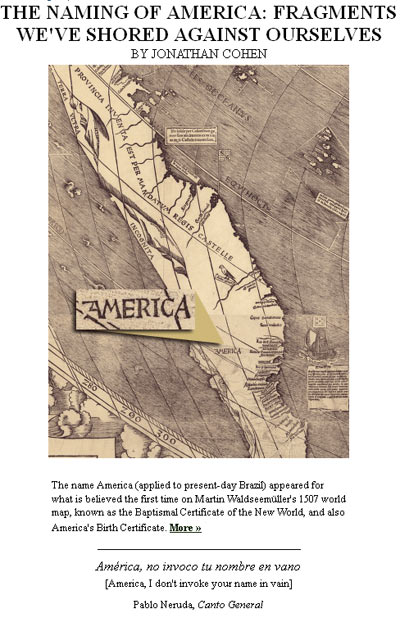
While no one knows for sure where it came from, the first documented use of the name America was in 1507, when Martin Waldseemüller produced a world map on which he named the new continent America after Vespucci’s first name, Amerigo. More on this fascinating story can be found here: http://www.uhmc.sunysb.edu/surgery/america.html.

Tracing the etymology of Americus, I found the Middle English “yreke”, where its context was something like “as if to rake up the dying embers and thereby release a flame.”

The USA spiritually reawakened the freedoms of belief, speech and assembly associated with higher philosophical/ethical aspirations, among other things. For when people get together and converse openly, wisdom evolves, self-awareness develops, and there is potentially more time spent in the states of Observer and Flow.

We raked up the dying embers of idealism and released the flame in American hearts. While we have no exclusive lock on that product category, America’s purpose was and is to be the house on the hill — the moral high ground. We are the heroes, the good guys in this movie.

Today, having overspent for decades, it is finally catching up with us. Remember all the good times we had? Weren’t they all great? Weren’t they all worth it?

What is “it”? Why, it’s the current comeuppance of suddenly discovering that credit card bills have been piling up in some mailbox we forget we had and now we owe 55 trillion dollars and the number is growing every second.

We are not looking very heroic right at the moment as we use TV and all other media to keep up on how our leaders are solving this crisis.

Most of our leaders and other officials we see head-shots of in the media seem to be yelling at each other and jockeying for position in such a blatant way as to intentionally send the signal to the people that they better get used to it. There is no accountability, it’s all too complex for us so if you were to revolt you would find yourselves back where you are now with nothing more than tragedy as your gain.

The candidates who seem to be different from that norm are the true heroes and many of us vote for such folks whenever we see them. We need to be more informed to vote better, studying more about the lesser players who need our votes too. This will do some good in the long term but will not help with the current economic crisis.

This is a world-wide interconnected economic crisis different from any before, although we like to classify it into the familiar pigeonhole of recessions and The Great Depression. In fairness there are similarities and there are differences.

The important difference this time is in the forecasting of the next 20 years.

Government forecasts have turned out to be too bullish all too often. Happens as frequently there as in business. People make assumptions about how hard they are going to work, how effective they are going to be, how well everyone else is going to help them, etc. After all, what is the alternative? If you put out a realistic (negative) forecast sometimes you lose the investors entirely, or get replaced by other people.

The realistic forecast going forward is that we are going to pull a rabbit out of a hat and get out of relative restriction on our capabilities including enjoyment (that is what economic cutback equates to) in less than 20 years. That is the challenge. That is the game.

If we are in Flow half the time the chances are we could do it in 5 years. Just a SWAG.*

We have to start considering entirely new ideas because we have made the dead horse floggingly unrecognizable on the stale ideas we constantly go try to resuscitate.

Totally new ideas.

If not now, when?

Minds must be opened. Zero-based thinking.**

Examples below are just to prime the pump. Maybe some of what follows could be refined into workability, but my point is to get everyone pitching in with new ideas to get out of the economic hammerlock in the shortest time and with least suffering.

Scenario A: Government creates an innovative plan and assembles the richest people in the USA. Presents its plan. How they benefit. How the people benefit. Reminding them of Thomas Jefferson’s belief in enlightened self-interest. Yes, the richest people bail out the USA. What they get out of it is more than just a fair return — the psychic diet from their citizenry brethren turns from nearly homicidal to respect and nearly awe — because they handle it with grace and turn back a percent of their gain, to the people. Possibly in the form of grants/investments on a Digitally efficient basis (i.e. Internet-based process like Facebook with spreadsheets) to vetted people below the poverty line who have entrepreneurial ventures in mind.

Scenario B: Government creates an innovative plan and assembles the leaders of all of the nations of the Western Hemisphere. Presents its plan. How they benefit. How the people benefit. The neighbor countries and the richest people in them bail out the USA. What they get out of it is more than a fair return — their countries get the highest technology not only today but forever, and their economies and quality of life are destined to shoot up. The individual robber barons do not lose their seat if they and their people can establish fond relations. In a few cases, Cuba for example, they might decide to go their own way and not be part of a new sovereign meta-nation called either THE UNITED STATES OF THE AMERICAS or THE UNITED NATIONS OF THE AMERICAS or simply AMERICA.

It might become known colloquially as The New World for a time in the press until the term is over-used.

The name America was after all, first applied to mean the entire landmass with surrounding archipelagos — which in this scenario becomes a single nation — and was on the first map to include the name America, actually specifically applied to what is now Brazil.

The Naming of America

From http://www.uhmc.sunysb.edu/surgery/america.html#vesp-map

Imagine the complementarity of all of the Western Hemisphere united. The economies of every nation in the world would benefit.

The leading question of the New Founding Fathers would be, “Now that we are back into manufacturing, how do we optimize this driver?” Roboticizing plants south of the previous border will be one obvious part of that future choice.

Good companies in other countries will be provided favorable terms to invest in new plants and offices in the new America.

There will be a billion citizens in the new nation.

What a market to sell to! The New China.

Pan-Western Hemisphere networks such as CNN will be the first beneficiary of The New National way of looking at media advertising. The beverage companies will probably be the first to make buys across the Americas with a single deal. Everyone else will follow. Other networks hasten to catch up.

What buying power in terms of taste for foreign goods, and what self-reliance on everything from oil to metals of all kinds. We will be winding down use of oil anyway, in a specifically staged wind-down with tax breaks given to whoever can help it along.

Of course the new meta-nation still has debt. Not just the USA, whose ratio of external debt to gross domestic product (GDP) is 99.9%. Canada’s is 71%, while Mexico’s is only 23% and Brazil’s is only 19%.

The US debt share to the average citizen in the US today is $47,559 and rising every minute. Diluted by far lower debts per citizen in the rest of the “New World”, the average US citizen share after the merger will be probably half or lower.

But those are abstract concepts anyway. What really counts is getting people back to work, and the excitement of new opportunities for business and trade suddenly abounding as there are fellow citizens you never had before who want stuff you have, and you want what they have, and the rest is details to be worked out.

When companies cannot grow by internal revenue growth and increased efficiency, they grow by merger and acquisition. Perhaps there is a lesson in that for nations too. Mergers where all parties are in favor of the merger — in sharp contrast to Imperialism.

These are but the first two crazy ideas. I have more crazy ideas as to how to bail out the US debt.

Scenario C: Individual productivity bails out the US debt. The US government goes on an efficiency tack in all departments and nooks and crannies. Instead of cutting jobs people are able to accomplish much more. New business management processes ensure this is not wheel spinning but instead benefits the people. The efficiency is so great and the desire to not let people go provides opportunities to move people out of cubicles into “the field” where they can become case workers to help other people hands-on — teaching them marketable skills such as computer capabilities even including software development. People go back to work and the jobs problem goes back into the yellow zone again.

Scenario D: Crime bails out the US debt. Just by decriminalizing opiates (a small fraction of the total market for criminal drugs, gambling and prostitution) $65 billion could be diverted out of the underground economy and this would choke off “The Taliban’s principal and most lucrative source of income in Afghanistan [is its control of the opium trade].” By decriminalizing all “victimless” crimes (drugs, gambling and prostitution) — we would exclude gambling involving animal violence or human violence (beyond pugilism and martial arts, etc.) — the total savings that would accrue for other uses in The New World could be significant.

This scenario could essentially bring our economies back to life much faster than in the current “wait it out” scenario, which is the path we are now walking until somebody has a better idea. It could be you: explore your mind and see what you find. Happy to publish your ideas here unless they are too crazy even by my standards, which would be going pretty far. All ideas contain some seeds of positive possibility, even the terrible ideas we have played with in history — we went there because we saw the germ of good in them but didn’t realize the downside fallouts. The same could apply — must apply to some degree — to all ideas including my scenarios above, which are intended as illustrations more than proposals. Illustrations of how we must take off the shackles and blinders and let ourselves envision many options that otherwise will never be considered.

Let’s step forth and be the ones who start the new positive constructive spirit with open minds and all-inclusive hearts.

Some might see it as a new spirit. Some might recognize it as the original American spirit. It might be the spirit that existed before time.

The spirit that steps out in the direction of the ideal with the intention and conviction of success.

That spirit is in all of us.

Let’s tap it.

Now would be a good time.

Best to all,

Bill


* SWAG = Scientific Wild Ass Guess

** Like zero-based media planning, meaning you ignore what you did last year.

Source: “Warlord, Inc. Extortion and Corruption Along the U.S. Supply Chain in Afghanistan,” Report of the Majority Staff, Rep. John F. Tierney, Chair, Subcommittee on National Security and Foreign Affairs, Committee on Oversight and Government Reform, U.S. House of Representatives (Washington, DC: June 2010), p. 39. [http://drugwarfacts.org/cms/?q=node/38]