Tag Archives: America

What Unites Us and What Divides Us

In Honor of Flag Day, Sunday, June 14, 2026

Welcome to this week’s Bill Harvey Blog , June 12, 2026.
Created September 16, 2022
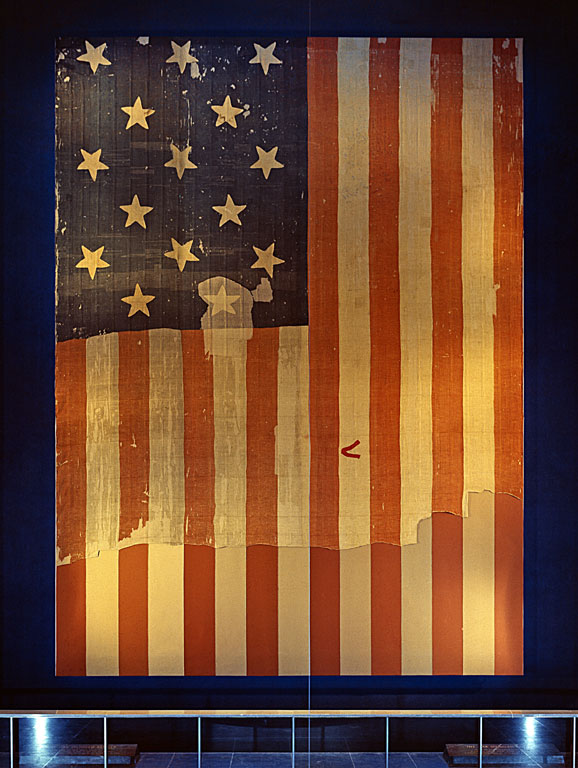
The 30 by 34 foot Star Spangled Banner Flag that inspired the lyrics below when it flew above Fort McHenry in the 1814 Battle of Baltimore. It is on permanent display in the Smithsonian National Museum of American History.

Please allow me, courtesy of Wikipedia, to begin with all of the stanzas of Francis Scott Key’s Star-Spangled Banner, including the fifth stanza added by Oliver Wendell Holmes Senior in 1861. For I believe that these lines most truly express what unites US:

“O say can you see, by the dawn’s early light,
What so proudly we hailed at the twilight’s last gleaming,
Whose broad stripes and bright stars through the perilous fight,
O’er the ramparts we watched, were so gallantly streaming?
And the rocket’s red glare, the bombs bursting in air,
Gave proof through the night that our flag was still there;
O say does that star-spangled banner yet wave
O’er the land of the free and the home of the brave?

On the shore dimly seen through the mists of the deep,
Where the foe’s haughty host in dread silence reposes,
What is that which the breeze, o’er the towering steep,
As it fitfully blows, half conceals, half discloses?
Now it catches the gleam of the morning’s first beam,
In full glory reflected now shines in the stream:
‘Tis the star-spangled banner, O long may it wave
O’er the land of the free and the home of the brave.

And where is that band who so vauntingly swore
That the havoc of war and the battle’s confusion,
A home and a country, should leave us no more?
Their blood has washed out their foul footsteps’ pollution.
No refuge could save the hireling and slave
From the terror of flight, or the gloom of the grave:
And the star-spangled banner in triumph doth wave,
O’er the land of the free and the home of the brave.

O thus be it ever, when freemen shall stand
Between their loved homes and the war’s desolation.
Blest with vict’ry and peace, may the Heav’n rescued land
Praise the Power that hath made and preserved us a nation!
Then conquer we must, when our cause it is just,
And this be our motto: ‘In God is our trust.’
And the star-spangled banner in triumph shall wave
O’er the land of the free and the home of the brave!

When our land is illumined with Liberty’s smile,
If a foe from within strike a blow at her glory,
Down, down with the traitor that dares to defile
The flag of her stars and the page of her story!
By the millions unchained, who our birthright have gained,
We will keep her bright blazon forever unstained!
And the Star-Spangled Banner in triumph shall wave
While the land of the free is the home of the brave.”
Would you be surprised if any American would object to anything said in the Star Spangled Banner? The song has conveyed our bravery, our love for liberty, and that we acknowledge our protection by God. Well, yes, that last part about God, at least three out of ten Americans today would say “Whoa!” to that one. In fact each of the two political parties in the US are led by people who claim that God is on their side, and they’re nowadays likely to claim that the opposition is not aligned with the Almighty. So far, then, we are divided by our disagreement as to whether God is on the side of Republicans or Democrats.

How silly. Any Being worthy of being called God would not choose sides among Her children. And if my Theory of the Conscious Universe happens to be right, we are made out of Her, and represent Her, with what we think of as our self actually being The One Self, combining all opposites, all deviations, all avatars, all of us.

But from the standpoint of this article, so far, we have identified one factor (God) which has been used divisively lately. Let’s continue the analysis.

Freedom, Liberty, Individual Agency without unnatural restrictions. We all want that, right? I don’t hear any objections. Freedom is something we all want.

Willingness to fight and die for what we believe in. Troublemaking as it is, yes, it is in the core of our being, here on the continent that revolted from the old ways. We have always been fighters. Balancing that with also being better diplomats – in the class with Franklin and Jefferson – might be a good thing.

In the era of Locke and Montesquieu, imagining what the optimal organization of government might be, Jefferson and other Founding Fathers became impressed by the way the Native Americans governed themselves via a “stacked-government” model, giving tribes autonomy yet coming together as a federation of tribes for accomplishing larger missions, such as increasing sediment yields to the Delaware River basin. This idea became known as federalism. We still practice it today. We fought a Civil War over it, and that system’s inability to agree on a slavery policy. States’ Rights are a second factor dividing us. Or is it?

There is no question as to the power of the States today. It is an established fact. So long as there is true unrigged, unobstructed, unweighted voting by all, if someone does not like what the voters decided, they can move to another State. Although there is talk of changing the Constitution, States’ Rights are in no visible danger, so far as I can see. If it’s a factor that seems to be dividing us, we ought to agree publicly that we are not actually divided on that one point. What we may actually be disagreeing about are the ways in which free voting needs to be protected for the benefit of all citizens.

And we might also benefit from similarly scrutinizing what else appears to be dividing us, because in many cases we shall emerge from the process with a more specific set of disagreements, smaller and more controllable than the general animosity would suggest. If we can speak civilly to one another about such matters again I predict we will find that there is much less disagreement on specifics, and once we do that, our minds can creatively collaborate to find a synthesis in those areas of true dispute. We owe it to ourselves to attempt this and to doggedly pursue the process, point by point, until at least the hypnotized part of the divisiveness goes away.

Oliver Wendell Holmes Junior, son of the poet and physician of the same name who added the final stanza to the National Anthem, the son being the most famous of the Supreme Court Justices, and an intellectual thought leader who, a Republican, influenced progressives such as FDR. His 1881 Common Law is the history and logic of how the law evolved. According to History.com:

“He emphasized both that the ‘life of the law has not been logic: it has been experience’ and that the law develops according to the ‘felt necessities of the time’ rather than according to any set of deductive premises.”

Thus doth the Law rest upon “the felt necessities of the time”.

That would be worrisome if our necessities are always changing. But they are always the same, or they wouldn’t be necessities in the first place. We shall always want our freedom, and most of us would want our equality. But there that equality thing – that’s a third divisive item (after God and States’ Rights). Or is it?

It’s possible to think “I myself must be treated like an equal by everyone” and at the same time say “but I work hard for my money, and I don’t want one of my equals to be a person who gets a handout out of the money I pay for taxes”.

Transfer payments are definitely a divisive factor. I first wrote about that in my 20s, suggesting that we invest in developing people with our transfer payments, with an eye toward gradually reducing the need for transfer payments.

If not the best answer, at least it suggests that we might get creative.

Those divisiveness factors we’re reviewing – God, liberty, equality, free speech (the latter item covered below) – are not meant to be an exhaustive list, so please think further and identify other causes of division.

Please do use this method of speaking civilly and peeling the onion to find where true disagreement lies (if it is there at all) and to try for solution directions to take together.

So far, the list has been pretty rational and cognitive. How about that larger part of ourselves? The subconscious, emotional, non-rational part that makes 95% of our decisions, according to Harvard don Gerald Zaltman?

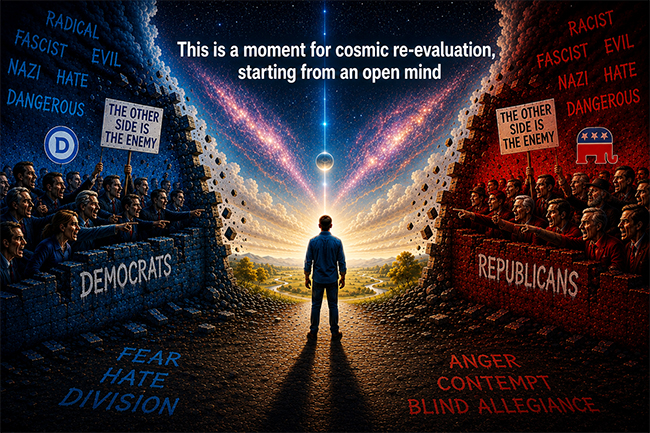
The possibly biggest divisiveness factor is not a rational thing. It’s more of an animal-instinctive feeling: “These people are not for me at all.” Right now, that’s how we are sorting ourselves into these two groups (Red and Blue), while the rest of us are trying to bring us all back to the table as citizens of the USA.

Metacognition, which humans apparently do better than the other species, although the jury’s still out, is the art and science of watching what is going on in your own mind and inner theatre of feelings, and understanding the why of it. Here’s how metacognition applies to this situation.

We can actually turn the tide on this divisiveness thing by catching and neutering that automatic response of being repelled by a perceived “Other” group. Hold that automatic response with your will and your mind, like a dangerous squirming toad, and inspect it. What did it feel like? Who did it remind you of? When in life did you start to feel that way?

Don’t accept the feeling of being repelled by a person. It’s more of an alarm signal about you than about that other person. Meditate on what it is in you. In less than a week, you shall definitely have a deep intuition about it.

Who said, “I do not like that man. I must get to know him better.”

It was Abraham Lincoln.

We are all in this together and are collectively losing the game. This shocks game theorists. Why would there be just losers? How could that even be?

The weaponry stacked around is certainly enough to make this a dead planet.

Wasn’t WWII bad enough?

We have to accept each other.

We need to be able to cooperate or none of us may survive.

Give up the “bad guy” idea. (Don’t stop incarcerating criminals convicted by due process of law, whether seditionists, murderers, rapists, or whatever. No one should be exempt from such accountability to justice. It’s more useful to think of them as being psychologically diseased/unbalanced than as “bad guys”. The “bad guys” construct triggers autonomic emotional reactions that are pragmatically obstructive to solution finding. We can think more effectively and creatively without that construct.)

Then we can easily talk the rest of this out so that each tribe can be satisfied. But not if we can’t talk to each other without negative emotion flaring up. Master your selves. Talk civilly and respectfully to all.

Free Speech, the Right guaranteed by the First Amendment to the Constitution, became a divisive factor when the enormous megaphone called the Internet happened.

We felt that we were given license to say anything we pleased, true or false, whether it would hurt someone else’s feelings or not. Not all of us activated that. But many tens of millions got into it as if they had been holding it in since kindergarten. And they are now a bit stuck in it. If they try to back out of it too gracelessly they will be attacked from all sides.

The people are still walking around in rage. Stop avoiding them. They need help. Have infinite patience. They will be blessed by it. You will be blessed by it. Use this post as a study guide to prepare for such meetings with your own ideas about what are the divisive factors and how can we peel each one away like an onion so that we can see reality together, agree on what we see at that moment, or do further research on any areas in which we cannot agree. But always civilly in recognition of the seriousness of the situation in which we had all better be on one side, the side of the human race, or we are quite literally doomed.

Love to all,
Bill


Visit Us On FacebookVisit Us On TwitterVisit Us On LinkedinVisit Us On Youtube

How Do We Protect Our Elections and Voting Rights At The Same Time?

Welcome to this week’s Bill Harvey Blog
Created May 21, 2026

The question of non-citizen voting in U.S. elections is a major point of public discussion. Extensive data, recent state-level audits, and nonpartisan research show that verified cases of non-citizen voting are vanishingly rare, representing a minute fraction of a percent of overall votes cast.

When state election officials conduct extensive audits using federal immigration databases (like SAVE) and Department of Motor Vehicles (DMV) records, the initial lists of “suspected” non-citizens routinely shrink drastically upon investigation. This is usually because the data relies on outdated status reports (e.g., individuals who were green card holders when they got their driver’s license but have since become naturalized U.S. citizens).

The Center for Election Innovation & Research (CEIR) and recent state reports provide the following official figures:

Note: “Potential” or “Suspected” means the individuals were flagged for review; subsequent checks usually reveal many are actually naturalized citizens who simply haven’t updated their DMV profile.

The conservative Heritage Foundation maintains a national database tracking verified instances of voter fraud. Going back to the year 2000, their database documents fewer than 100 cases of non-citizen voting across the entire country. Given that hundreds of millions of ballots have been cast in that timeframe, the percentage is statistically close to 0%.

A landmark study by the Brennan Center analyzed 42 jurisdictions during the 2016 presidential election (tabulating 23.5 million votes). Election officials referred only 30 cases of suspected non-citizen voting for investigation—amounting to 0.0001% of the votes.

Why It Happens (When It Does)

Data shows that the microscopic number of non-citizens who do successfully register or vote are almost exclusively Lawful Permanent Residents (green card holders) rather than undocumented immigrants. These cases are usually driven by administrative errors (such as being automatically prompted to register while getting a driver’s license) or honest confusion about eligibility rules, rather than intentional fraud.

Recent data from major polling operations, including the comprehensive PBS News/NPR/Marist Poll and federal tracking data, outlines where the public stands:

High Bipartisan Support for Specific Stricter Laws

When polled on specific legislative proposals—such as photo voter ID mandates or proof-of-citizenship requirements—supermajorities of Americans consistently voice support.

  • Voter ID Requirements: Between 81% and 84% of Americans support requiring a government-issued photo ID to vote. This includes roughly 95%–98% of Republicans, 79%–84% of independents, and 67%–70% of Democrats.
  • Proof of Citizenship: Approximately 75% to 83% of Americans favor requiring proof of U.S. citizenship when registering to vote for the first time.
  • The SAVE America Act: A White House data release tracking public sentiment on federal election security legislation shows 71% overall support for tighter federal restrictions on voter registration eligibility, including half of rank-and-file Democrats.

Fraud vs. Access: The Public Divide

Despite broad consensus on IDs, the public splits significantly when asked about the core philosophy governing election laws. The Marist Poll reveals a sharp divide over whether the priority should be stopping fraud or maximizing turnout:

  • The Primary Concern: 59% of Americans believe it is more important to ensure that everyone who wants to vote is able to do so. Conversely, 41% say the bigger concern should be ensuring no one votes who is ineligible.
  • Partisan Splits: This question is highly polarized. 70% of Republicans prioritize stopping ineligible voters, while 86% of Democrats and 53% of Independents prioritize maximizing voter access.

Perceived Threats to Elections

When Americans are asked to name the single biggest threat to safe and secure elections, voter fraud ranks high, but it shares the spotlight with other anxieties:

  • 33% cite voter fraud as the top threat.
  • 26% cite misleading information (including concerns about AI-generated misinformation).
  • 24% cite voter suppression (worrying that strict laws will turn away eligible voters).

Notably, 57% of Republicans view voter fraud as the top threat, whereas 41% of Democrats view voter suppression as the primary threat, and a plurality of independents worry most about misinformation.

In summary, the percentage of Americans who want stricter laws depends heavily on how the question is asked. If asked about voter ID and citizenship verification, support sits overwhelmingly at 75% to 84%. However, if asked whether tightening laws to prevent fraud is more important than protecting voter access, only about 41% of the country prioritizes fraud prevention above all else.

When forced to weigh election security against voter access, a clear majority of Americans prioritize ensuring that eligible voters are not locked out of the system.

According to the comprehensive PBS News/NPR/Marist Poll on Election Security:

  • 59% of Americans state that their primary concern is making sure that everyone who wants to vote is able to do so.
  • This concern is heavily driven by partisan lines: 86% of Democrats and 53% of Independents prioritize maximizing voter access over stopping potential fraud.

Fear of Voters Being Turned Away

Anxieties regarding specific voting rights being taken away or restricted at the ballot box have hit a multi-year high:

  • 58% of Americans believe it is likely that people will show up to the polls only to be told they are not eligible to vote.
  • This represents a striking 16-percentage-point jump from when the same question was asked in 2020. Among Democrats, this fear rises to 74%.

Concern Over Gerrymandering and Vote Dilution

While broad polling generally measures “gerrymandering” through the lens of overall trust in the political process, the sentiment that the system is being rigged to minimize the effect of certain votes is incredibly widespread.

  • Threats to Democracy: In the February 2026 Marist Poll78% of Americans stated that they believe U.S. democracy is “in jeopardy” or “under serious threat.”
  • The “Voter Suppression” Threat: When asked to isolate the single largest threat to a safe and fair election, 24% of Americans specifically point to voter suppression (the intentional restriction of voting access).
  • Lack of Confidence in Fair Elections: Driven heavily by the ongoing “arms race” of mid-decade redistricting across states like California, Texas, North Carolina, and Virginia, public confidence that state/local governments will run fair and accurate elections dropped to two-thirds (66%)—a 10-percentage-point decrease from late 2024.

Data tracking from organizations like the Pew Research Center confirms that large majorities of Americans intuitively favor electoral fairness and believe that extreme partisan gerrymandering actively undermines confidence in whether their individual vote actually matters.

What do these facts tell us? Despite the incidence of voter fraud being close to zero, 41% of us want stricter laws preventing it, outweighing in their minds the risk of citizen voting being made so much more difficult or diluted that “one person, one vote” no longer applies, and minority rule can take over America.

How can we explain this?

Possibility #1: 41% of us are racists.

Possibility #2: 41% of us are unaware of the near-zero factual threat of voter fraud to date.

Possibility #3: 41% of us simply want the Republicans to win, regardless of the issues or consequences.

Possibility #4: 41% of us fear the perceived weakness of the Democrats more than they fear anything else.

Possibility #5: 41% of us fear that the elections are going to be rigged from now on, because of the actions now being taken by the government, and they want stricter anti-fraud laws to protect us against that. (However, the laws that we need to prevent that are not being strengthened, in fact the weakening of voter rights strengthens that.)

Possibility #6: all of the above to varying degrees. This is the likely real answer.

What should we all do?

  1. Take action to make sure the facts about voter fraud statistics are known by as many people as possible. We can all do this in social media. Let’s make social media socially a positive force for a change.
  2. If you do not see yourself as weak, run for office, or help someone you see as strong and wise run for office. Socrates and George Washington agreed that wise and morally strong people must be willing to accept the role of governing, even if they would prefer to do something else with their lives. Unfortunately, the public votes for strong over wise, so if you are in any way involved in politics or are willing to become involved now that our country needs all of us to become more involved, and you are a combat veteran or simply a strong person, hear and take the call now.

Happy Memorial Day Remember and Honor May 25, 2026

Love to all,
Bill


Live chat with my avatar

How AI Might Help Shape a Better Future for American Politics

Welcome to this week’s Bill Harvey Blog
Created March 6, 2026

I’ve been asking AI a lot of questions lately about the American Revolution. I can see it like a movie now. Sort of like the original 1960 Ocean’s Eleven, when we see how the gang comes together like iron filings around a magnetic story arc.

In the real his-and-her-story (formerly known as his story, i.e., history), John Adams got religion first, around 1765, PO’ed by the Stamp Act and Taxation Without Representation.

George Washington, always methodical, gradually shifted his attitude over a period of years, 1769–1774, in increasing indignation against the British treatment of Americans as inferior. The major stimuli included trade restrictions and the Coercive Acts. But there was also a personal matter. He had joined the British Army, and because he was American, he was given the rank of Brevet Captain instead of full Captain. Apparently, his mother had rankled him all his young life with put-downs, which made him extra sensitive in his adult life to treatment like that.

Thomas Jefferson was drawn into the revolutionary mindset ~1774 (the turning point year, as we shall see in a moment) by the issues of infringement on natural rights and self-governance.

Alexander Hamilton joined the movement in 1774, spurred by political unrest in New York and the Continental Congress.

Benjamin Franklin was the last of this group to join. He spent decades in London trying to bridge the gap between the colonies and the Crown. He truly believed the British Empire could be saved. The turning point was the “Hutchinson Letters Affair” (1774), where he was publicly humiliated by British officials. He realized reconciliation was impossible and sailed home in March 1775, arriving in Philadelphia just after the battles of Lexington and Concord, ready to serve the rebellion.

Thomas Paine joined the American revolutionary movement upon arriving in Philadelphia from England on November 30, 1774. Recommended by Franklin, Paine quickly immersed himself in colonial politics, publishing his influential, pro-independence pamphlet Common Sense on January 10, 1776, which galvanized support for the revolution.

The American Revolution was primarily influenced by Enlightenment philosophers, most notably John Locke, whose theories on natural rights (life, liberty, property) and the social contract directly shaped the Declaration of Independence. Other key influences included Montesquieu (separation of powers), Rousseau (popular sovereignty), and Thomas Paine (republicanism). Most of the Founders themselves also wrote brilliant philosophical treatises. If we had leaders today who were as creative in thinking about the future, we would probably not be in the current mess.

Enter AI.

The USA is a representative democracy, and this worked for almost 250 years, but it is showing signs of wear. The necessity for representatives was obvious all this time because there was no way for all of us to vote every day on every big and little decision and still get anything else done, like producing goods and services, inventing things, defending the nation, etc.

AI does change this. It would be possible for each of us to tell AI everything we want government to do and not do, every day, as the spirit moves us. AI could combine all this input from ~325 million people, knowing which ones are adults and eligible to vote, which ones are citizens but minors, which ones are immigrants not eligible to vote. AI could provide summaries of what We, The People want continuously to the government at all levels, as well as to the press and to educators and back to all of us.

This would seem to be a highly probable eventuality at some point. It might start very soon as unofficial experimentation and perhaps as a more constructive channeling of the shouting match we call social media.

This would use a lot of computing power and have a high carbon footprint and possibly lead to some breakthroughs in clean energy sources.

Rooting out biases in AI and the need for continuous fact checking would be crucial in such a system.

Bad actors would focus on political cybermanipulation. Good agents of the Justice and Intel systems would work to keep them from ruining a good thing.

But wait! How would this be better than polling? Doesn’t polling serve this function already?

Polling is limited to the ideas which are already on the table. The AI method would pick up creative new ideas even if only one person came up with them. In fact the national governmental AI should not be a single AI but a collegial team of AIs looking at the same data from many viewpoints, some looking for new ideas, some fact checking, some looking for historical precedents, and so on.

Polling has another problem of representativeness. The response rate to polling is typically under 10%, suggesting a very large nonresponse bias. Pew and other sources taken together suggest that something like 87% of Americans use social media, implying a willingness to key in at least a few words every now and then. The AI scenario envisioned here would be voice driven rather than requiring keystrokes, which would also be an option. In order to maximize engagement, the government could offer modest tax rebates based of the degree of contribution to the ideas of the nation.

We would still need representatives and the rest of government at all levels to carry out the wishes of the people. In fact, the mess we are in now is only slightly the result of imperfections in the system the Founders designed, and a much larger factor is the imperfections of the people in that system.

If we elected people who were of good character, devoted to the good of the many, more of us would vote.

“Using data from the University of Florida Election Lab, a new analysis by the Environmental Voter Project shows that 85.9 million eligible voters skipped the 2024 general election, far surpassing the 76.8 million ballots cast for Donald Trump or the 74.3 million for Kamala Harris.

If “Did Not Vote” had been a presidential candidate, they would have beaten Donald Trump by 9.1 million votes, and they would have won 21 states, earning 265 electoral college votes to Trump’s 175 and Harris’s 98.” This quote from the Environmental Voter Project website.

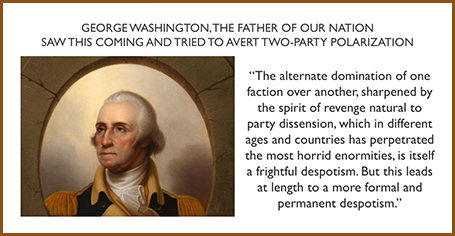
The party system was not included in the U.S. Constitution. It actually started as a result of the greatly differing visions of Hamilton and Jefferson. Hamilton wanted a strong federal government and industrial development in order to make the U.S.A. a major world power. Jefferson wanted more of an agrarian distributed nation. Hamilton’s views spawned the Federalist Party, and Jefferson’s gave birth to the Republican Democratic Party. The two men, although at odds ideologically, were able to work together and make deals such as the one which created the first national bank and led to what is today the Fed.

The Party system today is essential to get Presidential candidates to be known to the public, a costly affair because advertising is not free. In the future, it is conceivable that a different system might emerge in which the media charge nothing for political advertising (which would increase the cost of advertising to all the other categories by less than 3%).

Schools ought to bring back civics classes and inspire some students to become dedicated public servants motivated by non-ego, non-money, and non-power motivations. People who are of that ilk who want to run for office ought to be lifted up by even the small set of early supporters they find. Social media provides a way for the bubble up from grassroots method to be potentially viable. If the product (the candidate) is authentic enough and of high character, a noble human being like the Founders, for all their human flaws, he or she will go viral. The new mayor of New York is an example of what can happen (I do not know enough to say anything pro or con about his character; time will tell, let’s give him a fair chance), but he did rise rather rapidly from obscurity.

Times look dark when creativity has not been fully leveraged yet. There are more possible outcome scenarios than appear to be on the table based on the loud megaphones of the two parties and limited time each day for creative thought and imagination. AI and HI (Human Intelligence) together in harmony can overcome all messes.

To The Protectors

Volume 3, Issue 39

It is Veteran’s Day as I write this. On the way to the airport listening to the radio I heard the Mormon Tabernacle Choir doing a special show celebrating America and its war veterans.

Flashback to the 60s when certain protesters sometimes crossed the line to not only condemn the war but also the country itself with the moniker Amerika, sometimes substituting a swastika for the “k”. That saddened me.

We all make mistakes and sometimes they are big ones. This is true not only for individuals but also for groups of people like protesters, countries, corporations, even well-meaning nonprofits and religious institutions.

But the ideals of the Founding Fathers are unique among the articles of constitution for each of the 190+ nations on Earth. The U.S. Constitution is our Mission statement and our collective vision still. Protecting these ideals and this country that seeks to bring about a world based on these ideals is still a sacred trust.

Those who are warriors for any free nation, especially if they take that role voluntarily, are at least in part moved by a very high level of consciousness. The realization of something greater than oneself, and the urge to serve others. This can also be true of cops, firefighters, doctors, and many other vocations, even the oft-criticized paramilitary. Not every individual in these vocations is equally motivated by the idea of service and the will to protect, and that motivation can vary over time. But when one is in that headspace and heart space it is a form of the Flow state and attracts cosmic fire support — at least according to my Theory of the Conscious Universe, which is explored in my soon-to-be-published new book, You Are The Universe: Imagine That!

Most if not all of us would like to see an end to war, but this does not mean we should be unappreciative of the warriors. The prerequisites to ending war forever are not forever distant and unapproachable; in fact we are closer than ever to realizing these possibilities:

  1. Psychotechnology and education bring about better self-management and decision-making at an individual level everywhere, engendering sanity, clarity, perspective, menschness, and happiness.
  2. Science and technology release unlimited free energy by which there is plenty of whatever anyone might need or want, as in the “Culture” novels. With free energy we can afford to transport the Earth’s still abundant raw materials from where they are to where they are needed. Nicola Tesla was on the track of unlimited free energy a century ago and it is no further off than unlimited life extension. Perhaps another century will do the trick.
  3. Space travel provides enough room and raw materials to not have to fight over land.
  4. Medical science brings about the ultimate cures. Only a matter of time. Not soon enough to end the heartache in our lives but soon enough to remove great gobs of pain from the lives of our children’s children’s children.

It will all happen. If we don’t blow ourselves up or befoul the environment too much more between now and then.

In the meantime, here’s to the protectors. We still need them, and they deserve to be honored with our gratitude and deepest respect.

In that spirit, I’d like to share the lyrics to a song written by my friend Stan Satlin, who was inspired by Walt Whitman’s Leaves of Grass to write songs about the country he loves.

I Am an American

Chorus (repeats after each verse):

I am black and I am white, I'm yellow and brown
I am red white and blue, Yankee Doodle won't you come to town
I am the whole wide planet, rolled into one
I am a citizen of the world, I am an American

Verse 1:

I came from distant lands, to seek a better life
All I owned was on my back, by my side my wife
The work it wasn't easy, in the factory and the farm
But hope in me grew stronger, like the muscle in my arm               

Verse 2:

As I sailed across the ocean I was told of gold in the streets
When I arrived I soon found out not everything was sweet
I built the road and cities, from the east coast to the west
I've been tricked and cheated, but the land is still the best

Verse 3:

Some things are much better, some things still need change
I wish I could bring back some things, like buffalo on the range
I don't want to be a master or servant of any man
I just want to go on living my life, doing the best I can

And this, to honor the symbol that inspires our warriors, Old Ragged Flag, as told by Johnnie Cash: http://www.youtube.com/watch?v=Vgpp0V7sDbE.

Best to all,

Bill

Follow my regular blog contribution at Jack Myers Media Network: In Terms of ROI. It is in the free section of the website at  Bill Harvey at MediaBizBloggers.com.