Category Archives: A Plan for America

Be Careful What You Wish For

Welcome to this week’s Bill Harvey Blog
Created April 17, 2026

Quantum theory supports the notion that minds can contribute to the occurrence of events in the material world. This idea started to become popularized in the U.S. in the late 19th Century and was initially known as American Transcendentalism. Today, millions of people in the U.S. speak of “manifesting”, and this is particularly prevalent in the MAGA segment.

In my writings, I’ve postulated that the Universe responds to these inputs in a way very similar to counting the popular vote, and that minds that dwell upon scenarios they don’t want to happen help bring about the dreaded scenarios as much as those who want to bring them on.

Today’s uncomfortable world situation can be traced to the desires of many white Christians wishing for things that are actually counter to the wishes of Jesus.

In my view of the Conscious Universe, what we are living through today could be the Universe giving us what so many people have yearned for, as a way of getting them to realize that they have been confused in their thinking.

Bruce Springsteen, in his address at the Minneapolis No Kings Rally on March 28, reminded Americans of what their values are, and insisted that these are not expired; they are still our values, but many of us have not been upholding them.

At a layer under conscious values, the subconscious motivations drive all human action. The conscious values have some driving force on behavior, but they are overwhelmed by the subconscious motivations. In this way, the ego (which operates at conscious and unconscious levels) easily takes over, especially during periods of maximum distraction and minimum time set aside for contemplation and meditation.

Ego values are by definition selfish, conceited, arrogant, demanding, conniving, and concerned only with the success of the owner of the ego.

Someone who is consciously entirely devout and loves Jesus can therefore be quite capable of being unkind to strangers, needy people, people of different skin colors or genealogical heritages, directly contradicting the directions given so simply and clearly by Jesus. Going back a bit earlier in the Judeo-Christian philosophy and cosmology, Moses made it clear that a person cannot be loyal to both God and money at the same time. That was the symbolism of the Golden Calf, and the god of money was Mammon.

Ego was already taking over the human race that far back.

In the Old Testament, the phrase used to describe ego was the hardening of the heart.

Many books have been written about “The Secret” and “The Law of Attraction,” but they typically fail to warn against the ego. No self-improvement book is complete without fully arming the reader how to deal with his or her ego, how to recognize when the ego is at work, even when the ego is hiding in some rationalized bundle of idealistic values shot through with consciously invisible underpinnings of ego motivations.

Humans with half-knowledge of these phenomena tend to subconsciously want to stay in the ego, unaware that they are being played like a puppet by parts of themselves, which are conditioned layers of neuron networks grown in their minds as colonized invaders from the ideas of other people.

They fight like the dickens against the realization that they are not only brainwashed but also acting in a way that will make them unpopular, incapable of achieving great positive things that history will admire, petty, vulnerable to what other people think of them, and at the end of their lives when they go naked into the spiritual world, bereft of the virtues and powers that would enable them to gain leadership roles there.

They also make sure to stay in their own bubble of confirmation bias, where no unnerving ideas will disturb their black and white absolutism.

What will help these people – virtually all of us are subject to ego control from time to time, if not continuously – what can we do to speed up the cleansing of our minds?

We have to be able to control our attention. We need to pay attention internally as much as externally. Jesus said this, quoting the prophets of the Old Testament.

“Jesus taught that true control over the mind comes through surrendering it to God, rather than worldly conformity, to achieve transformation. He emphasized renewing the mind (Romans 12:2), guarding against negative thoughts, and bringing every thought into captive obedience to Him (2 Corinthians 10:5) to overcome spiritual battles and maintain peace. [1, 2, 3, 4]

Key concepts regarding Jesus and the mind include:

  • Renewing the Mind: Romans 12:2 teaches that Christians should not be conformed to the world but transformed by the renewal of their minds, enabling them to discern God’s will.
  • Taking Thoughts Captive: 2 Corinthians 10:5 calls for capturing every thought and making it obedient to Christ, comparing the mind to a battlefield.
  • Guarding the Heart/Mind: Proverbs 4:23 advises guarding the heart with all vigilance, as it is the source of life, which Jesus supported by emphasizing inward purity over outward conformity.
  • The Mind of Christ: Followers are encouraged to have the “mind of Christ” (1 Corinthians 2:16), which offers peace and perspective, rather than focusing on the “flesh,” which leads to death (Romans 8:6-11).
  • Replacing Negative Thoughts: Rather than just managing behavior, believers are encouraged to replace negative, sinful thoughts with Truth, allowing the Holy Spirit to transform thinking patterns. [1, 2, 3, 4, 5, 6, 7, 8]

Essentially, Jesus taught that mastering thoughts prevents them from becoming sinful actions, urging believers to align their mental life with his teachings. [1, 2]” (Google AI)

Love to all,
Bill


Live chat with my avatar


My new book POWERFUL MIND is now available in e-Book format at

amazon     &     Barnes & Noble

An innovative too for self-discovery

“A compelling, optimistic, and original approach to mental focus, Powerful Mind is an innovative tool for self-discovery and creative liberation. Succinctly outlined and intuitively structured, this book is replete with rational advice, using a radical but commonsense approach. It takes a rare and adroit thinker to incorporate myriad worldviews and welcome diverse readers, regardless of ideological allegiance, but Harvey shows himself to be precisely that. The book is a masterfully structured, intellectually affirming, and potentially paradigm-shifting read.”
~ Self-Publishing Review, ★★★★

How AI Might Help Shape a Better Future for American Politics

Welcome to this week’s Bill Harvey Blog
Created March 6, 2026

I’ve been asking AI a lot of questions lately about the American Revolution. I can see it like a movie now. Sort of like the original 1960 Ocean’s Eleven, when we see how the gang comes together like iron filings around a magnetic story arc.

In the real his-and-her-story (formerly known as his story, i.e., history), John Adams got religion first, around 1765, PO’ed by the Stamp Act and Taxation Without Representation.

George Washington, always methodical, gradually shifted his attitude over a period of years, 1769–1774, in increasing indignation against the British treatment of Americans as inferior. The major stimuli included trade restrictions and the Coercive Acts. But there was also a personal matter. He had joined the British Army, and because he was American, he was given the rank of Brevet Captain instead of full Captain. Apparently, his mother had rankled him all his young life with put-downs, which made him extra sensitive in his adult life to treatment like that.

Thomas Jefferson was drawn into the revolutionary mindset ~1774 (the turning point year, as we shall see in a moment) by the issues of infringement on natural rights and self-governance.

Alexander Hamilton joined the movement in 1774, spurred by political unrest in New York and the Continental Congress.

Benjamin Franklin was the last of this group to join. He spent decades in London trying to bridge the gap between the colonies and the Crown. He truly believed the British Empire could be saved. The turning point was the “Hutchinson Letters Affair” (1774), where he was publicly humiliated by British officials. He realized reconciliation was impossible and sailed home in March 1775, arriving in Philadelphia just after the battles of Lexington and Concord, ready to serve the rebellion.

Thomas Paine joined the American revolutionary movement upon arriving in Philadelphia from England on November 30, 1774. Recommended by Franklin, Paine quickly immersed himself in colonial politics, publishing his influential, pro-independence pamphlet Common Sense on January 10, 1776, which galvanized support for the revolution.

The American Revolution was primarily influenced by Enlightenment philosophers, most notably John Locke, whose theories on natural rights (life, liberty, property) and the social contract directly shaped the Declaration of Independence. Other key influences included Montesquieu (separation of powers), Rousseau (popular sovereignty), and Thomas Paine (republicanism). Most of the Founders themselves also wrote brilliant philosophical treatises. If we had leaders today who were as creative in thinking about the future, we would probably not be in the current mess.

Enter AI.

The USA is a representative democracy, and this worked for almost 250 years, but it is showing signs of wear. The necessity for representatives was obvious all this time because there was no way for all of us to vote every day on every big and little decision and still get anything else done, like producing goods and services, inventing things, defending the nation, etc.

AI does change this. It would be possible for each of us to tell AI everything we want government to do and not do, every day, as the spirit moves us. AI could combine all this input from ~325 million people, knowing which ones are adults and eligible to vote, which ones are citizens but minors, which ones are immigrants not eligible to vote. AI could provide summaries of what We, The People want continuously to the government at all levels, as well as to the press and to educators and back to all of us.

This would seem to be a highly probable eventuality at some point. It might start very soon as unofficial experimentation and perhaps as a more constructive channeling of the shouting match we call social media.

This would use a lot of computing power and have a high carbon footprint and possibly lead to some breakthroughs in clean energy sources.

Rooting out biases in AI and the need for continuous fact checking would be crucial in such a system.

Bad actors would focus on political cybermanipulation. Good agents of the Justice and Intel systems would work to keep them from ruining a good thing.

But wait! How would this be better than polling? Doesn’t polling serve this function already?

Polling is limited to the ideas which are already on the table. The AI method would pick up creative new ideas even if only one person came up with them. In fact the national governmental AI should not be a single AI but a collegial team of AIs looking at the same data from many viewpoints, some looking for new ideas, some fact checking, some looking for historical precedents, and so on.

Polling has another problem of representativeness. The response rate to polling is typically under 10%, suggesting a very large nonresponse bias. Pew and other sources taken together suggest that something like 87% of Americans use social media, implying a willingness to key in at least a few words every now and then. The AI scenario envisioned here would be voice driven rather than requiring keystrokes, which would also be an option. In order to maximize engagement, the government could offer modest tax rebates based of the degree of contribution to the ideas of the nation.

We would still need representatives and the rest of government at all levels to carry out the wishes of the people. In fact, the mess we are in now is only slightly the result of imperfections in the system the Founders designed, and a much larger factor is the imperfections of the people in that system.

If we elected people who were of good character, devoted to the good of the many, more of us would vote.

“Using data from the University of Florida Election Lab, a new analysis by the Environmental Voter Project shows that 85.9 million eligible voters skipped the 2024 general election, far surpassing the 76.8 million ballots cast for Donald Trump or the 74.3 million for Kamala Harris.

If “Did Not Vote” had been a presidential candidate, they would have beaten Donald Trump by 9.1 million votes, and they would have won 21 states, earning 265 electoral college votes to Trump’s 175 and Harris’s 98.” This quote from the Environmental Voter Project website.

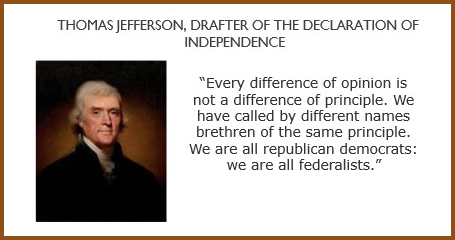
The party system was not included in the U.S. Constitution. It actually started as a result of the greatly differing visions of Hamilton and Jefferson. Hamilton wanted a strong federal government and industrial development in order to make the U.S.A. a major world power. Jefferson wanted more of an agrarian distributed nation. Hamilton’s views spawned the Federalist Party, and Jefferson’s gave birth to the Republican Democratic Party. The two men, although at odds ideologically, were able to work together and make deals such as the one which created the first national bank and led to what is today the Fed.

The Party system today is essential to get Presidential candidates to be known to the public, a costly affair because advertising is not free. In the future, it is conceivable that a different system might emerge in which the media charge nothing for political advertising (which would increase the cost of advertising to all the other categories by less than 3%).

Schools ought to bring back civics classes and inspire some students to become dedicated public servants motivated by non-ego, non-money, and non-power motivations. People who are of that ilk who want to run for office ought to be lifted up by even the small set of early supporters they find. Social media provides a way for the bubble up from grassroots method to be potentially viable. If the product (the candidate) is authentic enough and of high character, a noble human being like the Founders, for all their human flaws, he or she will go viral. The new mayor of New York is an example of what can happen (I do not know enough to say anything pro or con about his character; time will tell, let’s give him a fair chance), but he did rise rather rapidly from obscurity.

Times look dark when creativity has not been fully leveraged yet. There are more possible outcome scenarios than appear to be on the table based on the loud megaphones of the two parties and limited time each day for creative thought and imagination. AI and HI (Human Intelligence) together in harmony can overcome all messes.

Even in Uncivil War, Can We Agree On Some Things?

Welcome to this week’s Bill Harvey Blog
Created February 13, 2026

George Washington

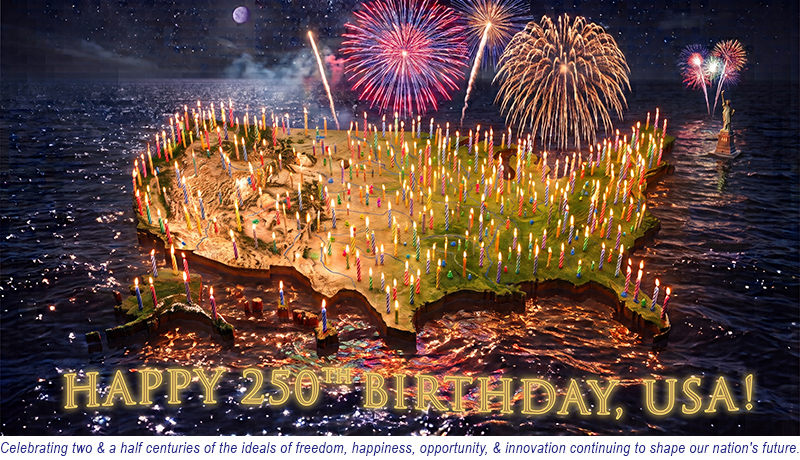
This July 4th is the 250th Anniversary of the Declaration of Independence. The USA has been around for a quarter of a millennium. The longest running Noble Experiment in Self Rule by The People. Often referred to in the past as the Greatest Hope For The World.

And yet these are among our darkest hours, on a par with the Civil War, the War of Independence, and the early days of WWII, when we were not sure we could win it. Another one of those times when the continued existence of the USA as conceived by The Founders is not guaranteed.

We have not had many of these existential threat periods in our history. Only a few of us alive today were there the last time this happened, which was the dark period between December 7, 1941 (Pearl Harbor) and February 2, 1943 (the battle of Stalingrad). The Allied victories at El Alamein and the battle of Midway, followed by Stalingrad, turned the tide and made us feel certain we were going to win, surely at terrible cost in lives.

We are back in one of those situations again, perhaps the worst of all, because we are internally at war with ourselves, as in the Civil War. But this time it seems to go much deeper than in the Union vs. Confederacy war. Is it because of the mind-bending media we now have, which are being used intentionally and unintentionally to divide us? The race issue is still a part of it, but now there appear to be many more issues which divide us. Is one key difference between the Civil War and today’s internal polarization that we now face a horde of irreconcilable issues?

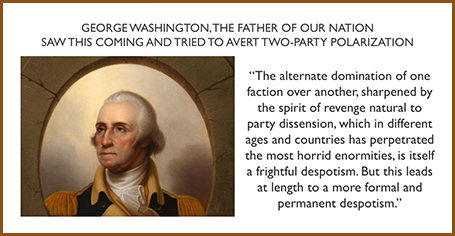
I wonder. It’s conceivable that we are closer together than we realize on a great many (not all) issues. What puts the venom in the situation is the divided loyalties caused by the existence of two teams that have always been rivals, and that rivalry in recent decades has become increasingly bitter (see quote from George Washington at the top of this article).

If We The People still want to rule ourselves, and if we are dissatisfied with both political parties to some extent, can we set aside the teams for a while and just talk amongst ourselves about the issues? (Thanks to Bob DeSena for his ongoing emphasis on issues, without which I might not have gotten this idea.)

But let’s not look at that one idea as a panacea. It’s likely that even when discussing the issues, there will be a tendency to flare up when it becomes evident that one’s party has a very different vision on that issue than the other party. It will be difficult for people to be able to separate party loyalties from the issues. In higher states of consciousness (Observer state and Flow state), one can perform this trick, but in the default network state of Emergency Oversimplification Procedure (EOP), automatic reactions will follow ingrained patterns.

So what can we do to bring us all back together again?

It’s still worth thinking creatively about issues, and sharing any innovative ideas in social media, with your government representatives, and with your friends, family, and acquaintances. Good ideas tend to bubble up in the zeitgeist. Don’t look for getting credit for your good ideas, spread them unselfishly for the good they may do, and be satisfied if they get a public hearing, even though no one remembers it was your idea.

The political discourse has, in my lifetime, been plagued by a paucity of creative new ideas. It always seems to be the same old ideas recirculated again and again. People want a change from that.

There is something else we can all do, which will have a positive effect even though it may sound like magical thinking.

Imagine the two warring sides gradually, like a giant zipper that has been unable to zip closed, finally slowly closing, one click at a time, as the two sides see ways to agree on one little thing at a time. Picture how it might happen. Two people discussing one of our many problems and somehow, between them, converging on common ground solutions that have never been tried or even thought of before.

Outside of politics, these Aha moments happen every day. People are more creative than ever before. Thirty million Americans are now Creators; everyone is writing books, blogs, doing podcasts, and we are more creative now than ever before. Let’s bring politics into the creativity game. It doesn’t have to be a sad show forever. It wasn’t a sad show to be a patriotic American for a quarter of a millennium. It has only been sad for a little while, and we are feeling like there is no light at the end of the tunnel. That feeling itself can be a self-fulfilling prophecy. Undo that feeling.

Here’s what some of our Presidents said about these subjects, worth remembering in honor of Presidents’ Day:

John Adams, the second President of the USA:

“The happiness of society is the end [goal] of government.”

“There is danger from all men. The only maxim of a free government ought to be to trust no man living with power to endanger the public liberty.”

James Madison:
“The Constitution is the guide which I will never abandon.”

James Monroe:
“The best form of government is that which is most likely to prevent the greatest sum of evil.”

“A free, virtuous, and enlightened people must know full well the great principles and causes upon which their happiness depends.”

“National honor is national property of the highest value.”

John Quincy Adams:
“If your actions inspire others to dream more, learn more, do more and become more, you are a leader.”

“’Courage and perseverance have a magical talisman, before which difficulties disappear and obstacles vanish into air.”

Andrew Jackson:
“Every good citizen makes his country’s honor his own, and cherishes it not only as precious but as sacred.”

“As long as our government is administered for the good of the people… it will be worth defending.”

“Any man worth his salt will stick up for what he believes right, but it takes a slightly better man to acknowledge instantly and without reservation that he is in error.”

Abraham Lincoln:
“The struggle of today is not altogether for today – it is for a vast future also.”

“It is for us the living, rather, to be dedicated here to the unfinished work which they who fought here have thus so far nobly advanced.

“With malice towards none, with charity for all… let us strive on to finish the work we are in.

Thomas Jefferson

Love to all,
Bill


POWERFUL MIND 12 Simple Keys
available February 16

POWERFUL MIND 12 Simple Keys by Bill Harvey

A July 4th Message from the Father of Our Country

Welcome to this week’s Bill Harvey Blog.
Updated July 3, 2025. Original post: July 2, 2021

HAPPY AMERICAN INDEPENDENCE DAY 2025!

The address of Gen Washington to the People of America

Washington’s Farewell Address

For at least two decades from July 4, 1776, George Washington was the most trusted person in the United States of America.

The Walter Cronkite of his times.

He served as President when, to him, the job was a burden rather than a prize.

He was the glue of authenticity and integrity that gave our country its chance to build a foundation that would last.

For two decades, he made parties unnecessary, because all differences could be resolved in him.

And then, when the party divisions arose with their bitterness and hate, he stood down and would not accept another term as President. He was 64. Average life expectancy for an American male was 36.

In departing, he was sure to warn us about the forces that were arising to counter the most innovative governmental structure in history.

In this post, I will read you some excerpts from George Washington’s final address, his last guidance to the children of the country he helped create and lead through its fragile infancy. I’ll also provide the link to the full going away letter he left for all of us, which is read annually to both houses of Congress.

I hope it revitalizes your true loyalty to our true bedrock principles, and helps bring the unity we need now more than we have ever needed it before.

Washington begins by humbly and diffidently explaining why he will not accept another term in office:

Transcript Excerpts of President George Washington’s Farewell Address (1796)

Friends and Fellow Citizens:

The period for a new election of a citizen to administer the executive government of the United States being not far distant, and the time actually arrived when your thoughts must be employed in designating the person who is to be clothed with that important trust, it appears to me proper that I should now apprise you of the resolution I have formed, to decline being considered among the number of those out of whom a choice is to be made.


Later in his address, he warns of the dangers of the political parties just then sprouting up in America:

I have already intimated to you the danger of parties in the State, with particular reference to the founding of them on geographical discriminations. Let me now take a more comprehensive view, and warn you in the most solemn manner against the baneful effects of the spirit of party generally.

This spirit, unfortunately, is inseparable from our nature, having its root in the strongest passions of the human mind. It exists under different shapes in all governments, more or less stifled, controlled, or repressed; but, in those of the popular form, it is seen in its greatest rankness, and is truly their worst enemy.

The alternate domination of one faction over another, sharpened by the spirit of revenge, natural to party dissension, which in different ages and countries has perpetrated the most horrid enormities, is itself a frightful despotism. But this leads at length to a more formal and permanent despotism. The disorders and miseries which result gradually incline the minds of men to seek security and repose in the absolute power of an individual; and sooner or later the chief of some prevailing faction, more able or more fortunate than his competitors, turns this disposition to the purposes of his own elevation, on the ruins of public liberty.

Without looking forward to an extremity of this kind (which nevertheless ought not to be entirely out of sight), the common and continual mischiefs of the spirit of party are sufficient to make it the interest and duty of a wise people to discourage and restrain it.

It serves always to distract the public councils and enfeeble the public administration. It agitates the community with ill-founded jealousies and false alarms, kindles the animosity of one part against another, foments occasionally riot and insurrection. It opens the door to foreign influence and corruption, which finds a facilitated access to the government itself through the channels of party passions. Thus the policy and the will of one country are subjected to the policy and will of another.

There is an opinion that parties in free countries are useful checks upon the administration of the government and serve to keep alive the spirit of liberty. This within certain limits is probably true; and in governments of a monarchical cast, patriotism may look with indulgence, if not with favor, upon the spirit of party. But in those of the popular character, in governments purely elective, it is a spirit not to be encouraged. From their natural tendency, it is certain there will always be enough of that spirit for every salutary purpose. And there being constant danger of excess, the effort ought to be by force of public opinion, to mitigate and assuage it. A fire not to be quenched, it demands a uniform vigilance to prevent its bursting into a flame, lest, instead of warming, it should consume.

He goes on to warn against the danger of one branch of government becoming dominant:

It is important, likewise, that the habits of thinking in a free country should inspire caution in those entrusted with its administration, to confine themselves within their respective constitutional spheres, avoiding in the exercise of the powers of one department to encroach upon another. The spirit of encroachment tends to consolidate the powers of all the departments in one, and thus to create, whatever the form of government, a real despotism. A just estimate of that love of power, and proneness to abuse it, which predominates in the human heart, is sufficient to satisfy us of the truth of this position. The necessity of reciprocal checks in the exercise of political power, by dividing and distributing it into different depositaries, and constituting each the guardian of the public weal against invasions by the others, has been evinced by experiments ancient and modern; some of them in our country and under our own eyes. To preserve them must be as necessary as to institute them. If, in the opinion of the people, the distribution or modification of the constitutional powers be in any particular wrong, let it be corrected by an amendment in the way which the Constitution designates. But let there be no change by usurpation; for though this, in one instance, may be the instrument of good, it is the customary weapon by which free governments are destroyed. 

To me, the humility, authenticity, and kindness of the Father of our Nation comes through loud and clear in these his last words of advice, to us his children, endowed to carry on the idealism of the Founders.

Let his spirit re-inspire us to our original Mission and Values, and help us return to unity with forgiveness and a renewed dedication to work together for the good of all of us.

What you feel when you read these words of George Washington…
You are feeling what it is to Be An American.

This American Noble Experiment is worth preserving!

Commemorating and honoring that Beacon for The World,

A song from the heart of Ray Charles in 2022, 50 years after first singing this rendition of it on the Dick Cavett Show.

I hope you agree with me that this post should be sent to as many Americans as possible. If we each send it to 10 or more people asking them to send it to ten or more people, by the sixth round at least a million people will have received it.

My best wishes to all,
Bill


Image source: George Washington, Public domain, via Wikimedia Commons

This image is available from the United States Library of Congress’s Religion and the Founding of the American Republic exhibition.