Category Archives: Emergency Oversimplification Procedure

Being a Fool Is Not Necessarily a Permanent Condition

Welcome to this week’s Bill Harvey Blog
Created April 10, 2026

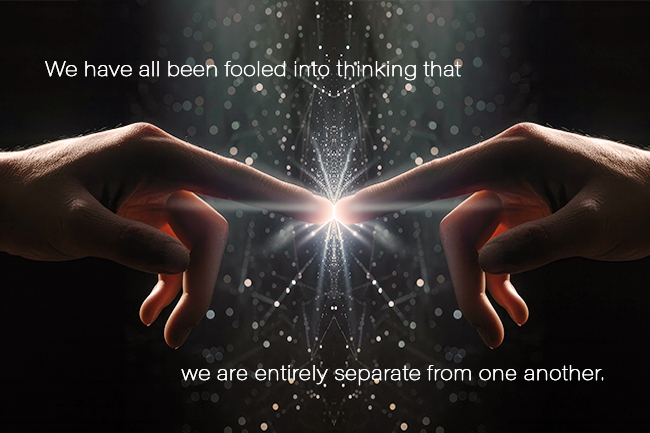
We have all been fooled into thinking that

In honor of the recent April Fool’s Day, some thoughts here about the idea of being a fool.

The word has had more than one meaning since it came into the English language in around the 13th Century. It comes from the Latin word for “bellows or inflated ball”, figuratively meaning an airhead. It came to English through French, where its connotations at one time were “the King’s jester” and at other times “insane” or even “a prostitute”. Even in English today, it has multiple meanings. It can mean someone who acts with poor judgment, a know-nothing, or someone who is gullible and can be easily taken in by a trickster.

In my opinion, each of us has a certain probability of doing something foolish at one point or another. We can be a fool for a moment or a day and then come out of it.

In today’s environment, in which the internet and AI enable scammers to trick even the smartest of us, we can be made fools of, possibly with greater frequency than in the past, if we are not cautious and patient enough. Acceleritis tends to cause us to always be rushing, and that leads to being a fool more often than we’d like.

It can make us feel really bad when we realize we have just now acted like a fool. We tend to quickly lose all confidence in ourselves. This is an overreaction and a dangerous one. Take it in stride; it’s part of life, it happens to all of us.

The most dangerous thing of all is to be stubbornly resistant to admitting that one has been played for a fool. Everyone in your life may be completely aware that you have been played like a violin and that you are in permanent and rigid denial. That makes others really lose respect for you. Much more than if you admitted your mistake.

Admitting that you can make mistakes, that you can be fooled, gains you respect from every person.

We all know how hard it is to admit our mistakes. When a person has the guts to do this difficult thing, everyone knows what reservoirs of integrity and strength undergird such actions.

Confucius said, “Someone who will not admit he made a mistake is making another one.”

Admitting mistakes is good because you can then learn from them. As you probably know, my cosmic philosophy is that we are here to learn, and that means making mistakes, for without mistakes, there cannot be much learning. And without admitting mistakes, there cannot be much learning.

There is a specific mental/emotional function which causes the refusal to admit mistakes. It’s called the ego.

Freud theorized that the ego was not the original self we are born with, but a mediator with the outside world, which forms as a functional center the first time our needs are thwarted. I agree with this theory; it jibes with my own personal science project of studying the way my own mind works for my entire life. Not that I remember the event of my ego coming into existence, but I can discern impulses coming from an egoistic source within myself from impulses arising from a different source within myself which is not so hung up on what happens to this particular body I’ve been assigned to this time around.

The two sources are not equally competent at making good decisions. I define good decisions as those whose outcomes are beneficial to all concerned. The ego is terrible at making such decisions. Its bias toward its own owner blinds it to opportunities to gain much more for that owner by making things come out all right for everyone involved in the situation.

The ego is an inferior part of the mind which makes decisions that end in our unhappiness and regret.

Unfortunately, not only do we live in a culture which feeds the dominance of the ego, the culture also creates a competitive race which has led to uncontrollable Acceleritis – inhuman amounts of information overload as a distraction. We are born in a relatively angelic state and are turned into egoists operating largely in Emergency Oversimplification Procedure (EOP). This causes us to mess things up on a grand scale, which condition is the one part of my narrative that is now universally recognized to be the unvarnished truth.

The Bible made the connection between “fool” and “ego” in Proverbs without using the word “ego” but by describing many of the main traits of egoistic behavior:

“In the Book of Proverbs, a fool is not merely someone lacking intelligence, but a person characterized by moral deficiency, arrogance, and a stubborn rejection of wisdom, discipline, and godly instruction. They are self-sufficient, quick-tempered, and prone to reckless speech that leads to ruin.

Usage Examples of “Fool” in Proverbs:

  • Rejection of Wisdom: “Fools despise wisdom and instruction” (Proverbs 1:7).
  • Arrogance: “The way of a fool is right in his own eyes” (Proverbs 12:15).
  • Uncontrollable Anger/Speech: “A fool gives full vent to his spirit” (Proverbs 29:11) and “A fool’s mouth is his ruin” (Proverbs 18:7).
  • Repeating Mistakes:

“Like a dog that returns to his vomit is a fool who repeats his folly” (Proverbs 26:11).

  • Quarrelsome: “It is an honor for a man to keep aloof from strife, but every fool will be quarreling” (Proverbs 20:3).

Synonyms and Types of Fools in Proverbs:

  • Simple/Simpleton: Gullible, naive, and easily led astray.
  • Scoffers/Scorner: Proud, mocking, and hostile toward correction.
  • Sluggard: Lazy and reckless with their responsibilities.
  • Babbling Fool: One whose speech is chaotic and foolish (Proverbs 10:8).

Common traits include being quick to anger, untrainable, and unteachable, often needing drastic, painful lessons to learn, as noted in Proverbs 27:22.”

– (Source: Google AI)

People who do not vote have been fooled. They think their votes don’t matter. They think they are powerless. They think the world is all screwed up far beyond anything they can do to make it better. It’s not true. In the 2024 election, 89 million eligible voters did not vote in the presidential election. That’s more people than voted for either candidate.

Some people who did vote know on some level that they have been fooled, but only some of them are willing to admit it.

We have all been fooled into getting into this polarized two-party headspace. We are all Americans, we are all citizens of the Earth, citizens of the universe, and in my estimation, we are all avatars of the One Consciousness that is the universe.

We have all been fooled into thinking that we are entirely separate from one another.

It’s not the end of the world to be fooled, nor to admit we were wrong about something.

We’re all fools to some degree, but we can gain back our self-respect and dignity by admitting our mistakes and moving on.

Happy belated April Fool’s Day! Happy glorious Spring!
May we all spring forward in all our inward and outward endeavors!

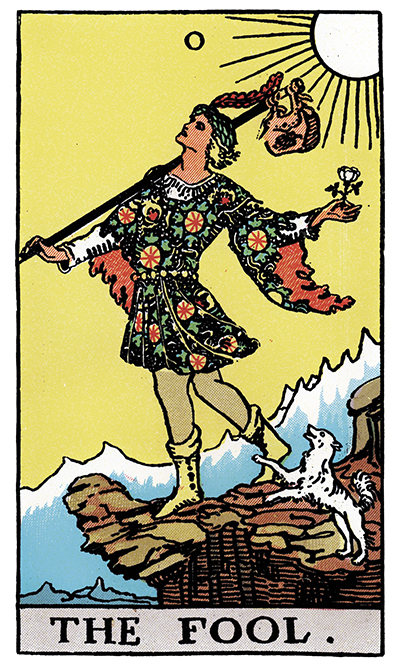
The Fool

Love to all,
Bill


Live chat with my avatar


My new book POWERFUL MIND is now available in e-book and print format at

amazon    

An innovative too for self-discovery

“A compelling, optimistic, and original approach to mental focus, Powerful Mind is an innovative tool for self-discovery and creative liberation. Succinctly outlined and intuitively structured, this book is replete with rational advice, using a radical but commonsense approach. It takes a rare and adroit thinker to incorporate myriad worldviews and welcome diverse readers, regardless of ideological allegiance, but Harvey shows himself to be precisely that. The book is a masterfully structured, intellectually affirming, and potentially paradigm-shifting read.”
~ Self-Publishing Review, ★★★★

Never Growing Up

Welcome to this week’s Bill Harvey Blog
Created April 2, 2026


The big problem with Emergency Oversimplification Procedure (EOP) – the pandemic, which almost no one realizes has made most of us borderline psychotics – is perhaps more accessibly explained as never growing up. Still thinking and acting childishly, but in a bigger physical body.

In the still male-dominated civilization we have inherited, this manifests as little boys becoming bigger boys but still playing with the same sorts of toys. Even before the ages when violent video games became the main toy, little boys and girls were privy to watching the television/streaming shows which glorify the heroes who are experts in violence. These are the characteristics of heroes that we teach children: they can punch out every bad guy. They are also good with guns and can throw knives with uncanny accuracy. Not just the heroes but also many of the heroines, particularly of the Marvel variety.

How could it end up any differently when violence dominates the news and, in a somewhat more controlled way, is inherent in sports? On top of reality shows, dramas, etc.

President Eisenhower warned us against the military-industrial complex. That has evolved now into the military-technology complex. The four biggest technology companies, Google, Meta, Amazon, and Microsoft, are each now the size of a mid-sized country in terms of annual gross revenues produced, and are projected to become the size of large countries soon.

“Everybody wants money and fame,” my great friend Zoe Kalar despairs. Her action to make this situation better has been to spend years building a better social media called 8. Standing for the infinity symbol standing up. Encouraging creativity and love, and AI-protected against hate. With millions of people and growing, backed by over a hundred caring advertisers.

Violence, money, and fame ought not occupy such large shares of our timespace. A more civilized civilization would spend more of its timespace with authenticity, respect, taking responsibility, creativity, love, doing good, and having uplifting and thought-provoking fun experiences. Although our rational minds might universally agree with this last statement, our rational minds are not in control of our actions.

Not growing up consists of acting out the conditioning received from others without realizing it. Not observing and learning from one’s own behavior and feelings what is really driving you. Not taking control over from that robot. Not choosing your own autonomous life and values. Not discovering your true gifts and developing them to Flow state levels. Living a meaningless life.

A brilliant article by Cal Newport in The New York Times recounts how physical exercise went from being something done regularly by 24% of Americans to 60% of the U.S. population between 1955 and 1971, and he lays out a plan for inducing a similar uptick in cognitive exercise. I’ve been trying to do the same thing all my life. I just wrote a note to Cal that reading and setting time aside for contemplation and staying away from social media are all definitely parts of the exercise needed, and I sent him copies of my two books of cognitive exercise, Mind Magic and Powerful Mind. I mentioned to him my diagnosis that long before today’s tech, our species was already on a long downhill decline in the use of our amazing brains and minds, as a result of mass conditioning to prescribed ideologies, and the absence of a culture supportive of daily periods of solitary contemplation.

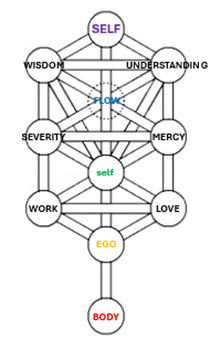
The ancient Kabbalah schematic called the Tree of Life was, in my estimation, a coded understanding of the process of growing up.

Self - Wisdom - Understanding - Flow...

Cautionary note: This is my intuitive interpretation, and may be considered unorthodox or revisionist by serious teachers and students of Kabbalah.

There are 5 levels of the self, going down the middle from top to bottom. We are born and at first simply experience the life of the body, not necessarily remembering anything from the day before. Soon the ego is born, the first time we do not get something we need, and a manager appears in our minds to rectify such situations in the future (Freud’s idea, which I agree with). We might live 100 years and not go any further than that.

Or, under the right circumstances, most of us can also shift at times into a state in which we are non-self-protectively simply being genuine. That is the “self” in the sphere right above the ego. The Tree of Life implies (to me) that we must achieve a balance between love and work in our lives in order to achieve a stable evolution from ego to self.

Most non-Americans have a view that Americans are all workaholics. This is supported by a lot of good evidence, although it might not apply to all of us. That would definitely constitute an imbalance which would set us back in growing up. In addition, our culture does not make it easy for us to align the work we get paid for with what our passion work would be, and there is no cultural inducement for us to spend any time trying to figure out what our passion work would be. These things tend to keep us from growing up to all that life offers.

Nevertheless, most of us have experienced some time in the self, and many of us get a bit of that each day for most days of the year.

Then, in order to keep growing up, we need to balance mercy and severity. This is very difficult. In the USA, we have split into two subcultures: one of which is overbalanced in the direction of severity, and the other, which is overbalanced in the direction of mercy. Because of the male domination and glorification of violence by most of our stories and heroic role models, severity appears more attractive, and this appears to be reaching a peak at the moment.

Whenever we, as individuals, have escaped from ego into self, and also achieve a balance between severity and mercy, we rise to yet a higher level of consciousness: the Flow state. Here, everything we do is automatically the right thing, for as long as the state lasts, often broken by ego thoughts and feelings, cutting the connection.

Once we have reached that penultimate state, we are called a mensch in the Jewish subculture.

At that point, there is one final balance to be achieved, between wisdom, “knowing what the right action to take is,” and understanding, “accepting the situation and forgiving those who do not take right action.”

When that final balance has been achieved, the human has spiritually merged with the One Consciousness of the Universe, the Self, capital S.

In India, such a person is called a sadguru, a true guru. This confers the additional power to lift others simply by one’s presence. This is the end goal of growing up. In Eastern philosophies, the purpose of reincarnation is to achieve this end goal, which is likely to take more than a single incarnation if one is born on a planet as a member of a very young species which has not yet learned to make the best use of all of its potentials.

Love to all,
Bill


Live chat with my avatar


My new book POWERFUL MIND has some great reviews

An innovative too for self-discovery

“A compelling, optimistic, and original approach to mental focus, Powerful Mind is an innovative tool for self-discovery and creative liberation. Succinctly outlined and intuitively structured, this book is replete with rational advice, using a radical but commonsense approach. It takes a rare and adroit thinker to incorporate myriad worldviews and welcome diverse readers, regardless of ideological allegiance, but Harvey shows himself to be precisely that. The book is a masterfully structured, intellectually affirming, and potentially paradigm-shifting read.”
~ Self-Publishing Review, ★★★★

Why Should We Be Good?

Welcome to this week’s Bill Harvey Blog
Created March 27, 2026

For thousands of years, great spiritual leaders and philosophers have given us all kinds of different answers to this question. And yet, from the beginning of recorded history right up to the present, it is mostly a record of bad behavior.

Why can’t we be good?

Is it because none of these answers is persuasive enough for the average person?

Ancient Eastern Philosophy

  • Lao Tzu (Taoism): To align with the Tao (the natural way of the universe). Acting with virtue isn’t about following rules, but about returning to a state of natural balance and simplicity.
  • Confucius: To maintain Social Harmony. Being “good” (Ren) fulfills our roles within the family and state, ensuring a stable, functional society through ritual and respect.
  • The Buddha: To end Suffering (Dukkha). Ethical conduct (Sila) is a prerequisite for mental clarity; by avoiding harm, we untangle the karmic knots that keep us bound to cycles of pain.

Classical Western Philosophy

  • Socrates & Plato: For the Health of the Soul. Just as a diseased body cannot function, an unjust soul is chaotic and miserable. Virtue is the “order” of the soul.
  • Aristotle: To achieve Eudaimonia (Flourishing). He argued that being virtuous is the unique “function” of a human; we are only truly happy when we are excellent at being human.
  • The Stoics (Marcus Aurelius/Epictetus): Because Virtue is the Only Good. External things (wealth, health) are indifferent; acting with reason and integrity is the only thing truly within our control.

Religious Traditions

  • Moses/Jesus/Muhammad (Abrahamic): To Obey and Imitate the Divine. The reasoning is rooted in a covenant: being good is an act of love, justice, and obedience toward a Creator who embodies these traits.
  • Krishna (Bhagavad Gita): As Selfless Duty (Dharma). We act righteously not for the “fruits” (rewards) of the action, but because it is our divine duty to maintain the cosmic order.

Enlightenment & Modern Philosophy

  • Immanuel Kant: Out of Rational Duty. He proposed the Categorical Imperative: you should act only according to rules that you would want to become universal laws for everyone.
  • John Stuart Mill (Utilitarianism): To Minimize Pain and Maximize Pleasure. The reason to be good is simple math: our actions should aim for the greatest happiness for the greatest number of people.
  • Friedrich Nietzsche: To Create Meaning. While he critiqued “slave morality,” he believed the “Overman” must create their own virtues to overcome nihilism and say “yes” to life.

Admittedly, all of these notions are obviously “hifalutin” as perceived by the average person. The average person is all wrapped up in having been hypnotized by over-acculturation and is in a state of Emergency Oversimplification Procedure (EOP), especially in our Age of Acceleritis in which information overload has clogged our neurons to the breaking point. Driven like a robot by conditioned reactions, subconscious drivers, and emotional mood swings make the average person go.

All of these ethical ideas are beyond the scope of available cognitive focus. So we would as likely be bad as good in any given moment, were it not for the maturation process that teaches us to try to get along because otherwise life is even more painful.

The rational mind itself cannot cause the individual to choose to be ethical and to then be able to carry that out. Too much of behavior is caused by the subconscious. Years or decades may be spent getting the subconscious to follow the intentions of the rational mind, and most people do not even try.

Why has the world taken a dark turn recently? Why do we now seem to expect and allow and even put on a pedestal, bad behavior?

In my view, it’s the combination of not knowing how to steer the mind and feelings, and the recent contraction of spirituality as a way of life. Even when I was growing up, the adherence to religious codes was very strong compared to the nihilism of the 21st Century.

The greatest times in terms of good behavior were back when spirituality went deep and was felt as being as real as the material world. Now, the people who believe themselves to be the most moral and ethical people cannot see their own bad behavior.

There is no sense of Meaning. Life is perceived to be Meaningless, so naturally, we can do whatever we want.

The virtues which led us for thousands of years have now slipped away into a relativistic grey area, giving us a sense of greater freedom, license to be bad, and there are no hard and fast guardrails. So naturally, those among us who lacked love in their youth would take bad behavior to extremes.

Right around the next corner, quantum physics is going to solve the hard problem of consciousness, and accept what the inventors of quantum physics already knew: the universe IS a Single Consciousness of which each of us is an avatar.

This does not negate biblical history; it explains how all of it can be true.

When this becomes widely known, it will gradually reinstate the perennial ideas about the need to be kind to one another – because we ARE one another.

And because the world has Meaning. One Consciousness is at play, that is the meaning of the universe. We are here to enjoy it and to learn from it. To play nice with each other. All of the reasons given by spiritual leaders and philosophers are right.

My reason to be good is that it makes everything better for me and everyone else.

Being bad is, underneath it all, a way of striking back at a universe that one feels has mistreated you. Actually, you did it to yourself, but most of us do not want to take responsibility for the consequences of our actions; it is part of EOP, and the way you see everyone else acting.

Of all of the spiritual leaders and philosophers discussed above, it is Nietzsche who comes closest to rationalizing the current mode of thinking: we each make up our own Meaning, we each decide what is real Virtue. It has created an era which really fits what Hobbes thought of the human race.

Hobbes argued that without a central authority or moral rules, humans live in a “State of Nature.” In this state, everyone has a right to everything, leading to a “war of all against all.” He famously described life here as:

“…solitary, poor, nasty, brutish, and short.” He felt that a strong leader would be the solution, forcing people to follow the rules or else. History has proven him wrong about this last bit. The Leviathan leaders have made things more like what Hobbes saw as the state of nature. Lao Tzu was closer to the mark on seeing the state of nature as idyllic.

To answer the question posed at the beginning of this article, we benefit by following the good path, and we benefit others by it.

By living a virtuous life of kindness to others, we tap into the love that is all around us and add to it, a truly spiritual feeling, and one that has meaning for everyone.

Love to all,
Bill


Live chat with my avatar


My new book POWERFUL MIND has some great reviews

An innovative too for self-discovery

“A compelling, optimistic, and original approach to mental focus, Powerful Mind is an innovative tool for self-discovery and creative liberation. Succinctly outlined and intuitively structured, this book is replete with rational advice, using a radical but commonsense approach. It takes a rare and adroit thinker to incorporate myriad worldviews and welcome diverse readers, regardless of ideological allegiance, but Harvey shows himself to be precisely that. The book is a masterfully structured, intellectually affirming, and potentially paradigm-shifting read.”
~ Self-Publishing Review, ★★★★

Which Level of Consciousness Do You Want To Be In?

Welcome to this week’s Bill Harvey Blog
Created February 20, 2026

Flow state, the Zone, where everything does itself perfectly, you exceed your expectations of performance limits.

You have undoubtedly noticed that you are not always at your best. Almost nobody is. Sometimes we have very smart ideas, at other times our minds are dull, and at other times we think we are thinking very intelligently, only to discover that we were way off and should have known better from various earlier experiences and supposed learnings.

We generally assume that this is the way things are and that there is no way to improve our own mental/emotional performance, with some exceptions. We might read a self-betterment book or article once in a while. We might take a supplement that is for making our memory and other faculties work better. If someone we trust gives us earnest advice, we might listen with an open mind, and take it to heart, try to be better in the way suggested. We might even meditate or do yoga.

All of this is admirable. But is it enough? Have we pulled out all the stops to maximize our own performance at the game of life? Should we? Is it worth it? If it were so important, wouldn’t everybody be doing it?

The game isn’t set up that way. Particularly today, when so many people have more than one job in order to make ends meet and maintain the all-important lifestyle, who’s got the time for the luxury of being a perfectionist in any area of life? With two media bombarding you during most waking moments (sometimes only one), who can focus on anything anyway? And if you had a moment to spare, would you want to fill it with something that seems very hard and complicated?

Of course not. Nor should you. Fortunately, upping your consciousness does not have to be hard, nor complicated. And it can make you feel better fast and all the time. This post is all about the lazy person’s way of hacking consciousness. Winning with minimum effort. What a relief!

First, a quick, simplified map of the three levels of consciousness you can be in:

  1. Flow state, the Zone, where everything does itself perfectly, you exceed your own expectations of performance limits, and are as happy as a child at play at their favorite game. This is where you want to be as much as possible. Peak experience as Maslow called it.
  2. Observer state. Here you have no external dependencies – whatever happens, you remain impassive. You have no internal dependencies – you are able to also remain unmoved by emotional alarms going off inside of you. All by force of will, courage, determination, and sheer grit. That’s all you need to ACCEPT WHAT IS. Also known as Stoicism. You take the blows, self-inflicted or otherwise, and do not cave in. As if you didn’t care at all about anything. The way heroes are characteristically depicted in all stories since stories began. You also keep an eye on things inside and out and carefully discriminate courses of action, waiting as long as practical before making each decision, like George Washington and Davy Crockett. Including decisions about what and who to believe. All the old locked-down decisions are unlocked again in Observer state. You coolly observe in detail everything all over again with a completely open mind and no biases from all previous experiences.
  3. EOP – Emergency Operating Procedure – you keep up by moving as fast as you can to get all the things done that have been heaped upon you by yourself and others, get them all over with, and you defer enjoyment until after the list has been mostly ticked off when you can indulge in effortless escapism without having to think about your life or about anything serious. During this time, you experience endless moments of irritation about one little thing or another. You may or may not realize that it is your ego that is causing the irritation, and that you are dependent on others to keep you in a good mood, at which they usually fail.

Those are the three choices, in the briefest summary. The wisest choice among these is to spend as little time as possible in the lowest state. It is achievable by establishing the Stoic mindset as your main point of view. You don’t want to be cast around by outside forces; you want to be your own person, able to stand alone when necessary. You don’t want dependencies, you don’t even want to be dependent on your own internal clamor of bad feelings and babbling voices.

You want to identify with the SELF that is your inner essence, the pure EXPERIENCER, and take everything else with a grain of salt.

Is that all there is to it? Just that one principle will keep you in the two upper states of consciousness?

Not quite.

There is one other basic rule. Do not add any negativity to whatever negativity has gone before.

Stop your negative facial expressions and body language, and internal wallowings, and above all, any hurtful statements. Don’t add any negativity to the sauce of life; there’s plenty already. It will bring you and everyone else down, except for the Stoics in the crowd.

Love to all,
Bill