Tag Archives: Powerful Mind

Study Thyself

Powerful Mind Part 17

Welcome to this week’s Bill Harvey Blog, February 21, 2025
Created June 30, 2023

Read Powerful Mind Part 16

“Know Thyself” goes back to the Delphic Oracle Temple in Sixth Century B.C. Greece then known as Hellas. The saying is attributed by legend to Apollo and by historians to a group of seven sages of whom the best known is Thales, who postulated that the universe itself contains a natural force that brought about all of existence, and was the first human on record to have predicted the exact timing of an eclipse. Socrates based much of his philosophy on these two words.

In general use at the time, the phrase was interpreted as knowing one’s own capabilities and limits. Plato altered the meaning to knowing one’s own soul. Judeo-Christian philosophers added the meaning of knowing one’s own relationship with The Creator.

In the context of metacognition, in my view, to know oneself means to have undergone the strenuous and time-consuming process of studying oneself as if “one is an observer from the outside, with a means of seeing, feeling and hearing what is going on within oneself,” including what lies below the conscious mind. And with the help of this objective pseudo-outside view, one has successfully edited one’s own thoughts, feelings, and automatic reactions, and thus achieved an inner integrity, a oneness, a simplification, and an autonomous focus. When these conditions have been met, I would call such a person, one who knows themself.

Note the mention of “what lies below the conscious mind.” This has become a hairy subject in psychology. The heavy emphasis placed on hewing to the a priori assumption of materialism within the social structures of academic scientists, while any a priori assumption is anathema to the concept of objective science, has caused psychologists as well as all other types of scientists to veer away from language which undermines their social standing within their fields. The words “unconscious” and “subconscious” – which had been the core of the Freudian/Jungian revolution in psychology – are now taboo. Words such as “preconscious” are preferred, but the safest way to discuss the subject is to use the lengthier construction “events that do not reach the threshold of conscious awareness.”

This latter workaround actually has some value in my estimation. It calls attention to the fact that qualia (subjective experiences within the psyche) can succeed or fail to leap over the line into conscious awareness. This is important to the inner explorer because it is a cue to strive to pay sufficient inner attention to become conscious of more of the arising qualia: thus making more of the subconscious, conscious.

One who achieves this degree of self-knowledge will experience moments of inner clarity when a fear or anger reaction starts to subtly arise and one catches and squelches it within less than a second.

In Parts 14, 15, and 16 of Powerful Mind, we have reviewed how each of us became substantially unfree, subtly enslaved to imposed views, and we covered the method of close self-analysis, and resolute perseverance in disciplining the mind and becoming an original person.

We leaned heavily on the metaphor of “the robot” to help your inner senses grasp the true relationship between the parts of yourself which have become automatic (the robot) and the essence of who you really are (the real you). One exercise we recommended is to check your level – are you trapped in the robot right now, or are you in the Observer state?

As we look back at the last few posts we see an opportunity to add one further recommendation as to how to know where you are.

If you sense some dilemma you seek to resolve, the likelihood is that you are in the robot. When you are in the Observer state, you are solving problems as they arise and there is no feeling of any dilemma.

One of the main objectives of Powerful Mind is to reduce all of the vast complexity of purifying and mastering one’s mind, to a set of a dozen principles, each of which can be stated in a few words.

The first of these principles, or Keys as we call them, was described in Powerful Mind Parts 10-13, and is:

Doubt your own last thought/feeling.

This is the method that most directly confronts the robot. As we specified in that section, this Key must be applied with balance and perspective to avoid sinking into a robotic Hamlet information analysis paralysis. If you find yourself having lost all confidence in your own intuitions, you will know then that the robot has judoed you and is still running the show. The doubt is meant as a momentary wipe – the “arc” we have spoken of earlier – a distance between the arising of an impulse to believe something specific, and your confirmation of your approval or the denial of your approval of that impulse. If too much time goes by without reaching closure you are being indecisive and need to shut out the world for 20 minutes or so in order to really study the situation and reach your best judgment as to an action plan which can later be improved as you learn more.

The second Key which we have been working on in Powerful Mind Parts 14-17 is:

Study, edit, and reset your automatic reactions.
This is radical new mental strategy #2,
The second simple key to the doorway
Of the upper mind.

Whereas the first Key is a permanent one, useful at all times, when applied correctly with balance, this second Key is one that is most important for the first year or so of the rest of one’s life, after making the decision to clear out the debris of other people’s influence, and re-evaluating everything from one’s own autonomous, empirically-driven, pragmatic and aesthetic intuitions. After the first year or so, you may see yourself needing to use this Key a bit less often, and that, if it happens, will be a good sign.

Love to all,
Bill

Acceleritis Theory Validated

Created March 14, 2024
Welcome to this week’s Bill Harvey Blog.

The amount of information being processed daily by the average human being has been accelerating ever since the invention/discovery of written language.

In my 1976 book Mind Magic I postulated that the amount of information being processed daily by the average human being has been accelerating ever since the invention/discovery of written language.

And I theorized that this was the cause of a mental/emotional state I called Emergency Oversimplification Procedure (EOP). This is a state of consciousness in which questions are set aside, experiences are not assimilated, personal effectiveness is reduced, creativity is blocked, the awe and wonder of life is invisible, one subscribes to black vs. white thinking imposed by others, one has prerecorded responses used all the time, new learning and growth are stultified. One is coping but not mastering life. One is a conditioned robot.

In 2011, in this article, I started using the term “Acceleritis” to describe the condition of information overload acceleration over time.

Recently my wife Lalita gave me a birthday present of a new book called Stolen Focus: Why You Can’t Pay Attention—and How to Think Deeply Again by Johann Hari. In this book, the author documents social scientists’ work, essentially proving that my theory is correct. Both the author and the scientists whose work he cites add greatly to the picture, and I highly recommend reading this book for that reason, and because it also is a great read.

We can regain the use of our individuality, solve our problems by focused attention, be happier, and give back more to others. We can accelerate our growth by slowing down and choosing what to do next based on real value.

Hari concludes that external forces have caused our inability to concentrate, rather than being caused by a lack of willpower on our part. He divides the book into chapters to review these external causes one by one. And he starts with the digital devices which are so obviously part of the problem. One citation is a 2016 study which found that we touch our phones an average of 2,617 times every 24 hours.

Interestingly, he also cites studies which use data from digital platforms to prove that acceleration is going on. For example, a 2019 paper in Nature Communications, “Accelerating Dynamics of Collective Attention”, studied the major digital platforms and found that over time, topics spiking in public interest last shorter and shorter times before wearing out. For example, trending hashtags in Twitter (now X) remained in the top 50 for 17.5 hours on average, but by 2016 that had dropped to 11.9 hours. Similar accelerations were found in Google and Reddit but not in Wikipedia. The appearance and disappearance of new phrases were analyzed across millions of books in Google Books published since 1880 and the pattern looked a lot like Twitter’s (now X).

(In a recent meeting I was asked if they should be worried because their ad recall scores appear to be dropping over a period of years. I explained that day-after TV ad recall scores averaged 26% when I first got into the business and were now 4%, so they shouldn’t take it personally.

I also mentioned that attention to ads and everything else has shortened dramatically during my tenure, and in our biggest media type today, digital, it is 1-2 seconds.

Since that meeting I’ve seen results of a neuro study where eye tracking showed that, out of hundreds of viewable social media ads, 90% of them got 1 second of attention or less – and this was in a laboratory forced viewing environment.)

Hari also interviewed Mihaly Csikszentmihalyi, the famous psychologist who coined the term Flow state, and had been an advisor to The Human Effectiveness Institute, and the author makes the connection between the state of distraction blocking Flow state, and advises slowing down, getting more sleep, staying off devices in much the way you’re used to reading in my posts here.

The amount of research covered in this book is impressive, and the writing is excellent. Where my own work is additive to this superb body of work lies in two main areas. (These may be addressed later in Hari’s book which I am not quite halfway through. I’ll let you know.)

One is the art and science of introspection. It’s important to spend as much time in Flow state and this is accomplished by first learning how to bring on the Observer state. Mind Magic and Powerful Mind are my two books on that subject. Powerful Mind was serialized in this blog last year and the book version will be out this year.

The other is our culture’s lack of an inspiring sense of mission for the vast majority of people. This is what causes the desire for distraction and the willingness to be led like sheep down any path that gives us a pleasant diversion from lives devoid of purpose and meaning. This is the source of the awful notion of killing time.

My recommendations as to how to develop an inspiring sense of mission are also included in the latter two books, and in my science-spirituality-synthesis nonfiction books A Theory of Everything Including Consciousness and “God” and You Are The Universe: Imagine That. The essence of my message: it is quite possible that we ourselves are part of a consciousness of such power that it earns the word “God”, and that if we watch for clues, we find we are being guided by events toward sharing our gifts with the world.

Because my view of reality is so different, I felt it would be necessary to also write fiction books which illustrate what I mean by getting into various characters’ heads. Hence Agents of Cosmic Intelligence, my series of four (so far) sci-fi/alternate history novels. In fact, Episode 1, The Great Being, was just published and became available on this site and Amazon yesterday.

We can regain the use of our individuality, solve our problems by focused attention, be happier, and give back more to others. We can accelerate our growth by slowing down and choosing what to do next based on real value.

If you have questions, please feel free to have a conversation with my Soopra AI.

Love,
Bill

Awakening Your True Will

Powerful Mind Part 16

Welcome to this week’s Bill Harvey Blog, November 1, 2024.
Created June 23, 2023

Read Powerful Mind Part 15

 Although the inelegant coinage “Woke” has been given many layers of automatic associations by today’s external world, use the strength of your own personal will to prevent being in any way affected by the word “awakening” – it’s as good as any other word, and it’s important because the entire species is walking around in a kind of dream state.

To review, what we are shifting over to when we cut away remnants of conditioned thinking imposed on us from the outside, is our own God-given self, not just our mind but our body and feelings and intuitions – the “ME” that was born. The unique nature package that will never be duplicated again. With your own gifts to bring to the world. When awakened to your own gifts you will be a soul-inspired and in Flow state for much of the time your gifts will actually help the world.

You are cutting over to your own will power, your ability to force aside old habits, and teach your mind and your body new and better habits, those which come from inside you.

This will take resolution and perseverance because of the strength of the conditioning each of us has received. Hundreds of thousands of hours of habit creation and reinforcement. Each habit repeated over and over tens of thousands of times. Most of the neurons in the brain perform automatically and at a subconscious level to determine 95% of our decisions. This is the part of you that I call “the robot”.

What is not the robot is the real you.

From moment to moment, from thought to thought, feeling to feeling, impulse to impulse, you need to know where it is coming from. Is it coming from you, or from the robot?

If it’s coming from the robot, you don’t want to act on it. If it’s a bad feeling, you want to drop it as if it were a living leech. Because that’s exactly what it is. Habits you have acquired that work against who you are. Leeching energy, time, and attention which you would prefer to use in other ways. Be aware of your own will power as the strength to enforce these decisions in the moment without backsliding into being controlled by a mind invader.

How do you know if you are in the robot or in your own true self?

One sign it’s the robot is the presence of fear. Take control by befriending the robot and discussing the situation with it. It is a biological AI, and you have common interests, so you are leading consensus, not bickering.

What are you afraid of, old chum?

Tell the robot where you are going with this, and why that fear is not useful. You have that situation figured out and are patiently applying the solution step by step, and the robot can cancel those ancient alarm requests.

Of course, if you don’t have the solution worked out yet, you can thank the robot for calling your attention to it, and ask it to turn off the distracting alarm emotions so you can work out the solution clearheadedly.

Anger is another sign that it’s not you. It’s the robot. The real you has reservoirs of courage and forgiveness that prevent flareup of anger. If you are not experiencing that arc, that space between having cause to feel angry and actually letting the anger in, you are not exhibiting metacognition. Metacognition is that arc. The space between neurons is where the synapse connection occurs, and in your consciousness, you need to have that kind of space too, where any action of the mind arises to consciousness to first be inspected, rather than automatically engaging the gears of the fight-or-flight response.

Overwhelming sadness is another sign of the robot. The true you is not overwhelmed by anything. You have your free will, your agency, your resoluteness, and courage. If you are sad you might be in your true self or in your robot, but take the reins and move into your real self by objectively determining the cause of your sadness and your alternative courses of action to remove the cause of sadness. If you come up with some solutions which favor you but not others, be suspicious it could be coming from the robot.

Put aside the fear of schizophrenia. Guiltless housecleaning of the mind, and finding that there is a robot you built yourself by giving yourself a great number of subconscious orders, doesn’t mean you have a split personality. It means you have a lot of externally imposed requests you are still obeying years later and you no longer need to follow those constraints. Your one self is your one self. These other automated parts of yourself are like Clippy the Microsoft Office Assistant and all of the other unhelpful and annoying attempts computer system designers have made (with good intentions) to provide even better service to users. In the case of your personal Clippy inside, you threw every external exhortation that hit you in that steamer trunk and expected it to sort everything out and cause your behavior to be found exemplary in the eyes of others. Your instinct to seek the approval of others is what caused the robot in the first place.

You only need the approval of yourself – and God (if you accept the possibility of the universe being conscious because that is what God could actually be, scientifically speaking).

Running after the approval of others is definitely robot behavior.

Not caring about others is definitely robot behavior.

Look out for these conditions as you observe yourself. Switch into objective Observer state and do not wish for specific outcomes, start from observation first, then problem statement, then solutions, then a plan. That plan will aim at specific outcomes but do not allow yourself to become attached to the outcome, the situation or your knowledge and understanding of it might change, and that might change the outcome targeted. Stick with the plan and enjoy carrying it out.

If you find yourself rushing, that’s the robot. Set up your plans so that you don’t need to rush anything. You want top quality Flow state within the time constraints that are beyond your control. Reduce the number of specific things on your list to permit non-rushing. If you overbook yourself, you are forcing the robot on yourself.

Love to all,

Bill


Listen to my recent interview about my book THE GREAT BEING
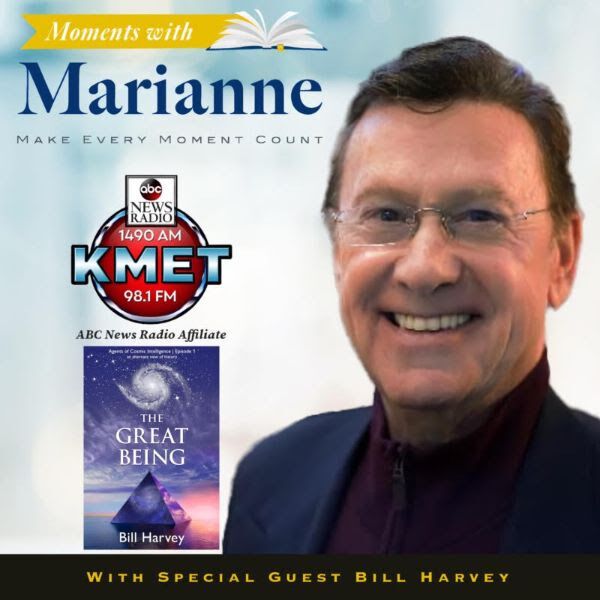
Moments with Marianne with Bill Harvey KMT radio interview about THE GREAT BEING book

In this 15-minute interview with Marianne Pestana on KMET ABC News Affiliate, I talk about THE GREAT BEING, my latest book in the Agents of Cosmic Intelligence series.
Listen here.


You may know that I’ve been publishing a sci-fi series called Agents of Cosmic Intelligence, an alternative history of the Universe, in which some of the main characters put into practice the mental methodologies I’ve compiled into my nonfiction books. All of this is aimed at enabling the human race to become more effective and to undo the messes made in the past. By contradistinction to AI, Artificial Intelligence, I think of this as HI, Human Intelligence. I feel that it’s obvious we should be putting at least as much time, money, and effort into HI as into AI – especially if we are fearful of what AI can do to subjugate us.

The books in the series so far take place long ago or in the near future, but what was missing until now is how the Universe began, and what happened on Earth before ~3000 BC. That is now in The Great Being, which is chronologically the first book in the series.

Two reviewers have already written reviews of The Great Being and they really “get” what the whole series is aiming at. I’ve waited for this feeling of someone really getting it for a long time and it is heartwarming to say the least. Here are excerpts and links to the reviews. — Bill

Reviews of The Great Being Warm the Cockles of My Heart

Indie reader approved

4.2 stars. A compelling and thought-provoking work of science fiction. Harvey’s sprawling, hugely ambitious exploration of consciousness, free will, and the eternal dance between light and darkness is intellectually stimulating and emotionally resonant. The novel’s central message—that all beings, no matter how lost or misguided, are ultimately part of a greater cosmic unity—is a hopeful and uplifting one…Read the full review. — Indie Reader

IR Independent Review

A singularly unique and eye-opening work of visionary fiction, Blending realms of historical, religious, spiritual, and mythological traditions, this is an ambitious and epically creative read … The full value will be more readily apparent to those readers who can see the threads of allegory, legend, and science woven into one unified whole. Enlightenment and radical self-awareness are powerful undercurrents within the narrative; the role of dogmatic thinking, hierarchical power structures, and the tyranny of knowledge are explored in various ways through the characters’ revelations, opinions, and personalities. The story within a story here is one of psychological development and the real-life pursuit of higher modes of thinking … A wide-reaching and insightful assessment of human civilization and behavior…Read the full review.—Self-Publishing Review / Independent Review of Books

bluelink review

Tonally amusing, aesthetically fearless, and packed with witty observation and divine incident … By turns accessible, erudite, and hallucinogenic, it is an intriguing philosophical romp that cleverly fuses psychedelic science-fiction and fantasy elements with organized religion’s creationist ideologies and the scientific theories of evolutionism … An ambitious, entertaining novel packed with spiritual curiosity, one that will greatly appeal to fans of intelligent science fiction and alternative history stories alike… Read the full review—BlueInk Review

booklife by Publishers WeeklyBlending spiritual philosophy, alternate history, pre-historic adventure, and brisk life-after-life storytellingThe Great Being is above all a beginning. First comes creation itself, which gets started with the knockout opening line (“The Nothingness felt surprise upon realizing itself.”), … This is the fourth entry published but the first chronological chapter. It shares the swift pacing, spiritual seeking, twisty plotting, and sharply human dialogue of the earlier books, though its focus feels tighter… Read full review, —BookLife by Publisher’s Weekly.  

kirkus reviewsIn Harvey’s retelling of the creation myth, heavenly agents combat a growing rebellion unfolding on Earth … this story deftly explores human nature—the uplifting qualities and dour traits alike … enthralling tale of humanity’s origins and cosmic espionage… Read full review, — Kirkus Reviews

Midwest Book ReviewA real standout…The radically inviting nature of this story brings with it the opportunity to view life and God in an entirely different light…Designed to awaken and introduce new interpretations of spirituality and life meaning. As readers who may not have expected such nuances come to absorb the greater gift of The Great Being‘s message, they will find the radically inviting nature of this story brings with it the opportunity to view life and God in an entirely different light … The story evolves with a reinterpretation of myths, events, and concepts that doesn’t just invite, but demands discussion and insights on the parts of all kinds of spiritual thinkers as the story evolves a unique and compelling flavor of discovery … One of Bill Harvey’s great talents lies not just in his storytelling ability, but his focus on translating life events and history with new interpretations … Readers interested in transformative reading… will find The Great Being‘s message to be one of hope, discovery, and new ways of viewing the universe [and] will find The Great Being a standout. Read the full review— Diane Donovan for Midwest Book Review

THE GREAT BEING is available in print and Kindle. Read an excerpt.