Tag Archives: Freedom

How AI Might Help Shape a Better Future for American Politics

Welcome to this week’s Bill Harvey Blog
Created March 6, 2026

I’ve been asking AI a lot of questions lately about the American Revolution. I can see it like a movie now. Sort of like the original 1960 Ocean’s Eleven, when we see how the gang comes together like iron filings around a magnetic story arc.

In the real his-and-her-story (formerly known as his story, i.e., history), John Adams got religion first, around 1765, PO’ed by the Stamp Act and Taxation Without Representation.

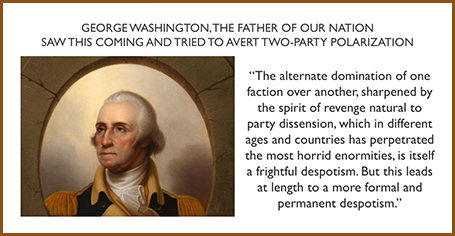
George Washington, always methodical, gradually shifted his attitude over a period of years, 1769–1774, in increasing indignation against the British treatment of Americans as inferior. The major stimuli included trade restrictions and the Coercive Acts. But there was also a personal matter. He had joined the British Army, and because he was American, he was given the rank of Brevet Captain instead of full Captain. Apparently, his mother had rankled him all his young life with put-downs, which made him extra sensitive in his adult life to treatment like that.

Thomas Jefferson was drawn into the revolutionary mindset ~1774 (the turning point year, as we shall see in a moment) by the issues of infringement on natural rights and self-governance.

Alexander Hamilton joined the movement in 1774, spurred by political unrest in New York and the Continental Congress.

Benjamin Franklin was the last of this group to join. He spent decades in London trying to bridge the gap between the colonies and the Crown. He truly believed the British Empire could be saved. The turning point was the “Hutchinson Letters Affair” (1774), where he was publicly humiliated by British officials. He realized reconciliation was impossible and sailed home in March 1775, arriving in Philadelphia just after the battles of Lexington and Concord, ready to serve the rebellion.

Thomas Paine joined the American revolutionary movement upon arriving in Philadelphia from England on November 30, 1774. Recommended by Franklin, Paine quickly immersed himself in colonial politics, publishing his influential, pro-independence pamphlet Common Sense on January 10, 1776, which galvanized support for the revolution.

The American Revolution was primarily influenced by Enlightenment philosophers, most notably John Locke, whose theories on natural rights (life, liberty, property) and the social contract directly shaped the Declaration of Independence. Other key influences included Montesquieu (separation of powers), Rousseau (popular sovereignty), and Thomas Paine (republicanism). Most of the Founders themselves also wrote brilliant philosophical treatises. If we had leaders today who were as creative in thinking about the future, we would probably not be in the current mess.

Enter AI.

The USA is a representative democracy, and this worked for almost 250 years, but it is showing signs of wear. The necessity for representatives was obvious all this time because there was no way for all of us to vote every day on every big and little decision and still get anything else done, like producing goods and services, inventing things, defending the nation, etc.

AI does change this. It would be possible for each of us to tell AI everything we want government to do and not do, every day, as the spirit moves us. AI could combine all this input from ~325 million people, knowing which ones are adults and eligible to vote, which ones are citizens but minors, which ones are immigrants not eligible to vote. AI could provide summaries of what We, The People want continuously to the government at all levels, as well as to the press and to educators and back to all of us.

This would seem to be a highly probable eventuality at some point. It might start very soon as unofficial experimentation and perhaps as a more constructive channeling of the shouting match we call social media.

This would use a lot of computing power and have a high carbon footprint and possibly lead to some breakthroughs in clean energy sources.

Rooting out biases in AI and the need for continuous fact checking would be crucial in such a system.

Bad actors would focus on political cybermanipulation. Good agents of the Justice and Intel systems would work to keep them from ruining a good thing.

But wait! How would this be better than polling? Doesn’t polling serve this function already?

Polling is limited to the ideas which are already on the table. The AI method would pick up creative new ideas even if only one person came up with them. In fact the national governmental AI should not be a single AI but a collegial team of AIs looking at the same data from many viewpoints, some looking for new ideas, some fact checking, some looking for historical precedents, and so on.

Polling has another problem of representativeness. The response rate to polling is typically under 10%, suggesting a very large nonresponse bias. Pew and other sources taken together suggest that something like 87% of Americans use social media, implying a willingness to key in at least a few words every now and then. The AI scenario envisioned here would be voice driven rather than requiring keystrokes, which would also be an option. In order to maximize engagement, the government could offer modest tax rebates based of the degree of contribution to the ideas of the nation.

We would still need representatives and the rest of government at all levels to carry out the wishes of the people. In fact, the mess we are in now is only slightly the result of imperfections in the system the Founders designed, and a much larger factor is the imperfections of the people in that system.

If we elected people who were of good character, devoted to the good of the many, more of us would vote.

“Using data from the University of Florida Election Lab, a new analysis by the Environmental Voter Project shows that 85.9 million eligible voters skipped the 2024 general election, far surpassing the 76.8 million ballots cast for Donald Trump or the 74.3 million for Kamala Harris.

If “Did Not Vote” had been a presidential candidate, they would have beaten Donald Trump by 9.1 million votes, and they would have won 21 states, earning 265 electoral college votes to Trump’s 175 and Harris’s 98.” This quote from the Environmental Voter Project website.

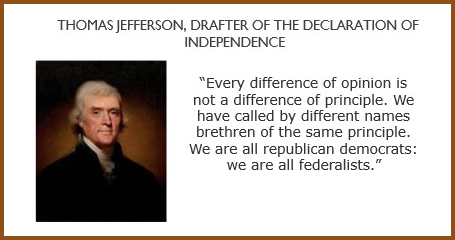
The party system was not included in the U.S. Constitution. It actually started as a result of the greatly differing visions of Hamilton and Jefferson. Hamilton wanted a strong federal government and industrial development in order to make the U.S.A. a major world power. Jefferson wanted more of an agrarian distributed nation. Hamilton’s views spawned the Federalist Party, and Jefferson’s gave birth to the Republican Democratic Party. The two men, although at odds ideologically, were able to work together and make deals such as the one which created the first national bank and led to what is today the Fed.

The Party system today is essential to get Presidential candidates to be known to the public, a costly affair because advertising is not free. In the future, it is conceivable that a different system might emerge in which the media charge nothing for political advertising (which would increase the cost of advertising to all the other categories by less than 3%).

Schools ought to bring back civics classes and inspire some students to become dedicated public servants motivated by non-ego, non-money, and non-power motivations. People who are of that ilk who want to run for office ought to be lifted up by even the small set of early supporters they find. Social media provides a way for the bubble up from grassroots method to be potentially viable. If the product (the candidate) is authentic enough and of high character, a noble human being like the Founders, for all their human flaws, he or she will go viral. The new mayor of New York is an example of what can happen (I do not know enough to say anything pro or con about his character; time will tell, let’s give him a fair chance), but he did rise rather rapidly from obscurity.

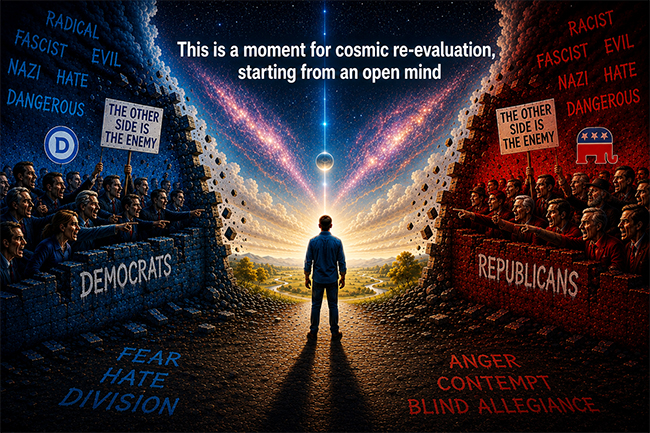
Times look dark when creativity has not been fully leveraged yet. There are more possible outcome scenarios than appear to be on the table based on the loud megaphones of the two parties and limited time each day for creative thought and imagination. AI and HI (Human Intelligence) together in harmony can overcome all messes.

Being Real

Powerful Mind Part 19

Welcome to this week’s Bill Harvey Blog
Updated July 11, 2025. Created July 14, 2023

Read last week’s blog post               |              See all 12 Powerful Mind Keys

In Powerful Mind 18, we talked about the consistency program, one of the elements of your robot (mechanized, oversimplified coping patterns) that constrains your freedom of expansive choice in every situation. There are other constraints on your free will and creativity in every moment, and one of them is social pressures.

We are social animals, we have built huge hives called cities, and we huddle in them together, or if we choose to live closer to nature, we still highly value the ability to go out and mingle. This is a natural form in which love expresses itself as belonging; we belong to each other and with each other, and we enjoy it. This is part of our reality and can have positive and negative outcomes on our ability to express what is in us. It is of more long-lasting positive value to learn how to channel situations so as to be free in every moment to be who you are, even if it does not seem to fit in at an obvious level.

It’s natural to seek rapport by acknowledging the beliefs you have in common with the people around you. It may feel risky and unnecessary to expose your differences. But it need not be risky, if done right. Instead of expressing disagreement, try the Socratic method: ask questions, and consider the answers objectively, temporarily suspending whatever you may believe based upon your accumulated past experiences.

A contrarian is one who has established a fixed script to argue against practically everything said in earshot. This is the robot with its oversimplified and fixated habit patterns.

Being yourself and not glossing over inner secret disagreements you may have while appearing to go along with the crowd is an act of courage. But it need not be risky if carried off with savoir faire, kindness, and respect.

Open-mindedness is an attractive quality and encourages people to be themselves too. Locked-in ideological dogmas are among the more dangerous side effects of allowing enslavement to one’s robot. Enslavement creeps. You start by enslaving yourself to robot reactions in order to avoid the psychic dissonance and feeling of helplessness at the complexity of life. That then becomes enslavement to other people because you are trying simplistically and superficially to become accepted by them.

The trick with being real is that it is not a stand-alone principle; it must be executed simultaneously with a complementary principle, screening out negativity. If you open up yourself without screening out negativity, the results will be undesirable. You will be expressing not only the real you, you will also be letting out the ventings of your robot. The real you does not want negativity, does not want to add more negativity to the world, would far prefer to never experience negativity, ever. So why do we so often express negativity, sometimes without realizing what a negative expression sits there on our face? It is a robotical phenomenon, not coming from our True Will. Call it a chemical reaction or Pavlovian conditioning or anything else you want; it is part of the problem not part of any solution.

When called upon to comment on a subject you know to be important to the people you are with, and you know going in that you differ from them on certain aspects of this subject, reveal your open-mindedness up front, and mention some of the things that have occurred to you about the subject about which you are still sorting things out. Handled this way, you are inviting your friends to discuss the subject open-mindedly, which is more fun for everybody. Everyone might learn something. This method of respectful discourse is the foundation on which great civilizations have been built. When this format of openhearted discussion is lost, these civilizations have crumbled. That’s how important it is to be real and yet positive at the same time. When you disagree, you can still express positivity by the way you do it, with respect and open-mindedness.

One of the best ways to move toward resolution of ideas which are being debated is by setting up experiments and objectively recording and interpreting the outcomes. This is the method of science and deserves to be applied to daily life, including politics and governance. Fact-based decision-making based on empirical observation of test results, safely testing concepts in action. This can be done at the level of small local organizations or on a global scale.

By avoiding giving your usual response, you open up the chances of creativity and learning, you rethink things. By avoiding social pressures to simply pretend to agree, yet maintaining friendliness and respect as you speak your mind, you make the world a better place, you add to the net value of the universe.

Every rule in the Powerful Mind series  (these posts will become the book Powerful Mind) has its exception cases. All 12 Keys work best when balanced together, customized to the current situation you face. This integration is best done intuitively without attachment to outcomes and without fear or anger. Living in this open way rests upon a foundation of courage. Winston Churchill identified courage as the most important virtue because all the other virtues rest upon it.

 See all 12 Powerful Mind Keys

Love to all,
Bill


Live chat with my avatar now.

Umberto Eco Deeply Understood and Cared

Welcome to this week’s Bill Harvey Blog:  July 26, 2024

Umberto Eco at his home.*

The Italian novelist, essayist, deep thinker Umberto Eco won first prize in a Fascist essay contest when he was ten years old. He was a product of his culture: Mussolini’s Italy was all he ever knew up until that point. That was reality. Fascism was his way of life, although not consciously. He had no inkling of other worlds then. The year was 1942.

Less than a year later on the morning of April 27, 1943 he learned from a radio broadcast that “Fascism had collapsed and Mussolini had been arrested.” (Five Moral Pieces) He ran out and looked at the headlines on the suddenly large numbers of newspapers and saw that political parties that must have existed in secret were all coming out. Until that moment he had believed that every country had just one party and in Italy it was the Fascist party.

“My God, I had never read words like ‘freedom’ or ‘dictatorship’ in all my life. By virtue of these words, I was reborn as a free Western man.”

Eco having been conditioned as a Fascist was released from that condition by outside forces and uplifted. He became a teacher, philosopher, scientist, best-selling novelist.

His concept of semiotics permits us to read the signs in all things since all things may be interpreted as signs in themselves. We all constantly create signs, both intentionally and without conscious intent. This was his unique perspective on the nature of reality.

In Five Moral Pieces he dissects fascism in its broader sense (i.e. not limited to Italy’s version) into a specific set of attributes. This is relevant because he was a person born into fascism and took it for granted as part of life. He experienced liberation by the Allies and the transformation of the way of life. His mind changed and he much preferred the new social contract and its freedoms. He realized himself as a passionate supporter of diversity.

Eco provides the following list of clues to help humanity detect fascism:

  1. The cult of tradition“. When all truth has already been revealed by tradition, no new learning can occur.
  2. The rejection of modernism“, which views the rationalistic development of Western culture since the Enlightenment as a descent into depravity.
  3. The cult of action for action’s sake“, which dictates that action is of value in itself and should be taken without intellectual reflection. This, says Eco, is connected with anti-intellectualism and irrationalism, and often manifests in attacks on modern culture and science.
  4. Disagreement is treason” – fascism devalues intellectual discourse and critical reasoning as barriers to action.
  5. Fear of difference“, which fascism seeks to exploit and exacerbate, often in the form of racism or an appeal against foreigners and immigrants.
  6. Appeal to a frustrated middle class“, fearing economic pressure from the demands and aspirations of lower social groups.
  7. Obsession with a plot” and the hyping-up of an enemy threat. This often combines an appeal to xenophobia with a fear of disloyalty and sabotage from marginalized groups living within the society. Eco also cites Pat Robertson‘s book The New World Order as a prominent example of a plot obsession.
  8. Fascist societies rhetorically cast their enemies as “at the same time too strong and too weak“. On the one hand, fascists play up the power of certain disfavored elites to encourage in their followers a sense of grievance and humiliation. On the other hand, fascist leaders point to the decadence of those elites as proof of their ultimate feebleness in the face of an overwhelming popular will.
  9. Pacifism is trafficking with the enemy” because “life is permanent warfare” – there must always be an enemy to fight.
  10. Contempt for the weak“, which is uncomfortably married to a chauvinistic popular elitism, in which every member of society is superior to outsiders by virtue of belonging to the in-group. Eco sees in these attitudes the root of a deep tension in the fundamentally hierarchical structure of fascist polities, as they encourage leaders to despise their underlings, up to the ultimate leader, who holds the whole country in contempt for having allowed him to overtake it by force.
  11. Everybody is educated to become a hero“, which leads to the embrace of a cult of death.
  12. Machismo“, which sublimates the difficult work of permanent war and heroism into the sexual sphere. Fascists thus hold “both disdain for women and intolerance and condemnation of nonstandard sexual habits, from chastity to homosexuality”.
  13. Selective populism” – the people, conceived monolithically, have a common will, distinct from and superior to the viewpoint of any individual. As no mass of people can ever be truly unanimous, the leader holds himself out as the interpreter of the popular will (though truly he alone dictates it). Fascists use this concept to delegitimize democratic institutions they accuse of “no longer represent[ing] the voice of the people”.
  14. Newspeak” – fascism employs and promotes an impoverished vocabulary in order to limit critical reasoning.

Thanks to Wikipedia for distilling these attributes, which saved me time; I have condensed the Wikipedia listing.

Eco published his essay on this subject in 1995. On July 11, 2024, another great writer and thinker, David Brooks wrote an essay in The New York Times aimed at understanding why America today is not repelled by the idea of authoritarianism. His conclusion is that, until the 1960s, America had a balance between reason and religion which, while disagreeing on one level, agreed upon the moral and ethical grounds for conduct. Then, starting in the 1960s, America began to become less religious, and reason and science on their own did not present as compelling a case for upholding idealistic values:

“At the same time, science and reason failed to produce a substitute moral order that could hold the nation together. By 1981, in the famous first passage of his book “After Virtue,” the philosopher Alasdair Macintyre argued that we had inherited fragments of moral ideas, not a coherent moral system to give form to a communal life, not a solid set of moral foundations to use to settle disputes. Moral reasoning, he wrote, had been reduced to “emotivism.” If it feels right, do it. In 1987, Allan Bloom released his megaselling “The Closing of the American Mind,” arguing that moral relativism had become the dominant ethos of the era.”

“In other words, Americans lost faith in both sides of the great historical tension, and with it the culture that had long held a diverse nation together. By the 21st century it became clear that Americans were no longer disagreeing with one another; they didn’t even perceive the same reality. You began to hear commencement speakers declare that each person has to live according to his or her own truth. Critics talked about living in a post-truth society. [James Davison] Hunter talks about cultural exhaustion, a loss of faith, a rising nihilism — the belief in nothing. As he puts it, ‘If there is little or no common political ground today, it is because there are few if any common assumptions about the nature of a good society that underwrite a shared political life.’”

“Was there anything that would fill this void of meaning? Was there anything that could give people a shared sense of right and wrong, a sense of purpose? It turns out there was: identity politics. People on the right and the left began to identify themselves within a particular kind of moral story. This is the story in which my political group is the victim of oppression and other groups are the oppressors. For people who feel they are floating in a moral and social vacuum, this story provides a moral landscape — there are those bad guys over there and us good guys over here. The story provides a sense of belonging. It provides social recognition. By expressing my rage, I will earn your attention and respect.”

“The problem with this form of all-explaining identity politics is that it undermines democracy. If others are evil and out to get us, then persuasion is for suckers. If our beliefs are defined by our identities and not individual reason and personal experience, then different Americans are living in different universes and there is no point in trying to engage in deliberative democracy. You just have to crush them. You have to grab power and control of the institutions and shove your answers down everybody else’s throats.”

“In this climate, Hunter argues, ‘the authoritarian impulse becomes impossible to restrain.’ Authoritarianism imposes a social vision by force. If you can’t have social solidarity organically from the ground up, then you can impose it from top down using the power of the state.”

“The task, then, is to build a new cultural consensus that is democratic but also morally coherent. My guess, and it is only a guess, is that this work of cultural repair will be done by religious progressives, by a new generation of leaders who will build a modern social gospel around love of neighbor and hospitality for the marginalized.”

I agree with Brooks that America, and the human race, needs and deserves a reason to value liberty, equality, justice, democracy, and differences of opinion. I don’t necessarily agree with his proposed solution of waiting for religious progressives to convince the masses of a modern social gospel. We need a solution now. My proposed solution is for the media to provide broad coverage to the idea that science cannot rule out the possibility that the universe is a single consciousness, the same consciousness that each of us thinks of as “myself”. Once there is near-universal realization that this is a real possibility, all of the moral compunctions required by religion return as the only logical course of action if we are all universally connected. It was aimed at this end that I wrote A Theory Of Everything Including Consciousness and “God” and made the ten-minute video Connectedness.

I am convinced by my own experiences that the truth is we are all parts of the greatest adventure that could ever exist, and we all benefit by win/win thinking and action. This is diametrically opposed to the zeitgeist of the present day. My research finds that this concept of who we are and what the universe truly is, appeals to all factions in the political spectrum. This scientific lens also supports the claims of the great religions, that their founders and saints received knowledge from a higher source, and even explains how “miracles” might have actually happened. This scientific and spiritual picture of reality can be the glue that puts us back together. We don’t have to prematurely accept it as scientifically proven until it is, but we can popularize the notion as a leading possible explanation for the nature of reality. The more this idea is exposed open-mindedly in the media the more likely we are to survive as a species.

Carpe diem!

My best to all,
Bill


Live chat with my avatar now.

*Image source: Aubrey, CC BY-SA 1.0 resized <https://creativecommons.org/licenses/by-sa/1.0>, via Wikimedia Commons

Shifting the Focus of Emotional Intensity

Volume 3, Issue 29

We are emotional beings. We are hardwired to have some emotional drama going on in the background at all times. Getting into the Zone aka Flow state requires awareness and management of that background emotional mood. If we are not proactively programming it, it will program itself.

After a long series of successes, the background state is often one of confidence, a can-do, can-win attitude. However, this can also set one up to crash in the case of a setback. “What is happening?” we will wonder. “This can’t be happening to me. I never fail.”

To prepare oneself for a challenging game ahead, one uses mental rehearsal including all the things that the other players might do, and the contingency plans of one’s own best actions in each scenario. At the end of such rehearsals, one pre-envisions as vividly as possible, with all emotions engaged, winning the game. At the very end of the preparation one gives up all care about winning or losing. Attachment to outcome blocks the Zone. You have to be playing the game for the sheer enjoyment of it, for its own sake, to shift into the Zone.

With the emotions as a wrapper around our whole psychic experience, the thoughts flit along the surface of the mind. Emotions program thoughts and vice versa. Everything affects everything else in there.

In the complex accelerated culture in which we live, self-mastery of our inner space, or even awareness of what is going on in there, is extremely complicated. Neuroses arise of certain types, like biocomputer viruses, and the viral infection spreads through society by intercommunication of memes and moods upon which neuroses depend.

Two recurring neurotic themes involve money and frustration. The culture is set up to cause most human inhabitants of Earth not living in a tribal setting to need to think like slaves or indentured servants, always worrying about money. Some conspiracy theory was involved but mostly it was natural forces. At first money was just a marker to help memory remember trades and symbolize real “property” such as animals and grain. Then it became what it is today, the leading indicator of our feelings of self-worth, belonging, achievement, status, freedom, security, wellness and potency. I’m probably leaving some things out.

Frustration is a natural effect when society does not encourage (or recognize) one’s inborn skills in certain directions that would channel one into a career he/she loves. Instead one takes a job one can tolerate but that may do little to bring out those inborn skills. Frustration mounts when co-workers and bosses don’t go along with the inspiring ideas one has about how to do one’s job better. The mix of money fear and frustration turns to rage, often bottled up inside where it is one of the causes of illnesses of the mind and body. One is blocked from getting into the Zone, which if achieved would provide ideas for action solutions that in turn would bring more money, security, and clever ways to break through the frustrating resistance to one’s best ideas.

The start of a new cycle can be effected by seizing the control point where the avalanche starts — the surrounding emotional mood. Control of the emotive space around the psyche is the key. Detachment from outcome is the core of heroism. A sense of humor gives perspective. Willingness to face the worst with confidence in oneself (and for some, confidence in God/the Universe) confers a courageous fatalism that has been rediscovered by all of the heroes in history.

In order to program the emotional wrapper, detachment is not enough. Our psychospheres thrive on emotion. Replace negative emotion, the doom of the Zone, with positive emotion — which means remembering what you have to be grateful for and what you have to look forward to and to be excited about. There may be challenging (even heartbreaking) trials but you need to be able to see them as opportunities to show what you’re really made of.

Best to all, 

Bill

Follow my regular blog contribution at Jack Myers Media Network: In Terms of ROI. It is in the free section of the website at  Bill Harvey at MediaBizBloggers.com.