Welcome to this week’s Bill Harvey Blog. August 14, 2026
Cosmic Crossroads Beyond Division
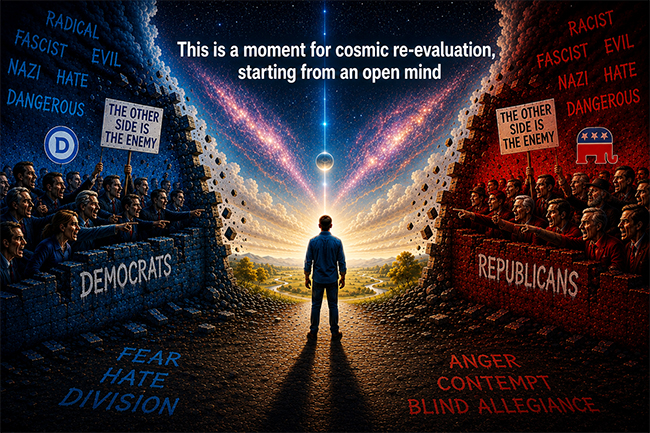
The trouble started long ago when Democrats started demonizing Republicans and vice versa. When I was a kid, it wasn’t this way. It was like rooting for the Yankees instead of the Dodgers, although living in Brooklyn. It was surprising but not something to rouse animus.
Sportsmanship has always been an attractive characteristic of individuals, athletes, and famous people. People could be rivals, kid one another, but never come close to demonization.
My first realization came about the turn of the Century. Someone sent me a Halloween card whose cover said, “Want to wear a really scary costume this Halloween?” Inside it said, “Dress up as a Republican.” I had to shake my head.
After that, it came on in slathers, and the buildup was tsunami-like. My beloved business partner, the late Bill McKenna, called liberals “Libbies,” and it was obvious from his tone of voice that the female surname “Libby” was a giveaway that all Liberals were effeminate and not masculine enough.
The algorithmic intensity of modern media has brought this to a level absolutely on a plane with Brave New World and 1984. In fact, the proportion of movies, video series, and books about dystopia has shot up. It is as if the whole population is helping to order up dystopia to engulf us in consensus reality, by the amount of our thinking and dreaming about it, which is helping to bring it about. We are “Living the Nightmare” in our expectations, and now we have accepted it as the necessary reality.
It has become literally mass hypnosis.
We now accept it as normal that our leaders will be corrupt, lie to us, bully us, shoot us, and steal our money in every way possible. Yet, we go about our daily routines less happy than usual and more prone to escapism. We don’t rearrange our fundamental thinking about our loyalties because that would be too much to bear; the fear of the unknown floods in when we even come close to thinking about that.
We would not be that way if we were not surrounded by all of our tribe and reinforced in our tribal thinking by very select use of media channels that echo chamber us and keep out the bad memes that would undermine our sense of self and drag us down into doubt.
“This is who I am,” we think, without words, down at a level below our own conscious awareness. “I have chosen this course in life, and it’s far too late to turn back and become somebody else. The other Party is far too radical and ugly; none of my best friends and family like them.” In these subconscious self-conversations, we do not have enough intellectual prowess to point out to ourselves that there is a third option of not being hung up on either Party. If we take the time away from escapism to have these self-conversations at a conscious level, we will have more controllable intelligence to make sense of things. The third option is to become a political Independent, which about half the US population has already chosen. That would allow us to vote based on individual merits rather than robotic puppeting the party line.
It’s hard to admit to oneself that one has been a puppet and played like a violin for decades of one’s life. It’s better to let awareness of the truth come in rather than to protect oneself against the truth and to live in a shell of self-deception. The truth will sometimes show you that you say one thing and do another, and that the high and noble precepts you mouth are not reflected in your actions. Yes, this is a painful experience, but so is childbirth, and both types of temporary pain lead to an infinite amount of emotional payoff in the end.
This is a moment for cosmic re-evaluation starting from an open mind.
Welcome to this week’s Bill Harvey Blog. July 17, 2026
We are being tested the way Job was tested.
It was a setup. Starting way back in the 1960s. As early as the 1960s, as documented by Yoni Applebaum in this month’s issue of The Atlantic, the way that American history was taught in schools bifurcated into two warring narratives. One emphasized the American ideals of what we have always aspired to be, and have generally been, to our own people and in our dealings around the world. The other narrative told it like it was, warts and all, not pulling punches about our imperfections, even as we were getting better year after year.
By 2001, when George W. Bush and Congress created No Child Left Behind, they dodged the bullet on setting a single standard for the teaching of history. The unintended net effect was to virtually mute the teaching of American idealism in schools for the past quarter of a Century. Although the trend toward subordinating American history as a school subject started back in the 1960s.
Can we see any effects that might be traceable to this change in the way schools have taught about what America means and is?
An AP-NORC Center for Public Affairs Research poll found that about two-thirds (67%) of U.S. adults say a democratically elected government is highly important to the nation’s identity. Conversely, this means roughly 33% of Americans do not see it as extremely or very important—a significant jump from 2021, when 80% viewed it as highly vital.*
The Generational Divide: Apathy or detachment is heavily concentrated among younger generations. Only 50% of Americans under 30 believe democracy is a key element of the U.S.’s identity, compared to 81% of those ages 60 and older.
Rather than outright hostility toward democracy, experts note that this detachment often stems from a growing belief among everyday citizens—especially younger generations—that the political system is fundamentally broken, corrupt, or simply failing to address their day-to-day problems.
If they had been taught the way the Old Guard had been taught, some of our current problems might never have been possible.
I’m not preaching in favor of whitewashing, but in favor of telling not only all the good and bad details, but also the philosophical drivers for why there is a USA designed the way it is. The ideals, the values, the logic, and reasoning based on deep studies of pre-American history and the types of governing systems there had been and how they fared. The Founders didn’t just make it up. They never claimed that they had received the Light from Above. They had assimilated Enlightenment philosophies and had studied history going as far back as it goes. They debated for 17 years from 1774 to 1791. 17 years to get it right.
And get it right they did. No republic has ever lasted as long as we have.
But loopholes existed. And things that The Founders had warned us against, like the two-party system happened despite their warnings. And the things that Washington said would happen if we went to a two-party system, have now happened big time. The people who felt that their Party was shrinking away found a leader who found those loopholes and has leveraged them. At a time when the schools had pressed the pause button for too long on reminding us of our ideals.
Even when idealism was being taught in schools, we have always, as citizens, not been 100% engaged. Other interests occupied our attention, for most of us, and only a fraction of us (usually around 40%) voted in elections. Socrates, who was all for having a republic, felt that it was a citizen’s duty to serve that republic, might have been shocked to see how lackadaisical the majority of Americans have always been about chipping in some time to serve in the role of engaged citizens.
In the 2024 US presidential election, approximately 85.9 million eligible voters did not cast a ballot. While 2024 tied the highest voter turnout rate in over a century (tied with 1960), the 85.9 million people who sat it out actually outnumbered the total votes cast for either major candidate.
This goes back to the feeling that none of us can do anything to change the inept, corrupt, and distracted from the needs of The People system as it now is. People who don’t vote feel that if they did vote, it would make no difference. As Simon & Garfunkel wrote and sang, “Going to the candidates’ debate, Laugh about it, shout about it, When you’ve got to choose, Every way you look at it, you lose.”
So, we’ve been set up to be tested, prepared by a quarter century of not teaching our own brand of American pragmatic idealism in schools, supported by the most successful governance system in world history and spoiled by it so as to take its benefits and our rights for granted without needing to lift a finger or even vote. And now, if we fail to stand up and be counted, and to vote against the removal of our rights to freedom of speech and assembly, cynicism and low meanness and corruption more blatant than ever before by an order of magnitude, the test will result in a longer period of learning to pass it.
That’s the way that the Universe works. It teaches us things. It first tries teaching it to us in ways that are fun. If we don’t get it, it teaches us with a few hard knocks. If we still don’t get it, the knocks get harder and harder the longer we cling to obstinacy and refusal to open our minds and eyes and see what the Universe is trying to tell us.
As the Father of Our Nation warned us, we might be obstinate because of the two-party system and what it has done to make us feel that the political party we cling to is vital to our personal identity. It is not. Our personal identity is unique in the Universe; it has nothing to do with which teams we root for.
Pass the test. Help us all pass the test. Plan to vote no matter what. Show what you’re made of.
And then when we have retaken our country and are again recognized as the seat of all governing power, “We, The People,” we have some loopholes to fix. In a moment of forgiveness, sometime in the future, we will thank the folks who called those loopholes to our attention so we could fix them before some more talented, more professional, more intelligent baddies come along and find them.
*However, according to aPBS News/NPR/Marist poll released in July 2026, the overwhelming majority of Americans are deeply concerned:
82% of Americans believe that the future of American democracy faces a serious threat.
This worry spans across the political spectrum: 74% of Republicans, 83% of independents, and 91% of Democrats share this view.
In that same poll, it was found that 84% of us feel that we know too little about history.
Welcome to this week’s Bill Harvey Blog.
Updated July 3, 2026. Original post: July 2, 2021
An excerpt of the Farewell Address given by President George Washington to the people of America.
For at least two decades from July 4, 1776, George Washington was the most trusted person in the United States of America.
The Walter Cronkite of his times.
He served as President when, to him, the job was a burden rather than a prize.
He was the glue of authenticity and integrity that gave our country its chance to build a foundation that would last.
For two decades, he made parties unnecessary, because all differences could be resolved in him.
And then, when the party divisions arose with their bitterness and hate, he stood down and would not accept another term as President. He was 64. Average life expectancy for an American male was 36.
In departing, he was sure to warn us about the forces that were arising to counter the most innovative governmental structure in history.
In this post, I will read you some excerpts from George Washington’s final address, his last guidance to the children of the country he helped create and lead through its fragile infancy. I’ll also provide the link to the full going away letter he left for all of us, which is read annually to both houses of Congress.
I hope it revitalizes your true loyalty to our true bedrock principles, and helps bring the unity we need now more than we have ever needed it before.
Washington begins by humbly and diffidently explaining why he will not accept another term in office:
Transcript Excerpts of President George Washington’s Farewell Address (1796)
Friends and Fellow Citizens:
The period for a new election of a citizen to administer the executive government of the United States being not far distant, and the time actually arrived when your thoughts must be employed in designating the person who is to be clothed with that important trust, it appears to me proper that I should now apprise you of the resolution I have formed, to decline being considered among the number of those out of whom a choice is to be made.
Later in his address, he warns of the dangers of the political parties just then sprouting up in America:
I have already intimated to you the danger of parties in the State, with particular reference to the founding of them on geographical discriminations. Let me now take a more comprehensive view, and warn you in the most solemn manner against the baneful effects of the spirit of party generally.
This spirit, unfortunately, is inseparable from our nature, having its root in the strongest passions of the human mind. It exists under different shapes in all governments, more or less stifled, controlled, or repressed; but, in those of the popular form, it is seen in its greatest rankness, and is truly their worst enemy.
The alternate domination of one faction over another, sharpened by the spirit of revenge, natural to party dissension, which in different ages and countries has perpetrated the most horrid enormities, is itself a frightful despotism. But this leads at length to a more formal and permanent despotism. The disorders and miseries which result gradually incline the minds of men to seek security and repose in the absolute power of an individual; and sooner or later the chief of some prevailing faction, more able or more fortunate than his competitors, turns this disposition to the purposes of his own elevation, on the ruins of public liberty.
Without looking forward to an extremity of this kind (which nevertheless ought not to be entirely out of sight), the common and continual mischiefs of the spirit of party are sufficient to make it the interest and duty of a wise people to discourage and restrain it.
It serves always to distract the public councils and enfeeble the public administration. It agitates the community with ill-founded jealousies and false alarms, kindles the animosity of one part against another, foments occasionally riot and insurrection. It opens the door to foreign influence and corruption, which finds a facilitated access to the government itself through the channels of party passions. Thus the policy and the will of one country are subjected to the policy and will of another.
There is an opinion that parties in free countries are useful checks upon the administration of the government and serve to keep alive the spirit of liberty. This within certain limits is probably true; and in governments of a monarchical cast, patriotism may look with indulgence, if not with favor, upon the spirit of party. But in those of the popular character, in governments purely elective, it is a spirit not to be encouraged. From their natural tendency, it is certain there will always be enough of that spirit for every salutary purpose. And there being constant danger of excess, the effort ought to be by force of public opinion, to mitigate and assuage it. A fire not to be quenched, it demands a uniform vigilance to prevent its bursting into a flame, lest, instead of warming, it should consume.
He goes on to warn against the danger of one branch of government becoming dominant:
It is important, likewise, that the habits of thinking in a free country should inspire caution in those entrusted with its administration, to confine themselves within their respective constitutional spheres, avoiding in the exercise of the powers of one department to encroach upon another. The spirit of encroachment tends to consolidate the powers of all the departments in one, and thus to create, whatever the form of government, a real despotism. A just estimate of that love of power, and proneness to abuse it, which predominates in the human heart, is sufficient to satisfy us of the truth of this position. The necessity of reciprocal checks in the exercise of political power, by dividing and distributing it into different depositaries, and constituting each the guardian of the public weal against invasions by the others, has been evinced by experiments ancient and modern; some of them in our country and under our own eyes. To preserve them must be as necessary as to institute them. If, in the opinion of the people, the distribution or modification of the constitutional powers be in any particular wrong, let it be corrected by an amendment in the way which the Constitution designates. But let there be no change by usurpation; for though this, in one instance, may be the instrument of good, it is the customary weapon by which free governments are destroyed.
To me, the humility, authenticity, and kindness of the Father of our Nation comes through loud and clear in these his last words of advice, to us his children, endowed to carry on the idealism of the Founders.
Let his spirit re-inspire us to our original Mission and Values, and help us return to unity with forgiveness and a renewed dedication to work together for the good of all of us.
What you feel when you read these words of George Washington…
You are feeling what it is to Be An American.
This American Noble Experiment is worth preserving!
Commemorating and honoring that Beacon for The World, here is a song from the heart of Ray Charles in 2022, 50 years after first singing this rendition of it on the Dick Cavett Show.
I hope you agree with me that this post should be sent to as many Americans as possible. If we each send it to 10 or more people asking them to send it to ten or more people, by the sixth round at least a million people will have received it.
Welcome to this week’s Bill Harvey Blog Created May 21, 2026
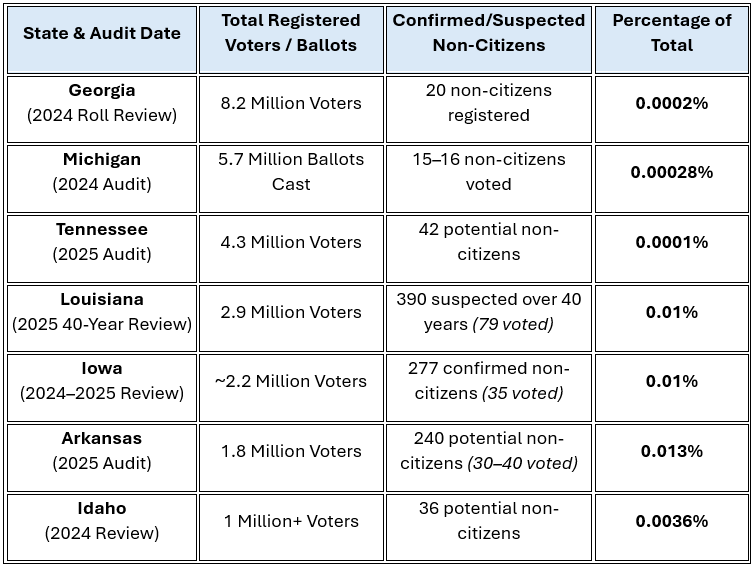
The question of non-citizen voting in U.S. elections is a major point of public discussion. Extensive data, recent state-level audits, and nonpartisan research show that verified cases of non-citizen voting are vanishingly rare, representing a minute fraction of a percent of overall votes cast.
When state election officials conduct extensive audits using federal immigration databases (like SAVE) and Department of Motor Vehicles (DMV) records, the initial lists of “suspected” non-citizens routinely shrink drastically upon investigation. This is usually because the data relies on outdated status reports (e.g., individuals who were green card holders when they got their driver’s license but have since become naturalized U.S. citizens).
Note: “Potential” or “Suspected” means the individuals were flagged for review; subsequent checks usually reveal many are actually naturalized citizens who simply haven’t updated their DMV profile.
The conservative Heritage Foundation maintains a national database tracking verified instances of voter fraud. Going back to the year 2000, their database documents fewer than 100 cases of non-citizen voting across the entire country. Given that hundreds of millions of ballots have been cast in that timeframe, the percentage is statistically close to 0%.
A landmark study by the Brennan Center analyzed 42 jurisdictions during the 2016 presidential election (tabulating 23.5 million votes). Election officials referred only 30 cases of suspected non-citizen voting for investigation—amounting to 0.0001% of the votes.
Why It Happens (When It Does)
Data shows that the microscopic number of non-citizens who do successfully register or vote are almost exclusively Lawful Permanent Residents (green card holders) rather than undocumented immigrants. These cases are usually driven by administrative errors (such as being automatically prompted to register while getting a driver’s license) or honest confusion about eligibility rules, rather than intentional fraud.
Recent data from major polling operations, including the comprehensive PBS News/NPR/Marist Poll and federal tracking data, outlines where the public stands:
High Bipartisan Support for Specific Stricter Laws
When polled on specific legislative proposals—such as photo voter ID mandates or proof-of-citizenship requirements—supermajorities of Americans consistently voice support.
Voter ID Requirements: Between 81% and 84% of Americans support requiring a government-issued photo ID to vote. This includes roughly 95%–98% of Republicans, 79%–84% of independents, and 67%–70% of Democrats.
Proof of Citizenship: Approximately 75% to 83% of Americans favor requiring proof of U.S. citizenship when registering to vote for the first time.
The SAVE America Act: A White House data release tracking public sentiment on federal election security legislation shows 71% overall support for tighter federal restrictions on voter registration eligibility, including half of rank-and-file Democrats.
Fraud vs. Access: The Public Divide
Despite broad consensus on IDs, the public splits significantly when asked about the core philosophy governing election laws. The Marist Poll reveals a sharp divide over whether the priority should be stopping fraud or maximizing turnout:
The Primary Concern:59% of Americans believe it is more important to ensure that everyone who wants to vote is able to do so. Conversely, 41% say the bigger concern should be ensuring no one votes who is ineligible.
Partisan Splits: This question is highly polarized. 70% of Republicans prioritize stopping ineligible voters, while 86% of Democrats and 53% of Independents prioritize maximizing voter access.
Perceived Threats to Elections
When Americans are asked to name the single biggest threat to safe and secure elections, voter fraud ranks high, but it shares the spotlight with other anxieties:
33% cite voter fraud as the top threat.
26% cite misleading information (including concerns about AI-generated misinformation).
24% cite voter suppression (worrying that strict laws will turn away eligible voters).
Notably, 57% of Republicans view voter fraud as the top threat, whereas 41% of Democrats view voter suppression as the primary threat, and a plurality of independents worry most about misinformation.
In summary, the percentage of Americans who want stricter laws depends heavily on how the question is asked. If asked about voter ID and citizenship verification, support sits overwhelmingly at 75% to 84%. However, if asked whether tightening laws to prevent fraud is more important than protecting voter access, only about 41% of the country prioritizes fraud prevention above all else.
When forced to weigh election security against voter access, a clear majority of Americans prioritize ensuring that eligible voters are not locked out of the system.
59% of Americans state that their primary concern is making sure that everyone who wants to vote is able to do so.
This concern is heavily driven by partisan lines: 86% of Democrats and 53% of Independents prioritize maximizing voter access over stopping potential fraud.
Fear of Voters Being Turned Away
Anxieties regarding specific voting rights being taken away or restricted at the ballot box have hit a multi-year high:
58% of Americans believe it is likely that people will show up to the polls only to be told they are not eligible to vote.
This represents a striking 16-percentage-point jump from when the same question was asked in 2020. Among Democrats, this fear rises to 74%.
Concern Over Gerrymandering and Vote Dilution
While broad polling generally measures “gerrymandering” through the lens of overall trust in the political process, the sentiment that the system is being rigged to minimize the effect of certain votes is incredibly widespread.
Threats to Democracy: In the February 2026 Marist Poll, 78% of Americans stated that they believe U.S. democracy is “in jeopardy” or “under serious threat.”
The “Voter Suppression” Threat: When asked to isolate the single largest threat to a safe and fair election, 24% of Americans specifically point to voter suppression (the intentional restriction of voting access).
Lack of Confidence in Fair Elections: Driven heavily by the ongoing “arms race” of mid-decade redistricting across states like California, Texas, North Carolina, and Virginia, public confidence that state/local governments will run fair and accurate elections dropped to two-thirds (66%)—a 10-percentage-point decrease from late 2024.
Data tracking from organizations like thePew Research Center confirms that large majorities of Americans intuitively favor electoral fairness and believe that extreme partisan gerrymandering actively undermines confidence in whether their individual vote actually matters.
What do these facts tell us? Despite the incidence of voter fraud being close to zero, 41% of us want stricter laws preventing it, outweighing in their minds the risk of citizen voting being made so much more difficult or diluted that “one person, one vote” no longer applies, and minority rule can take over America.
How can we explain this?
Possibility #1: 41% of us are racists.
Possibility #2: 41% of us are unaware of the near-zero factual threat of voter fraud to date.
Possibility #3: 41% of us simply want the Republicans to win, regardless of the issues or consequences.
Possibility #4: 41% of us fear the perceived weakness of the Democrats more than they fear anything else.
Possibility #5: 41% of us fear that the elections are going to be rigged from now on, because of the actions now being taken by the government, and they want stricter anti-fraud laws to protect us against that. (However, the laws that we need to prevent that are not being strengthened, in fact the weakening of voter rights strengthens that.)
Possibility #6: all of the above to varying degrees. This is the likely real answer.
What should we all do?
Take action to make sure the facts about voter fraud statistics are known by as many people as possible. We can all do this in social media. Let’s make social media socially a positive force for a change.
If you do not see yourself as weak, run for office, or help someone you see as strong and wise run for office. Socrates and George Washington agreed that wise and morally strong people must be willing to accept the role of governing, even if they would prefer to do something else with their lives. Unfortunately, the public votes for strong over wise, so if you are in any way involved in politics or are willing to become involved now that our country needs all of us to become more involved, and you are a combat veteran or simply a strong person, hear and take the call now.

 Cosmic Crossroads Beyond Division