
Category Archives: Uncategorized

The Quest for Peak Experiences

Created December 4th, 2020

Abraham Maslow described peak experiences as “sudden feelings of intense happiness and well-being, with an awareness of ultimate truth and the unity of all things.”

Have you had such experiences? Even if it doesn’t exactly fit Maslow’s definition, can you select one experience that might have been the best moment of your life so far? If you can, relive it now as best you can. It might help to close your eyes and take your time to let the memory fully form.

One of the reasons why Maslow thought so much about “self-actualization” as he called it, is because of the link he intuited between being a self-actualized person, and having larger numbers of peak experiences.

It wasn’t just his intuition, he himself was aware of how over the course of his life he graduated from being driven by the things that drive the mass of humanity – such as insecurity, the need to belong, money, lack of self-esteem, the desire to be held in high esteem by others – to a state in which those things were no longer important (because he had them all), and he was doing the work he loved and adding to the science of psychology each day. He had become self-actualized – understanding his own individuality and his gifts, and was expressing them every day, having the time of his life, replete with frequent peak experiences. His work in those years was an effortless mission to share these things with other people, so that they too could experience what he was experiencing, but in each case centered around the individual’s own personal potentials.

Owing to my parents having me perform on stage starting when I was four, I had peak experiences very early in life, and they caused me to become fascinated with my own consciousness and its various states. This became the through-line of my life. I wanted to learn how to bring these peak experiences about, and once I found some ways that worked, I kept a “scientific” journal of the methods that worked. Later I would write MIND MAGIC to share some of these methods life had taught me, quite a few of which I had identified before I was twelve, although my understanding of them continued to grow day by day.

I thought of those peak experiences rather differently than Maslow. To me, what was remarkable about the experiences was not that feeling of well-being and unity, but the fact that my stage performances were doing themselves at a level of expertise which I had never experienced before. Later, studying both philosophy and psychology at the college where Abe had been head of the psychology department (Brooklyn College), although loving Maslow’s work, the connection between his and my models of experience did not strike me. By contrast, many years later, when I discovered the work of Mihaly Csikszentmihalyi, head of the psychology department at Chicago University, and his term “Flow state”, I had a peak experience and a thrill of recognition that my lifelong project wasn’t something that only happened to me.

Recently, a social science colleague of mine, Judy Langer, invited me to give a Zoom class on Maslow at The Center for Learning & Living in Manhattan. It gave me an opportunity to ruminate for the class on how my own self-taught methods and ideas related to both Abe’s and Mihaly’s work (I never had the privilege of meeting Abe, but did have that honor in Mihaly’s case, and he agreed to be an advisor to my nonprofit The Human Effectiveness Institute).

Here is the slide that I used:
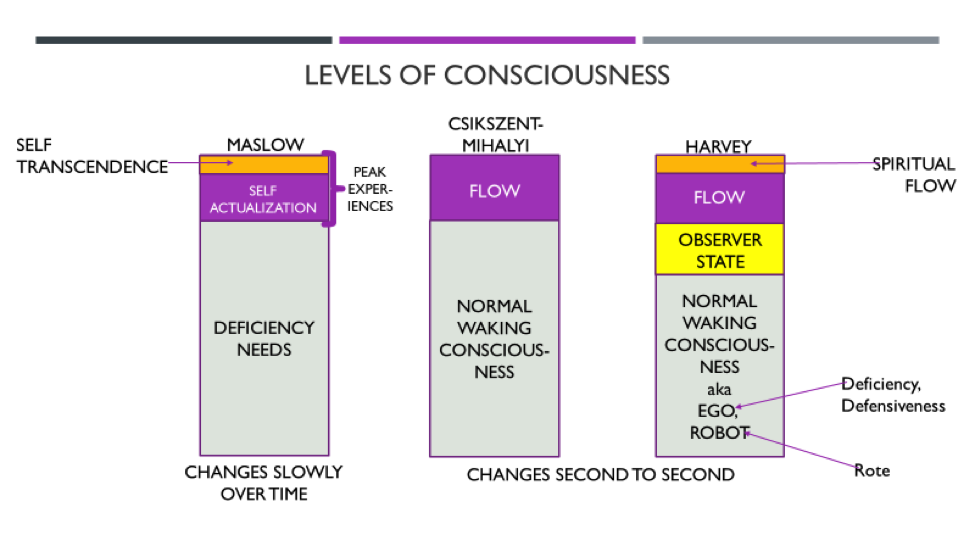
This slide tells you how I view the work of Maslow, Mihaly and myself, and how we are all describing the same things, but organizing our data differently.

In my way of looking at things, introspection with concentration – you can also call it meditation – is what gets us into the Observer state and then into the Flow state. I believe Maslow grouped the Observer and Flow state experiences into what he called peak experiences.

To all three of us, normal waking consciousness is a state in which our behavior and our sense of experience is highly dominated by outside forces, we are trying to fit in, be accepted, get along, move up, and do not feel disposed to much self-examination. When we do notice our inner experience it is largely one of anxiety to one degree or another, unable to break away from what negative events could befall us.

Maslow’s Hierarchy of Needs postulated that we would be obsessed by a given need until it was satisfied, at which point we became obsessed with a slightly “higher” need. We move up from being dominated by insecurity to being driven by a need to feel that we belong, and once having achieved that, it was self-esteem and the esteem of others that caused our behavior and our experience of life.

This series of posts will continue and the aim ultimately is to provide a condensed set of recommendations aimed at freeing you, the reader, from the conditioned motivators in your subconscious, so that you can enjoy more peak experiences, become self-actualized (if you are not already), and then self-transcendent, in a steady state of Flow and peak experience where what happens to everyone around you is more motivating than what happens to you, because you are already complete and feeling the unity.

I think of this series of posts which start here as “On the Road to Flow”. In the next post I will unpack the slide above.

My best to all,

Bill

Follow my regular media blog, In Terms of ROI at Media Village. Here is the link to my latest post.


To the People of the World

Created November 13, 2020

I am an American. I also consider myself a citizen of Earth, and a member of the Human Race club.

From my point of view, we have been spending too much time competing for political power to get done any of the immense things that we HAVE TO get done.

And then when somebody wins power, the other major party blocks getting anything done.

And the voters then seem to forget who actually tried to get something done, and who spent all their time blocking it.

This might not be worth discussing if everything was going to take care of itself because we are already in utopia.

However, there are not one but six tidal wave problems coming at us from all directions which all of us have to solve together, one way or another, with or without cooperating with each other, or we won’t be around anymore. They are also getting worse the longer we fool around. And we make each one of them worse by refusing to cooperate with each other.

  1. Pandemic
  2. American Schism
  3. World Debt
  4. Environment (and future pandemics if deforestation continues)
  5. International Envy
  6. Half of us might not find work (robotics)

We’ve seen from the pandemic that it doesn’t work as well when each State comes up with its own way of doing things. The bigger the problem, the more important wide scale cooperation is.

I recommend that the next time you read about any politician making a statement about anything other than one of these six problems, you ignore it, and let them know where you want them to refocus their attention.

Please let me know if my list is too short.

For manageability I grouped related challenges together, for example racial/ethnic/gender/all-inclusive equality is really at the core of problem #2.

“International Envy” groups together the threats from other nations, terrorist organizations, and all of the vendettas lingering from the distant and/or recent past.

It is easy to predict that we will be more efficient and faster about turning the tide on these threats the more we can work together.

I recommend the next time you read about any politician making a negative statement about anybody, you ignore it, and let them know where you want them to put their energies instead of this endless backbiting.

I recommend that you stop sending and mentioning in social media or in any venue “the backbiting channel” which has become the top-rated audience draw of all time. The computers will notice that and stop depending on it for the maximum audience draw that it has recently become.

I predict you will also, then, sleep better.

There are ways we can use our wonderful media to share constructive innovative ideas with one another. What we really need is for officials to start to practice the modes of creativity and to use each other’s ideas without caring about who gets the credit so much. I depict such media being used in a crisis similar to ours in a science fiction novel PANDEMONIUM: Live To All Devices (hope you will read the free sample available through the link).

Some time ago, two U.S. presidents and two dozen other well-known top US officials responded supportively to my idea that INDIVIDUALIZED EDUCATION can channel people into the specializations that perfectly match their inner purpose and skills, with corporations and work study programs meshing with the process from the earliest grades. Recently a friend in Germany told me that those ideas had taken hold over there.

Adults also need individualized education now if they are out of regular school but also out of regular work – or want to be in a different field.

We seem to have a ready workforce of life coaches who could be organized to help those out of school for whom life is not working out as joyfully as it could be if they were doing work that they loved. They would then be more likely to get into Flow state, where they could make more money, but even without the money would at least be doing what they were born to be good at.

Once totally successful, welfare and other transfer payments would dwindle to virtually nothingness. Individualized Education is the kind of work we ought to be doing in the 21st Century.

That’s only one innovative approach worth exploring and work on from both sides of the aisle together. There will be a panoply of exciting new ideas unleashed from the combination of crowdsourcing and a nonpartisan lens.

Let’s make political parties invisible for a while, can we?

When Japan was in the process of taking over China, with one city falling after the next, even more than US aid the ability of the Chinese Civil War combatants to temporarily unite was what pushed Japan off the mainland.

Can you imagine what will happen if we don’t stop it now and return to the normal we were used to for 200 years? We could be fighting WWIII in the streets and on the hills of America, first with each other, and then when other countries come over to help one side, it will be like the early days of America when Brits, French, Germans, and others were here fighting, except it’s more likely to be other superpowers and rogue nations. That’s the current direction we are pushing ourselves in by dividing the house so that it cannot stand.

Proof or not, the unbelievable intensity and extremity of it makes it hard to believe that a lot of it is not being caused by foreign powers.

Each of us can’t expect other people to take this advice while each of us keep dishing the dirt. We have to change ourselves first. Friends will read our silences or hear our remarks and understand that we have dropped out of the cycle of hate. The more of us do that, the more of them will do it, until there is no more them.

There never was a Them, it’s always been just US.

May The Center Hold,

God Bless America and each of you,

Bill

Follow my regular media blog contribution, In Terms of ROI at Media Village. Click here to read my latest post.

The Follower Type

Created November 2, 2020

A long time ago we each made up our own mind for ourselves. Language did not exist, and so there was no way to convince one another of any given viewpoint.

That all changed when language came along.

Life then became gradually more complex. There were more things to think about and wonder about.

It started to get awfully difficult to know whom to believe about some really important things. Like God. And how to run a State.

A new type of person began to emerge who had never existed before. This new type did not even know it was a type. These were people just like you and me. They weren’t especially good or especially bad. They weren’t especially smart or stupid.

They became a recognizable type because they combined certain psychological patterns that had never existed before.

  1. They really wanted to know who was right and who was wrong. They cared a LOT about right and wrong, they sincerely did.
  2. They thought a lot about it and couldn’t make their minds up no matter how hard they tried. They got very upset about this and could not take it anymore.
  3. One day, a switch went off inside them and they became The Follower Type. Rather than try to think for themselves they abrogated that right and committed to following some system or person. They subscribed to a pre-packaged viewpoint, achieving closure from mental dissonance, feeling the tonic chord which resolves the musical anticipations of that final perfect resting place.

Capitalism. Communism. Religion X. Religion Y. Republican. Democrat.

Wikipedia calls this type The Authoritarian Type and writes – prepare yourself dear reader, this is going to seem like an opposite type, but it’s one type with two ends:

In The Authoritarian Personality (1950), Theodor W. Adorno and Else Frenkel-BrunswikDaniel Levinson and Nevitt Sanford proposed a personality type that involved the “potentially fascistic individual.”[3] The historical background that influenced the theoretical development of the authoritarian personality included the rise of fascism in the 1930s, the Second World War (1939–1945), and the Holocaust, which indicated that the fascistic individual was psychologically susceptible to the ideology of anti-Semitism and to the emotional appeal of anti-democratic politics.

The authoritarian personality has a strict superego, which controls a weak ego that is unable to cope with the strong impulses of the id. The resulting intrapsychic conflicts cause personal insecurities, which result in the superego adhering to externally imposed conventional norms (conventionalism), and unquestioning obedience to the authorities who impose and administer the social norms of society (authoritarian submission). The ego-defense mechanism of psychological projection arises when the authoritarian person avoids self-reference to the anxiety-producing impulse(s) of the id, by projecting the impulse(s) onto the “inferior” minority social-groups of the culture (projectivity), which are expressed by way of greatly evaluative and harshly judgemental beliefs (power and toughness) and rigid (stereotypy).

The authoritarian person also presents a cynical and disdainful view of humanity, and a need to wield power and be tough, which arise from the anxieties produced by the perceived lapses of people who do not abide by the conventions and social norms of society (destructiveness and cynicism); a general tendency to focus upon people who violate the value system, and to act oppressively against them (authoritarian aggression); anti-intellectualism, a general opposition to the subjective and imaginative tendencies of the mind (anti-intraception); a tendency to believe in mystic determination (superstition); and an exaggerated concern with sexual promiscuity.

In human psychological development, the formation of the authoritarian personality occurs within the first years of a child’s life, strongly influenced and shaped by the parents’ personalities and the organizational structure of the child’s family; thus, parent-child relations that are “hierarchical, authoritarian, [and] exploitative” can result in a child developing an authoritarian personality.[4] Authoritarian-personality characteristics are fostered by parents who have a psychological need for domination, and who harshly threaten their child to compel obedience to conventional behaviors. Moreover, such domineering parents also are preoccupied with social status, a concern they communicate by having the child follow rigid, external rules. In consequence of such domination, the child suffers emotionally from the suppression of his or her feelings of aggression and resentment towards the domineering parents, whom the child reverently idealizes, but does not criticize.

(Source: Wikipedia) The solution to consider is to educate people from an early age to recognize any such impulses within themselves, and to lead them back to making their own minds up for themselves, rather than subscribing whole cloth to some existing body of beliefs, simply to relieve the inner tension created by not having any guidepost at all.

We might teach the young that in personal experience one rarely finds leaders who are always right or always wrong, the lesson being that the individual should always be checking his/her own compass on the leaders whoever they are.

May the Center Hold.

God Bless America,

Bill


Follow my regular media blog contribution, In Terms of ROI at Media Village. Click here to read my latest post.


Thomas Paine, the True Spirit of America, and the need to make Common Sense more common

Created October 16th, 2020

It is suspected that Tom Paine had a hand in the writing of the American Declaration of Independence.

But it is a fact that he had an important hand in the American Revolution. His pamphlet in 1776 is what set the match to the smoldering timber.

The revolution was about one single subject. Tyranny. Especially the tyranny of the British over their colony which painted itself as authentic concern about the colonists.

“Common sense will tell us, that the power which hath endeavored to subdue us, is of all others, the most improper to defend us.” –Thomas Paine

The name of his pamphlet was Common Sense. Only 500,000 copies were sold, but the 47-page treatise turned millions of British Colonists with a beef against the King, into people with a sense of being their own independent country, Americans.

He wrote the document as an Englishman, addressing The Inhabitants of America. His pamphlet is regarded as “one of the wellsprings of the thinking that founded the country. Common sense, that is, a plain practical ‘get on with the job’ philosophy is part of the American psyche.”

Today’s dictionaries define “Common Sense” as “sound and prudent judgment based on a simple perception of the situation or facts.” And: “sound practical judgment concerning everyday matters”, which specifies that common sense is limited to everyday matters.

“In the 1770s, the term Common Sense meant ‘primary truth’, that is, the unquestionable beliefs that all people receive from their experience of being alive, the faculty of self-evident truths.” If he did ghost write some lines for Jefferson in the Declaration of Independence, perhaps to Paine “Common Sense” meant “We hold these truths to be self-evident.”

The power of communication can be so great when one sticks to common sense. Common sense has no need of rancor, blame, insults. It sticks to the obvious and easily-agreed facts and argues from that common ground to what must be an unarguable answer.

Yet Paine and all the founders knew of human imperfections, even the ability to lose all sense, not just horse sense, but to literally lose the faculty of seeing even the obvious.

Thomas Paine on reason and thinking:

“Reason obeys itself; and ignorance submits to whatever is dictated to it.”

“It is an affront to treat falsehood with complaisance.”

“It is error only, and not truth, that shrinks from inquiry.”

“A long habit of not thinking a thing wrong gives it a superficial appearance of being right.”

“To argue with a man who has renounced the use and authority of reason, and whose philosophy consists in holding humanity in contempt, is like administering medicine to the dead, or endeavoring to convert an atheist by scripture.”

“When men yield up the privilege of thinking, the last shadow of liberty quits the horizon.”

The founders were all men and women of the world, realists. They gave us a system that – with kindnesswould work to “give everyone an even break, and then some.” –Frank Sinatra

Thomas Paine:

“He that would make his own liberty secure, must guard even his enemy from oppression; for if he violates this duty, he establishes a precedent that will reach to himself.”

“Human nature is not of itself vicious.”

“Suspicion is the companion of mean souls, and the bane of all good society.”

“I believe in the equality of man; and I believe that religious duties consist in doing justice, loving mercy, and endeavoring to make our fellow-creatures happy.”

“If there must be trouble, let it be in my day, that my child may have peace.”

“We have it in our power to begin the world over again.”

A Song For Today – Liberty Tree, by Stan Satlin, from the poem of the same name by Thomas Paine

More Potent Quotes for today, about Tyranny

May the Center Hold.

Best to all,

Bill