Category Archives: Cooperation

Starting Over

Welcome to this week’s Bill Harvey Blog
Created June 26, 2026

It’s a gloriously beautiful day in the future. The dark days of endless hate and hopelessness have finally ended. The United States has voted in a competent, pragmatic President who is inspired by the spirit of America and its dream for the world. The American dream of the preciousness of each human life and the dignity of every individual.

There is a lot of rebuilding and repair to do. Augean stables abound.

Rather than being overwhelmed by the scope of the task, Americans who begin this resurrection will feel grateful to be the lucky generations whose timing has granted them this historic honor. “We are the new Washingtons, Franklins, Jeffersons, Hamiltons, Lincolns,” they dare to realize with awe. “Completing their work.”

Starting over. A feeling of enormous creative license, freedom to paint on a grand scale canvas. And yet an imperative to start from and hew to originalism, the original Constitution, its exact words and meanings.

Even though that Constitution did not protect us from falling away from The American Dream into an American Nightmare.

That is where the creativity comes in. How do we Amend the Constitution so that it can never happen again?

Finally, a social media conversation worth having. A collaboration, a wikimedia, crowdsourcing at the highest level. With guard rails and guidelines contributed by experts in Constitutional Law.

Something better to do with the amazing media we have created.

A sense of common purpose.

Starting over is a lovely feeling.

What sorts of things will be up for discussion? What are some of the different ways things can turn out?

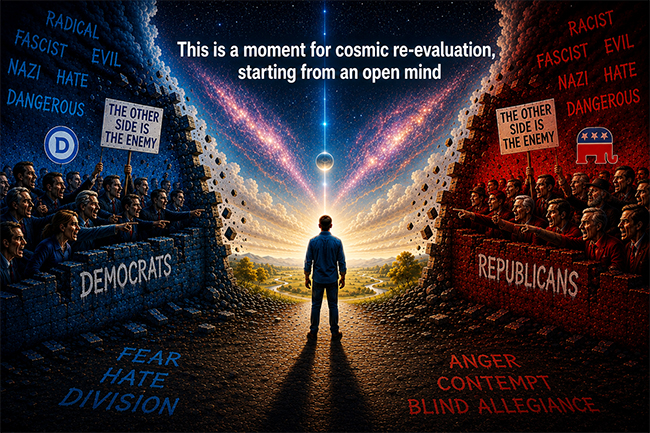
In one scenario, there may be a ban on the two-party system.

The idea of political parties is never mentioned in the Declaration of Independence nor in the Constitution.

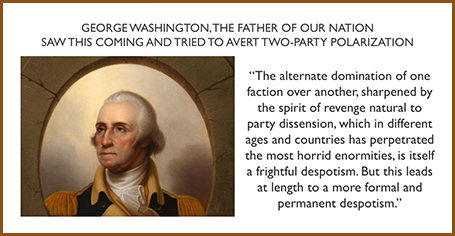
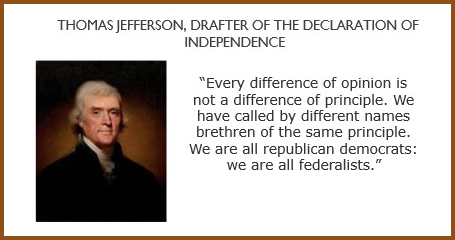
In fact, many of the Founding Fathers were deeply suspicious of them. They referred to political parties as “factions” and viewed them as a threat to national unity.

For instance, George Washington famously used his 1796 Farewell Address to warn Americans against the dangers of political parties, arguing that they would lead to “alternate domination” and distract the government from its duties. Similarly, James Madison wrote extensively in Federalist No. 10 about how to control the negative effects of factions.

George Washington

Thomas Jefferson

The landmark political science book Partisan Hearts and Minds: Political Parties and the Social Identities of Voters by Green, Palmquist, and Schickler argues against the common political science theory that political party affiliation is a rational, calculated choice based on policy. Instead, it’s a deep-seated social identity, much like religious or ethnic alignments. People adopt a partisan identity early in adulthood. This identity acts as a perceptual lens that filters all future political information. Major events like recessions or scandals rarely shatter a voter’s core party identity.

A social identity does not have the same psychological status as motivational drives; it is more like a mask that is worn, not the inner urgings which cause all of our behavior. We stick to our early self-classification as Democrats or Republicans because otherwise we feel a loss of identity and as if we no longer live within the safety and support of a large group. All of this goes on below the level of our conscious minds. This is why we can be rabble-roused and manipulated to hate each other. If our conscious minds were in control, we would not let that happen.

When the reconstruction comes, there may no longer be political parties. The first new President may be an Independent. This was never thought possible, but today we see great erosion in the images of both parties. Americans want a real change and this might not be possible with the current two parties.

How do we stop money from controlling politics?

This is really a media question.

If there were a foolproof mechanism for identifying candidates willing to serve and who have proven by their actions to be the kinds of people that could possibly serve us well, the media exposure of those candidates could be provided for free, mandated by law. True, this would reduce advertising revenues by about 3%, but perhaps that would be worth the cost.

One way or another, in the reconstruction, we have to stop the buying of elections by the amount of money raised for advertising.

Neither gerrymandering nor filibuster appears in the Constitution. The Electoral College causes gerrymandering, so it is time to switch to popular vote. The two-party system causes filibuster, so in the Second Life of America, we can sweep those out together.

The FCC may have been a bit prissy in regulating American media before there was digital, but on balance, we were better off then than now in terms of what we allow in media.

With AI, it is well within technical capabilities to automatically fact-check everything and to filter out lies and false statements made innocently – or to allow them with the fact check alongside – something for all of us to decide together. Then we get the best of Free Speech without the current Orwellian, Skinnerian conditioning of our whole population’s acceptance of blatant lying as the new way of being we are all supposed to adopt because somehow it is manly?

We who are suffering through the new Dark Ages are entitled to let our hearts and minds have respite by living in the future when we emerge again in the Light.

Starting Over.

Love to all,
Bill


Regaining Tolerable Differences in Opinion

Welcome to this week’s Bill Harvey Blog
Created February 26, 2026

Last week, we began this discussion of finding things we can agree upon across the political spectrum. It is the issue of the Age, and so obviously not soluble in one quick blogpost. In this post, we intend to dive more deeply into finding the pragmatic solution steps.

Step one in any solution process is a situation analysis. In this case, what is wrong, and how did it get broken?

The Ideological Brain: A Radical Science of Flexible Thinking, authored by political neuroscientist Leor Zmigrod, is a good read which came out in 2025 and touches upon many of the subjects about ways to use the mind, which I come at from a different angle in my writings, and which Jerry Zaltman writes about in his books. Where Jerry uses terms such as “open mind”, and I use terms such as “hasty closure” and “dichotomania”, Leor uses “rigidity” and “dogmatic”, but we are all talking about the same things: different ways of using our minds.

Leor brings both genetics and epigenetics into the picture in reporting meta-analyses of neuroscience experiments conducted all over the world which have found that there are structural brain differences which account for the tendency to not update one’s thinking based on new evidence, but to stick with doctrine that explains everything in life, i.e. some ideology, a narrative designed to be logically exhaustive and prescriptive about how to live one’s life.

Darwin taught us nothing if not that survival depends upon the ability to adapt to changing environments. But if one is in an ideological state of mind, this adaptability is crippled.

My friend Joel Tucciarone uses the phrase “frozen perceptions”.

Leor points out that the structural brain differences do not necessarily precede the adoption or the conditioning into belief in an ideology, and that brain plasticity enables a person to overcome and change the brain structure by acts of free will. There is not a deterministic no-exit mind trap; we can choose to use our minds in unfamiliar ways and stick to it and free ourselves. However, she also points out that there is a tendency for a person who is locked into one specific ideology, if he or she gives that up, to fall into a different ideology. She hypothesizes that the regimentation and the comfort of not having to think about the complexity of existence seduce many of us to choose a prepackaged ideology. This is also my hypothesis, that the stress of Acceleritis causes many of us to subscribe to an existing comprehensive set of beliefs as opposed to making our own decisions about the perennial largest philosophical questions.

Unable to bear ambiguity, many will seek hasty closure in an ideology. Better to be like a scientist, leaving closure open until there is replicated proof.

When I was a child, I became aware of a number of political and religious ideologies: Fascism (WWII was still going on), Capitalism, Communism, Democrats, Republicans, Jews, Christians, Hindus, Muslims, et al, each with its own logically comprehensive beliefs and action rules. I intuitively felt no resonance with any of them; they all seemed limiting to me.

So ideology has been going on a long time, for thousands of years (Leor traces the word itself to July 22, 1794, I won’t be a spoiler, enjoy her beautiful writing), people have wedded themselves firmly to belief systems. But today the matter has come to a head in a way that seems apocalyptic even compared to the American Civil War and WWII, because of the ferocity of the unforgiving anger and loathing between the most extreme of the right and left political ideologues in the USA.

Leor again comes to the rescue here by reporting well-replicated experiments which indicate that ideological locked-in thinking spikes during periods of fear and threat. It would appear from the evidence that the bitterness and implacability of the ideological clash today is explained by the many frightening existential threats that have come together at this point in history. Thermonuclear, biological, chemical, psychological weapons of mass destruction, environmental collapse, risk of economic breakdown because of fiat currencies and gargantuan debt buildups, devastation of trust, mental emotional Acceleritis overwhelm, AI, and the absence of a plausible scientific spiritual worldview. If Leor is right about fear being a cause of ideological exacerbation, then this doomsday litany is among the unmooring terrors of the present epoch, which arguably explain why the left and right have morphed from friendly competitors into vicious hated enemies.

In my philosophy with which readers of this blog are familiar, fear itself is an alarm that wakens us to think creatively about some problem and to solve it, which is best done in a mindset of resolute courage and stoic resilience, i.e., turn off the fear alarm before you start to think about the solution. Accept the possibility of the negative outcome and see how you will handle it if it comes. Then, turn to creative thinking to prevent the undesirable outcome.

Instead of doing these things, our two political poles are blaming each other, besmirching each other, and justifying their own righteousness. I’m not saying that both extremes are equally at fault; I’m saying that is not the useful handle on the solution. Whoever has done whatever wrongs will eventually be sorted out and penalties applied to criminal acts where appropriate. In the meantime, a general amnesty is necessary. In the end, most of us will be found innocent, and the time for forgiveness of the masses is at hand.

“To err is human, to forgive is divine.” This was written by Alexander Pope in 1711 and has roots in the Bible:

  • “To Err is Human”: Romans 3:23 (“For all have sinned and fall short of the glory of God”) acknowledges that making mistakes/sinning is a part of fallen human nature.
  • “To Forgive is Divine”: Ephesians 4:32 and Colossians 3:13 encourage Christians to forgive others just as God, through Christ, has forgiven them.
  • God’s Command: Jesus emphasizes the importance of forgiveness in Matthew 6:14, stating that if you forgive others, your heavenly Father will also forgive you.

In my own humble philosophy, we each are an avatar of the One Consciousness, and have been given free will in order, across incarnations, to learn for ourselves the right ways to be, and this learning will be driven by errors we make. Error is inherent in the cosmic video game the One is playing. Therefore, forgiveness is implicit in the whole setup.

By forgiveness, I do not mean to say that those who continue to act against our interests should be empowered to continue doing those things to us. I mean that in our hearts we can remove the anger and hatred and replace it with understanding, compassion, empathy, and pragmatic solutions to no longer have to put up with those mistreatments.

Voting is the way in which we can take the most effective action. Communication with our representatives is something we can do every day we feel like it (and is our civic duty), and speaking up constructively without rancor will be more effective than joining in with the yelling. We shall also be able to communicate more effectively if we are not taking an accusatory tone, the listener, if he/she is not being blamed, will have a more open mind. If we take the love out of our voice, the people we most need to listen will not listen and will make sure to black us out of their consciousness.

Takeaways:

  • Open Closure
  • Adaptive Optimization Synthesizing Idealism and Pragmatism
  • Agility, Resilience, Adaptability
  • Ability to reset one’s mind (finding the hidden switch)

Love to all,
Bill


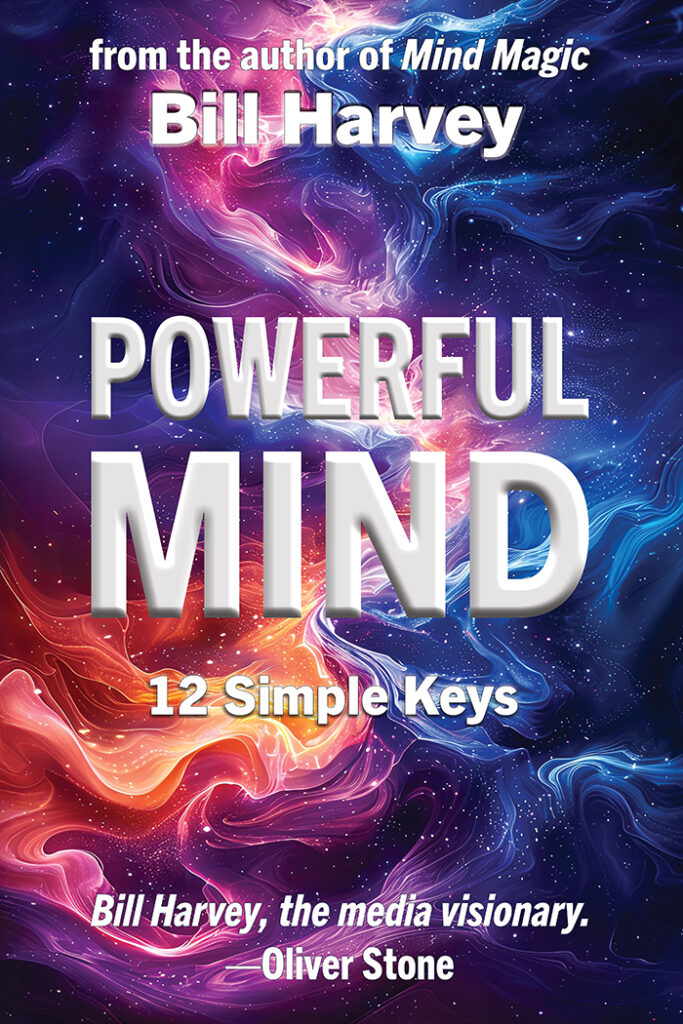
POWERFUL MIND 12 Simple Keys
Available Now
POWERFUL MIND 12 Simple Keys by Bill Harvey

SPECIAL EDITION: An Eye for An Eye

Created April 15, 2024
Special Edition

The Iranian tactic has an ancient basis in the respective bibles of the “People of The Book.” As a species we have known for a long time the disastrous consequences of escalation.

This demo by Teheran starts a new era in geopolitik.

It was prophesied in my 2022 novel Pandemonium: Live To All Devices. Not to make more of a spoiler than necessary, a virtual reality television star leads a coalition to prevent escalation, sort of a global NATO, and it works by careful judgment of the optimal degree of retaliation (e.g. page 457).

Israel will now know that unmanned missile and drone attacks are the preferred mode of making “just enough” reparations. Next time there is an October 7th type action. But can anyone afford one more such action?

Does this new context offer an increased feeling of safety, that forms of mischief which have been vaguely tolerated in the past, fighting terrorists but not the people that sent them, those mischief forms are now off the table? Would anyone blame Israel for using these same air missile and drone tactics on Iran if there were to be one further provocation?

Should not everyone take the moment to back away from provocations they are causing right now? Start quietly winding them down?

We have reached a moment that was easy to see coming. For the past 8 years and even longer, governments around the world have been continuing to rattle sabers and appear as strong as possible to one another, as if we were still using TNT, as if bioweapons and cyberweapons and thermonuclear weapons and propaganda weapons were still back at the primitive WWII level.

A bunch of macho men in a life raft, each loaded to the gills with all sorts of exotic and superpowerful weaponry, goading each other in a dominance drill that goes on for a seeming eternity, until one of them accidentally shoves another due to a sudden ocean swell, and there is an explosive bloody free-for-all, which they all call off when they see they are all going to die.

That’s where we are folks.

Time to bring cooperation and competition back in balance.

We have been unbalanced in the competition direction as far back as we can see in written history.

The Greeks and the Romans made slightly better use of cooperation for a time, and rose as empires as a result.

These United States have until recently (with the exception of the Civil War) shown an amazing degree of cooperation. The Native American tribes had been the inspiration for the Federalist philosophy of government which the Founders adopted. This gave us the States.

If we are – the whole universe is – a single consciousness at play, this would explain the reason why cooperation works so well. It’s natural to our nature.

Nature also shows us competition, for mates, for land, for food.

We are hard wired and soft wired for both cooperation and competition.

Hard wired meaning in our physical structure including nervous system. Soft wired meaning programmed by our experiences.

Perhaps we were looking to the animals as our role models when we started off on this competition kick, where cooperation is less to be seen. And yet we see incredible cooperation among cetaceans, fish, birds, certain insects. In WWII we saw incredible cooperation by the Allies. We saw it on April 13th (EDT) when so many nations pitched in to work against an attack.

The U.S. Congress which has been commandeered and far from successfully achieving actual cooperation, is not going to play deaf to this wakeup call “courtesy” of Iran. If the public does not see a change in behavior it will demand the immediate removal of obstructors, those who show no sincere intention to legislate for the good of the public. I think we will see improvement before it goes that far. The moment calls for showing that one is alert to some need to change something. And that it cannot be delayed, procrastination rarely helps in a fire.

No more nonsense.

My Best to all,
Bill

Could World Safety Be One Conversation Away?

Created March 23, 2021

The press and late-night TV comics had a field day when the Esalen Summit was announced by the White House. Backstory: Joe, Kamala and Chuck had a running joke about the subject and then one day, started to take it seriously.

It turned out that Vlad and Jinping liked the idea. Just the three of them, Joe and his counterparts, without aides, in the hot tubs overlooking the Pacific. No press. No guards visible. Just three men having a good time and talking shop or whatever they felt like. Aimed at visioneering the future together, if it should turn out that way. Otherwise, just a fun thing.

Naturally when they got there each of them took the full most deluxe spa treatment. Vlad did that every night at home anyway. They steamed, saunaed, swam, meditated, yogaed, got massaged, and then met in the hot tubs on the deck just before sunset. Nature was making its contribution in the sky as the pelicans began their evening hunt. A dolphin breached. The three men happily watched it.

Joe asked Vlad, “He wasn’t one of yours, was he?” and the three men chuckled. All three countries had enlisted dolphins into their military and paramilitaries.

The other two men were very relaxed and had no agenda so Joe got to say something else.

“Wouldn’t it be nice if it could always be like this?”

Both men are urbane and smiled good-naturedly, while shaking their heads to indicate it can never work. Joe poured for them. An excellent Russian vodka bottle in ice. All three had agreed in advance to start with vodka. A few steps further away was a bottle of Moutai chilling, and Jack Daniels setups sat in a corner. Joe poured himself a water.

“You remember that Bogart movie where Sidney Greenstreet says he would never trust a man who doesn’t drink?” Jinping asked mischievously.

“Maltese Falcon,” Vlad supplied.

“That was right before they slip him a mickey and then kick him in the head,” Joe recalled. They all laughed. Their respective guard squads had tested all the foods, beverages, the air, and everything else. The amount of air traffic high above was constantly audible.

“See, that’s why it can’t be like this, nice, all the time,” Jinping philosophized. “We know for a fact we can’t trust each other, none of us can afford to be trustworthy, I can’t see the present situation ever ending.”

“How can we be nice all the time while calling each other soul-less killers?” Vlad asked levelly.

“And thugs?” Jinping added with a smile.

Joe had been told to expect those questions. “Look, you guys are pros, you know how the game is played. You had to expect some kind of hard talk from me after you wiped the floor with the Donald and slipped all kinds of unthinkable things past him. The last time anyone got away with daring the US so blatantly was the Cuban Missile Crisis.”

The two Eurasian friends looked at each other and tacitly gave Joe the point.

“So,” Joe went on, “I apologize and will do so publicly when we announce something positive together after this is over. But let’s get back to the future, one in which we talk things over just the three of us, and try to settle everything amicably in advance. Have you wargamed it?” Joe asked both of them. “I mean peacegamed it. Scenarios…” They both nodded ponderously. This promised to be a boring conversation for them. However, as professionals they both enjoyed looking for the advantages they could gain from something he might say.

“We have too,” Joe confided, “it comes down to four things: whether we each feel we have elbow room, how much our behavior at home offends one of us, what to do about everybody else besides our three countries, not making aggressive moves against each other, and a load of details our people can work out.”

“Like the trade deals,” Jinping complained mildly, “just one of the little details?”

“And like what we base world currency on,” Vlad added studiously.

“Say it comes down to a trillion things, still, those top four are the ones to solve, the rest is like a zipper,” Joe pitched them. Both men sat back and pretended to be getting their backs done by the jets. Meanwhile their minds went into overdrive envisioning how they could turn this to their own advantage. Soon all three men were smiling, concocting their own visions of what might be achievable from the springboard of this summit.

Interestingly, all three gave some time to thinking about their people as well as about themselves.

To Be Continued…

Best to all,

Bill