Category Archives: Acceleritis

Regaining Tolerable Differences in Opinion

Welcome to this week’s Bill Harvey Blog
Created February 26, 2026

Last week, we began this discussion of finding things we can agree upon across the political spectrum. It is the issue of the Age, and so obviously not soluble in one quick blogpost. In this post, we intend to dive more deeply into finding the pragmatic solution steps.

Step one in any solution process is a situation analysis. In this case, what is wrong, and how did it get broken?

The Ideological Brain: A Radical Science of Flexible Thinking, authored by political neuroscientist Leor Zmigrod, is a good read which came out in 2025 and touches upon many of the subjects about ways to use the mind, which I come at from a different angle in my writings, and which Jerry Zaltman writes about in his books. Where Jerry uses terms such as “open mind”, and I use terms such as “hasty closure” and “dichotomania”, Leor uses “rigidity” and “dogmatic”, but we are all talking about the same things: different ways of using our minds.

Leor brings both genetics and epigenetics into the picture in reporting meta-analyses of neuroscience experiments conducted all over the world which have found that there are structural brain differences which account for the tendency to not update one’s thinking based on new evidence, but to stick with doctrine that explains everything in life, i.e. some ideology, a narrative designed to be logically exhaustive and prescriptive about how to live one’s life.

Darwin taught us nothing if not that survival depends upon the ability to adapt to changing environments. But if one is in an ideological state of mind, this adaptability is crippled.

My friend Joel Tucciarone uses the phrase “frozen perceptions”.

Leor points out that the structural brain differences do not necessarily precede the adoption or the conditioning into belief in an ideology, and that brain plasticity enables a person to overcome and change the brain structure by acts of free will. There is not a deterministic no-exit mind trap; we can choose to use our minds in unfamiliar ways and stick to it and free ourselves. However, she also points out that there is a tendency for a person who is locked into one specific ideology, if he or she gives that up, to fall into a different ideology. She hypothesizes that the regimentation and the comfort of not having to think about the complexity of existence seduce many of us to choose a prepackaged ideology. This is also my hypothesis, that the stress of Acceleritis causes many of us to subscribe to an existing comprehensive set of beliefs as opposed to making our own decisions about the perennial largest philosophical questions.

Unable to bear ambiguity, many will seek hasty closure in an ideology. Better to be like a scientist, leaving closure open until there is replicated proof.

When I was a child, I became aware of a number of political and religious ideologies: Fascism (WWII was still going on), Capitalism, Communism, Democrats, Republicans, Jews, Christians, Hindus, Muslims, et al, each with its own logically comprehensive beliefs and action rules. I intuitively felt no resonance with any of them; they all seemed limiting to me.

So ideology has been going on a long time, for thousands of years (Leor traces the word itself to July 22, 1794, I won’t be a spoiler, enjoy her beautiful writing), people have wedded themselves firmly to belief systems. But today the matter has come to a head in a way that seems apocalyptic even compared to the American Civil War and WWII, because of the ferocity of the unforgiving anger and loathing between the most extreme of the right and left political ideologues in the USA.

Leor again comes to the rescue here by reporting well-replicated experiments which indicate that ideological locked-in thinking spikes during periods of fear and threat. It would appear from the evidence that the bitterness and implacability of the ideological clash today is explained by the many frightening existential threats that have come together at this point in history. Thermonuclear, biological, chemical, psychological weapons of mass destruction, environmental collapse, risk of economic breakdown because of fiat currencies and gargantuan debt buildups, devastation of trust, mental emotional Acceleritis overwhelm, AI, and the absence of a plausible scientific spiritual worldview. If Leor is right about fear being a cause of ideological exacerbation, then this doomsday litany is among the unmooring terrors of the present epoch, which arguably explain why the left and right have morphed from friendly competitors into vicious hated enemies.

In my philosophy with which readers of this blog are familiar, fear itself is an alarm that wakens us to think creatively about some problem and to solve it, which is best done in a mindset of resolute courage and stoic resilience, i.e., turn off the fear alarm before you start to think about the solution. Accept the possibility of the negative outcome and see how you will handle it if it comes. Then, turn to creative thinking to prevent the undesirable outcome.

Instead of doing these things, our two political poles are blaming each other, besmirching each other, and justifying their own righteousness. I’m not saying that both extremes are equally at fault; I’m saying that is not the useful handle on the solution. Whoever has done whatever wrongs will eventually be sorted out and penalties applied to criminal acts where appropriate. In the meantime, a general amnesty is necessary. In the end, most of us will be found innocent, and the time for forgiveness of the masses is at hand.

“To err is human, to forgive is divine.” This was written by Alexander Pope in 1711 and has roots in the Bible:

  • “To Err is Human”: Romans 3:23 (“For all have sinned and fall short of the glory of God”) acknowledges that making mistakes/sinning is a part of fallen human nature.
  • “To Forgive is Divine”: Ephesians 4:32 and Colossians 3:13 encourage Christians to forgive others just as God, through Christ, has forgiven them.
  • God’s Command: Jesus emphasizes the importance of forgiveness in Matthew 6:14, stating that if you forgive others, your heavenly Father will also forgive you.

In my own humble philosophy, we each are an avatar of the One Consciousness, and have been given free will in order, across incarnations, to learn for ourselves the right ways to be, and this learning will be driven by errors we make. Error is inherent in the cosmic video game the One is playing. Therefore, forgiveness is implicit in the whole setup.

By forgiveness, I do not mean to say that those who continue to act against our interests should be empowered to continue doing those things to us. I mean that in our hearts we can remove the anger and hatred and replace it with understanding, compassion, empathy, and pragmatic solutions to no longer have to put up with those mistreatments.

Voting is the way in which we can take the most effective action. Communication with our representatives is something we can do every day we feel like it (and is our civic duty), and speaking up constructively without rancor will be more effective than joining in with the yelling. We shall also be able to communicate more effectively if we are not taking an accusatory tone, the listener, if he/she is not being blamed, will have a more open mind. If we take the love out of our voice, the people we most need to listen will not listen and will make sure to black us out of their consciousness.

Takeaways:

  • Open Closure
  • Adaptive Optimization Synthesizing Idealism and Pragmatism
  • Agility, Resilience, Adaptability
  • Ability to reset one’s mind (finding the hidden switch)

Love to all,
Bill


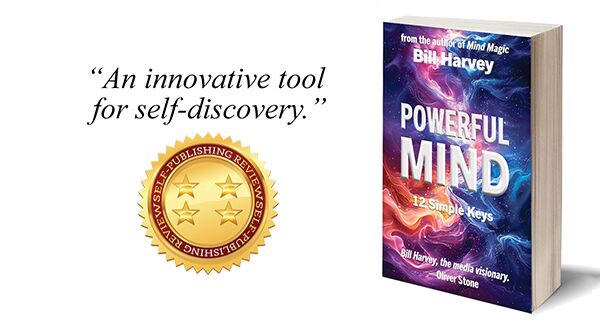
POWERFUL MIND 12 Simple Keys
Available Now
POWERFUL MIND 12 Simple Keys by Bill Harvey

Peel Away Your Layers of Conditioning

Powerful Mind Part 12

Welcome to this week’s Bill Harvey Blog.
Created May 26, 2023. Updated June 20, 2025

Read Powerful Mind Part 11               |              See all 12 Powerful Mind Keys

You may have an investment in accepting some thoughts over others, such as thoughts that make you look smart to yourself. Just knowing that you can be biased goes a long way to seeing past any bias you may have lurking in your head.

Example: Now that you are reading this blog series, Powerful Mind, you are paying more attention to what goes on in your mind. Someone just said something to you and you notice that you have a flash of invisible anger and then go on with the conversation as though nothing happened. Later, you have a free moment to look back and ask yourself, “What was that?” It takes a little while, but when you least expect it, when you are thinking of something else, it suddenly pops into your head that you have been secretly competing with a specific person, making him or her a rival, and what made you mad is that your rival scored a point. It was “secretly” because you never said to yourself “out loud in your mind” that you considered that person a rival. It was your own secret from yourself. You may know exactly what I’m talking about because this kind of thing has happened to you in the past. As a result of Powerful Mind, look forward to more of those exposés happening in the future as you peel away the layers of conditioning.

Don’t take anything to extremes. This key is not meant to turn you into Hamlet, never able to make a decision. You must, in fact, become more decisive, simply not hasty: think things through thoroughly and then take action.

If you sense something is dragging on too long and you have needed to take action for some time, you really need to get away by yourself for however long it takes (within reason) to plan out what to do decisively.

Check your Perceptions

One form of hasty closure is perceptual: you actually “hallucinate” in mild ways all the time, seeing or hearing things that are subtly different from the reality that actually exists around you. You tend to see things that you expect to see, rather than what really happened. In this way your preconceived biases act themselves out in your physical senses.

You expect that someone will be sneering at you and you actually seem to see that sneer although this time the person is actually trying to be nice. Or the other way around, you expect them to be nice and don’t realize they are actually sneering at you.

The automated pre-conscious mind has searched your memory banks, found something similar and projected it, so that you literally see your prediction instead of seeing the current reality. Only by paying careful and patient attention can you override this hasty closure of the senses.

Unless you are patiently paying attention to everything that goes on around and inside of you, you will not notice your mind screening out things that are familiar, things you have seen before. This function of the mind is a type of hasty closure where the closure occurs in the pre-conscious state, even before you become aware of something.

To the robotical part of the mind, this makes sense, because it is conserving mental energy by making “invisible” those perceptions that it considers unimportant because that sort of thing has been seen before. At some point in the past, it was interesting but then closure was achieved on that content. The beautiful view out your window that you persistently ignore.

Most of the time, it might even make sense that you save time by ignoring the familiar. But sometimes it means that you have lost the power to relish something beautiful just because your mind takes it for granted. Better that the whole you stays awake and aware of everything so the whole you can make your own decisions, rather than be run by automated functions of your pre-conscious mind.

Contemplation “Vacations”

I mention this strategy last because most people would say, “I don’t have time for this one.” Here the idea is to set aside some time for yourself, perhaps when there is nothing else to do — on a train, plane or bus when you have nothing you want or need to read, waiting in a doctor’s office, you can’t sleep for some reason, you’re getting a CAT scan or MRI and have to lay still for 25 minutes. Or when you are actually on vacation, or by yourself and no one is phoning you or texting you or otherwise distracting you.

Consider these times to be vacations from Acceleritis. There is no pressure. You can do anything you want. Instead of just letting your mind wander aimlessly, here’s something else you can do that is extremely useful and beneficial and pays back for the rest of your life.

Contemplate who you are — who you really are. And what do you really know about what life is really all about.

Many eminent scientists have pointed out that everything science has learned since the beginning of time is a mere thimbleful relative to what there is in total to know. As the song goes, “how little we know, how much to discover” (Springer/Leigh).

Actual knowing is very difficult. It requires the kind of proof demanded by science and by courts of law. Yet our minds want closure; it is built into our brains to want closure. We create fake closure just to have a sense of closure. This is hasty closure and it is self-defeating. It keeps us from objectively seeing and, in the long run, from getting closer to true knowing.

Details to follow in the subsequent posts.

See all 12 Powerful Mind Keys

Love to all,
Bill


Visit Us On FacebookVisit Us On TwitterVisit Us On LinkedinVisit Us On Youtube

The Consistency Program

Powerful Mind Part 18

Welcome to this week’s Bill Harvey Blog, February 28, 2025
Created July 7, 2023
Read Powerful Mind 17

“Ralph Waldo Emerson wrote in his Essay on Self-Reliance: ‘A foolish consistency is the hobgoblin of little minds, adored by little statesmen and philosophers and divines.’ His point was that only small-minded men refused to rethink their prior beliefs. Or, put another way, he thought that today’s intuition could trump yesterday’s conclusions.” — Paul Rosenzweig, LAWFARE

Wise people have been aware of this excess invocation of consistency for some time, but their admonitions have been little grasped as cultural necessities. Why is that?

Decision-making is the basis for all action by conscious agents of any species.

Almost all decision-making is implicit, meaning the same as subconscious in this context. And because that literally means it takes place below the level of conscious awareness, it becomes understandable that many mental bad practices can persist for millennia.

Wise folks can and do tell us the right ways to live, and yet, even if it sounds good to us, we can’t seem to put their wisdom into practice.

That’s because it is harder to change mental habits than the wise have realized in the past. Those wise in today’s age are probably quite aware of the importance of this difficulty in taking control of one’s actions such that one is able to optimize real-world decision-making and its real-world outcomes, without being helplessly dragged along by past inner scripts which have become lodged in our minds.

There is a subtle sense of time pressure in our culture – often not that subtle. Under these conditions (I call Acceleritis), it’s natural that one would want to be able to make fast decisions, especially about things which do not immediately seem to be all that important.

When one’s mindset is set that way (I call it Emergency Oversimplification Procedure), one way to speed up decision-making is simply to be consistent with one’s past behavior.

We become imitations of ourselves, especially imitators of our remembered experiences. It would be more effective if you’re going to imitate, to remember back to your best moments, and to emulate whatever you did at those moments. Although, that would still be sub-optimizing.

The best practice is to be real in the moment, filtering out only negativity.

What does that mean – being real in the moment? It means exposing your true current feelings in a positive way. Not remembering back. Not imitating yourself or anyone else. Just acting naturally, without the inner sense of being at risk. Not self-protective. Not defensive. Just yourself, but editing out any negativity. Translating what may feel negative on the inside so it’s just an objective statement of facts on the outside.

This is easy to say but not easy to do. Bringing autonomous auto-reactions under one’s own conscious control is a major life achievement.

There are tricks you can use, such as applying your sense of humor.

Such as not imitating yourself or anyone else.

Such as by not choosing to be consistent with what you said yesterday or ten seconds ago, choose instead to re-inspect what you were espousing, and learn about your current self-administration by doing that inspection. You’ll recognize this to be Key #2. The Keys all work together and there are many overlaps among them. Here we are beginning our journey into Key #3 and we can see how Key #2 helps achieve Key #3. See all 12 Powerful Mind Keys

Consistency is a program in your mind. Supported by networks of neurons that interact in consistent ways. The universe has not given us a keyboard so that we could manipulate and change these neuronal patterns directly and so we shall have to build it someday, but in the meantime these Keys are the closest proxy we have for that keyboard. Which is not to dis-include the equivalent of Keys contributed by other thinkers on the subject, many of whom today are scientists, and many of whom today are spiritualists (which to them/us is an inner science).

Feed your mind voraciously while keeping it steadily open.

Details to follow in the subsequent posts.

See all 12 Powerful Mind Keys

Love to all,
Bill


ADHD, Autism Spectrum Disorder, and Depression on the Rise

Created May 10, 2024
Welcome to this week’s Bill Harvey Blog.

The inability to pay attention is a symptom of EOP (Emergency Oversimplification Procedure). My theory of Acceleritis postulates that the amount of question-producing stimuli experienced by the average person per day has been increasing ever since the start of written language. This produces information overload and the tendency to hasty closure – making up one’s mind too fast. It also causes reduction in considering the ultimate questions because we are too busy keeping up with the pace demanded of us by those around us, including media. The natural awe and wonder at life and the universe every child feels, fades away.

Do you let people complete whole sentences without jumping in to say something?

In EOP, one has little patience, because everything is happening too fast, and a part of oneself that wants to do everything perfectly is perpetually frustrated by this. Which makes us rush others to complete their thoughts.

Many people who have not yet been formally diagnosed as ADD or ADHD also have it.

In a recent New Yorker article, writer Nathan Heller cites a study by medical software company Epic which found an over-all tripling of ADHD diagnoses between 2010 and 2022, skewing even higher among younger people.

Inability to sustain attention doesn’t necessarily get optimally controlled by drugs, which often have side effects that bring down individual effectiveness in other ways. Metacognition would be a more successful medical strategy. Meditation could be more effective than medication in the long run. The optimal combination might include a gradual reduction of the drug and finally its removal.

50–70% of people with autism spectrum disorder (ASD) also have ADHD according to the American Psychiatric Association:

“Attention deficit hyperactivity disorder (ADHD) and autism spectrum disorder (ASD) are both associated with internalizing problems like depression and anxiety, and the two often co-occur. A recent study found that ADHD is more strongly linked to depression than autism. ADHD traits are also a stronger predictor of depression symptoms than autistic traits.

Youth with ADHD and autism are at high risk of experiencing mental health conditions like depression and anxiety. Depression is one of the most common mental health problems in young people with neurodevelopmental disorders (NDDs) like ADHD and ASD. Depression in NDDs can be more severe, have an earlier age-at-onset, and have a worse prognosis than in the typically developing population.

Some factors that might be driving the relationship between ADHD and mental health problems include: Genes linked to ADHD, Stressful life events, Environmental factors, and Social cognitive factors.”

Gallup in May 2023 reported that in 2017, 18-29-year-olds in the U.S. were about average in terms of being diagnosed with depression, but by 2023 that level had increased +68% in just six years, to over one in three people in that age group. The whole population is experiencing an increase in depression. Metacognition is not just a nice to have anymore. It is a must.
Rising trends: lifetime and current depression rates

Today science is finally looking objectively at the use of psychedelic drugs for their potential benefits in dealing with medical problems of cognition and affect. The Harvard professors who brought this up in the 60s spelled out the necessary setting and mindsets necessary for such experiments to have the most beneficial effects.

Millions of people today are using cannabis, MDMA, psilocybin, etc. mostly for mood elevation, and can be taught to also use them for self-reflection, under medical guidance respecting the setting and mindset best practices established by the former Harvard professors, much-maligned Timothy Leary and much-beloved Richard Alpert (Ram Dass).

Use of drugs is not a necessity for the achievement of self-awareness, even for those with neurodevelopmental disorders. To demonstrate that semantic and semiotic interventions without chemicals can have beneficial effects, you might try reading parts of this free booklet, The Navigator, from The Human Effectiveness Institute to someone you know who is having any kind of hard time.

Another exercise you might suggest to a person suffering from any of these variations of extreme EOP is to try doing this exercise:

    • Get out along in nature.
    • Find a flower (or any interesting object).
    • Contemplate it.
    • Maintain eye contact with that object.
    • Gently focus your attention upon it.
    • Allow it to permeate your mind.
    •  Notice what you notice about it.
    •  Sustain this attention for at least one full minute without checking the time.
    •  If your mind wanders, gently bring it back to the object of contemplation.
    • When you’ve had enough of the object, keep your eyes focused on it for a little while longer while using your peripheral vision – without moving your eyeballs – to see how much of the background you can see to the left, to the right, up, and down.

This exercise will also begin to bring attention under your conscious control.

Love to All,
Bill

Live chat with my avatar now.