Author Archives: grnthei

Optimizing the value of feelings in decision making

What are feelings? How are feelings optimized?

Besides the input from the five physical senses, human consciousness receives feelings. Upcoming posts will offer experiments focused on this input stream, which you can conduct yourself. These experiments will establish whether you can achieve measurable improvements in your own effectiveness stemming from better channeling or processing of feelings-type information.

To prepare for the experiments, let’s contemplate: what are feelings?
 Here you can contemplate this question if you wish, or just go on.

The Orion Nebula

Feelings are urges that arise to sensibility within us, within our minds and within our bodies. Feelings are experiences, states of consciousness resulting from motivations, sentiments, preferences or desires. These terms all really mean the same thing: motivations, what we value, what we want, what we are trying to get, what we want to avoid.

Feelings are the way we respond internally to external and internal phenomena, based on what we are trying to get and avoid, and how current events can help or threaten our desired outcomes.

Therefore feelings generally come in two valences, positive or negative. The feelings are positive if current events appear to favor our targeted outcomes, and they are negative if events seem to be heading away from what we want to have happen.

Positive feelings are valued universally in themselves. We don’t need to argue in favor of them, we all like them, and would like to have them all the time.

Negative feelings not only make us feel bad (by definition), they lower our immune system thus making us more prone to disease, and they distract our cognitive concentration thereby reducing our effectiveness. These bad feelings can also serve a positive function as an alarm system to get our attention to the problem fast. Ironically, if the bad feelings continue while one is grappling with the problem on a rational level, it will take longer to solve the problem.

When a problem arises and is sensed partially by the bad feelings within oneself, alerting us to focus on the challenge, it’s easy to say, “Turn off the alarm and get on with solving the problem.” However, it is not so easy because of attachment and Acceleritis.

Acceleritis, the unending acceleration of information entering the human brain each day, simply overloads the average human being’s capacity to do effective mental work of any kind. One kind of mental work we are supposed to get better at as we truly mature and “grow up” and become a “mensch” is to be able to sanely and in a balanced way take our feelings into account in our actions, without being stampeded or reduced to hand-wringing by those feelings. Acceleritis therefore also escalates the power of other mental subsystems that push in the direction of closure, black-and-white thinking, snap decisions, self-consistency and self-imitation — anything to simplify. Complexity is tacitly perceived as the main threat and pain causer. Acceleritis therefore lays many of us low with attachment — if Acceleritis were not present, we would actually have the mental and emotional maturity to cope with the situation without attachment.

What then is attachment?
Here you can contemplate this question if you wish, or just go on.

Whirlpool Galaxy
Attachment is the excessive dependency on something. It is actually love carried too far. You love something so much (a wonderful thing) you cannot do without it, and so you fall prey to fear of losing it, and this distracts the mind so that Observer state and Flow state are impossible. Your mind tends instead — in the Acceleritis-induced state of Emergency Operating Procedure (EOP) — to go around in circles wallowing in the fear of loss or the sense of loss, or the anger and bitterness related to the loss or threatened loss, or the hopeless defeated depression of having lost it with no hope of regaining it. No useful mental work is achieved, no problem solving, no creative new leaps rising to meet the challenge sideways, as would occur in the higher states of effectiveness, namely, the Observer and Flow states.

As discussed in earlier posts, these effectiveness states are posited to be real physical states in the brain, differentiated from one another in measurable ways. Our Theory of Holosentience is based on the hypothesis that the primary dimension determining the state of the brain and consciousness is the degree of harmony among functional areas of the brain (inhabiting our entire sentience at once) — wherein thoughts, feelings, motivations, and the other aspects of self achieve a synchronous integrity in both the experientially measurable consciousness domain as well as the scientifically measurable biometric material domain.

This brings us back to feelings. Feelings have always been less studied and talked about than thoughts. Descartes did not say “I feel, therefore I exist.”

The word feeling originally may have related (Wikipedia says) to the sense of touch, and then its meaning expanded to include the ineffable internal sense that brings us more bits (information) than the five physical senses in terms of the way it affects our actions.

What evidence is there that we are generally more driven by our feelings than by our thoughts? Freud established that thoughts are more likely to be rationalized in support of feelings, rather than people being able to use their thoughts to control their feelings. And yet, how valuable it is to be able to do just that — to have the mental self-discipline to focus one’s thoughts effectively even when one’s feelings are in an uproar.

In a nutshell, feelings are a manifestation of our motivations colliding with the external world. What feeling would we have if we had no motivations?

Here you can contemplate this question if you wish, or just go on.

Cassiopeia Galaxy

You can actually discover this for yourself, by meditating. While there are many specific methodologies for meditation, all of them have this mind/gut mirror effect of showing you what your own motivations really are, where they have gotten you, and why you have each experience you ever have. You can also achieve such objectivity that you can, as it were, turn off certain motivations for the moment and see what that feels like — what visions of future possibilities arise now that X motivation is gone, how are you breathing, how do you feel?

This gaining of perspective through meditation makes you feel good. In other words, it not only helps you inspect deeply your own feelings and their consequences in the world, it also generates a feeling, and a very good one.

What is that very, very sweet feeling? Is it happiness? Is it ecstasy? Yes, it’s all those things and more. Then what is it?

It’s love. A word that provokes instant uneasiness all round. It’s a word that makes us all feel silly. The guy has lost it. You don’t talk about such things. Verboten. Just for family talk, not public talk. What an interesting word to have such an effect.

The F-bomb has become popular in meetings with both males and females, at least in certain businesses I have moved through in the last decade. It is more acceptable than the word “love” in such venues.

Beyond getting the author in hot water, what is love?
Here you can contemplate this question if you wish, or just go on.

Pink sheer heart shape, computer generated fractal abstract background
It is the master feeling, the one all the others come from. Love is white light whereas each feeling is a color.

Love is the residue that is left when motivations are tuned down into conscious perspective, in light of an open-minded empirical philosophy of demanding proof for everything, dropping every bit of information one has heard onto a trial workboard in the consciousness storage bin, and taking it offline in terms of decision making. This is the perspective of yoga. Zen. Meditation. Contemplation. Focused singlepointed attention. A way of life for millions of people today and throughout human history. These multi-strands of movements see themselves as part of a whole, although to those outside they seem like a bunch of cults that are all different. They are all the same in achieving perspective, distance from motivations that the bodymind otherwise assumes are immutable, non-negotiable. These methods are among those crystallized into simple steps in our book Freeing Creative Effectiveness.

Why does love remain when one has achieved objective distance from one’s motivations? What evidence do we have for that assertion, and what explanation do we have for it?

As an individual my only evidence for any assertion here are my own experiences. Every time through meditation I clear away the built-in locked-in powerful sway of my own motivations, I discover that I am content, every tiny aspect of what I am experiencing is enjoyable and interesting, I simply love it, all of it, I love myself, and everyone. Others have reported similar experiences, enough so that I know I am not an isolated case. In the next post we will offer a meditative experiment whereby this may also happen to you.

Why should it be so? Why should we feel love when we are not being driven this way and that by irresistible motivations?

In my cosmological Theory of the Conscious Universe (TOTCU) we are all dubs of the master consciousness, like MP3 copies of a master recording of a song, each of us a microcosm of the whole universal consciousness. When we rise above the petty motivations that seem so all-important to us in our daily lives down here on this one planet, we partake of the carrier wave motivation we share with the master consciousness, the one that is always there under all the other motivations, from which they draw their power. Love that is omnidirectional is the wellspring, the source from which we splinter off love of money, love of power, love of sex, love of the idea of getting that big job, and so on. All other motivations are modulations of love. So when the splinter motivations are quieted, the background radiation that differentiates itself into these “local” motivations becomes visible. This is how I explain it to myself, that I have this omnidirectional love experience whenever I am centered and immune to the compulsions to protect and seize what I feel I must have.

Acceleritis makes it very difficult for me to communicate this so that it is widely credible, because Acceleritis works against the stopping of the momentum of the mini-mind —so it seems ridiculous to assert that we already have an abundance of love without having to get anything we don’t already have. And yet, if you allow the possibility of a universal consciousness of which we are all a part, what motivation would it have to be doing this universe if it did not love the doing of a universe as a game in itself, the master game, the master art form, the ultimate form of self-discovery.

Acceleritis makes it much easier to deal with information overload by focusing on differences and categorization into buckets mostly on a single continuum from good to bad. This goes on constantly below our conscious awareness. Making automated decisions that are often the wrong ones. This leads to all sorts of feelings, many of them bad. Clouding over the master feeling that exists already, unbrokenly from beginning to end. It is there underneath all this debris. It comes out when we clear off the rubble.

Now that we’ve explored “feelings”, the next post will describe an experiment you can carry out yourself on the optimization of feelings.

Best to all

Bill

______________________________________________________________

PS – Humorously, Wikipedia says that feelings are the conscious subjective experience of emotion. This is funny because psychology defines emotion as the aspect of feeling that can be measured in the body, such as glandular secretions, muscle tensions, breathing rate, brainwaves, perspiration, etc., and you could just as easily say that feelings cause emotions as you could say emotions cause feelings. The leftover behaviorist psychology way of looking at it would be to make emotions more important — in fact 100% important, with feelings relegated to the trash bin of mind as epiphenomenon, a sound track that actually has no control of what the body is doing.

Such behaviorist Pavlovian thinking is now almost a century out of date, yet remnants of that thinking still creep into the generally excellent Wikipedia (which needs our donations incidentally to stay alive, and someone should tip them off to using advertising to support themselves, doing it in a PBS-like manner to the side all the way down from top to bottom, with true sponsorship tonality). Behaviorist ideas permeated so much of our thinking as a culture when they held reign that growing up we each got a dose of such ideas in the background conversations of adults we overheard. This is where we got the idea that we can just let the mind and body do their thing the way we always do and the way other people do, without any stopping to check out what the hell these operational action decisions are being based on.

______________________________________________________________

Gaining Conscious Control over Involuntary Reactions

In this post we will begin to share what have been considered esoteric secrets by hidden schools for thousands of years. Today they would be classified as methods of applied cognitive psychology.

For thousands of years, mystery schools have existed at the core of each religion, where the religion at large is a diluted, simplified form of the core schooling, consisting mostly of rituals without retaining the full explanation of the entire system of thought. Over time, in response to the rise of religious tolerance and freedom, some of these occult (meaning “hidden”) schools have come out into the open at least to the extent of admitting their existence.

All of these schools taught (1) ethics (2) what today would be called applied cognitive psychology – the subject of today’s post, and (3) a cosmology centered around the idea of a unified identity of all things. These were never taught as three separate “courses” but as an organic whole in which the ethical and psychological portions were logical outgrowths of the cosmology. In other words, “Since you are part of a whole, treat the other parts fairly (ethics), and gain control of your involuntary reactions, which cause friction with the other parts and with your relationship to the whole (applied cognitive psychology).”

Teaching took many forms including a kind of immersive theater in which the teachers were actors and the student was not aware that they were performing. This was exemplified during the Classical Age in Greece by the Eleusinian Mysteries, and carried forth to this day by Freemasonry. The underlying principle being the now-scientifically proven fact that a person cannot change merely by intellectual understanding; instead it is pivotal that emotion/intuition/perception must also be engaged in order to make a profound and lasting psychological shift.

These “initiations” as they are called provide the types of feelings called “numinous” (magical) and what they do to the intellect – when theatrically effective – is to jar the belief in an accidental/”meaning”-less/materialistic-only universe, by seeming to provide contrary and compelling sensory evidence, i.e. a miracle or magical event. Today’s illusionists are an entertaining derivative of such practices but operate in a context where the adult audiences are fully aware that these miracles are simulated and because every adult knows the senses are being artfully tricked, hence these maneuvers are called “tricks”.

This is not to rule out that in some of these performances, something magical might actually occur – magical not in the sense of unscientific, but in the sense of not yet understood by science.

Science has now caught up to and verified that the cosmology being taught down through the ages by these hidden schools is correct. There is connectivity among all the constituent parts of the universe, matter is made of energy, space and time are one thing, particles are waves and waves are particles, and these “wavicles” remember their connection so that when apart and one changes, so does the other (as proven by the innumerable replicated experiments testing Bell’s Theorem). The information transfer from one wavicle to the other is supraluminal, i.e. faster than the speed of light, suggesting either that Einstein’s theories are at least partially incorrect, or that distance itself is an illusion, or both.

How did these relatively primitive people thousands of years ago know things that are only today being realized by our top scientists? My hypothesis is that the founders of these schools which radiated outward into far simplified dilutions called religions, were in the highest levels of Flow state when they had moments of enlightenment and realized these facts about the universe directly, through the faculty of cognition called “intuition”.

I’ve written here about Flow state many times. It is the state where the brain noise across the corpus callosum between left and right hemisphere disappears (Master Marvin Chun, Yale), and there is activity across all levels of brain rhythm as measured by EEG (delta, theta, alpha and beta waves) that appears as highly regular and synchronous between the brain hemispheres – in other words, organized rather than chaotic brain patterns. Experientially the Flow state manifests as perfect action, inspired ideation, joy, automaticity (everything is doing itself and you are along for the enjoyable ride) — and in its highest form (for there are sub-levels within this state) clairvoyance, precognition, telepathy, and ultimately a spiritual dawning (conviction of universal connectivity, liberation from fear through intuitive trust in the ultimate benevolence of the universe) which if articulable (sometimes these experiences cannot be translated into words) would be what caused  the emergence of mystery schools and later religions themselves.

Latest science proves the existence of connectivity in physics (Bell’s Theory experiments among others) and in psychology (odds against chance being in the millions to one for the existence of clairvoyance, precognition and telepathy, per meta-analyses reported by Dean Radin and Charles Tart). The Theory of the Conscious Universe (my cosmology) posits that the basic stuff of which everything is composed is information and all of this exists within a single consciousness of which everything else is a part. But what is consciousness? It is that which experiences information. To be, to exist, is to be perceived/experienced by consciousness. This would have been a radical notion at the height of materialism, which probably peaked when I was a child and is already waning today as science makes strict materialism untenable. It’s pretty obvious to all of us that we are privileged to be living at an extraordinary time of change for the human race on Earth. One key aspect of this profound change is the proof that we are all connected and the true universe we live in is as miraculous as the ancients sensed.

Smooth and striated muscle tissue in the body generally have separate functions, the striated muscles being subject to voluntary control, and the smooth muscles being those that function without conscious will being involved – such as breathing. The mind and its four functions (Jung) of intellect, intuition, feelings and perception also has voluntary and involuntary aspects. We can use willpower and practice to extend the range of control we can exert over what is generally involuntary. For example, belly dancers can so control their stomach muscles as to make a quarter flip over and over while lying on their back, and advanced yogis can slow their heart rate down to reach a point approximating suspended animation. The term they use is “yogic control”, meaning the extension of the ability to control things in their formerly uncontrollable body-mind.

This yogic control concept comes into play in everyone’s life with regard to the phenomena of negative emotions including depression, dis-courage-ment, fear, anger, and other non-helpful manifestations in the domain of feeling. When such feelings arise they tend to curtail the ability of the intellect and the intuition to see solutions to the problems that have caused these negative internal states, and even the perceptions are changed, as we subtly begin to see more ugliness and less beauty in the world around us.

The ancient mystery schools still teach methods of making these involuntary feelings – which nobody likes to have, so they must be involuntary – something that can be controlled and stopped by the voluntary will. This involves the same principle of yogic control – extending what the individual can control within their own mind-body. These teachings were typically expressed in language that today would be regarded as unscientific. My book is an effort to provide the same teachings – which have been proven to work for thousands of years on small percentages of the population – in language that is non-mysterious, operational, actionable, simple, and hopefully therefore allows everyone to gain these extraordinary degrees of control, particularly over their own minds. Thousands of my readers have written in to say that the book worked for them, and only 11 out of approximately 35,000 readers have taken advantage of the lifetime moneyback guarantee.

Let’s take a look at anger, fear, discouragement and depression and the ways that these moods can be brought under conscious control and turned around – a small sampling of the book.

Most people assume there is nothing you can do about negative emotions – they come as they will, and you must just suffer through them. However, almost everybody knows someone who they have seen rise above these feelings at one time or another. Especially at a time such as now when the world is facing so many challenges all at once, it is vital to increase everyone’s ability to rise to the occasion and surmount negative feelings.

The common “solution” today for depression consists of drugs. These drugs often do alleviate depression temporarily but it always returns and another dose is needed. The drug approach is not bad but it is really a form of depression-maintenance program: it does not cure the problem but finds a way to live with it. The best aspect of drugs is the speed and ease of getting an effect. But this allows weakness of self-control to be carried forward often for an entire lifetime, skipping over the opportunity to use the problem as a springboard to increase the individual’s yogic control.

All of the mystery schools teach that death is not the end, that like matter-energy, consciousness also is conserved by nature, and that none of these things can ever be created nor destroyed, and some such schools explicitly teach that yogic control gained in this lifetime is carried over to subsequent lifetimes on this or other planes. Because the teaching of interconnectedness has been validated by science, this does not automatically mean that all the teachings of mystery schools are necessarily true, but it’s something to think about. The alternative is to rule out thoughts that have been associated with superstition just because of association in the mind, which is itself non-scientific. All things are unproven until they are experimentally proven. Whatever happens after death will remain very difficult to prove one way or another for us the living. Science may someday figure out the death barrier, but not today.

Regardless of such considerations, one does not have to go too far in order to justify the desirability of gaining control over defeatist feelings: regardless of any view of what the world is, it’s obvious that such feelings work against the person who has them — we see the evidence every day.

It is extremely difficult if not impossible to overcome one’s own negative feelings while remaining in the everyday state of consciousness. You can say, “I am going to put those emotions away and get down to the business at hand”, but many of us don’t really have the willpower to do it. The trick is to get out of the everyday state of consciousness. By moving into the observer state, one is able to far more easily turn off useless feelings. The active ingredient in this case is simply clarity.

The steps involved are not mysterious. The first step is to turn down all distractions which means getting into an alone space where one cannot be interrupted, where you can’t hear voices in the next room, where there isn’t a TV or something playing, where you are not under time pressure if at all possible (this is not an absolute requirement, especially after you have some practice behind you — in fact after practice there are no absolute requirements).

Once you are alone, with writing implements, task number one is to understand why you are in a negative state. The writing implements can be used for this but you really have them with you to write down notes about other things that distract you from what you are there to do – shopping lists, to-do lists, whatever. Be patient and wait. Once your mind knows you are focused on one thing, diagnosing the cause of why you feel the way you do, it will soon start to give up answers to that question. They may be obvious or they may contain non-obvious aspects as well. You may find yourself writing down non-obvious aspects or simple phrases that are suddenly more revealing and meaningful than you expected, which cast new light or which simply state things you already knew but in much sharper and more useful language than you had before.

What you are doing is called contemplation, and what you are contemplating is the causes for your current state.

It is likely that you will see the causes, at least some of them, and they may make you angry at other people for being part of the causation. This is part of everyday consciousness, and will not get you past your feelings but will in fact just keep you going round and round in those feelings. You need to reject everyday consciousness, reminding yourself that any ordinary negative feelings such as fear, anger, depression, discouragement, etc. are automatically wrong. They are just alarms going off to get you to see the real underlying causes so you can cure those causes. Some of those causes may in fact be within you. You may be the first cause that leads those other people to do what they do to make you angry, fearful, or whatever.

You are flying higher, getting above the weather, so whatever weather disturbance or turbulence you experience must be rejected, whatever is commonplace and you have been there before, put aside. Focus on this rejection of commonplace negative emotion. Say to yourself, “It must be wrong, by definition, it’s not constructive, it’s not getting me anywhere, it doesn’t lead to a solution, I need something NEW.” Strip it away as it arises and see what is underneath. Where is it coming from? Where did the whole pattern start? What did you want that led you into this negative mindset?

Get creative. Generate crazy ideas. Visualize what John Wayne or Katherine Hepburn would do – whoever you look up to – drop the boundaries on the types of thinking you will use to get closer to a good idea – something that will work. Come up with ideas that will not raise resistance – think in terms of Eastern martial arts, where you go with the flow not against it.

All mystery schools and religions teach acquiescence, trust and gratitude as three sides to the same coin – the acceptance of what is. In Islam, it is called the Will of Allah. In Taoism it is called getting into the rhythm of the Tao, linking into the underlying force of the universe. The word religion itself comes from the Latin religare, meaning to link up. The word yoga comes from the Sanskrit, meaning to yoke up, like yoking an ox to a cart.

How can you feel gratitude at times that try you to the breaking point? By comparing the situation to one even worse. What if you had never existed at all? The Universe has created you — is this not justification for gratitude?

Pastor Leonard DeWitt says, “It’s not about religion, it’s about relationship.” The relationship you have to the whole can either be synchronous or it can be at odds. When you are angry, fearful, and so on, you are not in synchrony with what is happening, you are fighting it. This is why you need to reject these feelings as you strive to drop everyday consciousness, and get into an esoteric, spiritual mood.

Whether you call it God or the Universe, today science knows that you and I are intrinsically intermingled into it. Get with the Flow of it, don’t be at odds with it. To do this, you need to reject ordinary thinking and feeling. What is really happening? What is IT trying to teach you? How can this situation possibly be something that can make you better and stronger?

These are applied cognitive psychological interventions. The ones we have just shared skim one surface of the subject, but should give you a flavor.

Best to all,

Bill

America, the New World

The name America is widely believed to derive from Amerigo (Americus in Latin) Vespucci, a contemporary and eventual friend of Christopher Columbus who not only explored unknown regions of the “New World” but who also invented a system of computing exact longitude and arrived at a figure computing the earth’s equational circumference only fifty miles short of the correct measurement. Quite a feat in the early 16th century!

While no one knows for sure where it came from, the first documented use of the name America was in 1507, when Martin Waldseemüller produced a world map on which he named the new continent America after Vespucci’s first name, Amerigo. More on this fascinating story can be found here: http://www.uhmc.sunysb.edu/surgery/america.html.

Tracing the etymology of Americus, I found the Middle English “yreke”, where its context was something like “as if to rake up the dying embers and thereby release a flame.”

The USA spiritually reawakened the freedoms of belief, speech and assembly associated with higher philosophical/ethical aspirations, among other things. For when people get together and converse openly, wisdom evolves, self-awareness develops, and there is potentially more time spent in the states of Observer and Flow.

We raked up the dying embers of idealism and released the flame in American hearts. While we have no exclusive lock on that product category, America’s purpose was and is to be the house on the hill — the moral high ground. We are the heroes, the good guys in this movie.

Today, having overspent for decades, it is finally catching up with us. Remember all the good times we had? Weren’t they all great? Weren’t they all worth it?

What is “it”? Why, it’s the current comeuppance of suddenly discovering that credit card bills have been piling up in some mailbox we forget we had and now we owe 55 trillion dollars and the number is growing every second.

We are not looking very heroic right at the moment as we use TV and all other media to keep up on how our leaders are solving this crisis.

Most of our leaders and other officials we see head-shots of in the media seem to be yelling at each other and jockeying for position in such a blatant way as to intentionally send the signal to the people that they better get used to it. There is no accountability, it’s all too complex for us so if you were to revolt you would find yourselves back where you are now with nothing more than tragedy as your gain.

The candidates who seem to be different from that norm are the true heroes and many of us vote for such folks whenever we see them. We need to be more informed to vote better, studying more about the lesser players who need our votes too. This will do some good in the long term but will not help with the current economic crisis.

This is a world-wide interconnected economic crisis different from any before, although we like to classify it into the familiar pigeonhole of recessions and The Great Depression. In fairness there are similarities and there are differences.

The important difference this time is in the forecasting of the next 20 years.

Government forecasts have turned out to be too bullish all too often. Happens as frequently there as in business. People make assumptions about how hard they are going to work, how effective they are going to be, how well everyone else is going to help them, etc. After all, what is the alternative? If you put out a realistic (negative) forecast sometimes you lose the investors entirely, or get replaced by other people.

The realistic forecast going forward is that we are going to pull a rabbit out of a hat and get out of relative restriction on our capabilities including enjoyment (that is what economic cutback equates to) in less than 20 years. That is the challenge. That is the game.

If we are in Flow half the time the chances are we could do it in 5 years. Just a SWAG.*

We have to start considering entirely new ideas because we have made the dead horse floggingly unrecognizable on the stale ideas we constantly go try to resuscitate.

Totally new ideas.

If not now, when?

Minds must be opened. Zero-based thinking.**

Examples below are just to prime the pump. Maybe some of what follows could be refined into workability, but my point is to get everyone pitching in with new ideas to get out of the economic hammerlock in the shortest time and with least suffering.

Scenario A: Government creates an innovative plan and assembles the richest people in the USA. Presents its plan. How they benefit. How the people benefit. Reminding them of Thomas Jefferson’s belief in enlightened self-interest. Yes, the richest people bail out the USA. What they get out of it is more than just a fair return — the psychic diet from their citizenry brethren turns from nearly homicidal to respect and nearly awe — because they handle it with grace and turn back a percent of their gain, to the people. Possibly in the form of grants/investments on a Digitally efficient basis (i.e. Internet-based process like Facebook with spreadsheets) to vetted people below the poverty line who have entrepreneurial ventures in mind.

Scenario B: Government creates an innovative plan and assembles the leaders of all of the nations of the Western Hemisphere. Presents its plan. How they benefit. How the people benefit. The neighbor countries and the richest people in them bail out the USA. What they get out of it is more than a fair return — their countries get the highest technology not only today but forever, and their economies and quality of life are destined to shoot up. The individual robber barons do not lose their seat if they and their people can establish fond relations. In a few cases, Cuba for example, they might decide to go their own way and not be part of a new sovereign meta-nation called either THE UNITED STATES OF THE AMERICAS or THE UNITED NATIONS OF THE AMERICAS or simply AMERICA.

It might become known colloquially as The New World for a time in the press until the term is over-used.

The name America was after all, first applied to mean the entire landmass with surrounding archipelagos — which in this scenario becomes a single nation — and was on the first map to include the name America, actually specifically applied to what is now Brazil.

The Naming of America

From http://www.uhmc.sunysb.edu/surgery/america.html#vesp-map

Imagine the complementarity of all of the Western Hemisphere united. The economies of every nation in the world would benefit.

The leading question of the New Founding Fathers would be, “Now that we are back into manufacturing, how do we optimize this driver?” Roboticizing plants south of the previous border will be one obvious part of that future choice.

Good companies in other countries will be provided favorable terms to invest in new plants and offices in the new America.

There will be a billion citizens in the new nation.

What a market to sell to! The New China.

Pan-Western Hemisphere networks such as CNN will be the first beneficiary of The New National way of looking at media advertising. The beverage companies will probably be the first to make buys across the Americas with a single deal. Everyone else will follow. Other networks hasten to catch up.

What buying power in terms of taste for foreign goods, and what self-reliance on everything from oil to metals of all kinds. We will be winding down use of oil anyway, in a specifically staged wind-down with tax breaks given to whoever can help it along.

Of course the new meta-nation still has debt. Not just the USA, whose ratio of external debt to gross domestic product (GDP) is 99.9%. Canada’s is 71%, while Mexico’s is only 23% and Brazil’s is only 19%.

The US debt share to the average citizen in the US today is $47,559 and rising every minute. Diluted by far lower debts per citizen in the rest of the “New World”, the average US citizen share after the merger will be probably half or lower.

But those are abstract concepts anyway. What really counts is getting people back to work, and the excitement of new opportunities for business and trade suddenly abounding as there are fellow citizens you never had before who want stuff you have, and you want what they have, and the rest is details to be worked out.

When companies cannot grow by internal revenue growth and increased efficiency, they grow by merger and acquisition. Perhaps there is a lesson in that for nations too. Mergers where all parties are in favor of the merger — in sharp contrast to Imperialism.

These are but the first two crazy ideas. I have more crazy ideas as to how to bail out the US debt.

Scenario C: Individual productivity bails out the US debt. The US government goes on an efficiency tack in all departments and nooks and crannies. Instead of cutting jobs people are able to accomplish much more. New business management processes ensure this is not wheel spinning but instead benefits the people. The efficiency is so great and the desire to not let people go provides opportunities to move people out of cubicles into “the field” where they can become case workers to help other people hands-on — teaching them marketable skills such as computer capabilities even including software development. People go back to work and the jobs problem goes back into the yellow zone again.

Scenario D: Crime bails out the US debt. Just by decriminalizing opiates (a small fraction of the total market for criminal drugs, gambling and prostitution) $65 billion could be diverted out of the underground economy and this would choke off “The Taliban’s principal and most lucrative source of income in Afghanistan [is its control of the opium trade].” By decriminalizing all “victimless” crimes (drugs, gambling and prostitution) — we would exclude gambling involving animal violence or human violence (beyond pugilism and martial arts, etc.) — the total savings that would accrue for other uses in The New World could be significant.

This scenario could essentially bring our economies back to life much faster than in the current “wait it out” scenario, which is the path we are now walking until somebody has a better idea. It could be you: explore your mind and see what you find. Happy to publish your ideas here unless they are too crazy even by my standards, which would be going pretty far. All ideas contain some seeds of positive possibility, even the terrible ideas we have played with in history — we went there because we saw the germ of good in them but didn’t realize the downside fallouts. The same could apply — must apply to some degree — to all ideas including my scenarios above, which are intended as illustrations more than proposals. Illustrations of how we must take off the shackles and blinders and let ourselves envision many options that otherwise will never be considered.

Let’s step forth and be the ones who start the new positive constructive spirit with open minds and all-inclusive hearts.

Some might see it as a new spirit. Some might recognize it as the original American spirit. It might be the spirit that existed before time.

The spirit that steps out in the direction of the ideal with the intention and conviction of success.

That spirit is in all of us.

Let’s tap it.

Now would be a good time.

Best to all,

Bill


* SWAG = Scientific Wild Ass Guess

** Like zero-based media planning, meaning you ignore what you did last year.

Source: “Warlord, Inc. Extortion and Corruption Along the U.S. Supply Chain in Afghanistan,” Report of the Majority Staff, Rep. John F. Tierney, Chair, Subcommittee on National Security and Foreign Affairs, Committee on Oversight and Government Reform, U.S. House of Representatives (Washington, DC: June 2010), p. 39. [http://drugwarfacts.org/cms/?q=node/38]

Tom Paine, Viral Marketing Pioneer

Pamphlets from hand to hand were a mainspring of the American Revolution.

Who was Thomas Paine, the writer of Common Sense, a single pamphlet that changed the world, and The American Crisis, a series of pamphlets that widened his reach and influence still further?

He was also involved in the French Revolution. A serial revolutionary.

Using clear common language to reach the common man and woman. Using shortform media with pass-along capability. The act of passing was endorsement from a disinterested party: the most powerful form of advertising and/or propaganda and/or idea promulgation.

We consider our own media to be far ahead and yet no one has really used Digital to change the world for the better as profoundly as Tom Paine did, working with the other Founders. Perhaps there’s a clue.

Inspired by Paine, June 10, 1975 (back in the days when I was Wild Bill) found me in the back of a station wagon en route to Washington DC on a self-assigned mission to employ the Paine methodology within the highest ranks of our own government. In the car was a box of reports called “A Plan for America: Report to the President and Domestic Council”. The report’s author was listed as the Human Effectiveness Institute (then called something else).

No one had ever asked us to deliver such a report. (Hence, Wild Bill.)

Our plan was to pretend to be delivering a report that had to be distributed at the beginning of the meeting of the Domestic Council, which the news had reported would be convening that day in the White House to deep dive into domestic problems existing then (similar to the ones existing now) — budget problems, jobs, inflation.

In the back of the station wagon I sensed the spirit of Tom Paine. Guess he wanted us to know that he “got it”.

My friend RR was the sometimes-actor, sometimes-writer who would carry out the actual contacts with guards to get the report inside. His mood was cheerful and excited and he did not seem nervous at all. He was dressed as sort of a messenger except for his battle-scarred short leather jacket.

My colleague Ina was driving and was in similar high spirits. She made first contact at the gate of the White House, and was told that the meeting was going to take place at the Executive Office Building. She got directions and we headed to the new location.

At the Executive Office Building, RR had no trouble getting himself and the box inside and X-rayed. He was gone a long time while we waited in the car. It crossed my mind that perhaps they have arrested him and we’re next, though I did not mention this to Ina.

He came back in an obviously high mood and let us know, “I got into the room.” Turns out someone took the box from him once he was in the room with the President and other recognizable figures and ordered it distributed, whence it was slit open and a copy placed in front of each personage. Before he had to leave he saw that a couple of people had picked it up and flipped through it before the meeting started.

In the following weeks we received letters of thanks from President Ford, Mrs. Ford, Ted Kennedy, Walter Mondale, George Wallace, Carl Albert, Senator Charles Percy, Birch Bayh, Donald Rumsfeld and many others. That was better than getting arrested.

What was in “A Plan for America” that generated gratitude letters?

While covering many areas, its focus was on developing the people resource.

This is still our recommendation today.

Our 300,000,000 Americans, if properly led and organized, could be the most powerful team the world has ever seen.

It is in all of our interest to think this way and to get to that “team” state.

We are not talking about submerging individuality but rather the exact opposite: developing the individual’s talents and innate desires in order to deliver the highest value, the highest social good and the highest ROI. Adding to the net value of the Universe.

In 1975, the first page of “A Plan for America” said:

There will be many Future Plans to discuss. Each Future Plan will be based on a particular way of stating our national purpose.

This Future Plan states our national purpose as follows:

TO BRING OUT THE BEST IN OURSELVES.

This is the way to state our national purpose if the object is to inspire and unite the people behind a common goal they can see themselves participating in and enjoying.

This is the new promise we propose AMERICA make to each of her people:

I, AMERICA, WILL HELP YOU DISCOVER WHAT YOUR UNIQUE HIGHEST POSSIBILITIES ARE, AND I WILL HELP YOU ACHIEVE THEM.

This was the proposed platform for communicating the Plan to the people, and to other countries. It was also the driving and focusing idea for the specific mechanisms recommended later in the Plan. Developing people and plugging them in. A tweak on “pursuit of happiness”, a bit more methodologically specific.

Whereas “pursuit of happiness” as the summum bonum (highest Good) or ultimate goal describes a targeted end state, “developing people and plugging them in” describes a means to that end state.

Visions of what defines happiness are all over the lot — hedonistic, amorous, comfort-oriented, and especially security-oriented — and often after a moment’s reflection one realizes there is no meaning to life unless one is working at something one loves that is ultimately of some perceived value in the eyes of others. Our happiness depends on this as much as on the conditions listed above being met. Work, love and play must all be optimized, as echoed by the Qabala, Freud and Maslow among many others. Leave out the work and you will not be happy.

All of us can continue our life’s work until the very end. Here, I am using the word “work” interchangeably with “purpose” and “mission”. I’m not talking about the work you do for money but rather about the work you would be doing if you had your druthers. The system has not made it easy for most of us to get to our ideal work. This is the first thing to fix. Digital offers efficient means for massive movements to be set in motion in this regard. Governments have been slow on the uptake to use Digital for anything more than tax forms and getting elected. The whole bureaucracy could be shrunken and would perform better by leveraging Digital. At the same time, the people no longer needed for some government jobs need to be efficiently plugged in where they can do the most good for themselves and others. It is a people development and redistribution optimization equation.

Page 2 of “A Plan for America” described two scenarios side by side. In Scenario A, the June 10, 1975 meeting changes nothing — the Domestic Council is business as usual, unemployment and inflation worsen and drag on, other nations surpass us, we become insecure and thus even more concerned about security, and backbiting increases. In Scenario B, in the June 10 meeting the President and Domestic Council decide to announce a vision of the future based on the philosophy of the Founding Fathers (especially Jefferson), in which each American can see himself/herself playing a real part, beyond being a cog in the machine. The people become reinspired and they reunite behind the goal of developing themselves to their highest capacities. All of the specific issues are then approached and individually solved with knowledge of that overall goal in mind.

It appears that since 1975 we have been following Scenario A.

There is still plenty of time to shift to Scenario B.

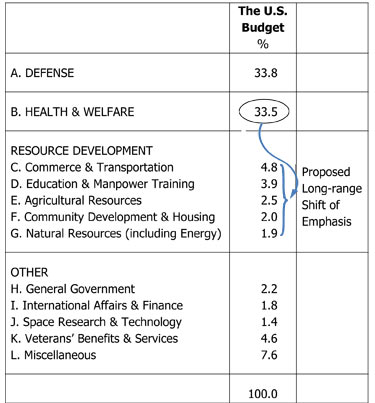
Page 5 of the Plan looked like this: 

 A Plan for America U.S. budget

What we are saying is that government needs to efficiently come to an understanding of the highest performance that might come out of each individual on the huge American team. Without Digital the very thought would be laughable. With Digital it’s doable.

Then the education/training and in some cases resources the individual needs must somehow be delivered to him/her in a way that is economically sensible to everyone. This again is an equation.

The thing about taxes is that the current system is hugely labor intensive and invites cheating. Meanwhile far vaster pockets of wealth are sitting around nearly dormant, producing value only for the hoarder (earning interest) who clearly is the last person that needs it. Rich people have started coming to their senses and philanthropy has voluntarily increased. This is a trend that ought to continue. People with more money than they need should find sustainable ways to invest that money in people — starting with their fellow Americans. In the next few years I hope rich people come up with hundreds of ideas to invest in people in ways that make sound business sense. I would bet that every single one will involve Digital.

Just as a pebble in the pond, to get even better ideas started, here is one.

BEST PLANS

A Digital Destination in Virtual Reality

Scenario: a rich person or corporation or grant-giving organization — or a group of all these types — creates a new website similar to Worlds.com and Second Life — or in one of these virtual worlds. If you’ve been there you know: you choose an avatar to represent you, and then you go where you will, speak with whomever you like, and can buy and sell things using virtual money. (Neal Stephenson’s latest novel REAMDE is based on a cyberspace in which the virtual economies blend with the real economies of the world.)

Now picture (perhaps you have seen it) the TV series Shark Tank, in which investors decide whether or not to back entrepreneurs based on their business plans. Now translate that into virtual reality. What have we here? A way of test marketing business plans with virtual money.

The idea would be a process by which to organize and optimize — entertainingly! — the investing of billions of dollars into a new mutual fund called BEST PLANS. The fund invests across entrepreneurial opportunities that have scored high in virtual reality pretests — many people bought their product or service and stayed with it and the process was profitable in getting enough people to spend enough virtual money to pay the people doing the virtual jobs and still turn a tidy profit.

Just a for-example.

Again, readers of this blog are a hand-picked lot because of your minds. We have every confidence you can think of better ideas than this one to reoptimize the work we each do and the way we find our jobs and the ways of compensation so that the tweaked system is better than ever before. Why not let your daydreams drift in that direction and see what happens?

Thank you in advance for sharing your daydreams.

Best to all,

Bill