Author Archives: grnthei

Google Validates Psychotechnology for Business

Volume 2, Issue 6

The Human Effectiveness Institute defines psychotechnology as methods which increase human effectiveness.

With the collaboration of my old friend and former brainwave research partner Dan Goleman, Google is offering its employees a seven-week course called S.I.Y. for “Search Inside Yourself”. The course is delivered by its prime creator, Chade-Meng Tan, a Google engineer, and other teachers, and is offered four times a year. More than 1000 Google employees have already taken the course. Each time it’s offered, half the 60 seats are already taken by the waiting list. This video  will give you a feel for what it’s like.

This is potentially a major turning point. One of the goals of The Human Effectiveness Institute (THEI) is to bring psychotechnology into schools at all levels and into organizations in a widespread way. Way to go, Chade-Meng Tan, Daniel Goleman, Google, and the rest of the collaborators behind the S.I.Y. course. Now that Google is doing it, all sorts of organizations will follow with psychotechnology courses for their staffs. As I say, a major turning point for the good.

When you start considering psychotechnology for your own organization, here are some things to think about:

  • Is there a focal point you have in mind, perhaps some problem you are trying to solve? In Google’s case it was the pressure and friction issues. The driven high-achievers who make up the Google corporate culture experience 24/7 stress and some had boiled over, and from this challenge came the idea of using psychotechnology to channel the energies back into constructive directions. One of the key takeaways from the Google course is S.B.N.R.R. — Stop, Breathe, Notice, Reflect, and Respond. Our parents taught us to take a deep breath and count to ten — a variant of the same ancient piece of psychotechnological lore. We get the sense that the Google course is somewhat focused in the affective (feeling) dimension.
     
  • Are you looking for a broader spectrum of benefits — cognitive, intuitive and perceptual as well as affective? The Institute’s psychotechnology aims to cover the broadest ground for the widest benefits, designing workshops that focus wherever the need is greatest.
     
  • Make sure that participants will be given interactive exercises not just lectures. In order to accomplish actual behavioral changes, people must do more than just listen; they must practice internal techniques during the course/workshop.

Let it be known that the Human Effectiveness Institute is a resource you can turn to for bringing psychotechnology into your organization. The Institute has for more than three decades been developing course materials and conducting psychotechnology workshops for organizations ranging from major corporations to elite units of the U.S. military.

Do a search and give consideration to all potential sources. Check out the testimonials from people who have taken the courses and/or used the course materials.

In order to accommodate expected demand for psychotechnology, THEI will be partnering with Richard Zackon in the delivery of courseware. Richard and I will be launching our collaboration later this year with a workshop (Richard changed the name to “playshop”) focused on creativity for high-level research executives, through the auspices of the Advertising Research Foundation (ARF). More details here as we approach the date and ARF puts out the call for participants.

Psychotechnology for business is now not such a wild and crazy idea. Hallelujah!

Best to all,

Bill

Entering the Age in Which Business and The People Are On The Same Side

Volume 2, Issue 5

I first met Bob Herbold (see www.bobherbold.com) when he was at P&G, before he went on to be COO of Microsoft where he’s credited with a fourfold increase in revenue and a sevenfold increase in EBITDA. Last week I got to reconnect with Bob by phone and as in all my conversations with him I learned a lot.

Nowadays Bob is spending half his time in the fast-developing areas of Asia such as Singapore, Indonesia, Penang and Chongqing. He’s feeling the vibrant energy of these places, where companies from the U.S. and other developed nations can ride the ebullient ballooning of commerce. He notes the intelligence of the talent pool, the effectiveness of the education systems, and the willingness to work hard that he attributes to the population not having the excess self-esteem of American workers. I’m thinking Americans don’t have to give up their self-esteem (nor their hard-won rights as workers) if they are reinspired by a crystallizing and uniting vision — this might be a way to make us show the same focused yet humble drive of these new economic engines. Bob would like to see the USA fulfill Ben Franklin’s dream of a land of people taking personal responsibility to the degree that the need for unemployment insurance and welfare payments is naturally reduced. Undoubtedly the recipients of those payments today would protest that conditions outstripped their ability to take responsibility, and what is needed are better systemic solutions empowering personal responsibility — educational/training-oriented, incentives to create jobs, methods of helping small business, and so on.

A similar idea appeared in my 1976 report A Plan For America, which recommended strategies for empowering people to become plugged in where their talents and training could contribute the most success for themselves and for the rest of society.

Bob’s ardent wish is that the US government and the press could become what he perceives as less anti-business. He points out as one example the fact that US corporations are disincentivized by high (35%) tax rates on money that has already been taxed to bring cash back from overseas into the US. He goes on to say there are only the US and seven other Western nations with similar policies — out of all of the nations — whereas countries he considers smarter in adapting to changes, such as Switzerland, allow the money back into the home country without re-taxing it above the taxes already paid in foreign countries. He cites Switzerland’s 2.5% unemployment rate as indicative of what the US could achieve by learning from policies of other countries that are adapting better to the massive shifts in the world economic order. Clearly there is a question here of whether we can help our leaders find ways to better dial tax structure decisions to maximize US job creation.

My cousin Bernie like others in my immediate family growing up, was a union man. To show for it he had a steel plate in his head, where company-hired goons hit him with truncheons. This is an early impression I had of the seemingly natural strain between business and people. Today I no longer feel there is anything natural about such an adversarial tension between business and people. We all need the US to be more economically successful. We all need there to be jobs for everyone who needs and wants and is able to work. Business and people are the same folks looked at two different ways. What can be done to eliminate ancient distrust and get the whole team humming?

We need a new way to work at solutions together, collaborating between people and business. Business saw the need for an association called ALEC* to work out solutions good for business and to pitch these solutions to legislators. Social media has shortened the time it takes for seismic events to occur in our 21st century society. A blogger discovered ALEC and didn’t like it. One corporation found itself being misquoted as daring the people to boycott its products if they didn’t like ALEC. Digital conversation reaction sentiment was negative and voluminous, and now corporations are rapidly departing ALEC.

Why not replace ALEC with a digital platform that opens up such conversations about legislative solutions, to take place between business and people on all sides of the issues, together? We need innovative solutions because mostly what we get are old ideas recycled endlessly. With all of the media exposure taking place about our problems, why shouldn’t a non-negligible percentage of it be about constructive new solution ideas, good for business owners and workers alike?

The Human Effectiveness Institute has designed a digital platform for this purpose and is seeking the right partners to make it work. We call it The Democracy Channel. Bill Rouhana, CEO of Chicken Soup for the Soul and a good friend has already joined us. Take a look at The Democracy Channel platform  and get in touch if you’d like to play a role in making this happen. It’s a good thing that business wants to help find new solutions, let’s just channel that energy into a venue where one’s customers want to help — where both sides win.

Best to all,

Bill

* For those who want to see what all the hubbub is about from a different point of view, here’s an interesting site: 
http://alecexposed.org/wiki/ALEC_Exposed

The Total Ineffectiveness of Negative Moods

Volume 2, Issue 4

Our motivations are the original rock that starts an avalanche. Motivations turn into goals, and then cascade into emotions that flare negative or positive when events/people are perceived to interfere with or enable us in reaching our goals. This all happens whether we are aware of any of it or not.

When we are in a state of negative emotion our capabilities are reduced. Brainpower is being distracted away from effective action clarity. The very thing that caused our negative emotion guffaws in triumph at our helpless self-attack, which leaves the irritant unscathed. The very thing we need most when the negative alarm goes off is to turn off the alarm and use all our brainpower effectively. So from the standpoint of adult commonsense logic, our indulgence of wallowing in negativity for more than an instant is totally unjustifiable and indefensible — in a word, ineffective.

People say they have no control over negative emotions. This is the archetypal self-fulfilling prophecy. If you refuse to give up control to your own habituated robot circuitry and instead fight it (the true meaning of jihad) eventually you win and then you feel very good forever after that. This is called Enlightenment. Think of it over-simplistically as gaining control of your own castle, your own motivations, goals, emotions, and everything else that is you.

What is a man?

What has he got?

If not himself, then he has not.

—   Excerpt from the lyrics of My Way, sung by Frank Sinatra

Once you have that control it is easier to give up control to the Flow state, where things seem to be doing themselves spontaneously and perfectly while we watch as observers from the inside. This often has the appearance to outside observers of you performing so perfectly that you even seem to know what other people are going to do next. Your motivations-goals-emotions-ideas-actions system is performing as a whole in Flow state, which is why the actions are so perfect. This is where you eventually get by rejecting negativity and getting down to solving whatever is the cause of your negative emotion.

I hypothesize that our being trained to cry for rescue in infancy sets up a circuit that sublimates into the same thing on more invisible levels throughout life. Parenting around this would be a good idea, for example by soothingly reminding the infant every time he/she cries that it is more effective to call for us more pleasantly, perhaps even musically, and we will come just as fast. Then we have to remember to pay off that promise ardently so as to reinforce the non-anguish appeal over the rescue me syndrome. I see all negativity as coming from this rescue me circuit. It is a construct that helps me overcome it.

Any construct that works to gain control of habitual counterproductive programming is a useful tool. A more extreme version is my imagining that an alien spy is the source of the negativity — it is not coming from the true me. Such constructs appear to resonate with the animal parts of ourselves or perhaps at the cellular level of consciousness and certainly with the oldest parts of our brain including the limbic system. At any rate negativity deflates in the presence of such mental toolware, which emerges from imagination in the marketplace of the inner mind. Imagination is a great source of energy and leads to clarity.

The Human Effectiveness Institute offers such toolware but we achieve our own highest success when we inspire individuals to get into the game of creating their own toolware in response to their own observed moments of EOP and their own observing of what works to overcome it.

To return to our first point, motivations are the base of your being, so it is good to start there as you re-inspect your “SELF” from these perhaps new points of view offered here. What are your motivations and why? What are the goals that serve these motivations? What is helping you reach those goals? What is impeding you? What do these insights imply in terms of action decisions?

In the absence of protracted negativity — using it just as an appreciated alarm system — enjoyment of life is the natural levity remaining once the weights have been lifted. Let’s levitate into levity!

Best to all,

Bill

Dial Back on Arousal to Reach Highest Performance

Volume 2, Issue 3

Science verifies the Vedas, Tantra, Qabala, and other ancient ideas

Hope you’re enjoying the new “2-minute read” format.

Thousands of years ago, individuals who trained themselves to be introspective all learned the same wisdom about the mind, in Greece and Egypt as in India and elsewhere. I’ve also rediscovered those bits of wisdom in a lifelong self-training to be an objective introspective observer — so as to really learn things and not just prop up my own ego, as we are all mostly forced to do by the information overload pressure that all too often sinks us into EOP.

The ancient wisdom even more applicable in today’s accelerating culture says that if we care too much we ruin it. Whatever “it” is. The word “attachment” is the meme of this wisdom, the gene from which a Pandora’s Box of linked ideas emerge.

Some became Buddhists, but most of the kids in my college class went on with their lives with their attachment level dialed way up, and this caused them painful life lessons from which they have grown up and consequently dialed down their attachment levels.

Although we find it expedient to ignore ancient wisdom, believing our science to be light-years ahead, science is only now coming to the same conclusions as the ancients but by humorously roundabout trips. If only psychology had listened to William James and seen introspection as a valuable tool of science. Science today would be accelerating into Observer and Flow state discoveries, leapfrogging over my mere intuitions and practical experience.

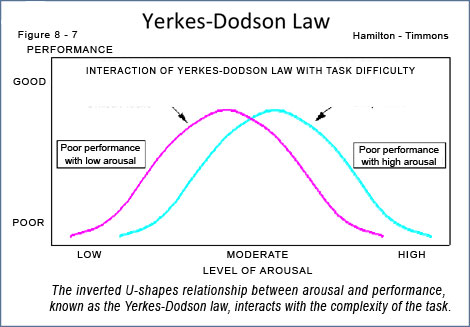
Consider the following “now-scientific” evidence. The widely-accepted Yerkes-Dodson law in psychology says that the optimal level of arousal for highest performance is moderate — a word Aristotle would also have chosen.he inverted U-shapes relationship between arousal and performance,  known as the Yerkes-Dodson law, interacts with the complexity of the task.

Note that arousal should be set even lower for more difficult tasks. Not rookie over-eagerness, but a fatalism that is above caring about success or failure — kind of a playful fun resignation to whatever outcome the universe chooses, so long as you like your play.

Arousal in this context means the same thing as the mental causes of physical and brainstem arousal — we call these motivations. If we are attached, meaning too highly motivated such that not succeeding would be anguishing — then we are not going to give our highest Flow state (Zone) performance.

Dial back the arousal. In future posts we will address the next question: how does one actually do that?

Best to all,

Bill