Tag Archives: EOP

Go for Flow in Your Métier First

Volume 2, Issue 7

Valuable lessons from two great scientists — one of the mind, the other of marketing

The Human Effectiveness Institute defines Flow as the state of autotelic perfect action. It is a brain/mind state where all parts of you are in synch, and is now popularly known as the Zone. “Autotelic” means you are doing the action for its own sake, not for its outcome, and it feels to you as if it is doing itself, because you are going with the flow (“automaticity”). This however is different from your robotic Emergency Oversimplification Procedure (EOP) state where you run off at the mouth, for example, without all your mental/intuitive gears meshing and thus you constantly undo yourself.

A subtle state indeed. Most people can remember having at least one experience of being in the Zone, but are not quick to agree that one can learn to spend more time in Flow. Most people consider it something accessible to top athletes, musicians, artists and other performers, but to no one else. The Institute’s mission is to change that perception.

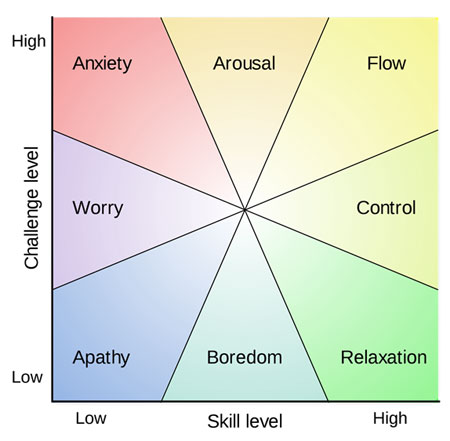
Mihaly Csikszentmihalyi, former Chair of the Department of Psychology at the University of Chicago, coined the term “Flow” and has written the definitive books about the phenomenon. His theories were developed while working to successfully improve the performance of the school’s lacrosse team. He created the accompanying schematic,

presented a few years back at the Technology, Entertainment and Design (TED) conference, which shows that you are not going to get into Flow unless you are doing something in which you are already highly skilled. Flow happens when high skill and high challenge meet.

This means that to truly train yourself to attain Flow more often, you need to practice it within your own personal métier — the thing you do best.

For those of my readers who work somewhere in the broad field of marketing, I recommend Al Achenbaum’s new book. This will be a way for you to practice your skills at an even higher level, by absorbing the 1500 pages of lessons that must be the single most valuable treasure trove of marketing learning in existence, given where Al has been and what he has accomplished.

When I was a rookie at Grey, Al and his estimable right hand at the time (another luminary, Russ Haley) were moving the industry away from sole reliance on judging the value of an ad based on its memorability. They introduced the difficult new concept of attitude shift into a field that at the time was as auteur-dominated by creatives as Hollywood, and therefore just as hard to present science to. Yet they succeeded, with help from FCB’s Frank Gromer and his Study of Brand XL, which established that attitude shifts actually preceded buying changes (the only extant copy I know of is the one I donated to Ed Papazian’s library).

Back in those days Grey had assembled a brain trust of Al Achenbaum, Russ Haley, and Betty Coumbe on the research side, and on the media side Hal Miller, Larry Deckinger, Howard Kamin, Helen Johnston, and Norm Hecht — and me at the bottom of the food chain. These incredible mentors encouraged me to roam the halls at 5AM reading from all the unlocked files on the 11th floor at 445 Park — like a monk in the Alexandrine Library. This is how I absorbed Al’s teaching, as well as that of other luminaries. Plus Hal had his personal training program for two lucky pups, one of whom was me.

Al’s book is called (“and may I say, not in a shy way”*) Marketing Lessons From a Living Legend and is available from BarnesandNoble.com on their eBook platform, the Nook. Al is truly one of the all-time original Mad Men and he will help your quest for Flow even if you’re not in marketing but have an interest in how scientists have improved that art.

Best to all,

Bill

*From the song “I Did It My Way”.

The Total Ineffectiveness of Negative Moods

Volume 2, Issue 4

Our motivations are the original rock that starts an avalanche. Motivations turn into goals, and then cascade into emotions that flare negative or positive when events/people are perceived to interfere with or enable us in reaching our goals. This all happens whether we are aware of any of it or not.

When we are in a state of negative emotion our capabilities are reduced. Brainpower is being distracted away from effective action clarity. The very thing that caused our negative emotion guffaws in triumph at our helpless self-attack, which leaves the irritant unscathed. The very thing we need most when the negative alarm goes off is to turn off the alarm and use all our brainpower effectively. So from the standpoint of adult commonsense logic, our indulgence of wallowing in negativity for more than an instant is totally unjustifiable and indefensible — in a word, ineffective.

People say they have no control over negative emotions. This is the archetypal self-fulfilling prophecy. If you refuse to give up control to your own habituated robot circuitry and instead fight it (the true meaning of jihad) eventually you win and then you feel very good forever after that. This is called Enlightenment. Think of it over-simplistically as gaining control of your own castle, your own motivations, goals, emotions, and everything else that is you.

What is a man?

What has he got?

If not himself, then he has not.

—   Excerpt from the lyrics of My Way, sung by Frank Sinatra

Once you have that control it is easier to give up control to the Flow state, where things seem to be doing themselves spontaneously and perfectly while we watch as observers from the inside. This often has the appearance to outside observers of you performing so perfectly that you even seem to know what other people are going to do next. Your motivations-goals-emotions-ideas-actions system is performing as a whole in Flow state, which is why the actions are so perfect. This is where you eventually get by rejecting negativity and getting down to solving whatever is the cause of your negative emotion.

I hypothesize that our being trained to cry for rescue in infancy sets up a circuit that sublimates into the same thing on more invisible levels throughout life. Parenting around this would be a good idea, for example by soothingly reminding the infant every time he/she cries that it is more effective to call for us more pleasantly, perhaps even musically, and we will come just as fast. Then we have to remember to pay off that promise ardently so as to reinforce the non-anguish appeal over the rescue me syndrome. I see all negativity as coming from this rescue me circuit. It is a construct that helps me overcome it.

Any construct that works to gain control of habitual counterproductive programming is a useful tool. A more extreme version is my imagining that an alien spy is the source of the negativity — it is not coming from the true me. Such constructs appear to resonate with the animal parts of ourselves or perhaps at the cellular level of consciousness and certainly with the oldest parts of our brain including the limbic system. At any rate negativity deflates in the presence of such mental toolware, which emerges from imagination in the marketplace of the inner mind. Imagination is a great source of energy and leads to clarity.

The Human Effectiveness Institute offers such toolware but we achieve our own highest success when we inspire individuals to get into the game of creating their own toolware in response to their own observed moments of EOP and their own observing of what works to overcome it.

To return to our first point, motivations are the base of your being, so it is good to start there as you re-inspect your “SELF” from these perhaps new points of view offered here. What are your motivations and why? What are the goals that serve these motivations? What is helping you reach those goals? What is impeding you? What do these insights imply in terms of action decisions?

In the absence of protracted negativity — using it just as an appreciated alarm system — enjoyment of life is the natural levity remaining once the weights have been lifted. Let’s levitate into levity!

Best to all,

Bill

Dial Back on Arousal to Reach Highest Performance

Volume 2, Issue 3

Science verifies the Vedas, Tantra, Qabala, and other ancient ideas

Hope you’re enjoying the new “2-minute read” format.

Thousands of years ago, individuals who trained themselves to be introspective all learned the same wisdom about the mind, in Greece and Egypt as in India and elsewhere. I’ve also rediscovered those bits of wisdom in a lifelong self-training to be an objective introspective observer — so as to really learn things and not just prop up my own ego, as we are all mostly forced to do by the information overload pressure that all too often sinks us into EOP.

The ancient wisdom even more applicable in today’s accelerating culture says that if we care too much we ruin it. Whatever “it” is. The word “attachment” is the meme of this wisdom, the gene from which a Pandora’s Box of linked ideas emerge.

Some became Buddhists, but most of the kids in my college class went on with their lives with their attachment level dialed way up, and this caused them painful life lessons from which they have grown up and consequently dialed down their attachment levels.

Although we find it expedient to ignore ancient wisdom, believing our science to be light-years ahead, science is only now coming to the same conclusions as the ancients but by humorously roundabout trips. If only psychology had listened to William James and seen introspection as a valuable tool of science. Science today would be accelerating into Observer and Flow state discoveries, leapfrogging over my mere intuitions and practical experience.

Consider the following “now-scientific” evidence. The widely-accepted Yerkes-Dodson law in psychology says that the optimal level of arousal for highest performance is moderate — a word Aristotle would also have chosen.he inverted U-shapes relationship between arousal and performance,  known as the Yerkes-Dodson law, interacts with the complexity of the task.

Note that arousal should be set even lower for more difficult tasks. Not rookie over-eagerness, but a fatalism that is above caring about success or failure — kind of a playful fun resignation to whatever outcome the universe chooses, so long as you like your play.

Arousal in this context means the same thing as the mental causes of physical and brainstem arousal — we call these motivations. If we are attached, meaning too highly motivated such that not succeeding would be anguishing — then we are not going to give our highest Flow state (Zone) performance.

Dial back the arousal. In future posts we will address the next question: how does one actually do that?

Best to all,

Bill

Finding That Hidden Switch Inside

Sensible procedures for quickly returning to your best self

This blog aims to provide a new psychotechnology for maximizing human performance and happiness, derived from a synthesis of the author’s experience and the relevant findings of science both modern and ancient. The construct posits three levels of waking consciousness:

  1. Flow state — the most desirable state in terms of performance and happiness, where things happen perfectly and one feels a seamless part of everything. A non-ordinary, altered state of consciousness that occurs when you are totally immersed in and merged with an activity you have practiced well and you have simultaneously given up caring whether you win or lose, rising above all negativity and all of your usual ordinary concerns. Action just happens without hesitation, like a child at play.
  2. Observer state — the second most desirable state, in which your attention misses very little of what is going on inside you and around you. The access window to Flow, this state is a form of meditation/contemplation that requires no closing of eyes or immobility, but does require self-honesty/objectivity and paying very close attention both inside and outside.
  3. EOP (Emergency Oversimplification Procedure) — the typical state of the overwhelming majority of human beings today, from which individuals spring infrequently into the higher states in rare moments of clarity and nobility. In EOP there is always a background dilemma, a sense of incompleteness, of wanting and being attached to something that you may or may not get.

In my theory the EOP state is not the natural state of the species but arises from a multi-millennial delay in integrating our evolutionarily most recent brain part, the cortex. Like children handed loaded machineguns, with our newfound inventiveness running amok, our weapons-centric culture has handed control of the planet to those who possess the most powerful weapons, and now through proxies they control everything else as well. This has been true since earliest recorded history. In fact the invention of written language appears to have been the catalyst for the only culture we know, which has made information overload and distraction the way we spend our days, separation our hidden assumption, and EOP our state of being.

Yet every philosopher worthy of such designation has explained that we need not live this way. Each in his/her own way has explained how to peel away the tarnished layer of the outer accidental self to find the pure inner self that exists always, despite whatever culture we find ourselves in. Collective wisdom and understanding from philosophy, theology, science and commonsense proverbs have always existed as a form of primitive psychotechnology. “Primitive” because the whole problem has never been clearly defined. Therefore the solutions have always been merely rote methods that work for reasons beyond the understanding of even those who practice and teach them.

I’ve spent my lifetime trying to figure out the things that spontaneously propelled me into the higher states, having first experienced Flow when performing onstage as a child, being part of a show business family. Over the years, working at it daily, I’ve discovered procedures that help me stay in the higher states more of the time. I rediscovered many of the same procedures that others before me have rediscovered. There are few among us who themselves have not discovered some of this — each of us has come upon some of these truths of how to be one’s highest self. Like me, most people strive to be the best they can be, often without even knowing they are doing this, nor explaining it to themselves in any philosophical or otherwise reasoned way.

Years back I founded The Human Effectiveness Institute to share these procedures, the ones that work for me and for 3000 or so readers of the first edition of what is today the book Freeing Creative Effectiveness — all reporting (unsolicited) positive results. The Institute also exists to understand the underlying scientific mechanisms, i.e. why these psychotechnological procedures work to elevate the mind into the higher states. In an earlier post I provided hypotheses drawn from my theory as to which brain parts are involved in each of the three states of waking consciousness. These hypotheses are the starting point toward making psychotechnology more of a science than an art. Today it is an art more than a science — or a soft science in contrast with the highly-regarded hard sciences.

In the rest of this post we’ll focus on what to do when you find you are not in your best place — and how to get back to your best self as quickly as possible. We’ll divide this into two short sections: (1) the first time you do this, and a few times a week after that, when you can grab an oasis of alone space to check in on your self, and (2) on an ongoing moment-to-moment basis.

The first time, and in alone spaces after that

First, how do you know you’re not in your best self? That part is easy, here are the symptoms: you’re not happy, something is bothering you and you may not even know what it is. You are making mistakes and making things worse. There is a loop going around in your head telling you so many different things about you and your life that you don’t like — you don’t know where to start and you feel defeated before you start. Those conditions are the clue to quickly find that hidden switch in your head.

The practical, sensible procedure when you are having this kind of experience, the first time it happens from now on, is:

  1. You need to be alone for awhile.
  2. You need to let your mind dump the problem statement and whatever solution idea fragments it may have by simply transcribing — taking dictation from your mind, in the form of incoherent notes or however they spill out when you are not trying to make them read well for other people.
  3. Note how much you care about — are dependent upon — certain attachments, as if you are an outside observer watching yourself as a scientific subject. Note how many of these attachments are ignoble things — like envy, jealousy, pride, vanity — that you would rather not see in yourself. Consider what you might do with your life if you gave up caring so much about these specific things or about any specific things. Being looked up to, having more money, whatever forms your attachments take.
  4. Give it all up. Even if you are just pretending, or experimenting — picture and feel that you are tired of it all, and you don’t want these things any more. You are not dependent on anything or anyone. Whatever happens, you will be strong enough to start from scratch and be creative and make decisions to flow with whatever reality deals you. Vividly envision losing it all, and being tough enough to withstand that loss.

One piece of psychotechnology common to many Buddhist and Hindu traditions is to meditate on a corpse in order to eventually lose all horror about it — a common practice also for doctors and nurses. This illustrates the psychological principle at work: it is possible to get used to anything, to the idea of losing anything, given enough time and mental practice. It doesn’t happen overnight in most cases, although sometimes it does.

Will life be worth living, you might ask, if you stop caring about all the things and people to which and to whom you are now attached? You don’t have to stop caring — you can still love people and things even more — it’s just that you are becoming fatalistic and accepting of whatever might happen that would cause you to lose these people and things.

In the moment, in the midst of action

Any time you notice you are not in your best self — making mistakes, losing your temper, feeling lousy or scared, whatever it is — re-set your mind by erasing everything. “Clear the mechanism” as Kevin Costner’s character says to himself in the movie “Love of the Game” (a film that shows what Flow state feels like to a baseball pitcher, as Bob DeSena points out).

Assume that any sense of dilemma is a lack of clarity, that if you were thinking straight you would be accepting what is and dealing with it without negative emotion, just with pure effectiveness. The one thing you want is to take whatever life hands you and deal with it most effectively, and anything short of that is rejected out of your mind and body instantly.

At first you will find yourself re-setting again and again as you slip back into the old time-worn ways of mental hand-wringing, but over time your mental muscles will toughen up. Just stick with it and you will become indomitable.

I know that many of my readers have already been practicing this for a long time, and this post may seem elementary to you, though the review can’t hurt. Since our aim is to always widen our audience to reach as many people as possible, we will sometimes return to basics.

Wishing you Flow and Observer filled days.

Best to all,

Bill