Tag Archives: EOP

The Force Is Conscious

Volume 2, Issue 11

In his inspired space epic film series Star Wars, George Lucas postulates a religion based on the notion that a single Force pervades all of spacetime, and can be used by adepts in combat and other situations. It imparts powers of telekinesis (the ability to move matter with the mind), prescience/precognition (knowing the future), remote sensing/clairvoyance (the ability to see things beyond the field of vision), and the ability to shoot bolts of energy from the fingertips.

In Lucas’ cosmology, the Force also has a Dark Side that can seduce you into using these powers for selfish benefits; however, this turns your eyes red and ruins your complexion.

When the first Star Wars movie came out on May 25, 1977, I had just two years earlier formulated my vision of reality which I refer to as The Theory of the Conscious Universe. I was keenly interested in the similarity between Lucas’ vision of the Force and my own theory. One of the key differences is that Lucas does not convey that the Force is conscious. In my theory, the universe is a self-aware field of consciousness.

There is no scientific reason why this cannot be the case.

In fact my theory makes it understandable why the world’s leading theoretical physicist of our times, the late John Wheeler, stated that we observers (consciousness) co-create reality, and that “bits (information) precede “its” (physical objects/energy fields)”. Why shouldn’t our consciousness co-create reality, if we are part of the One Consciousness that created reality in the first place? And why should we be surprised that information plans precede the creation of bits of matter/energy, since consciousness and sometimes conscious planning precede all human inventions including the words we speak — if everything is just one big consciousness?

We know that fields exist — electromagnetic, gravitic, the strong nuclear force that holds atoms together, the weak nuclear force that mediates particle decay. Why should consciousness not be a field?

The other key difference between Lucas’ Force and my theory is that I postulate the One Consciousness lives through us — what we take to be our identity is a sub-identity of the One Consciousness.

One reason I have conviction this theory may actually be the truth is that whenever I am most deeply immersed in acting for the good of all, the incidence of my slipping into Flow state, aka the Zone, is increased.

I have not detected anything like a Dark Side of the Force. When I am in a dark selfish mood I never find myself in Flow state. In my Theory of Holosentience I hypothesize that dark moods are part of EOP, which is the opposite end of the performance spectrum from Flow.

Why not experiment for yourself with “wearing” this point of view of what the universe is, to see if it has any effect on your daily life, and your experience of the Flow state?

Best to all,

Bill
Go for Flow in Your Métier First

Volume 2, Issue 7

Valuable lessons from two great scientists — one of the mind, the other of marketing

The Human Effectiveness Institute defines Flow as the state of autotelic perfect action. It is a brain/mind state where all parts of you are in synch, and is now popularly known as the Zone. “Autotelic” means you are doing the action for its own sake, not for its outcome, and it feels to you as if it is doing itself, because you are going with the flow (“automaticity”). This however is different from your robotic Emergency Oversimplification Procedure (EOP) state where you run off at the mouth, for example, without all your mental/intuitive gears meshing and thus you constantly undo yourself.

A subtle state indeed. Most people can remember having at least one experience of being in the Zone, but are not quick to agree that one can learn to spend more time in Flow. Most people consider it something accessible to top athletes, musicians, artists and other performers, but to no one else. The Institute’s mission is to change that perception.

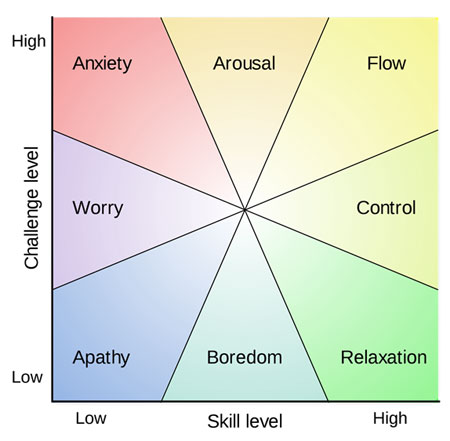
Mihaly Csikszentmihalyi, former Chair of the Department of Psychology at the University of Chicago, coined the term “Flow” and has written the definitive books about the phenomenon. His theories were developed while working to successfully improve the performance of the school’s lacrosse team. He created the accompanying schematic,

presented a few years back at the Technology, Entertainment and Design (TED) conference, which shows that you are not going to get into Flow unless you are doing something in which you are already highly skilled. Flow happens when high skill and high challenge meet.

This means that to truly train yourself to attain Flow more often, you need to practice it within your own personal métier — the thing you do best.

For those of my readers who work somewhere in the broad field of marketing, I recommend Al Achenbaum’s new book. This will be a way for you to practice your skills at an even higher level, by absorbing the 1500 pages of lessons that must be the single most valuable treasure trove of marketing learning in existence, given where Al has been and what he has accomplished.

When I was a rookie at Grey, Al and his estimable right hand at the time (another luminary, Russ Haley) were moving the industry away from sole reliance on judging the value of an ad based on its memorability. They introduced the difficult new concept of attitude shift into a field that at the time was as auteur-dominated by creatives as Hollywood, and therefore just as hard to present science to. Yet they succeeded, with help from FCB’s Frank Gromer and his Study of Brand XL, which established that attitude shifts actually preceded buying changes (the only extant copy I know of is the one I donated to Ed Papazian’s library).

Back in those days Grey had assembled a brain trust of Al Achenbaum, Russ Haley, and Betty Coumbe on the research side, and on the media side Hal Miller, Larry Deckinger, Howard Kamin, Helen Johnston, and Norm Hecht — and me at the bottom of the food chain. These incredible mentors encouraged me to roam the halls at 5AM reading from all the unlocked files on the 11th floor at 445 Park — like a monk in the Alexandrine Library. This is how I absorbed Al’s teaching, as well as that of other luminaries. Plus Hal had his personal training program for two lucky pups, one of whom was me.

Al’s book is called (“and may I say, not in a shy way”*) Marketing Lessons From a Living Legend and is available from BarnesandNoble.com on their eBook platform, the Nook. Al is truly one of the all-time original Mad Men and he will help your quest for Flow even if you’re not in marketing but have an interest in how scientists have improved that art.

Best to all,

Bill

*From the song “I Did It My Way”.

The Total Ineffectiveness of Negative Moods

Volume 2, Issue 4

Our motivations are the original rock that starts an avalanche. Motivations turn into goals, and then cascade into emotions that flare negative or positive when events/people are perceived to interfere with or enable us in reaching our goals. This all happens whether we are aware of any of it or not.

When we are in a state of negative emotion our capabilities are reduced. Brainpower is being distracted away from effective action clarity. The very thing that caused our negative emotion guffaws in triumph at our helpless self-attack, which leaves the irritant unscathed. The very thing we need most when the negative alarm goes off is to turn off the alarm and use all our brainpower effectively. So from the standpoint of adult commonsense logic, our indulgence of wallowing in negativity for more than an instant is totally unjustifiable and indefensible — in a word, ineffective.

People say they have no control over negative emotions. This is the archetypal self-fulfilling prophecy. If you refuse to give up control to your own habituated robot circuitry and instead fight it (the true meaning of jihad) eventually you win and then you feel very good forever after that. This is called Enlightenment. Think of it over-simplistically as gaining control of your own castle, your own motivations, goals, emotions, and everything else that is you.

What is a man?

What has he got?

If not himself, then he has not.

—   Excerpt from the lyrics of My Way, sung by Frank Sinatra

Once you have that control it is easier to give up control to the Flow state, where things seem to be doing themselves spontaneously and perfectly while we watch as observers from the inside. This often has the appearance to outside observers of you performing so perfectly that you even seem to know what other people are going to do next. Your motivations-goals-emotions-ideas-actions system is performing as a whole in Flow state, which is why the actions are so perfect. This is where you eventually get by rejecting negativity and getting down to solving whatever is the cause of your negative emotion.

I hypothesize that our being trained to cry for rescue in infancy sets up a circuit that sublimates into the same thing on more invisible levels throughout life. Parenting around this would be a good idea, for example by soothingly reminding the infant every time he/she cries that it is more effective to call for us more pleasantly, perhaps even musically, and we will come just as fast. Then we have to remember to pay off that promise ardently so as to reinforce the non-anguish appeal over the rescue me syndrome. I see all negativity as coming from this rescue me circuit. It is a construct that helps me overcome it.

Any construct that works to gain control of habitual counterproductive programming is a useful tool. A more extreme version is my imagining that an alien spy is the source of the negativity — it is not coming from the true me. Such constructs appear to resonate with the animal parts of ourselves or perhaps at the cellular level of consciousness and certainly with the oldest parts of our brain including the limbic system. At any rate negativity deflates in the presence of such mental toolware, which emerges from imagination in the marketplace of the inner mind. Imagination is a great source of energy and leads to clarity.

The Human Effectiveness Institute offers such toolware but we achieve our own highest success when we inspire individuals to get into the game of creating their own toolware in response to their own observed moments of EOP and their own observing of what works to overcome it.

To return to our first point, motivations are the base of your being, so it is good to start there as you re-inspect your “SELF” from these perhaps new points of view offered here. What are your motivations and why? What are the goals that serve these motivations? What is helping you reach those goals? What is impeding you? What do these insights imply in terms of action decisions?

In the absence of protracted negativity — using it just as an appreciated alarm system — enjoyment of life is the natural levity remaining once the weights have been lifted. Let’s levitate into levity!

Best to all,

Bill

Dial Back on Arousal to Reach Highest Performance

Volume 2, Issue 3

Science verifies the Vedas, Tantra, Qabala, and other ancient ideas

Hope you’re enjoying the new “2-minute read” format.

Thousands of years ago, individuals who trained themselves to be introspective all learned the same wisdom about the mind, in Greece and Egypt as in India and elsewhere. I’ve also rediscovered those bits of wisdom in a lifelong self-training to be an objective introspective observer — so as to really learn things and not just prop up my own ego, as we are all mostly forced to do by the information overload pressure that all too often sinks us into EOP.

The ancient wisdom even more applicable in today’s accelerating culture says that if we care too much we ruin it. Whatever “it” is. The word “attachment” is the meme of this wisdom, the gene from which a Pandora’s Box of linked ideas emerge.

Some became Buddhists, but most of the kids in my college class went on with their lives with their attachment level dialed way up, and this caused them painful life lessons from which they have grown up and consequently dialed down their attachment levels.

Although we find it expedient to ignore ancient wisdom, believing our science to be light-years ahead, science is only now coming to the same conclusions as the ancients but by humorously roundabout trips. If only psychology had listened to William James and seen introspection as a valuable tool of science. Science today would be accelerating into Observer and Flow state discoveries, leapfrogging over my mere intuitions and practical experience.

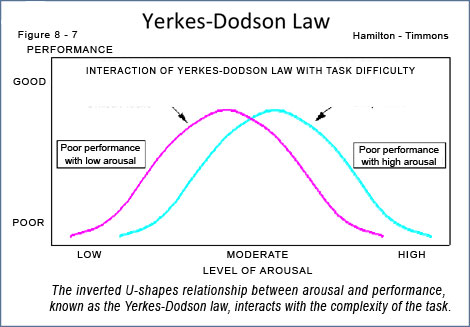
Consider the following “now-scientific” evidence. The widely-accepted Yerkes-Dodson law in psychology says that the optimal level of arousal for highest performance is moderate — a word Aristotle would also have chosen.he inverted U-shapes relationship between arousal and performance,  known as the Yerkes-Dodson law, interacts with the complexity of the task.

Note that arousal should be set even lower for more difficult tasks. Not rookie over-eagerness, but a fatalism that is above caring about success or failure — kind of a playful fun resignation to whatever outcome the universe chooses, so long as you like your play.

Arousal in this context means the same thing as the mental causes of physical and brainstem arousal — we call these motivations. If we are attached, meaning too highly motivated such that not succeeding would be anguishing — then we are not going to give our highest Flow state (Zone) performance.

Dial back the arousal. In future posts we will address the next question: how does one actually do that?

Best to all,

Bill