Welcome to this week’s Pebbles in the Pond Blog, written by Bill Harvey
October 16, 2026
Click here for an update about Pebbles.
MIND MAGIC / MIND EXPERIMENTS the 50th Anniversary Edition Excerpt Series: Part 11

For each manifestation, we ask ourselves why we did it, tracing the causes as far back as we can. Then we decide whether we want to give rise to such a manifestation again in light of our goals. If we do not wish to, we resolve not to.
Given our past experience with self-control, it’s useful to predict how successful we are likely to be in suppressing such manifestations. Thus, we set realistic goals for reducing unwanted manifestations gradually, rather than resolving to do the impossible all at once, which would only lead to discouragement and weakened self-belief.
If we always resolve to do something we believe we can do, even though it is only a little better than we have done in the past, we will gradually build self-belief, allowing us to confidently raise our sights a little more each time.
The effect of this process is to telescope the delay between action and thought so that at first we will find ourselves realizing soon after an inappropriate action that it was inappropriate and why. Then we will recognize these things instantly after the action; then we will catch ourselves in mid-action; and then we will catch ourselves before action. (Actually, these four types of experiences will always continue to occur, but the latter types will become more frequent and the former less frequent.)
Some of the programs we will decide to remove are programs we once consciously established, and which were useful to us at the time, but which have long since become counterproductive based on changing circumstances and our own increased capabilities.
It is an inherent characteristic of any developing system that heroes emerge and are heroes only within the context that stimulated their creation; as these heroes overcome and change such contexts, the heroes themselves become the context to be changed. Thus, both coping systems and governments begin as useful and gradually become counterproductive. This is the nature of the evolutionary process itself.
However, any system tends to be self-perpetuating: programs may be visualized as power centers in our heads, trying to survive despite their vestigiality. Thus, they will get some senators to speak in their favor, and in honoring them for their past service, we will hesitate to remove them. (Senators = mini-personalities that have been implanted in us by the internalized influence of others… at least two from Mom (her Mom and Dad); at least two from Dad (his Mom and Dad); etc. Each senator is a “parasite circuit” capable of “taking over our minds” by making us think its suggestions are ours.)
Mind Experiments
Revisit the Mind Experiments from Part 10
1. Identify your senators.
Pick a day, and on that day, listen to the conversations in your head and see if you can pick out the separate voices, e.g., the one that says, “You’re getting ripped off by” whomever you’re with, the one who’s always putting you down, etc.
Who are they?
2. De-energizing parental parasite circuits
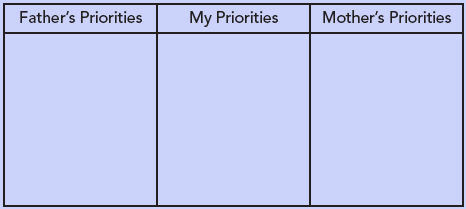
Make a list of your father’s and your mother’s priorities. Then, side-by-side, list your own. By comparing yours to theirs, detect which of your priorities aren’t really your priorities but do influence your actions just as if they were, because of the hypnotic conditioning of your robot by long association with their robots at a time when you were maximally impressionable/imprintable.
Note: You might use a format like this; draw arrows wherever you see connections.
3. De-energizing parental-dynamic parasite circuits
How did your parents play together? What were some of their acts—make a list.
Then, for each act, see occasions you have played out each one’s role in your own life.
Love to all,
THEI Team
Please note: The Pebbles in the Pond blog written before Bill Harvey passed will continue to be posted here. However, the email notifications you have been receiving in your inbox will now come from a new email address: billharveyblog@humaneffectivenessinstitute.org . You may have to set this to be recognized as “not spam” so it appears in your primary or main email. We send these out every Friday morning.
In case you missed the last 2 posts, here is the link to last week’s blog, Edit Your Head Files. Here is the link to the post from two weeks ago, Celebrating Bill Harvey.