Category Archives: Power of Words

The Human Heritage: Word Pollution

Welcome to this week’s Bill Harvey Blog.
July 9, 2026

This is the second in the new MIND MAGIC / MIND EXPERIMENTS book excerpt series. The first one, Release Your Self from the Hypnotic Power of Words, was published on June 5.


Humans come into the world. We find out certain things: for example, we find out that fire burns us. This “finding out” we call knowing: when someone has a true picture in his or her mind— “true” meaning that the picture cor­responds to the external reality—we call this knowing. So, if we have a picture in our mind of fire burning our hand, we say that we know that fire can burn us.

So far, language does not yet exist. We can know without language by holding true images in our mind. There is no “believing.” “Believing” comes into the picture when lan­guage is invented.

With language, one person who knows something can pass on this knowledge to another person who has not yet discovered it for themself. The latter person, in accepting the former’s knowledge as true, “believes” it. As we all now know, this “believing” often leads to the holding of untrue pictures in people’s minds.

The cure is to cut down on believing—tend to only hold pictures in one’s mind of the things one has seen oneself.

Belief was never much of an issue before words.

Belief = be lief = be for me. I believe him = he be’s for me on that. He was there. He saw it. He sees it for me. He sees it—I see him see it.

Cosmic humor: Most belief is founded on the form, not the content, of the words believed in.

Disidentifying with the feeling of belief

At almost every instant, you are likely to experience the feeling about a given postulate: “It is so.” Look for that feeling, and when it arises, remind yourself: “It may not be so.” Be willing to act based on your judgment as to whether something is more likely to be true or to be not true; but do not believe that it is either true or not true. In this way, belief is unnecessary to action.

Be especially wary of the feeling of belief at times when you have a thought and then do not contradict it. Simply, the experience of non-contradiction suggests to the belief program that it energizes itself. Thus, you must guard against the tendency to believe any thought you generate. This can best be done by remembering to say to yourself (but not in words), “It may not be so” in response to every thought.
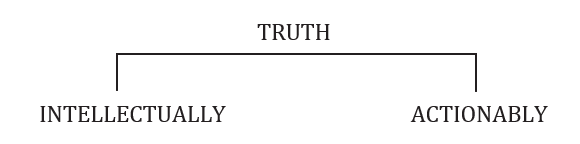
TRUTH - INTELLECTUALLY - ACTIONABLY

The definition of Truth at the intellectual level is what can be made to sound reasonable based on the words you use. Intellectual reason can find some truth and some falsity in every statement, depending upon how it is interpreted.

The definition of Truth at the action level is what works when you actually try it in reality . . . i.e., what the uni­verse reinforces.

We need to make action decisions each second. We need to make intellectual statements a few times a day. The two are usually unrelated.

Few people living in the Scientific Age have realized that the Scientific Method can be applied to Life . . .

Mind Experiment

What do you believe?

List your beliefs on one or several sheets of paper using only the left-hand side of the page. (Or on your laptop or tablet if you prefer. We recommend paper, so you don’t need to bother with formatting, auto-correct, etc.) Use question marks next to any beliefs you’re not sure you fully believe.

If you’re not sure where to start, you might start with beliefs about God, an afterlife, the purpose of life, and what is good and what is bad.

Where did they come from? Why do (did)

I believe that?

In this game, one remem­bers where each belief came from.

Easy if you take them slowly, one at a time.

No longer needing to have beliefs

In this stage, one faces the situation of no longer really having any beliefs, yet realizes that this is true freedom to learn. Often accompanied by brief ecstasy.

It may not be so.

To do this experiment, simply pick a period of time, and in that time watch your thoughts, remembering to realize that each thought might be right or it might be wrong.

This is one of the most universal forms of meditation.

The way it usually goes, you keep getting sucked into iden­tifying with some thought or another and forget to doubt it—then catch yourself and back out of auto-agreement with the thought.

Over time, you begin to see how your idea-generation process, your conviction-decision process, and your other mental processes work. Then you will have control over these processes rather than being controlled by them.

Love to all,

Bill

Release Your Self From the Hypnotic Power of Words

Welcome to this week’s Bill Harvey Blog
Created June 5, 2026

Listen Watch Speak Obey Reaction Control

Some of you have read my book Mind Magic. The Seventh Edition is soon to be released, and it will contain Mind Experiments at the end of each chapter, games you can play with your mind that will have positive effects on your effectiveness in navigating through life. To give you a feel for the way the text of Mind Magic and the Mind Experiments will work together, in most of our posts starting here, we will serialize the beginning of the new edition. Hope you enjoy it!
All my best, Bill 

The Human Heritage: Word Pollution

Because words are so powerful, we tend to believe them rather than assimilate our own experiences.

Word intoxication: All words hypnotize to some ex­tent.

Where did words come from? From the depths of our soul. They were discovered inside us, not invented.

The evidence of similar-root-noises-for-similar-concepts across separated peoples, attests to this. We all discov­ered something like the noise mama for mother. Even apes apparently make similar sounds for the same concepts as we.

It is as if we were all discovering the same master lan­guage, distorted into various different directions by the effects of different genetic/environmental conditions.

Words just became important recently.

We came down out of trees over 1,000,000 generations ago. (1)

  • “Generation” = 20 years

For 999,750 of these, humans used or heard only a few words each day. Over just the last 250 generations, this has increased to tens of thousands of words going through the average human head each day.

Words have tremendous programming power.

Words are not arbitrary sounds we can choose to ignore. They are tailored by physical (pre-human interference) nature to fit our sensori-cognitive biochemistry.

Like a key in a lock: words were discovered from inside of us. They can be used by a talking head to a separate listen­ing or reading head, and when they are so used, they tend to exert a behavior-impacting influence on the listening/reading head.

When the ancients talked about spellcasting, it wasn’t just their superstitious ignorance at work. They were recogniz­ing the hypnotic power of communication, lifted to a new level by the use of words.

How do words compound the power of communica­tion?

By making it far easier for conceptualization to occur. Conceptualization is the structuring of individual percep­tion-items (percepts) stored in memory, into association-clusters with specific “relationship bonds” between per­cepts associated. Like making a tinker toy.

Your concept of freedom, for example, is a tinker toy of all of the specific words, pictures, and feelings you have stored inside, associated with the retrieval-keyword “freedom”. Until words were popularized, people tended not to build such elaborate tinkertoys in their minds. Associations among percepts tended to cluster into “attraction” and “repulsion”, without many finer breakdowns. This meant that we tended, when we wanted an effect, to repeat all of the “causes” which we associated with that effect.

This is undoubtedly how the program of throwing salt over the shoulder, the program of blessing people for sneezing, and all other “magical” programs first arose: they had happened in the “first instance” and were there­after regarded as causally essential.

Our magical phase preceded words and was pushed out by words. Words gave us the power to more easily separate things into parts. We didn’t have to conceptualize only with wholes anymore. We could put a word-label on a part of an event, to more easily trace whether or not that part always went along with the event or not.

Words appear to have kicked off a phase of developing the left lobe of the cortex, which handles data sequentially–analytically rather than holistically. When we were con­centrating on our right cortex, we were able to achieve certain effects of persuasion, “getting our way”, etc. we didn’t understand at all—but we knew they worked and we used them.

Childhood is a time through which each of us has the opportunity to re-experience the whole evolution of the race, firsthand, in microcosm. As children, we do have “magical” means of getting our way through gestures and moods that somehow work.

So, the race has always wielded a lot of right-brain power it never understood. Then it took up words, wielding vast

left-brain power, which the race also used with only faint understanding.

As words can hypnotize,

they can also dehypnotize.

Out with the bad air,

in with the good air.

Mind Experiment

  1. World without words

Imagine that words had never been invented. Catch your tongue in your mouth. Use your eyes. Breathe.

Words cannot come into your head. Those that others speak are meaningless and are whisked away before they reach your ears.

At some point, you will remember having read the above description, and although you will not remember the words, the state they describe will come over you: your mind will, for a moment, give up its attachment to words.

You will look around you and see in a new way.

Your mind will look at issues and see deeply into them—without words. In this state, remember to look at the important issues.

Whenever you are confused by a situation, go into this “world without words” state and let the situation sink in.

Love to all,
Bill