Welcome to this week’s Bill Harvey Blog.
July 24, 2026
MIND MAGIC / MIND EXPERIMENTS Book Excerpt Series: Part 3
In the usual unscientific approach to personal life, if someone gives you a piece of advice, you either believe it or disbelieve it. In the scientific approach to personal life, you neither believe it nor disbelieve it. What you might do is test it.
This also covers advice from “your own thoughts”. It even covers “advice” from “your own feelings”. In other words, your own feelings might steer you right, might steer you wrong—you can’t assume one or the other because there have always been instances of both. You can only “test” a particular feeling by seeing its results:
1) First in a simulation run in your head of what could happen if you were to “run with” this feeling;
2) Then, possibly, by “going with” the feeling in real Life and seeing what the consequences are.
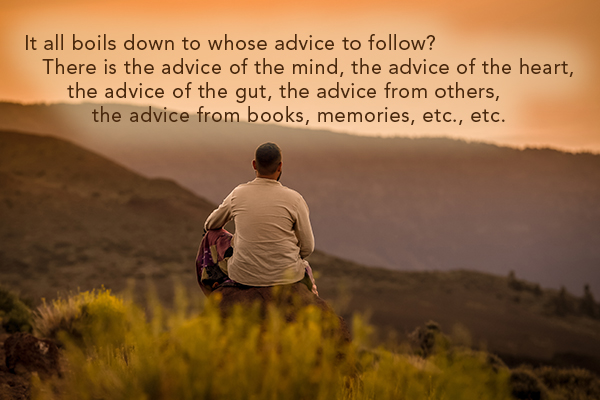
So, it all boils down to whose advice to follow? There is the advice of the mind, the advice of the heart, the advice of the gut, the advice from others, the advice from books, memories, etc., etc.
The only way to know is to try experiments. Be sure you remember which advice you are testing at the moment, so you know why you are getting certain results (there is a tendency to forget).
Example:
Let’s say somebody, maybe a parent of yours, when you were small, said to you “Hey—dig it—unselfish actions pay back better.” Let’s say you had a flash of real understanding and decided to try this advice. You would have found that it works.
In trying out this advice in practice, conscious of what you were doing and willing to see the advice succeed or fail in all objectivity, you were living that moment by the Scientific Method.
This is the way a “guru” lives each second, watching the evidence of experience very closely (inner and outer experience), stepping back a pace from all the opinions.
The Guru has/is savoir-faire.
What impresses people about gurus? They seem to know how to do everything right, like certain fictional heroes, and people in history’s favor. This implies the existence of a Best Operating Procedure that they have discovered.
The thing about a guru is that he/she is watching very closely. This way, he/she learns. A flash to the wise is sufficient.
This is what neurosis is.
Neurosis is the mouse endlessly trying the dead end. Not learning. Living with unsatisfactory stuff in one’s Life permanently, as if it inherently cannot be overcome.
Unlimited willingness to refine one’s position
In the usual unscientific approach to Life, one attempts to get one’s positions unshakably firm as soon as possible, and then defends against any changes to these positions with demonic energy.
In the scientific approach to Life, one is always eager to take one step further in any particular analysis.
Thus, one is always making provisional action decisions for this time, now; keeping an open mind about later; suspending belief and disbelief. One’s positions, this way, gradually evolve, based on day-to-day learning from experience.
Unfortunately, most of the race has forgotten how to do this.
Mind Experiment
What do you believe?
List your beliefs on one or several sheets of paper using only the left-hand side of the page. (Or on your laptop or tablet if you prefer. We recommend paper, so you don’t need to bother with formatting, auto-correct, etc.) Use question marks next to any beliefs you’re not sure you fully believe.
If you’re not sure where to start, you might start with beliefs about God, an afterlife, the purpose of life, and what is good and what is bad.
Scientific Method applied to your life—One way
Put yourself on the Witness Stand.
Now also be the Prosecutor cross-examining the Witness. The Witness is about to defend their beliefs (listed in 2a) with evidence.
This means that the Witness looks back at their life to find incidents that prove these beliefs are correct, that they describe reality objectively.
You can start with the beliefs you listed first and work down the page, or put rank-order priority numbers next to the beliefs and then take them in priority order.
“Evidence” means evidence that realistically could be made to stand up in a court of law.
This game can be played in odd moments over the course of a week or more.
What if they said it differently?
This is a game played during life action. It’s played whenever anybody says anything that upsets you.
What you do is pretend that you are them and realize that you have offended someone. Then you restate the offending words so that they are not offensive.
You might then ask the person if the inoffensive statement of their words was what they meant.
Example:
Other person: “You’re not going to wear that pink tie…?”
You: “You mean, you like some other tie better?”
The point is that specific words trigger emotions based on past associations, but you can change the words to clear out the emotions.
Later, you can clear out the past associations, and then no words can manipulate your emotions.
Unselfish actions pay back better.
In this game, you look into your past to find the most unselfish actions you took and evaluate the results that came from those actions.
You can also do the same for the most selfish actions.
Which paid back better?
Which advisors are conflicting?
This is an experiment to do when you find yourself internally divided as to which way to go in a situation.
You ask yourself:
—What do my thoughts say I should do?
—What do my feelings want to do?
—What does my body want to do?
—What does my intuition say to do?
—What would my father want me to do?
—What would my mother want me to do?
—What did the books I’ve read say to do under these circumstances?
—What does society say you’re supposed to do in this situation?
—What would the person I respect the most do in this situation?
—What would God’s preference be in this situation?
Then, you note which of these advisors conflicts with which.
This pattern of conflict may be a habitual one in your head or may just apply to one type of situation.
Entraining a daily cycle of assimilation and new provisional action decisions
At the end of each day, you relive it before sleep, identifying which moments do not fully please you or about which you have some vague lingering concern.
You allow yourself time to contemplate and learn from these moments by taking the role of your own Coach and coaching yourself as to how to play such a moment better in the future.
When you know how to flow through that situation so that it will be no problem next time, i.e., when you have made certain Provisional Action Decisions as to what to try next time, there is a feeling of peace.
If your Provisional Action Decisions do not work out next time, you revise them and keep up this process until every aspect of your life works smoothly.
Then you get bored and get into wider experiences, which produce displeasing moments for which you need to develop new Provisional Action Decisions, i.e., new theatre, to flow through smoothly.
And a new cycle begins.
Love to all,