Welcome to this week’s Bill Harvey Blog.
July 31, 2026
MIND MAGIC / MIND EXPERIMENTS Book Excerpt Series: Part 4
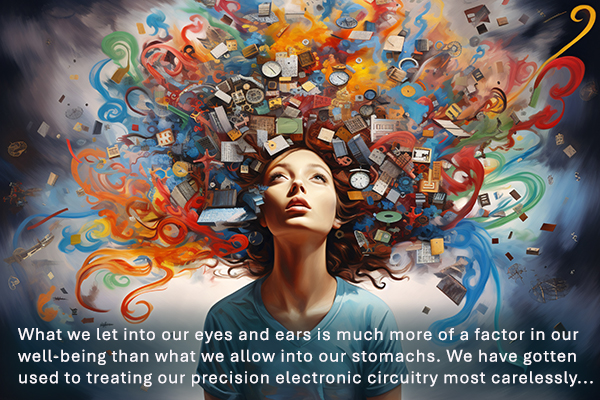
How the tonnage of words and other input has increased past the overload point, causing hysterical imitation in the place of real life.
Meditation as accelerated information-processing
Information Overload: A cybernetic explanation for the state of the world (1)
Over millennia, up to about 300,000 years ago, we humans evolved a neuronic net, which we call a cerebral cortex. We are still learning how to use this new facility, and currently, it is running amok and hypnotizing us, due apparently to an overload of “question-producing” sensory input per average second.
This overload appears to have been brought about by the successive waves of the media revolution, which began with the printing press and have reached tidal wave proportions with today’s Internet, television, radio, magazines, newspapers, books, records, outdoor signs, movies, plays and so on.
The world was very different 600 years ago. We estimate that about seven weeks’ worth of sensory “question-producing” stimuli 600 years ago is what we now get in a day—about fifty times the pressure to learn and adapt.
Just as an “Ice Age” appeared to stimulate humans to discover “travel” and master fire, this media revolution, while it has paralyzed the brains of our leaders as well as ourselves, also appears to be a stimulus for humans—to evolve the capacity to remain focused through complexity.
Cybernetically contemplating the brain
In order to appreciate how “question-producing” sensory overload can have such a powerful effect, one must cybernetically contemplate the brain. The neuronic net we call the cerebral cortex contains about 80 billion neurons, each capable of relating in many different ways to thousands of other neurons around it. (2)
Let us visualize this as transparent, as if it were a force field rather than matter, so that we can look through it in our minds. When sensory input comes in, it moves from neuron to neuron. At each neuron, it encounters other information, and sometimes, the contact results in a cognitive association between the new input and a memory.
Brain researchers can tell that the incoming sensory data is “filtered” (as if through a grid) as it moves in through layers of neurons, each of which checks the data from slightly different “viewpoints.”
This is how the brain updates many of its files based on each new piece of data passing through. Something we see on the street may trigger “notes to oneself” in several different “files” without our being consciously aware of all this (because there is so much going on so fast inside and outside).
Because of the many logical connections between each bit of incoming sensory stimuli and each bit we have already stored as memory, a cyclopean computer update takes place in our brain each second our eyes are open on anything other than a totally familiar scene.
Yogis estimate that 70% of the energy we consume is consumed through the eyes.
Today’s media revolution proves that what we let into our eyes and ears is much more of a factor in our well-being than what we allow into our stomachs. We have gotten used to treating our precision electronic circuitry most carelessly, by feeding it sustained hyper-overload with scarcely a letup—as if our neuronic nets were more like Sherman tanks.
There’s your brain there every moment like a secretary tugging at your sleeve asking you where to file something, and your answer requires a decision. But meanwhile, outside your eyes—the world still wants you to do this and that (and it asks questions, too!).
Before the media revolution, people just took their time, thought things through pretty carefully and slowly, and worked out all the details. Today, there are too many details. The brain shifts into a different kind of functioning entirely.
The brain represses dissonance. It accepts that questions needn’t be answered. And it lets itself regard certain questions only long enough to identify them as having been looked at before; then it puts them away with a “characteristic-habitual-decision-feeling” as if the matter were solved…
We call this phenomenon “hasty closure”. In other words, we let ourselves fool ourselves into ignoring things we should be understanding because we “simply haven’t got time.” (Actually, we don’t know where to begin.)
A different kind of functioning entirely
When people are hypnotized by the things they are told, their resulting emotional motivations drive them at a hectic pace, precluding meditating on their own experience. They “click into Emergency Oversimplification Procedure”—another way humans can process information other than the way that is normally best.
In this emergency oversimplification procedure, our biocomputers follow a grosser logic. For one thing, in EOP, everything must be either black or white. And it must be decided immediately, based on precedent.
We also have little foresight in EOP. In meditation, we can see where things will lead years hence and so avoid entanglements we won’t want then. The mind has little agility for this maneuver in EOP.
Mind Experiment
- For one entire day, concentrate on not jumping to conclusions.
- Am I in EOP?
For one entire day, keep checking to make sure you’re not in EOP, and if you are, get yourself out of it.
Signs of EOP:
- Black/white thinking
- All force goes to precedent
- Things you see are auto-categorized
- Negative or no feeling
- Speediness
- Engaging in activities to get them out of the way
How to get out:
- Breathe…
- Let your body relax wherever it is holding tension.
- Regain your sense of humor.
- Change the scene for a moment.
- Use your body (walk, go outside, etc.).
- Remember your long-range objectives and how they translate to immediate goals in the NOW.
- Remember your agreements.
But most of all, find out what YOU want to do NOW. Then, balance that with your agreements.
Let yourself enjoy a long, slow, new, creative approach to all situations. There’s no hurry.
- Cybernetic = from the Greek for “Helmsman.” The Science of Guidance Systems, human or otherwise.
- Most neurons can either “fire” or “not fire.” Some, called “microprocessors,” have a wider repertoire. However, even the two-way neurons can have a range of meanings depending upon which other neurons are firing.
Love to all,