Category Archives: Flow State

Holiday Blessings

A holiday gift to you from all of us here at The Human Effectiveness Institute and songwriter Stan Satlin: https://www.youtube.com/watch?v=ooF8CDQIpDE

Outsmart Hasty Closure

Created December 22nd, 2020

Built into each human being before birth is an information-processing program whose apparent purpose is to help us understand our external and internal experiences.

It works as follows: certain experiences or perceptions trigger a feeling of dissonance in the mind; you pay closer attention to and think about these until you have a feeling of having absorbed their information, at which point the feeling of dissonance goes away and we say that you have achieved closure.

 Hasty closure can be defined as those instances in which it would have been useful to you to think further before closure. In the Observer state or Flow state peak experience states of consciousness – we are “above” or “behind” the autonomic mind (Ego) and Hasty Closure does not occur.

“Acceleritis”  — the condition caused by having too many things to pay attention to all at the same time, and pretty much all the time — makes us impatient if we are in “normal waking consciousness” – the autonomic mind (Ego aka The Robot). When we do not fully understand something, the drive for closure becomes palpable within our minds. We may become frustrated and maybe even apoplectic, especially if additional variables continue to be introduced — a ringing telephone, someone comes in with a request or sends us a text or e-mail, etc. If we are living in a state of continual impatience, our minds will do anything to get to closure as quickly as possible. If we run our lives and our minds in the usual impatient way, we will lack insight into this process, and so we will be eager to grab our mind’s first offering of a way to closure.

To help you distinguish which of these states you are in at any given moment, here below are some of the signs of hasty closure. When you spot these signs happening within yourself, you are jumping into the Observer state!:

  • One of the most obvious effects of Acceleritis is the increased tendency to see things in black/white terms rather than in shades of gray. “She is always out to get me.” “That guy is never right.”
  • Positions based on beliefs rather than on personal empirical experience. “A company should always be sharply focused on just one thing.” “Religion is just superstition.” “The White Race is supreme.” These beliefs likely came from other people who were influential in your life, including your parents.
  • Negative Charge. The presence of negative emotion such as tension, fear, anger or irritation. These feelings are evidence that you are seeing a situation a certain way, and on top of that, you have subconsciously already decided on a strategy for dealing with it. With such a negative premise, this is not likely to work.

Often these closures will trace back to experiences you had many years ago that you interpreted in a way that locks you into a certain inflexibility, and which trick you into believing you have learned something empirically from your own personal bad experience. But you’ve been fooled by the takeaway you received from that experience; the real lesson is somewhat subtler than the lesson you articulated to yourself long ago.

Typically, you may have overcompensation bias. You were too open, you thought you learned a big lesson, but now you are too guarded — “falling off the opposite side of the log”. You may have been too generous and now you’re too stingy, too severe and now too gentle, too trusting and now not trusting anything or anyone. And so on. You learned the wrong lesson — it wasn’t black or white, it was finding the right spot between them for each situation.

A powerful strategy for jumping into the Observer state is to doubt your own last thought/feeling. Before going off half-cocked, look back at what you just thought or felt, and demand proof before you choose what action to take. This ensures that all of you, your whole self, is in charge, not taken over by a part of you.

You may have an investment in accepting some thoughts over others, such as thoughts that make you look smart to yourself. Just knowing that you can be biased goes a long way to seeing past any bias you may have lurking in your head.

Don’t take anything to extremes. This post is not meant to turn you into Hamlet, never able to make a decision. You must in fact become more decisive, simply not hasty: think things through thoroughly and then take action. If you sense something is dragging on too long and you have needed to take action for some time, you really need to get away by yourself for however long it takes (within reason) to plan out what to do decisively.

Enjoy the peak experiences of the holiday season,

Bill
Your You-ness

Created December 17th, 2020

To recap recent posts, this series within Pebbles in the Pond, “On the Road to Flow”, is aimed at helping you establish yourself in the Observer state, so as to be able to spring into the Flow state more often. We kicked off the series by reviewing the work of Abraham Maslow, who identified the existence of these higher states of consciousness, which he called “peak experiences”. We then introduced the work of Mihaly Czikszentmihalyi, who identified a higher state that Maslow had not alluded to directly but which ought to fall within Maslow’s definition of peak experiences. This he called the Flow state, and it is characterized by perfect action doing itself and a disappearance of the difference between self and other, a unity of self with the entire experience bubble (as I call it).

I introduced my additional higher state I call the Observer state, which appears to be the first step on the ladder upward from normal waking consciousness. I provided some preliminary takeaways about how to know when you are in the Observer state, and how not to immediately kick yourself out of the Flow or Observer states when you get there. After this post we shall turn from theory to practice: takeaways helpful to getting into and staying in these higher states.

I promised at the end of the prior post to discuss one more eminent philosopher of psychology in this issue, and because I used the hint “Ego” many of you probably knew I was going to talk about Freud.

To Sigmund Freud, when we are born, the original self we are is the Id, an animal-like mentality devoid of conscience, and the Ego arises as a mediator the first time our needs are not immediately cared for. Later we gain a Superego by being taught what civilization expects of us, that is the conscience.

I agree with Freud about a few things, and differ about a few. (Of course, what do I know, I am only talking about my own experience, a sample of one.) I agree with Freud that there is “The Me That Was Born”. To me, that is the Observer, the True Self, the Essence, the Witness, The Experiencer, Who We Really Are. To me it does not have conscience nor lack conscience, it is pure of such considerations, but intuitively loves and protects everything. So, quite unlike Freud’s description of the id, the original you-ness is neither animal-like nor intrinsically selfish, in my estimation: it is the pure experiencer, consciousness itself. On the other hand, I agree with Freud’s writings about the source and nature of the Ego and feel that the Superego is part of the Ego.

To me, the Ego consists of the neuronal connections the brain makes, starting when the individual begins to have experiences. Freud likens it to a manager but I think of it more as a press agent, and that’s close enough to know Freud and I are both talking about the same thing.

What I am saying is that the protein constructions the brain builds are the Ego and Superego. The True Self is The Observer that was born. When we get into the Observer state, we are residing in and acting from the Me That Was Born. At all other times, the Observer, The True Self, is merely along for the ride, watching and identifying with the modulations of the mind and feelings generated by the neuronal net the brain has built in a “machine learning” way from internalizing and learning from our experiences.

My hypothesis is that the Ego we think we are is actually like a bio-AI. A robotical system we have become falsely identified with over time, starting from the original terror we felt upon noting our own helplessness and lack of understanding at a world that could and often did hurt us. This subsentience became our tour guide and we trusted it to take care of us. We had no idea how it would enslave us. In the average moment, the average person believes this AI is the self.

What does this mean for you?

You will know you’re not in the Observer state (nor in any higher state) if you are experiencing even mild negative emotion, making judgments that are critical of people or things, rating your own performance – the list goes on and we will cover all of it in this series. These experiences are “tells” that you are centered in your Ego – that built-up defensive self that you were not born with but is now a network of real physical neurons in your brain. In my estimation this evolutionary development is not a positive survival factor – even when we need to protect ourselves the Ego just seems to make things worse – whereas staying out of Ego would make you more formidable and effective in your own self-defense.

Your sense of self (I call “Your You-Ness”) can be in one of two places:

  1. Your true self that was born, which is an observer not obsessively attached to what is going on in experience bubble. The Observer enjoys an intrinsic sense that everything will work itself out and it therefore stays cool. That is where you want your You-ness to reside. And the locus of your You-ness, your sense of self, is controllable, but much trickier than riding a bicycle.
  2. Your Ego, or robot, a mechanistic and deterministic response of a neuronal net biological AI in your brain which evolution thought might be helpful. Science has observed in many species that evolution produces dead ends sometimes.

Takeaways:

  • Keep your sense of self apart from the thoughts, feelings, and images rolling through you. Observe those ephemera and decide if there are gems of wisdom in there anywhere which could be actionable in your current life situation, and let the rest go by.
  • Especially let any annoying thoughts go by, those are definitely the Ego. It can only help you as an alarm clock does, by pointing out that deep down inside a few things are bugging you. Write those down and when you feel like it, look at the bug list dispassionately as if these were concerns one of your children or mentees brought you, asking you to make it better. Intelligently and without excessive caring determine what your best advice will be to your Ego-self.

To be continued.

My best to all,

Bill

Follow my regular media blog, In Terms of ROI at Media Village. Here is the link to my latest post.


Getting to Flow by Living in the Moment

Updated September 4, 2020


My first experiences of Flow state were at the Brickman Resort when as a young child my parents, Ned and Sandy, put me onstage. The height of stage fright got my attention. I was pulled out of my mind by the sheer challenge of dealing with it. I had no time to dawdle or stay in my head. This seemed as close to a life-threatening experience as I could imagine, although I did not have the time or ability (as a child) to put it into those words. I couldn’t even distract myself by paying attention to my fear! I was totally absorbed in handling the immense challenge of the moment.

This and other experiences when I was young made me keenly aware of the existence of Flow, although I had no name for it then and didn’t think about it consciously. I also noticed there were other incidents in which I was more like Hamlet, overthinking a problem while the time to move had long since passed. Continue reading

Are you balancing activity and stillness?

Updated July 17, 2020

If we are always pushing toward our goals, we are inadvertently setting ourselves back from reaching them. I know that many of you are nowadays in back to back Zooms almost all day, which means that in the remaining time you are besieged by emails, texts, calls, Linked-In, and actual deadline work on top of all that. The opportunity to take a breather and let your mind relax can wind up being postponed until evening. That isn’t conducive to optimal performance.

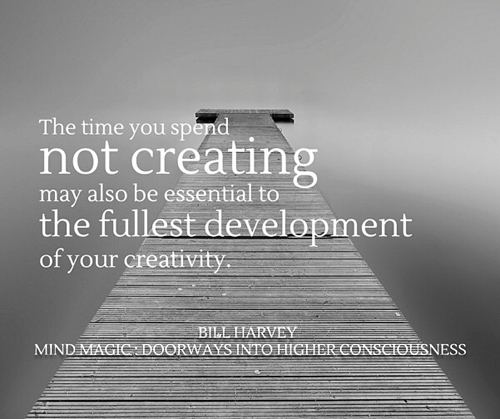
There is a stage in the creative process in which it is wise to turn away from the challenge and do other things, for it is during this turned-away phase that the Aha! moment comes.

not creating may be essential to creativity

Certain batteries get recharged when we take ourselves temporarily off the wheel that is always driving us. This can happen when we are entertained — on our screen devices, reading, watching stage or other performances, spectator sports, vacations, making love, being with family and/or friends.

The subtlest batteries, however, only get recharged when we are alone with ourselves. This can take the form of sitting meditation but it doesn’t have to. We can be alone in nature, alone at home, alone on an airplane, anywhere. As long as we are not working down the TO DO list, there is a greater chance that we will slip into the Observer state (the precursor to Flow state) effortlessly.

[dropshadowbox align=”center” effect=”raised” width=”auto” height=”auto” background_color=”#dbd4fe” border_width=”1″ border_color=”#3a2b89″ inside_shadow=”false” outside_shadow=”false” ]To help bring on Observer state — a mindset in which you are able to simultaneously observe and analyze your emotional reactions to situations somewhat impassively — this works for me:

  • Look more closely at the place from which thoughts/feelings arise.
  • Don’t add to what you observe inwardly/outwardly, i.e. stop interpreting everything.

[/dropshadowbox]

If we spend too much time doing, our conscious mind will block the functioning of our subconscious mind, and we’ll interfere with the stream of consciousness. If we spend too much time not doing, we will under-actualize our own goals. The movement associated with creative energy is a good thing, but stillness in body and mind is also valuable.

Balancing movement and stillness is optimal for maximizing effectiveness toward all our goals in life for love, creativity, and ultimately spiritual fullness, intuitively knowing and feeling connected with all beings and all things.

Strive to achieve the right balance between times spent doing versus time spent not doing.

L’chaim! (Hebrew toast “to life”)

Best to all,

Bill

Follow my regular media blog contribution, In Terms of ROI at MediaVillage.com. Here is the link to my latest post.