Category Archives: Classic Bill

Rediscovering that Ancient Territory: Your Own Mind

Updated March 27th, 2020

Now that we are all temporarily confined to quarters – with hopefully some escape to Nature – it’s a perfect time to spend some of it alone within our own selves, reinvestigating that ever-familiar landscape as if for the first time, taking a really good look at what’s in there, without expectations. But possibly with some other cartographer’s notes against which to compare your own inner experiences.

All of us are naturally curious about our own selves. When someone who knew us when, someone older, tells us a story about something we did when we were too young to remember it, we are raptly attentive.

Looking inward at oneself is the first step toward clarity.

If it were not for the culturally ubiquitous time pressure, we would have the same curiosity if offered a searchlight method to see more deeply into our own mind than ever before. Here we offer just such a searchlight.

This posting is a brief exploration into the architecture of inner experience and offers tools to look into your inner Self, through observation and experience. Why bother? Because in order to get into the two higher, most effective states of consciousness — the Observer State, where we can really see what is going on inside ourselves rather than being puppeteered by software in our heads, and the Flow state (Zone), where we are spontaneously doing everything just right — we need to become experts in the empirical study of our own minds and inner life.

What Is the Architecture of Our Inner Life?

Carl Jung defined the four functions of consciousness as perception, feelings, intellect and intuition — the latter referred to in day-to-day life as “hunches”. These are four kinds of events that can go on in consciousness.

Within consciousness, what we experience first is something inside that motivates us and moves us toward or away from something. Those are feelings. Instincts — hardwired genetic carryovers inherited before birth — are partly responsible for some or all of our feelings. The rest arise from motivations we accumulated during our lives, stuff we learned or decided to want or not want as a result of our experiences since birth.

So what are these things you call your thoughts, your feelings, your hunches, your perceptions? Consider, or reconsider, all of the experiences you have had of your own mind, your own inner life.

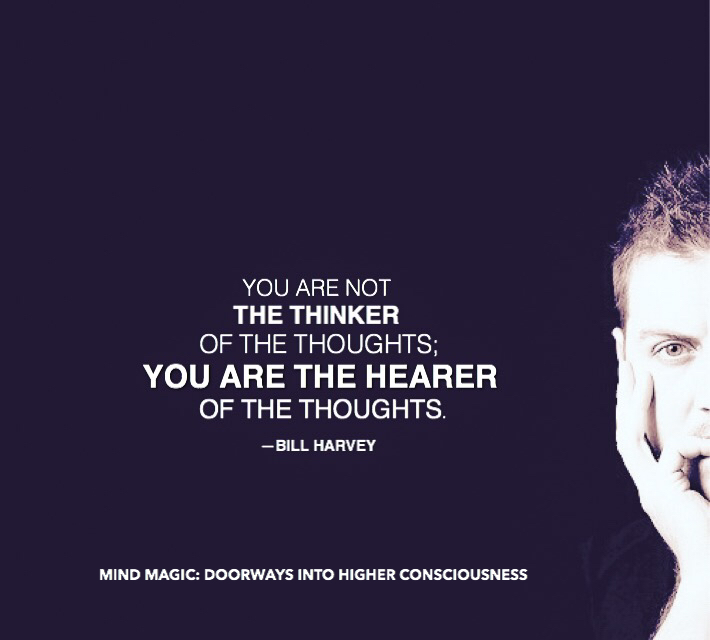
When I watch what goes on inside of me, it often starts with a feeling that is also somehow an image at the same time. Another part of me then takes that feeling/image and interprets it as a conscious thought — putting names, categorizations, and other specific recognizable details onto the original amorphous feeling/image.

I think that’s what a thought is. An interpreted feeling/image. Diverging from Jung, I posit that thoughts and feelings are the same thing, at different stages of development.

Thoughts add details to feelings/images, turning them into specifications, bringing out additional information that had somehow been packed into the feeling/image.

Possibly feelings are the most substantial and primary actor, coming out of our most intimate connection with our self, and arising to be transmuted into intuitions and/or thoughts and/or emotions and/or images/visions.

Perceptions coming in from the “outside” accompanied by an equal stream of feelings from “inside” suggests that feelings are another sense, like seeing and hearing. In which case, we simply perceive, and the rest of the functions are what evolves from our perceptions. In other words, feelings are inner perceptions, and what we call sense perceptions are outer perceptions. Inner and outer perceptions are the raw stuff of experience, and as we turn them over in our minds, those perceptions turn into thoughts and/or intuitions.

I suggest that perceptions evolve into what Jung classified as thoughts (intellect) and/or hunches (intuition). Outer perceptions — the five physical senses — are what Jung called “perceptions” — and the inner perceptions are what Jung called “feelings”. In my own experience, the raw stuff of my inner life is comprised of feeling/image arisings that I then articulate internally as thoughts, with either words or not, or observe as hunches, without inner words.

Intellect and intuition have always been seen as similar functions. Intellect reaches new conclusions step by effortful step. Intuition gets there in one leap, involuntarily, all by itself. Sometimes when the intuition or hunch is particularly credible and important and came out of nowhere, we call it inspiration, suggesting help from some outside invisible source.

The Searchlight to Our Inner Self

We need maps to study consciousness. We also need meditation to concentrate on seeing what really goes on inside by understanding the basic building blocks of all inner experience — thoughts, feelings, intuitions, and perceptions.

Try this. Find five minutes when you can’t be interrupted and there is nothing dragging you away like a deadline. You might not find time to try this until the weekend, so leave yourself a note somewhere you’ll see it Saturday or Sunday morning.

Sit with your eyes closed and back straight, with your head drawn up toward the ceiling. First, still the mind by experiencing your breath going in and out, without trying to control the breath in any way. After a half-dozen breath cycles or whenever you feel as if your mind is relatively still, begin the exercise.

Now simply watch for what happens at the very beginning of a thought or feeling. A thought or a feeling is going to arise. You are in a state of concentrated sharp attention and the game is to see that arising as quickly as possible, identify what it is, and be able to remember the experience of it as accurately as possible.

This is not as easy as it sounds because we tend to get so instantly caught up in the thought or feeling we forget that we are doing this exercise. That is, until through exercises like this, we find that we have gained true control of our minds in a gradual process that we get better and better at over time. By looking inside, we can begin to cut through dogma and other people’s beliefs, and see for ourselves who we are in our inner worlds.

Best to all,

Bill

Read the latest post at my media blog  “In Terms of ROI“ at MediaVillage.com.

Visualizing 2019

Visualize the whole universe as one thing

Originally posted January 5, 2016Volume 5, Issue 47

As we leap into 2019, with clear intentions and resolve, let’s keep this visualization in the forefront of our minds to guide our thoughts and actions:

Visualize the whole
Universe as one thing
Every individual

of every species
Every idea
Every event
Every moment of time
Every percept
Every lump of matter 
and energy
All parts of one thing*

Then, each day, realizing your connection with the Universe, play your hand as best you can:

You are a Musician,
harmonize.
You are an Actor,
detach.
You are Real,
don’t pretend.
You are in Time,
don’t hurry.*

May we all reopen our minds to the existence of all possibilities, as we rediscover the unique experiment that Nature has designed uniquely for each and every one of us on our branch of the Tree of Life.

Happy New Year 2019!
Bill

*From Mind Magic: Doorways into Higher Consciousness

Follow my regular media blog, In Terms of ROI at Media Village. Here is the link to my latest post.

Some Thoughts on New Year’s Resolutions

Make your resolutions this year define and focus on your real priorities

Volume 5, Issue 45

As we approach a New Year, many of us are considering making New Year’s resolutions. Are you wondering if you’ll stick with your resolutions this time around, and thinking about how you can strengthen your resolve?

Here are some thoughts on resolutions from my guide on 7 Life Tools for creating lasting happinessThe Navigator :

Consider that because our mind acts just like a computer, when we make a resolution our mind makes a prediction of how we will act in the future. Based on past experience our mind’s prediction will tend to be that we are not going to follow through on that resolution. The mind predicts, generally, that we are going to continue to behave exactly the way we have in the past. The mind will remember that we make resolutions from time to time, but they are mere sayings, not actual intentions or actions.

This is because there is no feeling of change inside when a resolution is made; so our mind feels that the resolution has not changed anything, and therefore it will not change anything.

To start making real changes it will help to prove otherwise by acting immediately on your resolutions.

Start with a baby step. Don’t resolve to make huge changes instantly, for this is rarely possible. Take it in the slowest possible stages, one baby step at a time!

We are grateful to each of you for the opportunity to share ideas and tools to help optimize your journey through this life. In the upcoming weeks we’ll be providing more tools to help you actualize your resolutions.

We wish you all the very best in the coming year(s), starting with a safe New Year’s Eve.

My best to all for 2019,
Bill

Follow my regular media blog, In Terms of ROI at Media Village. Here is the link to my latest post.

What Is America’s True Mission?

Originally posted October 20, 2015

What is it that we are striving to achieve as a nation, our Purpose on Earth?

What is our nation's mission on Earth?

What did Tom Paine expect of us, or George Washington?

If we do not know our purpose then no matter what good we may achieve on the face of the Earth, we will be rudderless inside. We won’t know where we’re going or how we want to get there or who can best lead us there. We will be guided by the plan du jour. Any good we do will be random, grasping at straws of tactical opportunity to head toward the seeming good at that moment without a clear picture of the totality of our decisions. We have seen throughout history that who or what at first seems good turns out to be not as good as we thought.

If we lose sight of our purpose, the nation will be contributing little to the spiritual nourishment of its citizens. Yes, spiritual. The words that led to our nation’s birth are spiritual words: Liberty, Equality, Justice. These words, chosen by our Founders, refer to and evoke states of spiritual sensitivity in which we are swept up into something larger than our personal self, open to the duty we owe others and the Universe or God, whatever we conceive Him or Her to be. Many of us envy these ideals but consider them pragmatically irrelevant in our actual moment-to-moment Acceleritis™-driven lives.

The ideals of Liberty, Equality and Justice must be nurtured as part of our heritage if we are to remain a nation focused on such high ideals. It behooves us in this and any other election cycle to support those who will fight to keep these ideals at the forefront of their decision making.

If we want to continue to be that inspired nation, then it is time to tap into the tide of positive emotion that can energize creative thought and enable right action together.

So let’s consider again — what is our true mission as a nation?

Mainstream thinking seems best summed up by Bret Stephens in a 2014 Wall Street Journal essay, “If the world’s leading liberal-democratic nation doesn’t assume its role as world policeman, the world’s rogues will try to fill the breach, often in league with one another.”

The US has long accepted the mantle of the world’s policeman — protecting the weak from aggressors. What if that isn’t the main point of our existence?

[dropshadowbox align=”none” effect=”lifted-both” width=”auto” height=”” background_color=”#bccefa” border_width=”1″ border_color=”#3f50a0″ inside_shadow=”false” ]We have the opportunity now (as always) to choose our own destiny. Let’s as a nation agree on what it is. And let’s start the dialogue, here and now. [/dropshadowbox]

As always, I welcome your thoughts.

Best to all,

Bill

Follow my regular media blog contribution, In Terms of ROI at Media Village. Here is the link to my latest post.