
Welcome to this week’s Bill Harvey Blog.
August 28, 2026
MIND MAGIC / MIND EXPERIMENTS Book Excerpt Series: Part 6
Meditation as automatic clear-out process
The number of “not-perfectly-familiar-so-as-to-be-invisible” sensory impressions falling on the individual per second determines how much unresolved experience will be created by a culture. Subtract out that culture’s propensity for meditation (“putting the biocomputer on ‘automatic clearout’”), which is the fastest process for resolving unresolved experiences, and what is left is the weight of residual unresolved experiences.
In our culture, the high sensory glut and low incidence of meditation create such a backlog of unresolved activity in the brain that these electronic “tensions held” become a distracting screen, and we go into a kind of hypnotic trance. We handle the trivial moment-to-moment stuff and lose sight of the highest long-range possibilities of our lives.
Meditation is the assimilation of information.
It does to sensory food what the liver does to physical food. Unassimilated food turns gangrenous. So do unassimilated experiences.
In meditation, the mind unclutches; super-efficiently, experience is assimilated; patterns are recognized; action implications become clear. The resulting clarity eliminates the tension of unassimilated experiences that caused the mind to clutch up in the first place.
Humans exist by processing information.
That information is our inner and outer sensory experience, including words we are told. All this tends to program us, if we don’t process the information in a certain way nature intended. If we do process it the natural way, we program ourselves.
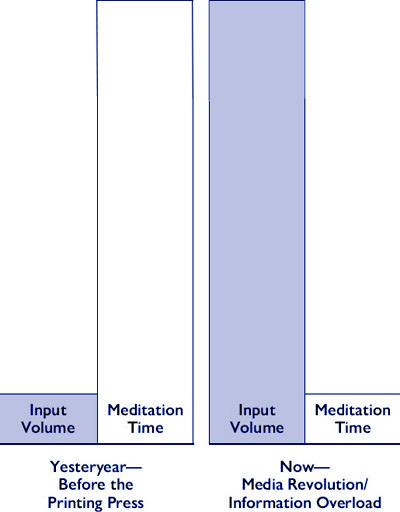
The natural way of processing assumes a reasonable ratio of input volume : meditation time. In today’s reality, this ratio has become highly unreasonable.
Assimilation = higher pattern recognition
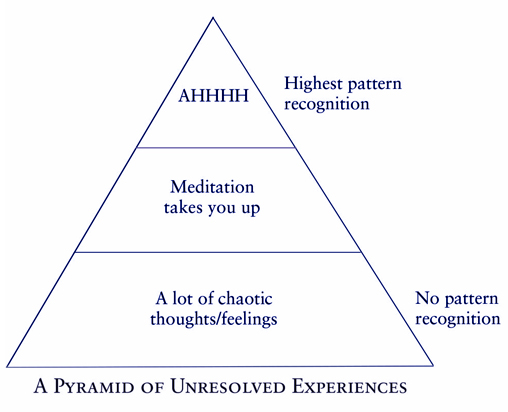
Picture a pyramid of many stories, each one containing books . . . a pyramid library. The basic structure of any field of information may be regarded cybernetically as a pyramid. (With thanks to Fred Klein, 1973.)
This is how it is organized:
-
- On the lowest floor (also the largest), are the specific detail books, covering diverse facts from all fields of knowledge.
- The books on the second floor cover the same fields of knowledge, but from a “theoretical overview” perspective. We can imagine a whole rack of books on the first floor telescoping upward to a point in one book on the second floor.
- The third floor brings whole fields together.
- The fourth floor brings everything together into philosophic viewpoints.
- The fifth floor contains books written about the fundamentals of philosophy itself.
- The sixth floor contains a single book.
- In the capstone of the pyramid is a single word
Each floor contains the same material as the floor below, but in integrated, reduced form, i.e., from a higher, more universal perspective, ignoring more and more of the “incidental details.”
This pyramid model is to be applied to any field of information. One’s perspective can be on any floor or in the capstone. However, this is not simply a matter of putting one’s perspective in the capstone. It has to “float up,” so to speak, as a result of the assimilation process.
The many unresolved experiences in one’s Life need to be meditated on. As a result of this process, one gradually “floats upward” out of “a lot of chaotic thoughts/feelings” into a sense of “everything falls into place.”
We have involuntarily shut down our inner and outer senses against the information overload.
Most of our minds are on “hold.” The brain is holding many messages for you, taking up much mindspace, mind-energy, and mind-time, giving you these same messages repeatedly. While with your conscious control over that same brain, you repress and dodge these messages.
You haven’t answered your messages in how many years? There’s a message for each person you haven’t forgiven. And for each pain in your body. And for every other symbol of something unresolved in your Life. And for every question you’ve asked that you’re still unsure about the answer to, that is relevant to your “maze.”
In effect, the brain knows it has the information you need, and it is trying to give it to you. Meanwhile, a set of functions often called the “subconscious” or “unconscious’ gives you away in various social situations, i.e., embarrasses you in various ways to get you to confront some of these messages. But we are not observant because we have involuntarily shut down our inner and outer senses against the sensory overload.
Skepticism is the anus of our mind clenching to keep out the information overload.
The severest human shortfall caused by information overload is the limitation of possibility.
One of the most overwhelming surprises one gets in deep meditation is how complicated it really is to figure out the right action in a typical everyday situation. This is certainly the key subconscious deterrent to really being: it is too complex now.
Too many variables
⇓
The limitation of possibility
⇓
“Magic of Life” extinguished. ⇓
We all move too fast.
We pretend that we are capable of functioning in this haze of complexity. This is a hysterical reaction. What happens to most of us is that under the pressure of time, we take automatic positions on things based on our programming. Without realizing it, most people are trying a desperate, short-cutting approach to existence.
We label this a hysterical “panic” reaction because it continues to persist for a lifetime in most cases, although it proves itself unworkable every day.
The realistic reaction belongs to the yogi under the tree. The yogi doesn’t act on an idea until he has meditated out all its possible connections to other ideas in his ken. Thus, the actions never snag.
Each other’s windup toys
All information has some intrinsic command effect on the brain. Even rhythms may be soothing or create a wide range of other moods. Our brains are being washed in information with some command effect over us, from waking to sleep each day (and during sleep). Ours is the Age of Background Brainwashing.
We don’t even notice that it is there or why we buy those products or snub those strangers. How little of our behavior is under our own control; how much was programmed from outside!
We become shorthand human beings.
There is always a subtle time pressure. “Don’t you dare waste my time!” is the unspoken rule. Thus, when someone asks a question, we tend to flip back something that “sounds like something we would say in such a situation”. We usually give no fresh thought to the matter.
It is the automatic pilot. Free will is switched off. Creativity is a forgotten ideal. The robot is playing its tapes.
This is the eventual result of a narrowing process that takes place via communication exchanges when we are very young. We encounter such a large number of understandings (with many “iterations” to “unwind” each one) that eventually, we stop trying to express what is inside of us and content ourselves with flashing cliché signals which everyone understands.
The capacity to remain focused through
complexity is a key survival characteristic
for humans today.
The point of staying focused is that it enables you to:
- Catch more of the incoming stimuli;
- Catch more of your total reaction to these stimuli;
- Identify the real priority items;
- Simultaneously continue or change motor activity gracefully as needed;
- Make decisions when needed—without “distraction-resulting-in-only-partial-attention” to any of these.
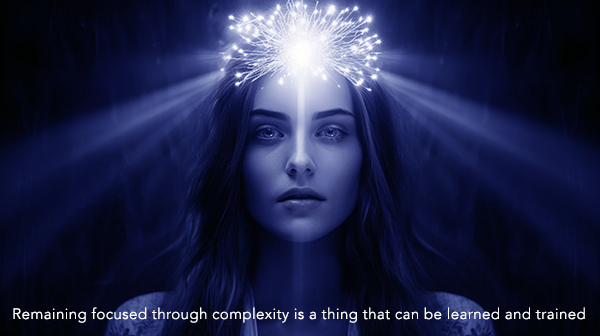
The true yogis know how to do this. Remaining focused through complexity is a thing that can be learned and trained.
Mind Experiment
1. Adaptive or programmed?
For one day, keep track of yourself from moment to moment, watching to see whether you are behaving in a more programmed or adaptive fashion.
Note the kinds of situations through which you flow adaptively, creatively, and spontaneously, and those through which you move in fixed mechanical ruts.
2. Massage to remove tension
Removing tension from the body yields more energy for use by the mind. Thus, massage can help induce meditative states.
Love to all,