What the World Needs Now

Volume 4, Issue 17

Happy Independence Day!

The answer is always the same — “Love, sweet love.” Hal David’s lyrics to the Burt Bachrach score. Reverberating in John Lennon’s “All You Need Is Love” a couple years later.

Yet at almost all times in memory there have been huge groups of people so angry at each other that the differences indeed appear irreconcilable. If they are truly irreconcilable differences, God help our great grandchildren, as Weapons of Mass Destruction (biological and chemical as well as radiological) become more and more refined and more and more available to anyone.

Shiites and Sunnis are once more at each other’s throats in Iraq — all we did was postpone it with the gallant soldiers who threw themselves bravely into the turmoil. Kurds are taking advantage of the distraction by consolidating their terrain. In our own country, there’s Fox News and the Outraged Democrats. Anywhere in the world you look somebody hates somebody, righteously holding onto their grudges and refusing to forgive. Even True Christians who know the sacredness of Forgiveness are allowing themselves this exception to the rule — they are allowed to hate at least one bad guy like “the Devil” and in real life other folks too with whom one has a long-running melodrama. And in the current Acceleritis™-degraded environment, each of us flips into demonizing another person or group at least briefly. This tendency has become so ingrained — maybe it’s just somebody driving too slowly in front of you when you can’t pass. Old brain circuits don’t die easily.

While we can all agree that this is pretty much the real scenario, most of us seem to feel nothing can be done about it. It’s the way the world is, and the world especially today has become so complex and so full of powerful rich people that control everything, what can any of us regular folks do to change anything so big and so pervasive?

We not only can do plenty, we are already doing it. As far as I can tell so far, it was not a huge conspiracy theory that brought about digital media, aimed at the democratization of power. It “just happened”. Possibly the plot was written from on high. In any case the inmates are now running the asylum to a more massive degree than ever before. Why not channel at least a tiny fraction of this digital free-for-all into content that evokes our capacity to love and forgive?

Sounds like boring screen fare? Not necessarily. Picture the MTV series “True Life” and then imagine amateur videographers all over the world starting to generate YouTube ongoing cinema verité series about friendships between a Sunni and a Shiite in Iraq, a Brit and a Catholic Irishman in Northern Ireland, a Liberal and a Conservative in the U.S., and other pairings of individuals from groups assumed to always hate each other. Maybe in some cases the friendships are between musicians or entertainers, perhaps from diverse cultures and global locations. Such as Yo-Yo Ma’s Silk Road Ensemble and other projects.

It might not be spectacular or grotesque enough to go viral, but as a constant drip-drip-drip in areas of the world where the hatred seethes to the boiling point today, it could begin to make a difference. The world’s establishment media can find cases of this already and simply bring the phenomena to everyone’s attention globally via mass media as well as social media. With very little effort it is possible to inject a little bit more love into the screens that now dominate our lives. 

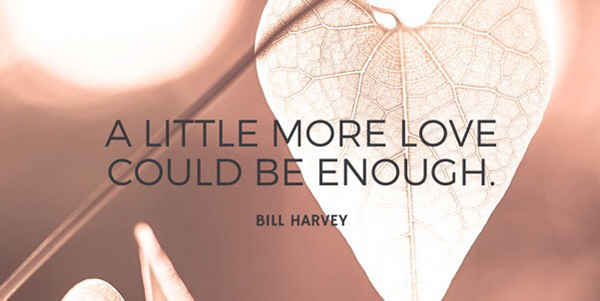
Just a little bit more love could be enough — imagine Archimedes’ lever slightly turning the angle of our world-line just one baby notch, with a little more oxytocin and a little less amygdala — as we endeavor to create a better future for our children’s children’s children. 

Love,

Bill

P.S. My wife Lalita and I will be attending "Footsteps of Mandela," an original musical production celebrating world peace, freedom and human dignity. We will be accompanied by our good friend Stan Satlin, the songwriter of several inspiring songs about the spirit of America that will be performed there. Footsteps of Mandela will be performed at Riverside Church in New York City on July 18 at 7 PM to benefit the Nelson Mandela Foundation.

Footsteps of Mandela

Follow my regular blog contribution at Jack Myers Media Network: "In Terms of ROI." It is in the free section of the website at  Bill Harvey at MediaBizBloggers.com.

My new book, You Are The Universe: Imagine That is now available. Read an excerpt and watch my videos where I talk about the book.


Which Motivators Drive Our Most Frequent Choices?

Volume 4, Issue 16
June 26, 2014

Lessons from my day job

One of the benefits of my day job as a media researcher is that I gain valuable insight into what sorts of things I should create in the future to carry the messages of the Institute to as many people as are ready for it. My day job also enables me to do my ultimate passion work, which is to improve human effectiveness and thus happiness and/or fulfillment for the greatest number of people. The following post illustrates the synergy between my day job and my ultimate passion work.

The year: 1997. My company Next Century Media is working with John Hendrick’s innovative Discovery network and John Malone’s dominant cable operator TCI, installing addressable optimizer Opti*Mark into the National Digital Tech Center (NDTC) in Denver, for inclusion in the uplinking of dozens of TV networks to cable systems. This will make all the cable commercials potentially addressable to the set-top box (STB), will measure the STB, and offer program recommendations to subscribers on command.

The reasoning behind the program recommender is both to increase natural delight and also to give subscribers a cogent reason to feel better about their behaviors being tracked, albeit anonymously.

A technology favored at that time for recommendation engines — and still used today — is the collaborative filtering technique (CFT). It’s not the Netflix method of slicing down programs/movies into 78,000 tiny sliver genres, like Humphrey Bogart WWII movies of the 40s, and then counting the incidence of these subgenre choices within each subscriber’s individual record to make recommendations of other properties in the subgenre cluster that have not been watched yet through Netflix. CFT is the familiar “people who have bought this book also bought this other book”. NCM did not want to use CFT although it was ready to go off the shelf and cheap, not to mention accepted.

NCM wanted a method that would yield insight about people’s preferences, not just the facts of their observed choices.

Also, CFT takes a while to build a database and cannot give recommendations for a new show until there is some history of who watched it and who didn’t. With the importance of new shows to TV ad planners and programmers there was no way to live with CFT’s delay. So NCM created a keyword-driven system (today like so many other things called Bayesian). We compiled 1500 or so different words that are used to describe TV programs, ads and movies — screen content. Some of this came from work I had done consulting for the launches of cable networks, some had been from movie work I did with studios, and some was the result of many researchers pooling their knowledge.

One day the late Gerry Despain, who led the dozen software developers working on this, came to me and said he wanted to drop over 1200 of the keywords. I was aghast because test viewers were thanking us more than 9 to 1 in favor of the recommendations the system was producing. He said, “You don’t understand. I just want to drop the ones that do not predict set-top box data.” I saw that he was right and approved the efficiency move.

Later it gradually dawned on me the utter enormity of what had just transpired. We had stumbled on 250-300 words that DO predict the choices people make as to what to watch and what not to watch. Nowadays, in finally having the time to continue that line of development, we are calling those golden terms DrivertagsTM (DtagsTM for short) because the modern screenworld name for such descriptors is “metatags” — and because these 250-300 metatags are the first we know of that actually do appear to describe inner motivational states that predict real world behavior. Specifically, what we choose to watch on screens.

This would be merely a very important discovery in one group of businesses in the private sector. However, if we zoom out, we see that today’s civilization on Earth is in the process of becoming totally dominated by screen content. This is the latest evolution of the information acceleration process we call Acceleritis™, which my theory attributes to the advent of written language.

The primary devices with screens on which there is content, used by most of us in civilization today, are the computer, TV set, tablet, and mobile phone. People with enough money (or enough credit) are making sure they have at least one of each. Monied households with large families are accumulating screens perhaps faster than anyone in the household can count or cares to. Moreover, by any researcher’s count, the average person now spends more than half their waking hours with eyes on these screens.

The Human Effectiveness Institute (THEI) will be working with ScreenSavants, the private sector startup licensing NCM’s IP in this area, to make applications of learning to our Mission of increasing human effectiveness. We’ll be studying how specific DTags identify viewers more prone to Observer state or Flow state. We’ll be networking with interested academics including people who are working in nearby inquiries such as explaining the attraction of viewers to specific characters, deriving psychological insight from natural language utterances, linking screen content to higher values, semantic mapping, and all forms of related psycholinguistics. One reason for doing this is simply to understand — pure science. The other is for practical application to the mission of THEI, improving human effectiveness. We’ll report our progress here.

For a first example, consider the following graph. What does it mean?
graph on DriverTags

The easiest way to explain a graph is to explain what one datapoint means. In the upper left you’ll see “Situation #2”. That is a particular DTag — and 9 out of 10 top-rated situation comedies have that DTag. None of the cancelled sitcoms have that DTag. Now look at the lower left and you’ll see “Value #50” — 8 out of 10 cancelled sitcoms have that DTag, but only 1 of the top 10 rated sitcoms has it.

If I were investing $2.5 million per average new TV series pilot I would love to know which DTags are vital to success and which drive failure. That is the business reason for all this.

For psychology, given that the biggest use of time in our civilization is screen usage, discovering the motivators of this preponderant activity yields considerable new insight into what motivates people in our culture today. That’s the science reason for it.

The attachment of DTags to TV shows happened long before the analysis of ratings and cancellations. The same DTags that worked in 1997 are still working in 2014. On the inside we haven’t changed so much.

This is the kind of science I personally get to do that is part of my passion work. I’m a very lucky guy.

The gratitude attitude and admission that the Universe may indeed be sentient are the causes I attribute to such great luck. Hope you are very lucky too!

All my best,

Bill

Follow my regular blog contribution at Jack Myers Media Network: “In Terms of ROI.” It is in the free section of the website at  Bill Harvey at MediaBizBloggers.com.

My new book, You Are The Universe: Imagine That is now available. Read an excerpt and watch my videos where I talk about the book.

A Possible Explanation for Dark Energy and Dark Matter

Volume 4, Issue 15

I’m sitting in the outdoor roof bar of New York’s Catch restaurant down in the meat packing district. The incessant heavy metal beat of the Muzak is almost drowned out by the traffic sounds below and the murmurs of voices from the adjacent inside bar. A cool breeze beats the heat and humidity of the day, promising another thunderstorm. Here I sit writing and editing my next two posts.

Readers who like my more emotional, feeling-oriented posts are asked indulgence for posts like this in which I offer my scientific theories. Originally a math and physics major before turning to philosophy, I have always loved science. I read the works of leading physicists to keep up on the latest proven findings in the physical world in order to see if there are any hints to the unseen world, which I intuitively feel certain is there supporting the visible universe. After all, why should a universe this wondrous be limited to what one species on one planet happens to be able to see?

Invisible matter and energy have been detected based on their gravity fields, which affect the movements of nearby bodies that we can see. That’s how we know something is there.

These dark (actually transparent) entities make up 95% of the mass of the known universe. Scientific theory currently has not yet integrated these findings. It is this staggering recent finding that allowed science to answer the longstanding question of whether the universe would collapse or keep expanding forever. The perceivable universe will keep on expanding because it is being drawn out by the gravity of the dark masses.

Again, science has not yet got a theory or explanation for the dark masses. Here we will offer one based on my Theory of the Conscious Universe, as contained in You Are The Universe: Imagine That.

All that exists is a single spaceless point of self-awareness.

All that we see is a projection of that one biocomputer in a multidimensional hologram — kind of like an interactive video show with feelovision, smellavision, and tastovision. The substance being projected is information. The Observers receiving the projected information are an instance of the self-aware point. The one point is also projecting Itself outward into this hologram so as to experience it from many viewpoints.

All known observers are within the see-able universe, which make up 5% of its mass. Dark Matter makes up 25% and Dark Energy 70%. What are these dark entities?

Dark Energy is a good candidate for being the Operating System or software of the universe. The algorithms and instructions that take our intentions and integrate them into the flow of the overall universe as our actions in the interactive CosmopolyTM game.

Dark Matter is a good candidate for being Data Storage or firmware of the universe. The conversion tables, past and future results, potentially usable as a time machine, what Indian tradition calls the akashic records, the subconscious of the universe, that which is not on display in the Projection but still exists eternally.

Thanks to Frank Wilczek for his beautiful leading-edge science book The Lightness of Being: Mass, Ether, and the Unification of Forces, which is an awesome read and inspires me to see possible connections between leading-edge scientific thinking and my Theory of the Conscious Universe.

Best to all,

Bill

Follow my regular blog contribution at Jack Myers Media Network: In Terms of ROI. It is in the free section of the website at  Bill Harvey at MediaBizBloggers.com.

My new book, You Are The Universe: Imagine That is now available. Read an excerpt and watch videos of Bill talking about the book.

Latest Lessons from Erwin Ephron

Volume 4, Issue 15

This last Monday I was presented with the Erwin Ephron Demystification Award by the Advertising Research Foundation. Naturally, I was tipped off in advance, and had organized my thoughts about what I would say.

Bill Harvey receives The ARF's first Erwin Ephron Demystification Award - June 9, 2014
Bill Harvey, recipient of the first Erwin Ephron Demystification
Award, with Gayle Fuguitt, CEO and President of the ARF.

(On the subject of acceptance speeches my mind always goes back to Sally Fields’ Oscar acceptance speech in which she emoted “You… like me!”)

For those of you who did not know Erwin, who passed on some months ago, he was one of the thought leaders of the advertising industry, known best for his ability to express himself so that not only did everyone understand him, his arguments were inarguable. He was also a great friend and mentor of mine. I’ve been extremely fortunate to have had so many great mentors. The Universe sure has treated me nice since I acknowledged its sentience.

For those of you who weren’t there on Monday, here’s approximately what I said, with some unintentional omissions and a couple of new thoughts as I write this:

Thanks ARF, everyone involved, for this award. Thanks Erwin for teaching me how to demystify a little bit. I’m working at it. No one can do it like you could, buddy.

Interestingly, the last conversation I had with Erwin sort of presaged that there would be an Erwin Ephron Demystification Award. I was in a hotel room in Manhattan and my cell rang. It was him. He said that he and I still had some unfinished work to do together with the ARF. He said that the keyword is simplicity, that we need to get back to the basics of brand building (sales and long-term brand equity), and resist the attractiveness of all the new things that distract us from getting the brand to be more successful by making wise creative and media decisions. He expressed concern about how much time we spend reading or talking about new technologies. He didn’t object to including new stuff in the conversation, he just didn’t want us to go goggle-eyed and indecisive and to spend all our time that way. He knew how much hard work it takes to make brands succeed better.

I’ve been applying his advice. I have people editing my ravings to help me demystify more (hopefully). There are large blocks of time in which I refuse to even glance at email and instead focus on the biggest priorities. I studied Erwin’s book, Media Planning – From Recency to Engagement, again for more clues. Of course, I love his first chapter, since he wrote it about me. How can you not love a friend who does that? But it was in his second chapter, on page 8, where I found that any brand can gain 5% to 10% more cost effectiveness by geotargeting. It’s still true. Five to ten percent is a lot considering that typical mature brand domestic growth is almost zero percent. Back to basics. With partners, I’m developing hyperlocal automation partly inspired by Erwin. Actually we are not claiming 5-10% but only a minimum of 2%. Not to revise the master, but he wrote that a while ago when mature brands were still growing domestically. Today the game is a lot harder. What is really needed goes beyond what media and creative people can do. What is really needed is new product development focused on healthy sustainable environmentally-friendly and animal-friendly products more than on advertising to fuel a new growth cycle.

Let me leave you with a tip as to how to be next to win the Erwin Ephron Demystification Award. Write something that de-confuses us, something simple yet profound. Take the mystery out of something we are grappling with. Or at least, help us organize our confusion.

Thanks again to all!

The ARF is a great organization that nurtures the actual and potential brilliant scientists in the industry. Marketing science is every much a science as behavioral economics, and the two are interlocking fields of psychology.

Wishing you all great joy at your work!

Bill

PS — In my Myers blog (link below takes you to the most recent post in that series) I will soon publish a supplement to this post focusing on the technical comments I made, which are of interest to marketers and possibly of less interest to most people.

Follow my regular blog contribution at Jack Myers Media Network: In Terms of ROI. It is in the free section of the website at  Bill Harvey at MediaBizBloggers.com.

My new book, You Are The Universe: Imagine That is now available.