Category Archives: Classic Bill

Unifying Our Idea of Social Progress

Created April 15, 2022

Welcome to this week’s Bill Harvey Blog.

The most powerful cultural change driving world and personal events today is the underlying sense of loss of belief in the American Dream.

I’m paraphrasing the words of Walker Smith, former President of Yankelovich, for many years the most psychologically sophisticated research company serving the marketing field, speaking today at the Advertising Research Foundation (ARF) annual AUDIENCExSCIENCE conference.

What is or was the American Dream and how could it account for what is happening outside the US today? Because Walker was not just talking about the USA.

The American Dream has always meant the hope, aspiration, and expectation that each generation would be better off than the preceding one.

This idea did not necessarily exist before the USA came about. In the Middle Ages, the prevailing feeling was that things used to be better in the ancient world’s Golden Age, and that was now all gone forever, never to return. 

The Renaissance opened the door to art and science and technology in ways which restored the human race’s belief in itself. This led into a period we call the Enlightenment which then lost touch with the human spirit and curled back into the awe-neutralizing world we live in today, formed in the Eighteenth Century. 

The democratic revolutions in America and France were a turning point that restored the zeitgeist of hopefulness about the future, revivifying the optimistic inspiration of the Renaissance. For more than 200 years the American Dream inspired people around the world to work harder and smarter and with more inspiration to shape a better world for their children and secondarily for themselves.

And now it appears that Walker Smith is right, there is a prevailing tacit sense of disillusionment, tacit in the sense of not being expressed as directly as he expressed it today to me and hundreds of other leaders of the world’s marketing and media intelligentsia.

Walker showed compelling survey results to back up his point. In countries where most progress has been made toward economic success, social justice and the dignity of the individual, he showed that after decades in which most people believed their kids would have it better than themselves, today the majority believe that the kids will have it worse.

A later speaker at the conference showed a verbatim comment made by a Gen Z person indicating “I no longer trust government, other people, or the world.” 

Both optimism and pessimism are biases, less desirable than objectivity, but between them, one helps and the other hurts, because any mindset becomes self-fulfilling prophecy, it’s the way our minds work. Pessimism forces us down into the pit we feared. Optimism gives us back the natural zest for life and enables us to overcome – anything.

Data shown at the conference confirms that Gen Z (people born since 1997) are far above average in holding brands to communicate, by their actions and authentic words and images, that brands recognize their purpose is to make life better for everyone. And yet now these idealists are already experiencing the disappointment in their own golden dreams, all too soon, all too soon.

We can’t let this go on.

What gutted our confidence?

Walker had pointed us at the Starting Points of a generation, telling us that each generation reflects what the Cultural Tent Pole events were when they came into the conversation.

For Gen Z, the oldest of whom is now 25, when they were first starting to use media they heard about the war on terrorism, and the US limited ability to dial back violence everywhere. As they grew up, they saw a growing divide along partisan lines within the US, mirrored around the world. The idea of limits was reinforced and the idea of possibilities was diminished. The split into red and blue idealists played out as one side limiting the other side from being able to make improvements.

They may have consciously ignored most of this while playing expressively within their social media communities, but nothing could have protected their subconscious minds from imbibing these toxins.

Unifying our ideals and values is necessary if we are to protect Gen Z and all future generations from reruns of the worst of history.

We have the power. We have to use it constructively. We need to unify our idea of “What IS social progress?”

Social progress starts with the criterion that one’s own descendants should have it even better than we do. That is the most unifying ideal of all. We should all find it easy to agree on that if nothing else.

Avoiding Derailment

The idea that everyone should benefit runs into major difficulty when it is looked at through the lens of a person who feels threatened. That person does not want a level playing field because they already feel cheated and are therefore naturally skeptical about the idea that they should support other people more than they have been supported.

The person who feels threatened is probably subconsciously feeling a sense of inferiority. In our materialistic culture the need to take work that is uninspiring leads the average person to live out a life of quiet desperation (TS Eliot) conducive of a sense of inferiority and of throwing one’s life away. So that there is a very large pool of people who instinctively flinch away from taking care of other people because they feel someone ought to be taking better care of them. 

The sense of inferiority was historically an albatross that Russia still bears. But the dissatisfied and resentful chords in the human chorus are not limited by geography, these poisons to the spirit are everywhere, and reduce openness to ideas about sharing with those even worse off than ourselves. Only those who feel good about themselves subconsciously and consciously can authentically support the idea of equality.

This does not mean putting the movement toward equality on hold. I personally feel that the momentum toward equality is now established, by the efforts of millions of people from Nelson Mandela to Martin Luther King and on and on, including the people of show business, and Gen Z will make it happen if we don’t complete the job, but we will. 

Instead, what I’m suggesting is that we don’t confuse the issue by too quickly bringing in more specificity, as we re-establish the unifying notion of a better life for our kids. All of our kids. That would defeat the drive to unity, a message in a bottle in all languages, e.g.: Rodovoi. Danketsu. Tongyi. Aikyam. Yachad. Henosis. Our objective here is unity in re-establishing the universal dream of human social progress. Today, in the present context, it can only be founded on one remaining point of solidarity: our children.  

So, as we sew up the ravaged flag of idealism and courage facing the future, in the complex world of motivations, we can’t go too far too fast. Start with the one universal common ground: our children. We must make a better life for them. We cannot, for whatever reasons we concoct with our brilliant rhetoric, justify anything less than a commitment of our lives, our fortunes, and our sacred honor (Thomas Jefferson) to this unifying ideal. This is the philosopher’s stone by which to navigate the rest of the journey. 

Because we must first re-establish unity of realistic idealism before we can turn to specifics.

Take the present most divisive issues and give them a rest. Let your hearts and minds discover what else there is to be said, with positivity, constructiveness, and encouragement. What will help make for a better world for all the generations to come. Words and feelings and actions that bring us together again. Don’t skip to step two, please, focus on step one.

Love to all, 

Bill


Visit Us On FacebookVisit Us On TwitterVisit Us On LinkedinVisit Us On Youtube

Applying the Scientific Method to Life

Created April 8, 2022

Welcome to this week’s Bill Harvey Blog.

Of all human endeavors, which are the most successful? Love, education, and art are certainly up there. One branch of education, science, has been spectacularly successful. Science is the form of education in which we plumb the mysteries of life from the ground up, before we know enough to teach others.

Why do I say “spectacularly” successful? If we had no science, Covid probably would have killed most of us by now. How else could hairless apes fly to the moon, or fly at all, or even build and drive cars?

Technology stands on the shoulders of science. Without science, our supreme technology might be fire, the wheel, and rudimentary weapons. No, that’s not true; without science, our supreme technology would be language. The transition from language to mathematics is where true science begins.

Einstein said “All of science is nothing more than the refinement of everyday thinking.”

We might unpack Einstein’s word “refinement” into the operational steps which turn everyday thinking into science.

Step 1 might be the “Elimination of Bias”. One must start from an open mind, without attachment to proving something, intent only on discovering the truth. One must be always on guard for one’s own subconscious biases and by making them conscious, overcoming them and attaining a real sense of objectivity. I play a game with myself as to how I will feel if the truth turns out to be A, how will that affect my emotions, if it turns out to be the opposite, how will that affect my emotions? In this way I can gain a degree of insight into my own remaining degree of subconscious bias.

If I still laugh nastily to myself when considering it might turn out to be the opposite of my hypothesis, I know that I’m still biased, and still consider the opposite of my hypothesis to be such nonsense that it could never turn out to be the truth.

Step 2 might be “Recording of Observations”. This is the inductive reasoning which leads to the formation of experiments, wherein deductive logic takes over. In an experiment (Step 3) there is a comparison of two matched events in which only one variable is different, such that if the outcomes are different, the cause of that difference had to be that one variable.

In this post I’ll focus on Step 2. In a later post we’ll get to Step 3.

What do I propose we observe, and why? What truth do I seek to have you discover?

The Answer to The Ultimate Question. That’s what I’d like you to discover for yourself, by using science to refine your everyday thinking.

The Ultimate Question is whether Consciousness is the main field, or whether the main field is Matter, or whether the truth is both at the same time.

Why is this The Ultimate Question?

Because if Consciousness is the main field, or if they are equally primary and came about together at the theoretical beginning of the universe (although Time may be a secondary detail added later and the primary elements have always existed), then things like God, telepathy, precognition, and divine inspiration could be scientific realities.

However (without evidence) the current culture has overwhelmingly decided in favor of a bias toward Matter being the substrate of the universe, and consciousness something that is created when Matter accidentally falls into the exactly right configuration to produce Consciousness in a select few of the objects in the universe.

Given this bias, we are indoctrinated subconsciously into not experiencing God, telepathy, precognition, and divine inspiration.

This does not stop us from joining in approved religions, where we may sometimes feel things that border on the experiencing of God, etc.

However if those things exist and we are not making full use of them in our everyday lives, then that is a loss.

Perhaps an unnecessary loss, if we can open our minds and keep unbiased records of our observations for later cogitation.

Here’s how it could work. You would keep a scientific journal in which you would be observing what might be your own hunches/intuitions – internal messages you receive from yourself or from somewhere, including messages that you might be getting in dreams.

You put that in your journal – which might be this format – recording when it happened, what the hunch was, whether you seemed to be reading someone else’s mind at the time or not, whether you had a feeling it might be the universe trying to tell you something or not, whether you sense your own emotional preference for it being true or not, whether you sense your own negativity while thinking about this hunch. These could be simple checkmarks for yes and X’s for no. Or you could add details to remind you of what the hunch was, whose mind you might have been reading, etc.

Subsequently you would add in the Validation column the evidence that the hunch was proven true or false.

I would expect that in the absence of negativity you would find most of the hunches to be validated.

The advantage of using a method like this is that you are making up your own mind about the most important questions in life. Not being a follower accepting authority’s answers. Seeing what your own experience tells you.

I suspect that you will be surprised at the degree to which you experience these so-called “supernatural” powers, although the word “supernatural” is an oxymoron since nature is what is.

Resistance to these possibilities has been so deeply ingrained it could take some time before you feel the effects.

Love to all,

Bill


Visit Us On FacebookVisit Us On TwitterVisit Us On LinkedinVisit Us On Youtube

What Is the Meaning of Life? – Revisited

Updated July 9, 2021

When I was younger, I would ask this question whenever anyone, even a tour guide in a museum, asked me if I had any more questions.

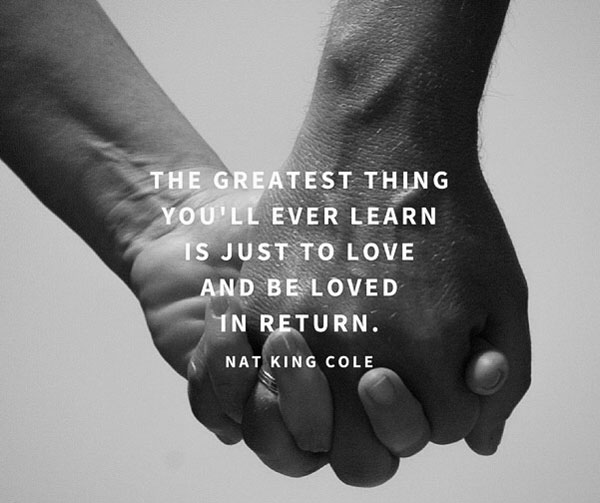
The greatest thing you'll ever learn

Internally, it’s the question I asked myself multiple times a day all my life until I felt sure of the answer, which occurred sometime in my 30s.

The underlying question is “What is the meaning of ‘meaning’ in this context?”

The intent of the question is to understand what life is, what its purpose is (if any), what the universe is, what its purpose is (if any), why we are here, who we are, how we are to behave, what our relation is to one another, is there a God, and why are we compelled to consider any of this as relevant or meaningful to the second-to-second management of our personal business of existence.

One alternative to asking and answering this question to one’s own satisfaction is to go about life happily without caring about the question (which could be a Zen-like answer in itself, essentially filing the question away into the “Overthinking” file). Another alternative is to consider life meaningless, which many existentialists did in the last century.

Other than an intuition I had at age 12 that “I am God and so is everyone else”, which I tucked away as an interesting but unexplained aberration, the meaninglessness of life was my own position for the first 30-odd years of life. Around age 20, as I studied philosophy, I put reasoning around this earlier intuition, deciding that one took positions like this based solely on aesthetic preference, since knowability of the answer to What Is the Meaning of Life? was apparently beyond our scope.

In my 30s I had some unusual experiences that also reminded me of similar experiences in my childhood, at which point I felt as I do now — a very strong conviction that I actually know the answer.

The way I see it, all that exists is a single consciousness of such great computing power as to know everything that goes on within itself instantaneously at all times (though God or the One Self is above time). Since we don’t share this omniscience, God gets to play our roles with more drama and excitement. So the meaning of life must be to realize and enjoy this game as our true Original Self does, and thereby re-merge into the Original Consciousness.

I talk about this theory more in my book You Are The Universe: Imagine That.

From a practical standpoint, life becomes most meaningful for us to the extent that we realize our own unique gifts; we love doing the things inspired by those talents; we develop a life plan around sharing these things with others, and then we go forward with that plan without being attached to the outcome.

We then have a Purpose, a Mission, which satisfies the thinking mind of our own meaningfulness. Just as I go into meetings with awareness of my preferred outcomes, I set them aside at the last minute so I can go with the meeting flow, taking the standpoint of simply trying to help out everyone else in the meeting as best I can. Pragmatically and empirically, this appears to work best in balancing out the complexities of life as well.

So “What is the meaning of Life?” Enjoying it, loving it, loving all, and helping others to do the same.

“The greatest thing
You’ll ever learn
Is just to love
And be loved
In return.”
— “Nature Boy”, by Nat King Cole

Pragmatically, one’s philosophy of life – i.e., one’s values – will tend to lead to the most rewarding outcomes, to the degree that it does not contain seeds of negativity. For example, if our worldview includes the tendency to sit in judgment of other people, this will create situations of unhappiness for ourselves in the long run. This realization is why Jesus said “Judge not, lest ye be judged”.

The founders of the great religions were, at minimum, seers, visionaries, who grasped the way things work in life, and shared these observations to help others.

The Perennial Philosophy is the synthesis of all this wisdom.

Game Theory leads one to recognize that in the game of life, one is always making bets. If one is betting that the universe is benevolent not accidental, one will live a happier, more fulfilling life. Pragmatically, that is the bet to make, according to Game Theory, whether or not the universe is an accident in reality.

At this time of great crisis in the world, what we all really need the most is the spirit of cooperation and sharing.

Ideologies we have become attached to, groups we have become identified with down to the core of our being, the deification of competition as a perfect Good, the Marxist dialectical materialist love affair with contradiction, mindless devotion to an authoritarian leader, lazy subscription to ideas of others rather than one’s own contemplation of personal empirical experience, are baggage which must be left behind in a deep mind cleanse and reset that is open to new learning from attentive worldly experience, the scientific method applied to life, rising up above the pettiness of one’s own robotical negativity to embrace higher states of being which come with pure unclouded observation as if seeing everything for the first time.

I propose that if you are not yet in that state, to allow it a try. If we all do it starting now, events will unfold that will take us away from the spiral of doom now seemingly at our doorstep.

Love,

Bill

Follow my regular media blog contribution, “In Terms of ROI“ at MediaVillage.com under MediaBizBloggers. Read my latest post.

See Through the Things That Still Manipulate You

Created October 30, 2020

You know what I mean. You’ve already conquered many of the things that used to push your buttons. Now maybe they can still get your goat from time to time when they catch you suddenly off guard while you are dealing with something else, or when you are just totally exhausted.

When I was 9 years old I refused to learn long division. Whenever the subject came up I became uneasy and defensive. My mind shrank in its capabilities because of the negative emotional tone I became trapped in.

When I was 12 years old I refused to wear glasses. It upset me whenever I was forced to put them on.

I’m sure the things you were vulnerable to as a child were silly like mine, and you’ve put them all away as I have mine.

Yet even as adults there are things that still can disturb our mental emotional tranquility. They somehow grab us and take over our minds and emotions. We are suddenly afraid or angry or simply not having a good time all of a sudden.

The next time that happens to you, observe it as a scientist would. What was it that took away your good mood? Why did you let it? What inside of you was the traitor? What fixated attachment do you have – perhaps to some image of yourself – that made you vulnerable being taken over as it by a spell?

Politics is one thing that can do it.

Modern Internet and all the other media we have now, is another thing that can do it.

These things can get to me if I learn about something happening which I wish I could fix, and I realize the enormity of the thing, and my own relative helplessness to come to the rescue. The frustration at not being able to do enough to help is still capable of disturbing my mental emotional tranquility sometimes. At most times I can turn it off like an alarm clock by contemplating what I can do, whether it will have much of an effect or not, and then doing it, without getting hung up on what the outcome might be.

We have to be able to rise above politics. In American Pragmatic Idealism there is a pantheon of ideals we hold high, some of which are more important to the conserving side of our natures, and some of which are more important to the progressing side of our natures, but all Americans want all of these things:

REPUBLICANS

DEMOCRATS

FREEDOM

EQUALITY

INDEPENDENCE

JUSTICE

FRUGALITY

BENEVOLENCE

DEMAND WHAT YOU DESERVE

PEACE

STOICISM

SELF IMPROVEMENT


People employed in government can be expected to be above average in being motivated by Power. This is not necessarily a bad thing if it causes us to have enough people interested in governance so the rest of us don’t have to spend more time on that than we individually feel like. We each have to devote some time to governance because that’s the nature of the deal in a democracy.

But Power as we all know can corrupt. And the lust for power can cause people to become manipulative and to use today’s incredibly powerful media to force a foothold in our private mental emotional space. These messages from both sides will tend to exaggerate the dangers of letting the other side win, and will tend to push us into warring camps. This is intentional or unintentional or both, but that is irrelevant, because one way or the other, it is happening. Only we can learn to be strong enough to prevent our own mental invasion by manipulative and maddening stimuli and memes.

We have a good thing going here. First, life itself. Second, this magically beautiful and awe-inspiring planet we all love. Third, love itself. The list goes on. It includes science. It includes America, and more generally, the notion of Democracy. The governance of the Universe which evidently loves us, wanted us to have all these good things.

We have to shake off the willies and get in touch with our own gratitude for the good thing we all have here all around us. We have to keep it going, and make it better where we can, without blaming or being unkind to one another.

Superman, the comic book character launched in 1939, through his writers, coined the phrase “Truth, Beauty, and The American Way”, just in time for WWII. Those were Superman’s ideals, his motivations, even though he didn’t come from America, he came from Krypton.

Many 18-year old GIs dying on the battlefield probably held the phrase in their hearts to keep themselves fighting to the last.

Truth is mentioned first of the three Superman ideals. Who is lying more to us, and who is lying less? Even if we cynically assume they are all lying to us (which I do not), we should at least be able to make a careful judgment call, citing specific evidence to ourself, as to who is probably lying more to us and who is probably lying less to us.

It’s time for you to vote, if you haven’t already done so. Voting is not only our right it’s our duty. If we do nothing else in the social compact we made with our country, that’s the one thing we must do, at least for presidential elections. Stand up and be counted. Take responsibility. Be a leader. Be true to yourself. What do YOU stand for? To not vote is to state that you stand for nothing. Nihilism. Disrespect for life.

If you’re being prevented from voting by BS rules, it’s up to you to find the way to overcome that BS. The Universe will help you if you put out the effort, and you will vote.

Hold your heart steady. Be able to go on if whoever you vote for, the other folks win. Keep in mind the long view of America. Its checks and balances were carefully worked out and there’s a good chance no matter who is in charge of the various houses of government here, the system itself will protect us. Moreover, have confidence in the strength of the good. Not only in America but around the world. Don’t write off the billions of good people we’ve got on this planet.

The center is where we all pull together. When we don’t hold the center, things can get out of hand.

May the center hold.

Best to all, and God Bless America.

Bill

A Song for Today https://www.youtube.com/watch?v=5NqszdLiJxg


Follow my regular media blog contribution, In Terms of ROI at Media Village. Click here to read my latest post.