Author Archives: Christine Niver

Be Indomitable

Welcome to this week’s Bill Harvey Blog, November 8, 2024.
Created February 16, 2024

Being indomitable is consciously favoring the approach mode.

The day my mother died, Jewish customs would have been for the whole family to do nothing else but “sit shivvah” for several days. Therefore, they were shocked when my father, MC and orchestra leader in a big NYC nightclub, went to work that night. His eyes briefly met mine, and without his having to say it out loud, his eyes told me what they had both always taught me about moments like these. The show must go on.

In moment-to-moment living, we each have our ups and downs. It occurs to some of us that we are being dominated by the inputs we receive from moment to moment, without having the ability to resist the invisible strings on our puppet selves being pulled by outside forces, and this stiffens our resolve to not be jerked around by the slings and arrows of outrageous fortune. We then go inside to find or to build the control systems that will make us each master of our own self, impervious to outside control by anyone and anything.

This discovery of one’s inner abilities to overcome one’s own negative emotions and not to be excessively carried away by one’s own positive emotions goes back long before spoken or written language, long before humans were able to clarify the processes involved enough to pass along how-to instructions. One of the earliest schools of philosophy on record is stoicism. This philosophy was all about understanding and inculcating these control abilities in human beings. Epictetus, in my estimation the greatest stoic philosopher of them all, was born as a slave. Enslavement gave him a fertile ground of unhappiness to deal with, and instead of caving into a life of misery, he faced squarely up to his situation and found out how he could modify his reactions to that situation. His book The Enchiridion, when I first discovered it as a teenager, blew my mind because stuff I had been working on within myself had actually existed before.

The need to become more fatalistic and resilient may not be greater than ever before in human hisandherstory but it is certainly much greater now than ever before in my lifetime. I need not list the litany of threat vectors currently present on our dance card. Possibly the one that is most disheartening is the attitude of young people who feel they have been gypped, and those who feel that way do so, not without good reason. The world needs a lot of fixing and we are just the species that can do that fixing in the highest and most heroic manner. Soon there will be a realization of a need to shift into that mindset, rising to the challenge. As we did, as a species, in WWII. That same right stuff still resides within us. It’s time to call upon it, to draw it out, to become the indomitable selves that we are and have always been. It’s what we are here to learn how to do, and to demonstrate that we have learned it. Then perhaps we can graduate to the next classroom.

I find it very interesting to learn from latest neuroscience the underlying computational functions of the brain. My special interest comes from a lifetime of introspection with concentration in which I have always attempted to understand how I make decisions and to improve upon the methods I observe myself using. Now in the light of current neuroscience I can link up my experiential evidence with the revelations of fMRI and EEG. For example, Richy Davidson, one of my many neuroscientist mentors, back in the 1980s when we had a company together, discovered that emotional valence could be measured based upon asymmetrical energy use in the left and right lobes of the frontal cortex, a method that is still prominent today. In the brain, this valence is understood to be based on the concept of approach versus avoidance. Positive emotion comes along with approach, whereas negative emotion is part of avoidance.

Being indomitable is consciously favoring the approach mode.
Stepping forward to engage with the challenges.
Fixing rather than worrying.

One cannot simply decide to do this, and then it is done. The effort involved is primarily one of self-discipline. This is hardest in the beginning and then becomes easier and easier with practice.

Whatever we choose to focus on internally becomes a stronger force in our lives.

When one is thrown into the pool as a babe, one swims, and instinctively swims with the current if there is one. Given little time to think the modern child is rushed into play with other children, sports and then studies, with daily doses of media, creating masses of questions and thoughts from all these impressions. Processing time to contemplate all of this is not built into the daily regime of our culture yet. In a subtle and generally unnoticed way, the child proceeding into adulthood adopts a somewhat defensive coping lens as the main way of thinking. What could go wrong, fear, plans to deal with feared situations, doing this planning in snatches between externally assigned priorities which must be coped with moment to moment.

The most dangerous aspect of this condition is that if a person spends most of their time focused on what could go wrong, they are actually mentally rehearsing for those things to go wrong. To repeat, whatever we choose to focus on internally becomes a stronger force in our lives. If we are focusing on the downside scenarios we are increasing the probabilities of those scenarios occurring.

How does this happen? There is a continuum of explanations, schools of thought. Physicalists (believers in materialistic accidentalism) may admit that this occurs but insist that it is because the individual is giving off micromomentary signals which telegraph their fears in a way that provokes others to manipulate them, all on an unconscious level. Two of our greatest physicists of all time, Wheeler and Hawking, posit what Wheeler named the Participatory Anthropic Principle, by which our consciousness helps cause reality. This theory rests on Wheeler’s theory that underlying what we dub as physical (“its”) are “bits” of information, and that both consciousness and matter/energy are therefore reducible to information, out of which everything is made. This is a short step away from my theory that a single self-aware consciousness is where all this information resides.

In both versions of reality, physicalism and cosmopsychism, there is adequate support for the true existence of the programming of reality by the thoughts and feelings of the individual. However one explains it, it is there, and ignoring it and giving in to wallowing in pessimism, what we might call brain avoidance rather than brain approach, is self-sabotaging.

So here we all are as a species wallowing in pessimism. Remaining this way cannot have a happy ending. The stoic response to this situation is to unlock concern about the probable bad landing ahead, to fatalistically accept it could easily happen, but to make oneself focus courageously on bringing about the happy landing anyway. Once understanding the way the feedback loop works, this is the only sane response, taking active conscious control of where the mind is allowed to go.

Realism requires that a small allocation of time is spent on making contingency plans for how to avoid the undesired outcome, and how to deal with it should it occur, so long as first and last the mind is mentally rehearsing and pre-experiencing the desired future of the individual. Meaning that contingency planning should be done seriously and carefully but not dwelt upon, instead gotten over with, so as to resume consciously telling the universe the way the movie happy ending is to be for oneself.

Chemicals and electrical trickery is used within the brain and body which makes it hard to get out of bad moods such as fear, anxiety, grief, resentment, and so on. It helps me to realize that the sodium pentothal and other psychometric drugs used to interrogate and brainwash are the same sorts of chemical agents my own brain whips up to give me these overwhelming feelings that dissolve my ability to focus on fixing. Knowing this enables me to see my brain as trying to force me into feeling certain ways I know to be against my best interests, and gives me the gumption to force back those feelings.

“Yes, that could happen, but why do I care so much?”

“Yes, that could happen, and I’ve prepared myself to deal with it if it does happen, including not showing it’s gotten to me, but meanwhile, I might as well enjoy every second to the max, and it may never happen and I may get away with it to the very end.”

“Or if it eventually does happen, I will have the satisfaction of knowing that I had fun without fear for such a long time, I got away with all of that, and so if it all ends badly at least I will know that I did what was right, what was good, and I can authentically admire myself for it.”

Self-admiration is a much healthier thing to experience than pride. Pride is not self-admiration because it goes too far and mixes it with vanity. This is caused by the needy defensive stance of the ego which is the sense of not having caught up with integrating all the clashing parts of myself (integrity).

There are other practical ways one can increase the ability to remain in the approach mode. Time alone especially in nature, paying attention internally, seeing the good, counting the blessings, seeing the beauty all around, remembering all the good in people, being grateful, opening the mind to all possibilities, recapturing the awe and wonder of existing as a consciousness in a vast universe, realizing the wellsprings of creativity inside which can be tapped to solve anything, remembering all of the love one has for this person and that thing, and understanding the scientific possibility that we are all one benevolent loving self, manifesting as many for the fun and learning. All of these are powerful inhibitors of the avoidance reaction.

You may still decide to avoid certain things that you conclude just bring you down, but you will do so indomitably rather than fearfully. You will find a smile on your face when you look in the mirror rather than a grim visage. Your sunny disposition will draw and uplift other people making it faster for this wave of indomitability to ripple out across the pond until herd immunity to fear and pessimism has been achieved.

Each of us shall then be a mensch.

Love to all,

Bill

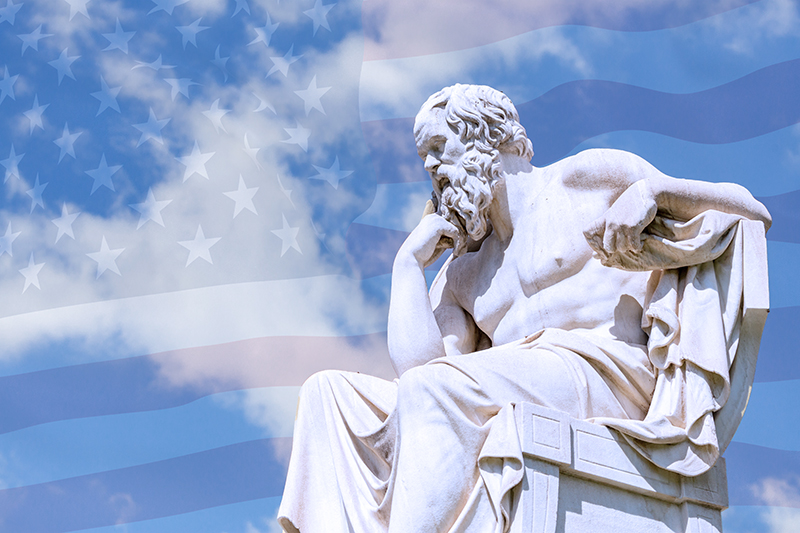
What Would Socrates Do?

Welcome to a special Pebbles blogpost.
Created October 23, 2024

Socrates took being a citizen to be a solemn matter.

He felt a responsibility to act in the proper manner for a citizen. He even agreed that the State had the right to put him to death, despite knowing it was their error.

Perhaps it is no longer the modern way to make such commitments to ideas.

Unless you are immune to reality, you are probably attuned enough to be voting in this election.

No election before ever had such significance in the history of the world. Many millions of people are getting very involved in this election. Many who are still undecided are preparing for it by studying the solutions that each candidate is talking about and trying to be objective in comparing these proposed solutions.

It’s the kind of thing you want to be a part of. Even if you never voted before, and never do it again.

Everything you experience teaches you things.

Here are my suggestions on how to get the most out of this election in terms of having a peak experience, knowing you are part of history.

Really feel alive. Take deep breaths. Look at the sky.

When you are in the voting booth (or voting in advance), here are the steps:

1.   Look and feel deep inside yourself, who you really are in yourself, not your parents, not anybody else. What do you want out of your future? For yourself, and all of the people you care about.

2.   Focus on one candidate. Let yourself imagine what it’s going to be like on that timeline if this one wins. How it will affect you, and all the people you care about.

3.   Do the same with the other candidate.

4.   Vote.

Love to all,
Bill


Live chat with my avatar now.

Oversimplifications Do Not Achieve a Happy Mind

Welcome to this week’s Bill Harvey Blog:  August 2, 2024

Achieve a happy mind.

Widespread mental emotional handicaps are not a new thing. Depression, anxiety, violent impulsiveness, sociopathy… they have been with us a long time.

So have inventions or discoveries of ways to improve one’s own use of the mind and feelings. They go back to antiquity. Counting to ten and taking deep breaths when losing one’s temper, for example, probably goes back before written language. In the first millennium of written language appear cogent ideas about better ways of using the mind that could have been passed down by oral tradition for generations. The Rig Veda had been sung for centuries by the time Vyasa first wrote it down. The advice given was quite sophisticated and the lessons taught about cooperation and consideration of consequences before action still to this day have not been learned by billions of us.

The Stoics such as Epictetus wrote down methods in considerable detail and I was amazed to read his Enchiridion written more than two millennia before my book Mind Magic with some of the same ideas, similarly expressed. Buddha’s and Christ’s teachings from millennia ago, as we all know, are at the highest levels of sophistication concerning what we permit to go on in our minds.

It’s not just the sophistication, it’s also the detail in which the method is described to the learner. The mind is extremely tricky and contains a robotical element which one must learn to deal with properly. The presence of this bio-AI was detected by the ancients and is described in the Old Testament as the “hardening of the heart”, which is only one of the ways the robot manifests. However, until Mind Magic in my lifetime of study of the mind and writings about the mind old and new, I have not seen detailed instructions for integrating the bio-AI into a useful member of the mind’s internal community, which is why I wrote Mind Magic. To date I have read many of the most popular as well as many of the least known self-help books and I have not found anything remotely detailed in terms of specific operational instructions as in Mind Magic.

This line of thought was triggered by an experience I had two days ago. I was having a Zoom call with one of my AI expert collaborators and he demonstrated to me a system that within a minute or two took the text of Mind Magic and turned it into a course, complete with tests. This of course was amazing and I am still duly impressed. The one fly in the ointment was the tests. They seemed to oversimplify the teachings into summary words containing no learning value, words like “Meditate”, “Contemplate”, “Use Mindfulness”, “Do Shadow Work”, “Use Affirmations”, “Law Of Attraction”, etc. The AI had scoured the Internet and found things like the ideas in Mind Magic and had assumed that all of the various books and scholarly papers were all giving the same generic advice. That is like summarizing the Old Testament or the words of Jesus into “Be Good” and implicitly assuming that advice was going to solve the whole thing and the person would emerge with a happy mind and life.

I have yet to look at the rest of the course and I expect that most of it will retain the detailed instructions so that all I’ll have to do is to retrain the AI how to pose the questions better. Yet it got me thinking about all of the generalizations and oversimplifications being made across the self-improvement field.

Overall impact of the New Age Movement since the 1970s has been quite positive despite shortcomings. There is a general sense of awareness and tendencies toward openness and respect for others that I did not perceive around me growing up on the streets of Brooklyn, where many kids carried knives and zipguns. The Beatles song “All You Need Is Love” is emblematic of the good that has been done by the human development movement which started in the 1960s. To some extent this has been the humanism movement supporting the logic of goodness as a way of life while the organized religions gradually slipped out of perceived relevancy in the modern world. Without the rise of the human potential movement the world today could be in even darker place, or we might have gotten to present straits much sooner.

Motivational speakers can, without passing on any detailed methodologies for better use of the mind and feelings, achieve short-term and even a sprinkling of long-term effects simply by their confidence, presentation ability, body language, and inspiring stories. Practically any self-help book can have some positive effect. However, without detailed instructions, especially concerning the multiple phenomena one finds in one’s mind, including the robot – which has now been called the inference engine and the prediction engine by Dr. Karl Friston – oversimplified advice will not achieve states of higher consciousness, and can even feed the ego to believe that one is in the Flow state when one is not. The term for this in the 1970s was Spiritual Materialism.

In every phase of life we see that there is a longing to keep things simpler than they actually are. This reductionism is one of the most dangerous temptations that we face. Oversimplifying something complex seems to be a good idea in the short run but then one bangs into the walls that have been ignored away. They didn’t really get removed by ignoring them. Instead, they stopped you when you needed to keep going and now you have to stop and rethink everything. Better to do all that thinking at the outset.

Look for methods, and test those that appeal to you. Identify platitudes and appreciate them as positive reminders, without pretending that they are sufficient on their own to solve problems.

My best to all,
Bill


Live chat with my avatar now.

Umberto Eco Deeply Understood and Cared

Welcome to this week’s Bill Harvey Blog:  July 26, 2024

Umberto Eco at his home.*

The Italian novelist, essayist, deep thinker Umberto Eco won first prize in a Fascist essay contest when he was ten years old. He was a product of his culture: Mussolini’s Italy was all he ever knew up until that point. That was reality. Fascism was his way of life, although not consciously. He had no inkling of other worlds then. The year was 1942.

Less than a year later on the morning of April 27, 1943 he learned from a radio broadcast that “Fascism had collapsed and Mussolini had been arrested.” (Five Moral Pieces) He ran out and looked at the headlines on the suddenly large numbers of newspapers and saw that political parties that must have existed in secret were all coming out. Until that moment he had believed that every country had just one party and in Italy it was the Fascist party.

“My God, I had never read words like ‘freedom’ or ‘dictatorship’ in all my life. By virtue of these words, I was reborn as a free Western man.”

Eco having been conditioned as a Fascist was released from that condition by outside forces and uplifted. He became a teacher, philosopher, scientist, best-selling novelist.

His concept of semiotics permits us to read the signs in all things since all things may be interpreted as signs in themselves. We all constantly create signs, both intentionally and without conscious intent. This was his unique perspective on the nature of reality.

In Five Moral Pieces he dissects fascism in its broader sense (i.e. not limited to Italy’s version) into a specific set of attributes. This is relevant because he was a person born into fascism and took it for granted as part of life. He experienced liberation by the Allies and the transformation of the way of life. His mind changed and he much preferred the new social contract and its freedoms. He realized himself as a passionate supporter of diversity.

Eco provides the following list of clues to help humanity detect fascism:

  1. The cult of tradition“. When all truth has already been revealed by tradition, no new learning can occur.
  2. The rejection of modernism“, which views the rationalistic development of Western culture since the Enlightenment as a descent into depravity.
  3. The cult of action for action’s sake“, which dictates that action is of value in itself and should be taken without intellectual reflection. This, says Eco, is connected with anti-intellectualism and irrationalism, and often manifests in attacks on modern culture and science.
  4. Disagreement is treason” – fascism devalues intellectual discourse and critical reasoning as barriers to action.
  5. Fear of difference“, which fascism seeks to exploit and exacerbate, often in the form of racism or an appeal against foreigners and immigrants.
  6. Appeal to a frustrated middle class“, fearing economic pressure from the demands and aspirations of lower social groups.
  7. Obsession with a plot” and the hyping-up of an enemy threat. This often combines an appeal to xenophobia with a fear of disloyalty and sabotage from marginalized groups living within the society. Eco also cites Pat Robertson‘s book The New World Order as a prominent example of a plot obsession.
  8. Fascist societies rhetorically cast their enemies as “at the same time too strong and too weak“. On the one hand, fascists play up the power of certain disfavored elites to encourage in their followers a sense of grievance and humiliation. On the other hand, fascist leaders point to the decadence of those elites as proof of their ultimate feebleness in the face of an overwhelming popular will.
  9. Pacifism is trafficking with the enemy” because “life is permanent warfare” – there must always be an enemy to fight.
  10. Contempt for the weak“, which is uncomfortably married to a chauvinistic popular elitism, in which every member of society is superior to outsiders by virtue of belonging to the in-group. Eco sees in these attitudes the root of a deep tension in the fundamentally hierarchical structure of fascist polities, as they encourage leaders to despise their underlings, up to the ultimate leader, who holds the whole country in contempt for having allowed him to overtake it by force.
  11. Everybody is educated to become a hero“, which leads to the embrace of a cult of death.
  12. Machismo“, which sublimates the difficult work of permanent war and heroism into the sexual sphere. Fascists thus hold “both disdain for women and intolerance and condemnation of nonstandard sexual habits, from chastity to homosexuality”.
  13. Selective populism” – the people, conceived monolithically, have a common will, distinct from and superior to the viewpoint of any individual. As no mass of people can ever be truly unanimous, the leader holds himself out as the interpreter of the popular will (though truly he alone dictates it). Fascists use this concept to delegitimize democratic institutions they accuse of “no longer represent[ing] the voice of the people”.
  14. Newspeak” – fascism employs and promotes an impoverished vocabulary in order to limit critical reasoning.

Thanks to Wikipedia for distilling these attributes, which saved me time; I have condensed the Wikipedia listing.

Eco published his essay on this subject in 1995. On July 11, 2024, another great writer and thinker, David Brooks wrote an essay in The New York Times aimed at understanding why America today is not repelled by the idea of authoritarianism. His conclusion is that, until the 1960s, America had a balance between reason and religion which, while disagreeing on one level, agreed upon the moral and ethical grounds for conduct. Then, starting in the 1960s, America began to become less religious, and reason and science on their own did not present as compelling a case for upholding idealistic values:

“At the same time, science and reason failed to produce a substitute moral order that could hold the nation together. By 1981, in the famous first passage of his book “After Virtue,” the philosopher Alasdair Macintyre argued that we had inherited fragments of moral ideas, not a coherent moral system to give form to a communal life, not a solid set of moral foundations to use to settle disputes. Moral reasoning, he wrote, had been reduced to “emotivism.” If it feels right, do it. In 1987, Allan Bloom released his megaselling “The Closing of the American Mind,” arguing that moral relativism had become the dominant ethos of the era.”

“In other words, Americans lost faith in both sides of the great historical tension, and with it the culture that had long held a diverse nation together. By the 21st century it became clear that Americans were no longer disagreeing with one another; they didn’t even perceive the same reality. You began to hear commencement speakers declare that each person has to live according to his or her own truth. Critics talked about living in a post-truth society. [James Davison] Hunter talks about cultural exhaustion, a loss of faith, a rising nihilism — the belief in nothing. As he puts it, ‘If there is little or no common political ground today, it is because there are few if any common assumptions about the nature of a good society that underwrite a shared political life.’”

“Was there anything that would fill this void of meaning? Was there anything that could give people a shared sense of right and wrong, a sense of purpose? It turns out there was: identity politics. People on the right and the left began to identify themselves within a particular kind of moral story. This is the story in which my political group is the victim of oppression and other groups are the oppressors. For people who feel they are floating in a moral and social vacuum, this story provides a moral landscape — there are those bad guys over there and us good guys over here. The story provides a sense of belonging. It provides social recognition. By expressing my rage, I will earn your attention and respect.”

“The problem with this form of all-explaining identity politics is that it undermines democracy. If others are evil and out to get us, then persuasion is for suckers. If our beliefs are defined by our identities and not individual reason and personal experience, then different Americans are living in different universes and there is no point in trying to engage in deliberative democracy. You just have to crush them. You have to grab power and control of the institutions and shove your answers down everybody else’s throats.”

“In this climate, Hunter argues, ‘the authoritarian impulse becomes impossible to restrain.’ Authoritarianism imposes a social vision by force. If you can’t have social solidarity organically from the ground up, then you can impose it from top down using the power of the state.”

“The task, then, is to build a new cultural consensus that is democratic but also morally coherent. My guess, and it is only a guess, is that this work of cultural repair will be done by religious progressives, by a new generation of leaders who will build a modern social gospel around love of neighbor and hospitality for the marginalized.”

I agree with Brooks that America, and the human race, needs and deserves a reason to value liberty, equality, justice, democracy, and differences of opinion. I don’t necessarily agree with his proposed solution of waiting for religious progressives to convince the masses of a modern social gospel. We need a solution now. My proposed solution is for the media to provide broad coverage to the idea that science cannot rule out the possibility that the universe is a single consciousness, the same consciousness that each of us thinks of as “myself”. Once there is near-universal realization that this is a real possibility, all of the moral compunctions required by religion return as the only logical course of action if we are all universally connected. It was aimed at this end that I wrote A Theory Of Everything Including Consciousness and “God” and made the ten-minute video Connectedness.

I am convinced by my own experiences that the truth is we are all parts of the greatest adventure that could ever exist, and we all benefit by win/win thinking and action. This is diametrically opposed to the zeitgeist of the present day. My research finds that this concept of who we are and what the universe truly is, appeals to all factions in the political spectrum. This scientific lens also supports the claims of the great religions, that their founders and saints received knowledge from a higher source, and even explains how “miracles” might have actually happened. This scientific and spiritual picture of reality can be the glue that puts us back together. We don’t have to prematurely accept it as scientifically proven until it is, but we can popularize the notion as a leading possible explanation for the nature of reality. The more this idea is exposed open-mindedly in the media the more likely we are to survive as a species.

Carpe diem!

My best to all,
Bill


Live chat with my avatar now.

*Image source: Aubrey, CC BY-SA 1.0 resized <https://creativecommons.org/licenses/by-sa/1.0>, via Wikimedia Commons