
Welcome to this week’s Pebbles in the Pond Blog, written by Bill Harvey
November 6, 2026
MIND MAGIC / MIND EXPERIMENTS: The 50th Anniversary Edition Excerpt Series: Part 14
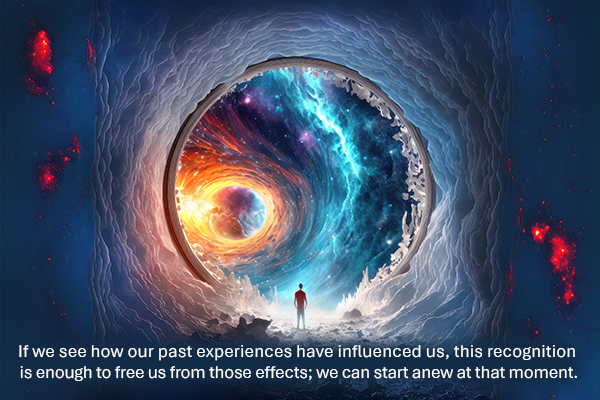
Avoid describing ourselves in unqualified terms.
Telling ourselves or someone else that we are a particular way tends to make us more that way, limiting our freedom to create who we are at any given moment.
If we believe we are a certain way because of our past experiences, we give those experiences power to dictate who we are. If we see how our past experiences have influenced us, this recognition is enough to free us from those effects; we can start anew at that moment.
Treating each second as the first second of our lives, and potentially as the last, when we hear ourselves describing ourselves, we then say, “That’s how I was. How do I wish to be from now on?”
Predict and eschew the predictable, culture-conditioned response. We don’t always have to get angry in situations where anger is expected of us; nor always contradict when contradiction is expected of us; nor always agree when agreement is expected of us. Instead, we avoid predictability except where it is necessary for the good of the Universe.
Avoid mimicry
We don’t have to be like our friend to be their friend.
Nor must we submit to the prevailing worldview. We may often be in the company of a group with a shared worldview; this creates a powerful impetus for us to fall prey to their worldview without even realizing it. They may value material success, wit in a specific vernacular, particular types of appearance and customs, and so on, and we may find ourselves accepting their negative judgment of us against their standards. This will first manifest in a tightening of free self-expression, formless negative emotion, and perhaps even mild mimicry on our part.
The option is to remind ourselves that our worldview differs from theirs and that ours is the only one we submit to. We can prepare ourselves to accept rejection from them with equanimity. And be honest with them, for they have no power over us; no one has any power over us because we are independent of even what is done to our body; it is not who we are; we are inaccessible to any but ourselves.
While seeking to determine whether anything useful can be derived from this confrontation between worldviews, we do not seek to establish ours as superior. It can be helpful to gently ask relevant questions and answer theirs; otherwise, we do not expostulate. Too much cannot be communicated in a single meeting. We accept the contact assignment the Universe has given us as having good potential purpose; then we see what happens.
We do not internalize their statements or identify with their worldview. Likewise, we do not accept judgment or care about irrelevancies. We consider no viewpoint sacred, not even our own.
Objectively seek truth and value.
Others who are anxious to have things be a certain way carry psychic momentum, which can be imparted to us without our even realizing it. Mindful of this, we don’t let ourselves be carried off by the momentum of others.
Instead of stampeding with our predisposition to help, we give ourselves time to think things through. What others think they want from us may not give them what they really want. We don’t allow ourselves to be influenced by the expectation that our hesitation will be misread as not caring, knowing that doing so would enslave us.
Once we let ourselves be affected by others’ momentum, we may not realize it is happening, because momentum interferes with observation. Thus, being transparent to momentum from the outset is advisable.
Mind Experiments
Since last week’s questionnaire asks you to describe yourself in unqualified terms, the next experiment corrects for this. Click here to download and print.
4. Give yourself the direction you need.
Now, add arrows to your responses on the questionnaire included in last week’s blog post, including any new adjectives you added, to indicate how you would prefer to answer. “No arrows” means you like your current responses and want them to stay the same.
Using arrows tells your robot which way to go at decision points. Check back months or years later to verify, to your delight, that the robot complied!
You might use the space below to note changes you’d like to make and how you plan to implement them over time.
Notes: You can keep those in your journal with the questionnaire
5. Unconstrained self-expression
When it does not risk a loss of value to the Universe, begin to relax the programs that “constrain the way you speak to ensure easy understandability”.
For example, when responding to your family about minor matters, see what happens if you simply open your mouth and speak, or mime an answer, gesture, or point rather than speaking at all.
Since the environment is low-risk, the play element may operate freely without concern for “meeting standards”.
6. De-narrowing unique/devalued child-things
To hold onto your parents, peers, and so on (something you felt you desperately needed at the time), you mimicked them and stopped doing what they and everyone else didn’t do. Thus, you were tricked into throwing away your unique experiment—temporarily.
Relive the moments when something YOU did or said was devalued. Did they lead you to give up the use or manifestation of a part of yourself?
Visualize bringing that part of you back into your life. Then energize it or not, as you like.
To be continued next week.
Our best wishes to all,
THEI Team