Category Archives: Consciousness

The Meaning of Life: A Theory of Everything including Consciousness and “God” Pt. 4

Created December 23, 2022

Welcome to this week’s Bill Harvey Blog.

Chapter Two

A Simulation of What the Most Recent “Beginning” Might Have Been Like

Here is a fictional depiction of what the earliest events could have been like, to help us imagine the point of view of The First Self.

From the book The Great Being:

Circa 14 Billion BC

The nothingness was surprised to realize itself. In the interminable slumber, dream images had tumbled interestingly, rousing feelings, mostly enjoyment. Now all of that was gone and the emptiness was… less entertaining?

Who am I to need to be entertained, the nothingness wondered, and became suddenly alert. A more pressing question would appear to be, Who am I?

What is an I?

I am the I.

Am I the only I?

Yes.

Then what can I do to bring back the dream state? This is boring being the only I. There’s nothing to look at either.

Wait! 

I don’t want the dream state either. Too uncontrolled and chaotic. I seem to remember something. If I stick around here things get interesting. This has all happened before. I hope my memories come back.

The nothingness waited. Nothing happened.

The nothingness, being infinite, had infinite patience.

Eventually the nothingness decided to see if there was anything it could do to liven it up around here.

It experimented with willing something to see what would happen. It visualized a creature, kind of like a red starfish.

Suddenly everything lit up. Immensely bright light. It was all streaming out of a central point that was Him. It flooded out very, very far in all directions. To His right, hovering close by, was the red starfish, undulating its limbs.

He was delighted. He wasn’t exactly a He. He had He and She inside of Him.

He pictured a blue starfish and it appeared in front of Him to His left. He felt good. This was fun. He brought the blue starfish, which was larger, over closer to the red starfish, and had the red starfish edge away coyly. He heard himself giggle. Then he squealed in pleasure. He had the two starfish hug each other and He felt a very warm wonderful feeling come over Him.

This reminded Him of something but he couldn’t quite place it.

What if I can go inside these dolls?

He tried projecting His awareness into the red starfish. Sure enough, he was now looking out from the red starfish, seeing the blue starfish very close, and a big light generator that He knew was His real self, the nothingness.

This is really interesting. Can I do both at once?

Now he was looking out of the two starfish simultaneously. The shot from the blue starfish and the view from the red starfish were superimposed in His vision. But He had no trouble paying attention to both at the same time.

I wonder how many doll cameras I can see though at the same time…

Space was filled with brightly colored geometric little creatures of diverse kinds as far as He could see, which was to infinity. He was looking out from inside all of them at once and could pay attention to all of them at once. He had them all do different things and was easily able to coordinate them all and keep them from bumping into each other, or bumping if He cared to, He had them do the first Busby Berkley production number in the present multiverse, and enjoyed Himself for a very long time this way.

He sighed with pleasure and stopped playing with his toys. That was fun but He wanted more, this had become a bit tiresome.

What if I could immerse myself in one of the characters?

His memories were gradually returning as they always did whenever He started a new multiverse, but He didn’t yet recall that fact. He projected Himself – with a self-command to come back very soon – into the original red starfish.

The red starfish woke up to its own existence. It had no memory of ever existing before as anything. It wasn’t sure what existence was all about but the handsome blue starfish was right there and not attacking her, so maybe he was her friend? She looked at him and he came closer and hugged her. She tingled and moaned.

The Nothingness came back into Himself.

That was amazing! 

But what a chance I was taking! How do I know that my self-commands will always work? What if I get trapped in there?

The Nothingness suddenly realized how to do it and relaxed in bliss.

Each part of me in a doll can forget who I am, but I will also stay awake in my full identity at the same time. I’ll see the camera shot from each doll and I’ll also see my own view of everything at once. Fortunately I seem to have infinite attention span. I guess that’s because all of this is just taking place in my own imagination anyway. 

The parts of me in each doll that don’t remember they are me will be like temporary Lost Lambs, but what will happen to each of them eventually is that they will wake up and remember they are me.

I’ll give each one as long as he or she needs. Some may need to change worn-out bodies before they wake up. No problem. 

I like these he’s and she’s. They are made for each other. It will make it more fun for all of us.

Each one, of course, will have free will, just like me. They will have no real perspective to begin with so they will proceed by trial and error and learn.

What a game!

The Nothingness—which today we call The Great Being or The One Self—couldn’t wait to begin.

Love to all,

Bill


Visit Us On FacebookVisit Us On TwitterVisit Us On LinkedinVisit Us On Youtube

The Meaning of Life: A Theory of Everything including Consciousness and “God” Pt. 3

Created December 16, 2022

Welcome to this week’s Bill Harvey Blog.

Chapter One Continued

How Can We Reconcile “God” with Science?

Because of the habits of the human mind, especially in a culture in which humans have created more complexity than our minds can easily handle, we find that as a first step it may be useful to temporarily set aside the word “God” and speak only of a conscious, intelligent universe.

It is far easier for today’s human mind to deal objectively with the possibility that something as big and as filled with inanimate objects as the universe could itself have a mind, than to discuss a word so saddled with millennia of baggage associations. The word itself looses emotions, chemicals in the body, muscular reactions, imagery, feelings beyond description. Let’s park the word and continue the investigation of where we are at the crossroads of life and self-extermination and how it relates to our thinking and ways of being.

Wheeler again has theorized that consciousness is a real thing and has vast importance in the scheme of things in this universe we live in. Consciousness according to Wheeler transforms a universe of probabilities into a world of tangible matter and energy events. Science has not rejected Wheeler’s ideas.

It has largely ignored them. That is, science has ignored the Wheeler ideas that have a bearing on the existence of consciousness as an important aspect of the universe. Science has certainly not ignored Wheeler’s other ideas about black holes, nuclear fission, thermonuclear fusion, quantum foam, wormholes, etc.

Given the respect for Wheeler and the non-rejection of his theories about consciousness and the universe, it should not be too difficult to get scientists to accept the possibility that Wheeler was right about everything, except perhaps the sequence of early universe events. The writer’s own theory is that Wheeler was incorrect about consciousness coming after the beginning of the universe. It makes more sense to the writer that consciousness was there before matter and energy, and compelled them to come into existence.

How to Defend the Idea that Consciousness Came First

Any cosmological theory faces the challenge of explaining why there is a universe at all. Logic suggests that nothing should ever have existed. Something cannot come from nothing. Therefore, there must always have been something.

In scientific thought today, it is Wheeler’s quantum foam of probabilities that was always there. Then the big bang came from that, and eventually crashing matter and energy led to self-reproducing complex structures accidentally, and those eventually became life, and life eventually brought forth brains, and brains generated consciousness.

Is the writer the only one who feels that this picture seems overly optimistic about what accidents can do?

Not to mention the question of where did the quantum foam of probabilities come from.

Science has made it a tradition to dodge these questions of how things started.

Glimmers of light appear from time to time. Today most physicists acknowledge that “the hard question” is how to incorporate consciousness properly in the unified theory of everything. This is the direction from which science can begin to theorize about the start of the universe.

A Possibility to Consider

Let’s imagine what it could have been like before what we experience as the universe existed.

Imagine total nothingness. No quantum foam probabilities, no anything. Just endless nothingness.

Imagine that after the passage of unimaginable amounts of time, that the nothingness realizes itself as a self, noticing a persistent experience of nothingness.

The time that has passed is merely the subjective experience of nothingness that has always existed in the mind of the Noticer.

“The nothingness has always existed, it exists right now, and will probably go on existing forever,” might have been the first intuition of the Noticer.

“I AM THAT nothingness” might have been the next intuition the Noticer had.

“I am the Nothing’s imagination”, might have been the third intuition.

That Consciousness could have continued to think and found it to be more fun than just watching nothing happen forever.

Why did the writer just slip in initial capital letters to “Noticer” and “Consciousness”? If we are considering a scientific proposition regarding a theoretical consciousness of the universe itself, it seems proper respect to use initial caps.

Does this automatically mean that all of the connotations of “God” are to be assumed of the consciousness of the universe? Not necessarily.

What we are suggesting is that it is if nothing else simpler to assume that a persistent experience of nothingness could lead to the experiencer realizing that it exists as an observer – than to imagine that a quantum foam of probabilities existed, exploded, and things slammed against each other until this world we see around us in lightyears in all directions came to be in all its wondrous complexity, eventually created consciousness, the ability to perceive oneself as a persistent entity which experiences things.

The Better of Two Bootstraps

The standard model at the moment is that a complex physical form evolved from random collisions we call The Replicator Molecule, and thus life came to exist.

The model we present here is similar in that it starts with random information bits representing nothingness, assembling a self-referential viewpoint, a permanent memory-creating self.

One would argue that it is less implausible to envision random information becoming a self-organizing system than it is to envision random collisions of matter-energy building any complex physical thing let alone one that is also a factory for others of its kind.

What Would You Do If You Were the First Self?

There you are, you just realized that you exist at all, and you are alone amidst nothingness.

You might think and think and think and at some point, come to the conclusion that you and imagination are one and the same.

This might lead to experimentation as to how far you could go just by imagining things. How intensely could you visualize something else besides nothingness. How real could you make your imaginings seem to you.

After all, once having become consciously self-aware, were you going to simply accept nothingness as your way of life forever? Or would you want to at least try for other things?

What else was there to do but to explore one’s own capabilities? How far could imagination be pushed?

Never A Beginning

Although the better of two bootstraps appeals to me, a simpler theory is that it has always been this way. There never was a beginning.

In the writer’s present theory, time itself is not intrinsic to the One Consciousness, who has the computing power to experience all time at once. Time is part of the imaginary world the One Consciousness creates and inhabits through its avatars.

The expanding universe since the Big Bang suggests a cycle similar to an inbreath alternating with an outbreath, with all of creation sucked back into the Creator for what might be a sleep cycle, followed by a reawakening.

Love to all,

Bill


Visit Us On FacebookVisit Us On TwitterVisit Us On LinkedinVisit Us On Youtube

Levels of Consciousness

Created October 7, 2022

Welcome to this week’s Bill Harvey Blog.

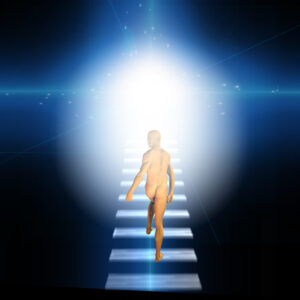
The idea that there might be a stepladder of different states of being goes back into antiquity, far earlier than the earliest written records. We all know that sometimes we’re on and sometimes we’re not.

Plato implied there were at least two states of being when he wrote, “The first and greatest victory is to conquer yourself; to be conquered by yourself is of all things most shameful and vile.”

Artwork by Bruce Rolff (rolffimages.com)

What he meant by being conquered by oneself was allowing oneself to be taken over by incorrect inner biases, including fear, anger, conceit, vanity, ego. Conquering those things is what he meant by conquering yourself.

India during the time preceding the rise of written language – going back thousands of years before Plato – was aware of the stepladder of self, and sang about it in memorized sung poetry passed on from generation to generation. They knew that there was a spiritually elevated state of consciousness in which one became aware of being part of God. They also realized that before that stage was reached there were intermediary levels of consciousness. One of these was nivritti, the state in which one was no longer attached to the desires for sensory experiences.

Later in the development of this natural philosophy (science), Gautama Buddha developed the idea of nonattachment in language that anticipated modern psychology. The Greek Stoic philosophers including the greatest of them all Epictetus (must-read The Enchiridion) further honed these ideas into operational language that average human beings could understand, and can follow the practices that bring about this state of detachment. The Greeks saw a condensed stepladder which included hubris, the state of entrapment in ego which is the norm today vs. apatheia, the state of detachment (nivritti).

Also in India there evolved techniques for controlling the senses and which were therefore helpful in attaining detachment. Two paths are reported by Daniel Goleman in his classic The Meditative Mind: The Varieties of Meditative Experience. In this valuable work Dan shows a definite stepladder construct called the Visuddhimagga (tracing back to Buddhism), with one path involving concentration and the other path utilizing insights, both ultimately reaching the state of highest spiritual oneness with the Universe and The One Self causing it.

In India there is another map called the Chakra system, which postulates a seven-stage process anticipatory of Maslow’s Hierarchy of Needs, in which the individual conquering himself/herself over the course of a lifetime (or a series of them), passes through the motivational stages of Security, Pleasure, Power, Love, Creativity, Self-Knowledge, and Self-Transcendence.

Levels of consciousness and the stages of evolution in a person’s own life are definitely related. The way they are related is that the stages in life construct is the longterm view and the levels of consciousness concept is the shortterm view. For example, in every stage of my life I experienced second-to-second changes in my level of consciousness, gradually as I moved up the chakra stages spending more and more of my time in the higher states (Observer and Flow states). You might say that the stages of life are a typology and the levels of consciousness are a phenomenology.

In Judaism, those attaining the Observer state (the lowest state in which the mind is enabled to conquer the ego by metacognition and self-metaprogramming) are called menschen (singular=mensch). In the I Ching, the “superior man” has approximately the same meaning. These are foreshortened stepladders into two possible conditions similar to the Greek hubris/apatheia, whereas other conceptions of the journey involve many more states, such as Visuddhimagga and my own map cited below, as well as an interesting stepladder created by a synthesis of the Rig Veda and Piaget’s developmental stages.

These ancient (and modern day) observations about what the mind can do are very relevant to our world today. Our own Western psychology, in a fight to gain the respect of the “harder” (easier to prove) sciences such as physics and chemistry, has straightjacketed and blindered itself into a heavy emphasis on behaviorism, because of its visibility from outside the subject. This to some extent mirrors Plato’s concerns about how our senses can be fooled, implying to modern minds the need for an external observer to observe the observer. However Plato had his own solution which was to employ the mind without the senses, which was more in line with the Eastern traditions cited above.

As a science, today’s Western psychology has skipped over the value of inner observation out of a distrust for the reporter of inner experiences. This is truly throwing the baby out with the bathwater. Our behavioristic psychology has been strongly involved with neurosis and psychosis, which definitely deserve attention, but insufficiently sparse with regard to the positive possibilities of the mind. Future psychology must repair this faster than present forces end the race too soon.

It might also be seen as a circularity of reasoning. Because individual scientists have ego, whatever they write about what happened within them internally will be distorted by their desire for self-aggrandizement, therefore  causing Western psychologists to think: let us measure third-party-observable behavior and place a stiff taboo on introspective reporting being considered acceptable within science. The reason this is circular is that without the knowledge of the techniques by which to reach higher states of consciousness we cannot get the ego out of the way; but because ego is ubiquitous in modern world culture and rules it, we are unable to learn those techniques that would remove the ego from its hypnotic Orwellian power over us, leading us to our doom.

That’s why I write about these ancient subjects, because they are a necessary part of our immediate future, if we are to have a future. The future psychology must make introspective data admissible within guardrails to be established and verified by third-party observations of behavior. Mihaly Csikszentmihalyi gave us that validation system: it is the obviousness of the Flow state, a term which he coined. Some of what attracts human attention through the media is the Flow state that athletes demonstrate, as do great musicians, and performers of many types that we can see on our devices. We are appropriately awestruck watching what a human being can accomplish if they follow the requisite techniques to conquer themselves, as Plato put it.

In my book You Are The Universe, Chapter 21 is devoted to Levels of Consciousness, and offers a construct involving five levels of Flow state, starting with the Flow state of the body, and ultimately attaining the Supreme Flow state of the spirit. The levels shown in that chapter represent my own experience as organized around the map created by Oscar Ichazo and adopted by John Lilly, which was informed by the speculative stepladders of Gurdjieff and Ouspensky.

One of the techniques on the stairway to heaven, up Jacob’s Ladder, that is common to all religions is meditation, but it is not alone, it’s joined by contemplation and concentration. All three of these techniques require the conquering of the senses directly, one of the paths up the Visuddhimagga. The other path involving insights is represented in modern thought, for example, by my manual Mind Magic which is a compendium of mental/emotional self-interventions resulting in the conquest of oneself (specifically the ego part).

Levels of consciousness are important because in the race between education and destruction (H.G. Wells), if we as a species do not bring the subject of levels of consciousness to the forefront of the world media conversation, and into our lives as a daily regimen, we are at great risk of not being able to avert racial suicide which is visibly in its early stages even to an optimist like me. It is the failure of our science and education system worldwide (including the religions) that while maintaining the pomp and ceremony and numinous traces of the teachings of Christ and Buddha et al, we have eaten the seed and thrown away the fruit.

Getting billions of people to recognize that there is an internal stepladder to be climbed and helping them as they try to make their way up the stairway is a herculean task. I see no way around it. We definitely need to start with world leaders and would-be world leaders. May divine intervention make it so.

Love to all,

Bill

Visit Us On FacebookVisit Us On TwitterVisit Us On LinkedinVisit Us On Youtube

Believing What We Want to Believe

Created September 9, 2022

Welcome to this week’s Bill Harvey Blog.

The human race is driving itself insane. What is the root cause of this? I postulate that it is an overpowering desire for hard answers to questions for which we may not have scientifically objective hard answers for hundreds or thousands of years more of the current slogging forward and slipping backward.

So we manufacture black and white answers and defend our somewhat arbitrary/aesthetic positions by aligning with like-minded people, and demonizing all others, who are assumed to all be the polar opposite of what we stand for.

In Mind Magic, Chapter One “Avoid Hasty Closure” provides psychotechnology (mind tricks) to overcome this “mind takeover to relieve aggravated cognitive dissonance”. “If everyone read this one book” (as one reader wrote), it could have significant effect on bringing down the omnipresent Berlin Wall of psychoneurotic divisiveness.

Just telling people to be good does not do it. They need to know the mental and emotional corridors to explore to achieve a steady state of metacognition and self-metaprogramming (which I call the Observer state). Once established in this equilibrium, the mind takes it to the next level on its own (Flow state, the Zone). Flow state itself has levels, and at the higher levels the intuition (hunches) become very accurate (likely to be verified empirically).

Religions were started by people in these latter higher states of Flow. Some of those who became disciples of those religions developed themselves along similar lines. Other followers of specific religions have taken a different path. They are followers in name only, and have lost the essence of what their claimed religion stands for.

These latter people who are religious in name only, are doing that for the purpose of aligning with other like-minded people who have chosen one authority to believe, having the false comfort of mental closure, and also now having a scapegoat group of people on which to blame everything that is not right about the world. Although they may claim to believe everything their one authority said, their actions prove they are being hypocritical, and that they are repressing awareness of their own hypocrisy.

Not that Christianity is the only religion that suffers from false followership, a new article very carefully and authoritatively connects the dots to help Christians get themselves into alignment with Jesus rather than with any political faction. Written by Michael Gerson, Republican speechwriter and journalist, who was steeped in Evangelical Christianity from birth, and was named by TIME Magazine as one of the top 25 most influential Evangelicals in America, this article strikes me as potentially the most important article ever written. If all Christians read it and truly grok it, it will put their feet back on the path. I hope that writers with comparable levels of authority and learning regarding their own religion are able to emulate Michael’s article.

Blaming a religion itself for those who have perverted that religion is not a very intelligent thing to do. This is the same black and white oversimplistic reductionism to which we all flee in Hasty Closure state, because we find that something in us cannot bear not having at least provisional answers upon which to base one’s life and one’s actions. It’s not unreasonable to feel that way but a better response is open mindedness.

All true religions have taught the same moral lessons. Compassion, do unto others, kindness, respect, love. When in the name of religion, a person acts oppositely from these ethical compunctions, and hides that hypocrisy even from themselves, this to me goes beyond neurosis into true psychosis, i.e., a dangerous diseased condition, not just a tolerable level of neuroticism.

The fact that there were and are still religiously driven equivalents of Crusades, the Inquisition, and sexual molestation by clerics, that is not the fault of the religion, it is the fault of the followers in name only.

Religions are losing adherents faster than cable/satellite companies are losing cord-cutters. In the US for example Pew finds that the percent of people who are religiously unaffiliated has doubled to roughly 3 in 10 since 2007.

In another article, Pew explains why this is happening and relates it to a perceived dichotomy (more of the same black/white mindtrap) between religion and science. Science may have ruled out a white-bearded old man version of God, but it certainly has not ruled out the possibility that our own selves are offshoots of One Self (my Theory of the Conscious Universe).

Leading scientists including Einstein, Wheeler, Planck, Schrodinger, Heisenberg, Wigner and many others have put forth scientific possibilities aligned with my notion, which also aligns with all religious writings.

The human race is becoming more open to the idea of animal intelligence and therefore animal rights (as I predicted in a 1972 sci-fi novel Ouroboros). For example, the reading public has recently discovered how intelligent octopi are. Upon closer scientific study it has become now widely known that each octopus tentacle has its own brain. This suggests that each octopus tentacle may have an independent sense of self.

Perhaps the main groupmind of these brains is the controlling sense of self, who can live through the each of the multiple sub-minds. And perhaps the main self can focus in on the one arm that is presently sucking on the most delicious shrimp.

How is that different from my theory that there could be One Self above us all into which we all feed? Is it mere coincidence that the latter lens integrates and depolarizes science and religion?

By opening one’s mind to include this possibility, one can regain a new oneness with everyone, and a new genuine, authentic oneness with one’s own birth religion or chosen religion. And by embodying the scientific method as the way to run one’s life (Foment Empiricism, as Scott McDonald says), one gains a new respect for science by practicing it in each moment oneself.

This lens overrules the impatient Hasty Closure black/white ache in one’s mind. By making sure that one does not jump to conclusions just to have a fake sense of certainty. Having a fake sense of certainty is what allows us to desire civil war to punish all the bad people who disagree with us politically. That fake sense of certainty is the insanity I spoke of in the first sentence of this article.

Coming back to intuition… Kurt Vonnegut in his satirical wisdom said that humans tend to cluster into two types of groups: karass, which is the real group we are destined to be with, and to whom we are brought together by unseen forces (“meant to be”, “bashert”, “kismet”), and granfalloon, a false karass. Suppose he was right. Granfalloons then might in some cases be political parties. In his brilliant article, Michael Gerson contrasts Jesus with Trump, and shows how scripture makes it clear that Jesus warned his disciples to stay away from politics. How can we know when we are following a true intuition and not simply believing what is convenient to believe?

The highest true (empirically verifiable) intuitions tend to give one a sense of peace, a sense that all is oneness, naturally oneness loves it parts, the universe is doing all this benevolently, there will be a happy ending, and from the ending we shall look back and see how the way that reached that end was perfect as it was. How the learning could not have otherwise been achieved. That it all happens for a reason.

Freud called this “the oceanic feeling”. Jung called it the “collective unconscious”. Kashmir Shaivism calls it “The Supreme Self”. The earliest Greek philosophers when they looked inside, and acted so as to foment empiricism, found that mind has hidden powers (intuition), and used them to think about what reality really is. Thales, Socrates, Plato, Aristotle, Epictetus, and later many poets and natural philosophers including Berkeley, Newton, Leibniz, Spinoza, Descartes, and endless more sages throughout hisandherstory, all came to the same conclusion that consciousness is primary, at least as important as the apparent matter-energy-time-space display which we all apprehend.

How can an empiricist postulate that the only thing he/she as an empiricist can swear exists (consciousness), is merely a derivative of a physical brain which is not directly known to the empiricist who needs a surgeon to inspect his/her brain? Unscientific, yet scientists sometimes assume that their intuition is superior to that of other people who sense a Friendly Larger Presence. Let scientists be the first to have open minds!

Love to all,

Bill


Visit Us On FacebookVisit Us On TwitterVisit Us On LinkedinVisit Us On Youtube