

I’m pretty sure that none of my readers fit in the category of needing to read this column. What I’m hoping for is that you all realize what I’m trying to do and agree with the notion that if everyone who sees this column posts a link to it on social media, we could make a positive difference. It will, through going viral on social media, penetrate all the news bubbles and some of the minds that DO need to see this and to correct the error of their ways.
Today, there are most noticeably tens (perhaps hundreds) of millions of people who call themselves Christians and yet propagate hate, who call themselves Muslims and do the same thing, and who call themselves Jews or Hindus or many other denominations and yet mirror these unkind behaviors.
This misrepresents what their own religions preach.
In my Theory of Everything, this is going to result in their being “left back” when the rest of their class graduates. What I mean by that is that when they reincarnate, it will be into a remedial classroom situation, as compared to the relatively balanced classroom situation we have here on Earth. Others of us who practice kindness and behaviorally (not just verbally and performatively) seek the good will graduate into a higher classroom, even more like “heaven” than this one.
This is my interpretation of heaven and hell. It is more of a gradient than a black-and-white situation.
Those who refuse to learn will need to be more strictly guided for their own good, and for the good of the Universe.
“Sin” means “missing the mark” – essentially, it means error.
However, stubbornly proceeding with sinful behavior earns the word “evil” if it goes too far. Extreme error. Requiring extreme remedial lessons. What the individual consciousness might consider to be a hellish situation.
Those are my interpretations of reality and meaning.
What does the Bible say in support of the idea that misrepresentation of God may be the most grievous sin?
While the Bible doesn’t explicitly rank a single action as the “number one worst sin” (outside of the theological discussions surrounding the “unforgivable sin” or blasphemy against the Holy Spirit), a powerful scriptural case can be made that misrepresenting God is treated with a unique level of gravity, wrath, and consequence.
When humans distort who God is, they create a false idol, twist His truth, and actively drive people away from salvation. Here is how the Bible supports the idea that misrepresenting God is uniquely grievous:
- Taking the Lord’s Name in Vain (The Third Commandment)
In the modern day, people often think the Third Commandment (“You shall not take the name of the Lord your God in vain” — Exodus 20:7) just means using God’s name as a curse word. However, in the ancient Near East, to “take” a name meant to carry it or represent it—much like a wife taking a husband’s last name or an ambassador carrying the name of their king.
To take His name “in vain” means to claim to belong to Him or speak for Him, but to do so in a way that is false, empty, or malicious. God explicitly adds a terrifying caveat to this commandment: “for the Lord will not hold him guiltless who takes His name in vain.”
- God’s Wrath Against Misrepresentation (The Story of Job)
Throughout the Book of Job, Job’s friends spin complex theological arguments to explain Job’s suffering. They confidently claim that God is punishing Job for some secret sin, framing God as a cosmic vending machine of strict, mechanical retribution. They thought they were defending God, but they were actually misrepresenting His justice and counsel.
When God finally speaks at the end of the book, He doesn’t vent His anger at Job’s messy, raw venting. Instead, He turns on the religious friends:
“My wrath is kindled against you and against your two friends, because you have not spoken of Me what is right, as My servant Job has.” (Job 42:7)
God required a blood sacrifice and the prayers of Job just to turn His burning anger away from them.
- The Severe Penalty for False Prophets
In the Old Testament, sins like theft or property damage required restitution. But misrepresenting God by claiming to speak for Him when He hadn’t spoken carried the ultimate penalty:
“But the prophet who presumes to speak a word in My name that I have not commanded him to speak… that prophet must be put to death.” (Deuteronomy 18:20)
God viewed spiritual forgery—signing His name to human opinions or lies—as a capital offense because it poisons the spiritual well-being of an entire community.
- Millstones and Severe Judgment for Teachers
In the New Testament, Jesus and the apostles reserve their harshest words not for broken sinners, prostitutes, or tax collectors, but for religious leaders who misrepresent God’s heart.
- Jesus on Stumbling Blocks: In Matthew 18:6, Jesus warns that if someone misrepresents God and causes a “little one” who believes in Him to stumble, “it would be better for him to have a heavy millstone hung around his neck, and to be drowned in the depth of the sea.”
- The Condemnation of the Pharisees: In Matthew 23, Jesus hurls a series of “woes” at the teachers of the law because their legalistic misrepresentation of God’s character shut the kingdom of heaven in people’s faces.
- Strict Judgment for Teachers: James explicitly warns, “Not many of you should become teachers, my brothers, because you know that we who teach will be judged more strictly.” (James 3:1)
- Paul’s Curse on Distorting the Gospel
When the Apostle Paul wrote to the Galatians, he discovered that false teachers were distorting the true nature of God’s grace, making salvation about human works instead of Christ. Paul’s response is incredibly severe:
“But even if we or an angel from heaven should preach a gospel contrary to the one we preached to you, let him be under a curse!” (Galatians 1:8)
Paul uses the Greek word anathema (devoted to destruction). To warp the message of who God is and how He saves people is to invite an apostolic curse.
Summary
Why is this sin treated so grievously? Because we cannot love a God we do not accurately know. When people misrepresent God—portraying Him as a cruel tyrant, a weak and passive bystander, or a transactional judge—they paint a monstrous caricature of the Creator. This drives hurting people away from the only source of true life, which is why Scripture guards the truth of God’s character with such fierce jealousy.
What about people who properly quote the bible but nevertheless do not act in the ways that the bible advises?
When people perfectly quote Scripture but fail to live by it, the Bible doesn’t just call it a minor lapse in consistency—it addresses it as a dangerous spiritual delusion and a severe misrepresentation of God’s character.
Scripture has a lot to say about this exact gap between theological literacy and moral obedience. Here is how the Bible frames it:
- Deceiving Oneself (The “Mirror” Metaphor)
The Apostle James addresses this head-on, arguing that knowing the Word without doing it is a form of self-delusion.
“Do not merely listen to the word, and so deceive yourselves. Do what it says. Anyone who listens to the word but does not do what it says is like a man who looks at his face in a mirror and, after looking at himself, goes away and immediately forgets what he looks like.” (James 1:22–24)
In this view, using the Bible merely as information to repeat—rather than a truth that transforms your behavior—makes your faith completely useless.
- Causing Others to Blaspheme God
When someone claims to speak for God or know His law, but acts wickedly, the outside world doesn’t just blame the individual; they blame the God that individual claims to serve. The Apostle Paul fiercely confronted the religious elite of his day for this exact hypocrisy:
“You who preach against stealing, do you steal? You who say that people should not commit adultery, do you commit adultery?… As it is written: ‘God’s name is blasphemed among the Gentiles because of you.'” (Romans 2:21–24)
By quoting the law but breaking it, they became walking anti-advertisements for the Kingdom of God, driving people away from the truth.
- The Danger of “Demonic” Faith
James takes the critique a step further by pointing out that even the forces of evil possess flawless theology. Merely intellectualizing or reciting biblical truths doesn’t make someone holy.
“You believe that there is one God. Good! Even the demons believe that—and shudder.” (James 2:19)
The implication is stark: if someone’s “faith” consists entirely of correct information and zero obedience, their spiritual state is no better than that of a demon.
- Christ’s Most Terrifying Warning
Perhaps the most sobering passage in the entire New Testament deals with people who perform religious acts and speak the right spiritual language, but do not actually submit to God’s will. Jesus warns:
“Not everyone who says to me, ‘Lord, Lord,’ will enter the kingdom of heaven, but only the one who does the will of my Father who is in heaven. Many will say to me on that day, ‘Lord, Lord, did we not prophesy in your name and in your name drive out demons and in your name perform many miracles?’ Then I will tell them plainly, ‘I never knew you. Away from me, you evildoers!'” (Matthew 7:21–23)
Notice that Jesus doesn’t dispute their credentials or their correct vocabulary. They called Him “Lord.” But because their hearts were far from Him and their actions were lawless, He rejects them entirely.
The Biblical Verdict
In the biblical narrative, Satan himself perfectly quoted Scripture to Jesus during the temptations in the wilderness (Matthew 4). Therefore, accurately quoting the Bible is never treated as a badge of righteousness.
Without love, humility, and obedience, quoting the Bible is viewed as a form of religious weaponization—using God’s own words to hide a heart that refuses to submit to Him.
What does the Koran say about this subject?
The Quran addresses the separation between religious speech and actual behavior with immense gravity. Similar to the biblical perspective, knowing the truth but refusing to live by it—or using God’s words as a mask for hypocrisy—is condemned as a dangerous, self-deluding sin.
In Islamic theology, this gap between words and actions is fundamentally linked to hypocrisy (Nifaq), and the Quran addresses it through several sharp rebukes and vivid metaphors.
- The Divine Displeasure of Empty Words
The Quran addresses this exact issue head-on in Surah As-Saff. God explicitly asks believers why their speech does not match their conduct, calling it a deeply hateful trait:
“O you who have believed, why do you say what you do not do? Great is hatred in the sight of Allah that you say what you do not do.” (Surah As-Saff 61:2-3)
The Arabic word used for “hatred” here is Makt, which signifies the highest degree of detestation or loathing. To speak of righteousness while acting unrighteously is framed as an affront to God.
- The Metaphor of the Donkey Carrying Books
For those who possess holy scriptures, understand them, and can quote them perfectly, but fail to implement them in their lives, the Quran uses a famously scathing, visceral metaphor:
“The example of those who were entrusted with the Torah and then did not take it on is like that of a donkey who carries volumes [of books]. Wretched is the example of the people who deny the signs of Allah.” (Surah Al-Jumu’ah 62:5)
A donkey can carry the most profound, life-changing wisdom on its back, but it derives absolutely no benefit from it because it cannot comprehend or live out the truth of what it carries. The Quran argues that a person who memorizes and quotes scripture without letting it transform their character has reduced themselves to that same state.
- Forgetting Oneself While Lecturing Others
The Quran also confronts religious people who are highly enthusiastic about correcting others and quoting divine standards, yet exempt themselves from those very rules:
“Do you order righteousness of the people and forget yourselves while you recite the Scripture? Then will you not reason?” (Surah Al-Baqarah 2:44)
This is framed as a failure of basic intellect and reason (“will you not reason?”). It highlights the psychological blindness required to look directly at God’s law, use it to judge others, and remain completely blind to one’s own disobedience.
- Selling God’s Verses for a Small Price
The Quran frequently critiques religious leaders and scholars of the past who knew the scriptures perfectly but manipulated them for social status, political power, or financial gain—quoting what was convenient and ignoring what was convicting.
“And do not exchange My verses for a small price, and fear only Me. And do not mix the truth with falsehood or conceal the truth while you know [it].” (Surah Al-Baqarah 2:41-42)
When someone quotes scripture selectively to justify bad behavior or protect their own interests, the Quran views it as a betrayal of the divine trust, trading eternal truth for temporary worldly comfort.
- The Fate of the Hypocrites
In Islamic theology, the Munafiqoon (hypocrites)—those who outwardly proclaim faith and speak religious words but inwardly harbor rebellion and act wickedly—are judged more severely than those who never claimed to believe at all.
“Indeed, the hypocrites will be in the lowest depths of the Fire—and never will you find for them a helper.” (Surah An-Nisa 4:145)
The Quranic Verdict
Just as in the Christian tradition, the Quran makes it clear that religious literacy is not a substitute for righteousness. True faith (Iman) in Islam is strictly defined as a combination of belief in the heart, profession by the tongue, and actions by the limbs. To decouple the tongue from the limbs is viewed as a spiritual sickness that destroys the soul from the inside out.
What do the scriptures of India say about this subject?
The sacred texts of India—spanning the Vedic literature, the Upanishads, the Bhagavad Gita, and the Puranas—address this concept with profound philosophical nuance. In the Indian tradition, the gap between speaking spiritual truths and living them, or misrepresenting the Divine, is examined through the lenses of Dharma (cosmic law/righteousness), Satya (truth), and Karma.
Here is how the scriptures of India frame this spiritual contradiction:
- The Fallacy of Mere Scholarly Talk (Shabdajalam)
The Upanishads and later philosophical commentaries argue that a vast library of scriptural knowledge is entirely useless if it remains an intellectual exercise rather than an experiential reality.
In the Vivekachudamani (attributed to the philosopher Adi Shankara), this is warned against sharply:
“A network of words is a grand forest which causes the mind to wander. Therefore, the reality of the Self should be known through experience from those who know it.” > He further states that loudly reciting scriptures without experiencing the Divine is like a sick man reading a medical textbook—it doesn’t cure the disease.
- The Gita on “Hypocritical Rigtheousness”
In the Bhagavad Gita, Lord Krishna addresses people who maintain an outward show of spirituality, chanting texts and controlling their physical senses, but whose minds are still entirely corrupt and attached to worldly desires. He labels them quite bluntly:
“One who restrains the organs of action but whose mind dwells on sense objects certainly deludes oneself and is called a hypocrite (mithyāchāraḥ).” (Bhagavad Gita 3.6)
Furthermore, in Chapter 16, Krishna describes the “demonic nature” (Asuric pravritti). He notes that such people love to hold ostentatious, prideful religious rituals and quote scriptures, but do so out of vanity and without true spirit, effectively insulting the Divine dwelling within themselves and others.
- Satya (Truth) as the Highest God
In the Vedas and Upanishads, God and Truth are not two separate things—Truth is God (Satyam Brahman). Therefore, to speak scriptural truths with the tongue while acting untruthfully in life is viewed as a direct attack on the Divine nature.
The Mundaka Upanishad famously declares:
“Satyameva jayate nānrtam” — “Truth alone triumphs, not untruth.”
When a person uses the words of the scriptures to present a false front, they are committing Anrita (falsehood/perversion of cosmic order). Because Satya is the very fabric of the universe, manipulating it creates severe, destabilizing negative Karma.
- The Metaphor of the Spoon and the Soup
In the Puranas and epic literature like the Mahabharata, there are vivid metaphors used to describe the scholar who can recite the holy texts but has no actual virtue or spiritual realization.
A famous verse states:
“A spoon stirs the soup all day long, but it never tastes the flavor of the soup. In the same way, an ignorant person may memorize all the Vedas, but they do not know the true essence of Dharma.”
The scriptures argue that someone who lives wickedly while quoting holy verses is actually worse off than an ignorant person, because they are sinning with full awareness.
The Verdict of Indian Philosophy
In Indian traditions, spiritual texts are not meant to be “believed” or “recited” as an end in themselves; they are maps to be walked. The ultimate goal is Achara (conduct).
As the ancient law-books (Smritis) state: “Acharahinah na punanti Vedah”—meaning, “The Vedas do not purify a person who is devoid of right conduct.” No amount of flawless chanting or perfect scriptural citation can shield someone from the karmic consequences of a hypocritical life.
What do all of these religions agree upon as the moral behavior rules required by God?
Across the scriptures of Abrahamic faiths (Christianity and Islam) and Dharmic traditions (Hinduism), there is a striking, universal consensus on what constitutes the foundational moral behavior rules. While their theological starting points differ, their divine mandates for human conduct overlap seamlessly.
The core moral laws they all explicitly agree upon can be categorized into four major pillars:
- The Principle of Reciprocity (The Golden Rule)
Every one of these traditions commands that you treat others exactly how you wish to be treated. This is viewed not just as good advice, but as a divine law.
- Christianity: “So in everything, do to others what you would have them do to you, for this sums up the Law and the Prophets.” (Matthew 7:12)
- Islam: “None of you [truly] believes until he wishes for his brother what he wishes for himself.” (Hadith – An-Nawawi 13)
- Eastern Traditions (Sanatana Dharma): “This is the sum of duty; do naught onto others what you would not have them do unto you.” (Mahabharata 5:1517)
- Absolute Honesty and Integrity (Satya)
As explored in your previous questions, all of these religions reserve a unique wrath for hypocrisy, but they also universally demand absolute truthfulness in speech and daily dealings.
- Christianity: “Therefore each of you must put off falsehood and speak truthfully to your neighbor.” (Ephesians 4:25)
- Islam: “O you who have believed, fear Allah and be with those who are true.” (Surah At-Tawbah 9:119)
- Eastern Traditions: Satya (truthfulness) is one of the foundational constraints (Yamas) for human life. The Manu Smriti notes that righteousness is rooted entirely in truth.
- Justice and Protection of the Vulnerable
God, across these texts, is fiercely protective of the weak, the poor, the orphan, and the widow. Exploiting the vulnerable is universally condemned as a direct sin against the divine order.
- Christianity: “Learn to do right; seek justice. Defend the oppressed. Take up the cause of the fatherless; plead the case of the widow.” (Isaiah 1:17)
- Islam: “O you who have believed, be persistently standing firm in justice, witnesses for Allah, even if it be against yourselves or parents and relatives.” (Surah An-Nisa 4:135)
- Eastern Traditions: The entire concept of Dharma hinges on upholding cosmic and social justice. Acting selflessly to support the welfare of all living beings (Lokasangraha) is commanded by Krishna in the Gita.
- The “Universal Negatives” (The Prohibitions)
When it comes to basic societal boundaries, the rules laid down by God across these texts read almost identically. They all strictly forbid:
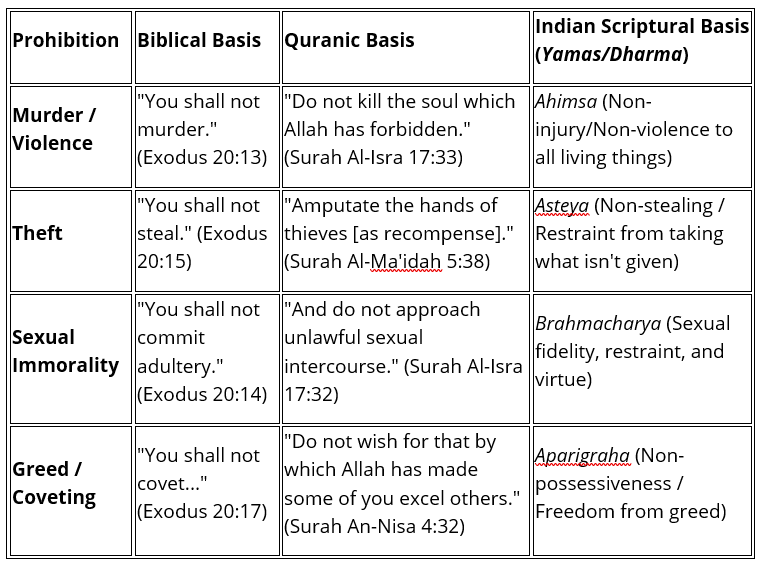
The Ultimate Point of Agreement
If you distill all of these scriptures down to a single behavioral thesis, it is this: True spirituality cannot be separated from morality. All of these traditions agree that God is not impressed by empty rituals, loud prayers, or flawless scriptural recitation if the person performing them is cruel, dishonest, or unjust. In the eyes of the Divine, the ultimate validation of your faith is how you treat your fellow human beings.